
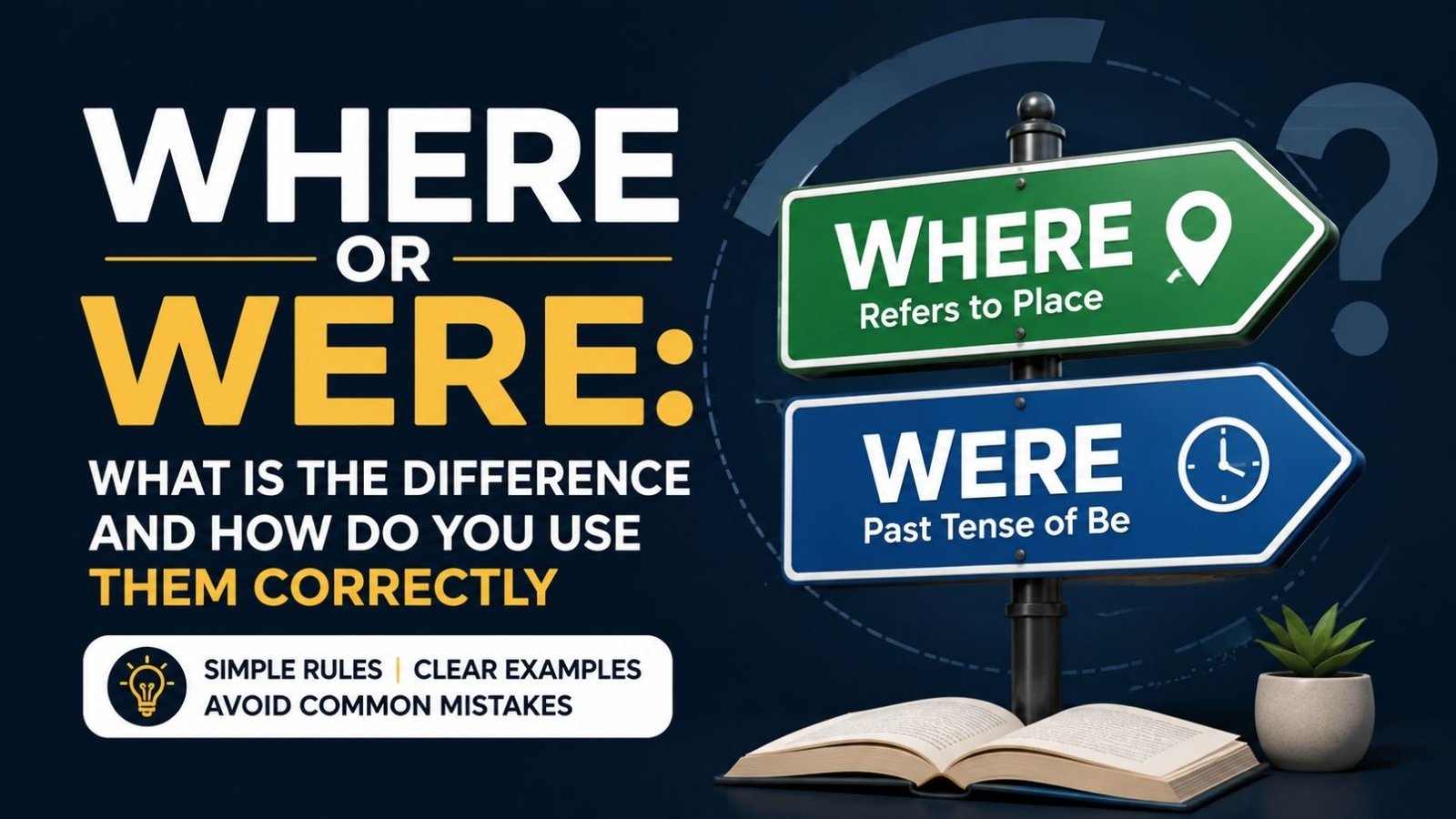
Where and were are two words that sound almost identical but mean completely different things. Where asks about location or place, while were is a past tense form of the verb be. If you have ever paused mid-sentence wondering which one fits, you are not alone.
This confusion happens because English has several words that sound alike but serve different grammatical roles. Getting where or were right matters for clear writing, whether you are texting a friend, writing an email, or completing a school assignment. Once you understand the simple rule behind each word, the mistake becomes easy to avoid for good.
Where or Were: Quick Answer
Where is used to ask or talk about a place, position, or location. Were is a past tense verb used with plural subjects or with you, and also appears in certain conditional sentences.
Here is the fastest way to remember the difference:
| Word | Type | Basic Use |
| Where | Adverb or conjunction | Refers to a place or location |
| Were | Verb (past tense of be) | Describes a past state or action |
If your sentence is asking about a place, use where. If your sentence is describing something that happened in the past, use were.
Where Meaning
Where is an adverb, and it can also work as a conjunction or pronoun in certain sentence structures. It points to a place, location, or position. It answers the question “in what place.”
Meaning 1: Asking about location
Where is most commonly used to ask about a place. It appears at the start of questions.
Example: Where did you put my keys?
Meaning 2: Referring to a place already mentioned
Where can connect a place to more information about it, without repeating the place name.
Example: This is the restaurant where we had our first date.
Meaning 3: Indicating a situation or point
Where can also describe an abstract point or situation, not just a physical location.
Example: We reached a point where no one wanted to speak first.
See More: Behavior Or Behaviour
Were Meaning
Were is the past tense form of the verb be, used with plural subjects (we, they, the dogs) and with the singular pronoun you. It describes an action, state, or condition that existed in the past.
Meaning 1: Simple past state
Were shows that something existed or happened before now.
Example: They were tired after the long trip.
Meaning 2: Past continuous action
Were pairs with a verb ending in ing to describe an ongoing action in the past.
Example: We were watching a movie when the power went out.
Meaning 3: Subjunctive mood for hypothetical situations
Were is also used in conditional or wishful sentences, even with singular subjects like I, he, or she. This is called the subjunctive mood.
Example: If I were you, I would apologize first.
This third meaning surprises many learners, since were normally pairs with plural subjects. In hypothetical or unreal situations, English breaks that rule on purpose.
Where Or Were: Grammar Explained
Understanding the grammar behind each word makes the choice almost automatic.
Where: Part of Speech and Function
Where usually functions as:
- An interrogative adverb, used to start questions about location
- A relative adverb, used to connect clauses about a place
- A conjunction, used to introduce a clause describing a situation
Where does not change form. It stays the same regardless of tense, subject, or sentence type.
Were: Part of Speech and Function
Were is a verb, specifically the past tense of be for plural subjects and you. It works as:
- A main verb showing state of being in the past
- An auxiliary verb, paired with another verb to form past continuous tense
- A subjunctive verb, used in hypothetical or conditional statements
Unlike where, were changes depending on subject and tense. Its present tense forms are am, is, and are.
Simple Test to Choose the Right Word
Ask yourself: does the sentence need a place, or does it need a past tense verb?
- If you can replace the word with “in what location,” use where.
- If you can replace the word with “was” or “are,” use were.
Example test: “____ you at the party last night?” Try “was”: “Was you at the party” sounds wrong, so the correct match is “Were you at the party last night?”
Where Or Were In A Sentence
Seeing both words in real sentences makes the difference clearer.
Where examples:
- Where is the nearest coffee shop?
- I forgot where I parked the car.
- This is the town where I grew up.
Were examples:
- We were late for the meeting.
- The children were playing outside.
- If they were here, they would help us.
Where Or Were: Common Confusing Cases
Certain phrases trip up even confident English speakers. Here is a breakdown of the most searched confusing cases.
They Where or Were
The correct phrase is always “they were,” never “they where.” They is a subject pronoun, and it needs a verb to complete the sentence. Where is not a verb, so it cannot follow they in this way.
Correct: They were excited about the trip. Incorrect: They where excited about the trip.
Is It Where or Were
This depends entirely on what the sentence needs.
- Use where if you are asking about a place: Where is the meeting room?
- Use were if you are describing a past plural or “you” state: Were you at work yesterday?
You Where or Were
The correct form is “you were,” since were is the correct past tense of be for the pronoun you, whether singular or plural.
Correct: You were right about the weather. Incorrect: You where right about the weather.
To the Point Where or Were
The correct phrase is “to the point where,” because this expression refers to a situation or stage, which where naturally describes.
Correct: She practiced until she reached the point where mistakes stopped happening.
Where or Were You Able
The correct phrase is “were you able,” since this is a past tense question using the auxiliary verb were.
Correct: Were you able to finish the report on time?
Where or Were Needed
Both forms are possible, depending on meaning.
- Where needed: This phrase describes a place. Example: Volunteers went where needed.
- Were needed: This phrase describes a past requirement. Example: Extra hands were needed at the shelter.
See More: Brite Vs Bright
Which Where or Were
The correct choice depends on the rest of the sentence. If asking about location, choose where. If describing a past plural state, choose were.
Example: I am not sure which restaurant, or where we should meet. Example: I am not sure which items were missing from the box.
Where or Were Possible
The correct phrase is usually “where possible,” meaning in situations that allow it.
Correct: Please recycle where possible.
Where or Were Difference
The difference comes down to function. Where relates to place, and were relates to a past tense verb. This distinction never changes, regardless of the sentence.
Where or Were Are You
The correct phrase is “where are you,” since this question asks about a current location and uses the present tense verb are, not were.
Correct: Where are you right now?
We Where or Were
The correct form is “we were,” following the same pattern as they were and you were.
Correct: We were surprised by the news. Incorrect: We where surprised by the news.
Where or Were Worksheet Style Practice
Try completing these sentences with the correct word. Answers follow below each set.
- _____ did you leave your umbrella?
- They _____ waiting outside for almost an hour.
- This is the street _____ the accident happened.
- If I _____ taller, I could reach the shelf.
- _____ you able to call the doctor?
Answers:
- Where
- Were
- Where
- Were
- Were
Where or Were Checker: Simple Self Check Method
Before publishing or sending a message, use this quick mental checklist:
- Read the sentence aloud. Does it describe a place? Where fits.
- Does the sentence describe something that already happened? Were fits.
- Try substituting “was” or “are.” If either sounds natural, were is correct.
- Try substituting “in what place.” If that fits, where is correct.
This self check takes only a few seconds and prevents the most common mix ups.
When to Use Where or Were
| Situation | Correct Word | Example |
| Asking about a location | Where | Where do you live? |
| Describing a past plural state | Were | The bags were heavy. |
| Connecting a clause to a place | Where | The park where we met is closed. |
| Forming past continuous tense | Were | We were driving home. |
| Making a hypothetical statement | Were | If she were here, she would agree. |
| Referring to a situation or stage | Where | We got to a point where nothing helped. |
Where or Were: Common Mistakes
Even experienced writers slip up occasionally. Here are the most frequent errors, corrected clearly.
❌ Incorrect: They where at the store all afternoon.
✅ Correct: They were at the store all afternoon.
❌ Incorrect: Were is the nearest gas station?
✅ Correct: Where is the nearest gas station?
❌ Incorrect: If I was you, I would leave now.
✅ Correct: If I were you, I would leave now.
💡 Tip: The subjunctive “if I were” sounds slightly formal but is still the grammatically correct choice in careful writing.
⚠️ Common mistake: Many writers swap where and were simply because they type quickly and the words look and sound similar. Slowing down for a second read usually catches the error.
Where Or Were: Similar And Confusing Words
Several other words sound close to where and were, adding to the confusion.
| Word | Meaning | Example |
| Wear | To have clothing on the body | I will wear my jacket today. |
| We’re | Contraction of we are | We’re leaving soon. |
| Ware | Manufactured goods or items | The shop sells kitchenware. |
Knowing these related words helps you avoid a wider range of spelling mix-ups, not just where and were.
Pronunciation Of Where And Were
Where and were are pronounced differently in most American English accents, even though they can sound similar in fast speech.
- Where is pronounced like “wair,” rhyming with “air” and “fair.”
- Were is pronounced like “wur,” rhyming with “her” and “sir.”
Saying both words slowly side by side, “where… were,” highlights the vowel sound difference clearly.
See More: Company-wide Or Companywide
Origin Of Where And Were
Both words come from Old English, and both are extremely old, native English terms rather than borrowed words.
Where developed from the Old English word “hwær,” which already carried the meaning of asking about place or location. It is related to other question words that historically began with “hw,” a pattern that later shifted in English to the modern “wh” spelling, such as who, what, and when.
Were comes from Old English verb forms of “beon” and “wesan,” which are ancestors of the modern verb be. Were specifically developed as the plural and second person past tense form, a grammatical pattern that has survived largely unchanged into modern English.
Frequently Asked Questions
What does where or were mean?
Where refers to a place or location, while were is the past tense of the verb be, used with plural subjects, you, or in hypothetical statements.
How do you use where or were in a sentence?
Use where when asking about or describing a location. Use were when describing a past state, past continuous action, or a hypothetical situation.
Is were a noun or a verb?
Were is a verb. It is the past tense form of be used with we, you, they, and plural nouns.
Is where a noun or a verb?
Where is not a verb. It is most often an adverb, and sometimes a conjunction or pronoun, depending on the sentence.
How do you pronounce where and were?
Where rhymes with “air” and sounds like “wair.” Were rhymes with “her” and sounds like “wur.”
What is the difference between where and were?
Where relates to place or location. Were relates to a past tense verb form of be. They serve entirely different grammatical purposes despite sounding similar.
Why do people confuse where and were?
The two words sound close in casual speech, and they share similar spelling, which makes it easy to swap them, especially when typing quickly.
Can were ever refer to a place?
No. Were is always a verb form and never refers to location. Only where carries that meaning.
Is “if I were” or “if I was” correct?
“If I were” is correct in formal and grammatically careful English, since it uses the subjunctive mood for hypothetical statements. “If I was” is common in casual speech but is considered less correct in formal writing.
Final Thoughts on Where or Were
Where and were may sound alike, but their roles in a sentence are completely different. Where always points to a place, a location, or a situation, while were always functions as a past tense verb tied to plural subjects, you, or hypothetical statements. Once you separate these two functions in your mind, the choice becomes almost automatic.
The simplest way to stay confident is to ask what your sentence needs. If it needs a location, reach for where. If it needs a past tense form of be, reach for were. With a little practice, this small grammar habit becomes second nature, and where or were will never slow down your writing again.

Danish Raza is the author of Grammavio, a trusted resource for simple and easy-to-understand English grammar guides. He creates helpful content covering grammar rules, word meanings, vocabulary, and common grammar mistakes to help readers improve their English skills.


