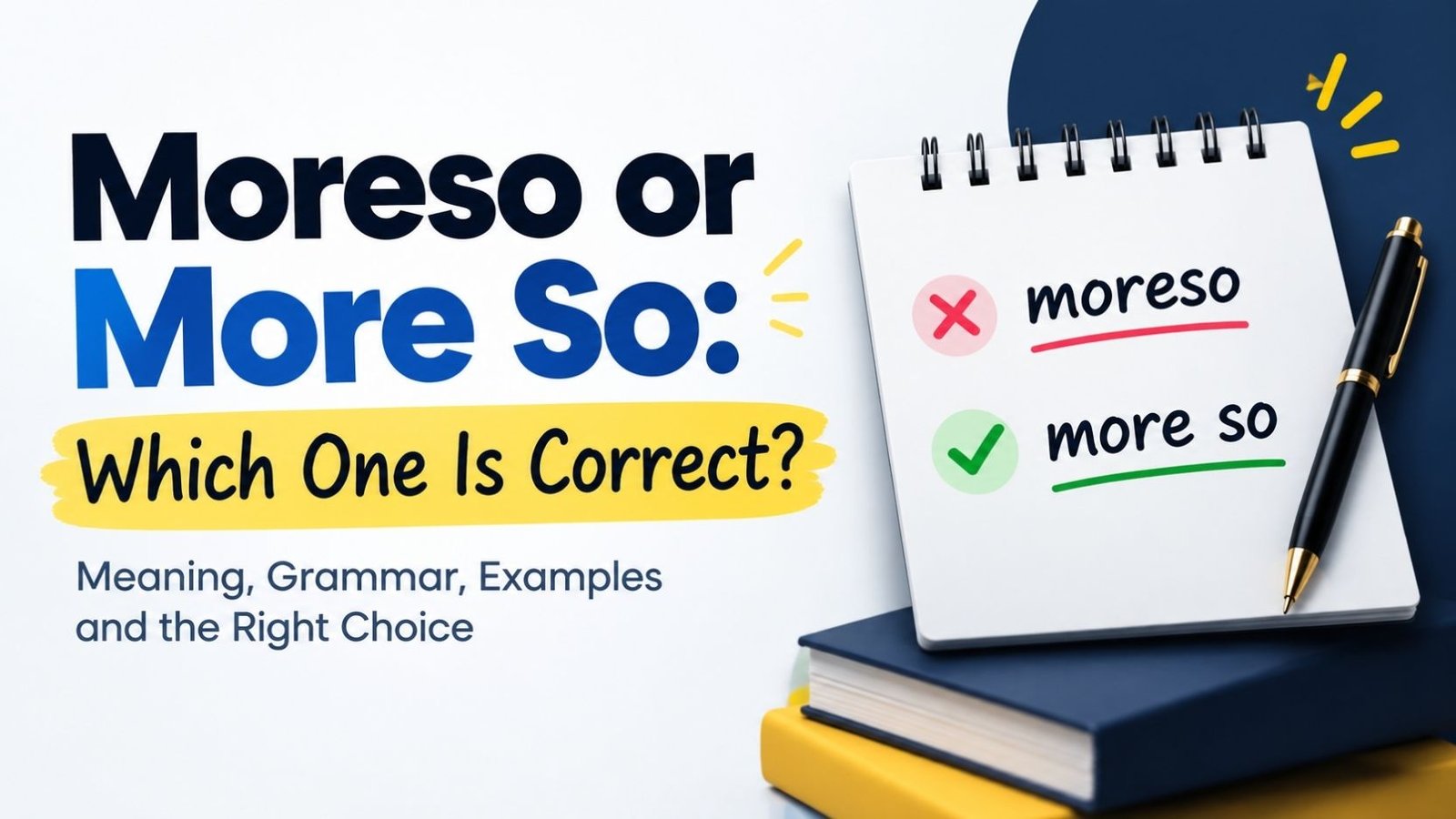
Use “more so,” written as two words. It means “to a greater degree” and refers back to something you already said. Some dictionaries list “moreso” as a variant, but most editors, teachers, and style guides treat it as an error or a spelling to avoid. If you want the safe choice for school, work, or publishing, write “more so.”
The mix-up is easy to understand. We write “moreover” and “nevertheless” as single words, so “moreso” looks like it belongs in the same group. It does not. The phrase “more so” is just “more” followed by “so,” and each word does its own job. Below you will find the meaning, grammar, examples, common mistakes, and answers to the questions people search for most.
What Does “More So” Mean?
“More so” means “even more than that” or “to a greater extent.” It points back to a word or idea from earlier in the sentence and says it applies with greater force.
- Simple meaning: to a greater degree
- Part of speech: an adverbial phrase (a phrase that works like an adverb)
- Common use: comparing two things or adding emphasis
- Tone: neutral, works in both formal and everyday writing
Here are two natural examples:
Tokyo is crowded, and more so during rush hour.
She was nervous before the interview, but her manager was more so.
In the first sentence, “more so” stands for “more crowded.” In the second, it stands for “more nervous.” The word “so” saves you from repeating the earlier word.
Read More: Requester or Requestor
Why “So” Is the Key Word
The word “so” in this phrase is a stand-in for something you already mentioned. Grammar books call this a pro form. Think of it like a pronoun, but for adjectives, adverbs, and verb phrases instead of nouns.
Read this sentence:
The exam was difficult, and the second part was more so.
If you replace “so,” you get “the second part was more difficult.” That is exactly what the phrase does. Because “so” is a separate word with its own role, the phrase stays as two words.
Is “Moreso” a Word?
Yes and no, and the honest answer depends on whom you ask. The form “moreso” appears in print and in some dictionaries, usually labeled as a variant of “more so.” However, many usage guides and editors advise against it. They prefer the two-word form.
| Form | Status | Best for |
| more so | Standard and widely accepted | All writing, formal and informal |
| moreso | Variant, often marked as nonstandard | Avoid in school, business, and published work |
💡 Tip: If your reader might be a teacher, editor, or hiring manager, “more so” can never be marked wrong. “Moreso” might be.
Dictionaries do not always agree on this. If you need an official answer for a style guide or school rule, check the dictionary or guide your institution uses.
Moreso or More So in American English
Since this article targets American readers, here is the practical rule. American style guides and editors generally favor “more so” as two words. You will see “moreso” in casual writing, social media, and some older texts, but it is not the form most professionals use.
Readers in the UK, Australia, and other English-speaking countries also use the two-word form as the standard. The one-word spelling is not considered correct in formal writing in any of these regions.
How to Use “More So” in a Sentence
The phrase works best when it follows a statement and extends it. You can place it at the end of a clause, or use it in the middle with a comparison.
Pattern 1: after a comma
The trail is steep, more so near the summit.
Pattern 2: with “and”
Prices are rising everywhere, and more so in big cities.
Pattern 3: with “than”
He cares about quality, more so than about speed.
Pattern 4: with “even” or “all the”
Teachers deserve respect, and even more so when resources are limited. The advice is useful, and all the more so for beginners.
Quick Rules
- Put a clear word or idea before it so “so” has something to point to.
- Use a comma before “more so” when it adds extra information.
- Add “than” only when you are making a direct comparison.
- Keep it as two words every time.
Read More: Ahold or A Hold
“Even More So” Meaning
“Even more so” is a stronger version of “more so.” The word “even” adds extra emphasis. It tells the reader that the point is true in general, but it is true to a much higher degree in this case. Sleep matters for adults, and even more so for teenagers.
This means sleep is important for everyone, but teenagers need it the most. You can use “even more so” when you want the contrast to feel stronger.
“More So Than” Meaning
“More so than” compares two things. It means “to a greater degree than.” This neighborhood is quiet, more so than the one we lived in before.
You can often swap in “more than” without changing the meaning, but “more so than” feels smoother when the earlier word is an adjective or an adverb.
“More So Than Ever”
“More so than ever” means “to a greater degree than at any time before.” It compares the present with the past. Remote work is popular, and more so than ever.
This phrase is common in news writing and business writing. It works well when you want to show that a trend has grown stronger over time.
“All the More So”
“All the more so” adds a reason for the stronger effect. It usually signals that something already true becomes truer because of a particular fact. Honesty is important in any friendship, all the more so when trust has been broken.
There is no accepted form “all the moreso.” Use the three word phrase “all the more so” if you want this meaning.
Is “More So” a Transition Word?
Not in the strict sense. Transition words such as “however,” “therefore,” and “moreover” connect separate sentences or ideas. “More so” is a comparison phrase. It extends the idea inside a sentence rather than linking two sentences.
Still, it can feel like a bridge when you start a clause with “and more so.” In that case it helps the reader move from a general statement to a stronger one. If you want a true transition, try “moreover,” “furthermore,” or “in addition.”
Pronunciation
Both spellings are pronounced almost the same way. The difference you hear is a tiny pause when two words are spoken.
- Simple pronunciation: more SOH
- IPA (American): /mɔːr ˈsoʊ/
- Stress: the second word, “so,” gets the stronger stress
- Syllables: two, “more” and “so”
📝 Because the sound is nearly identical, you cannot tell which spelling someone intends when they speak. This is one reason the error shows up so often in writing.
Origin and Background
The phrase “more so” is built from two very old English words. “More” is the comparative form of “much” or “many,” and “so” stands in for something already said. Putting them together creates a handy shortcut for avoiding repetition.
The joined spelling “moreso” is a later variation. It reflects a common habit in English where frequently used phrases sometimes merge into one word, as happened with “nevertheless” and “anyway.” In this case, though, the merge never became fully accepted. Many usage guides still recommend the two word form.
I have kept this section short on purpose. Precise dates for when each spelling first appeared differ between sources, so if you need exact historical records, a large etymological dictionary is the best place to look.
Synonyms and Related Phrases
Several phrases can replace “more so,” but each has a slightly different feel.
| Phrase | Meaning | How it differs |
| to a greater degree | with more intensity | More formal and slower |
| even more | stronger than before | Simple and everyday |
| all the more | increased because of a reason | Stresses a cause |
| especially | in particular | Highlights one case instead of comparing |
| more than that | beyond what was said | Works when adding a new point |
| if anything, more | slightly stronger, if at all | Softer and more cautious |
💡 Tip: If “more so” feels awkward in your sentence, “even more” or “especially” usually works as a clean replacement.
Read More: Burnt or Burned
Common Mistakes
Mistake 1: Writing it as one word
❌ Incorrect: The film is entertaining, moreso than I expected.
✅ Correct: The film is entertaining, more so than I expected.
The phrase is two words, so the standard form keeps them apart.
Mistake 2: Using it without anything to point to
❌ Incorrect: More so, the team won.
✅ Correct: The team was proud, and the coach was more so.
“So” needs an earlier word or idea to stand for. Without one, the phrase has no meaning.
Mistake 3: Mixing it up with “moreover”
❌ Incorrect: The plan is cheap. More so, it is fast.
✅ Correct: The plan is cheap. Moreover, it is fast.
“Moreover” adds a new point. “More so” strengthens an existing one.
Mistake 4: Writing “all the moreso”
❌ Incorrect: The rule matters, all the moreso for children.
✅ Correct: The rule matters, all the more so for children.
“Should We Sin More So That Grace May Abound?”
People often search for this phrase, but it is not the actual wording of the Bible verse. The question comes from Romans 6:1, and the King James Version reads: “Shall we continue in sin, that grace may abound?” The apostle Paul asks the question and immediately answers it with a strong no.
The words “more so” appear in some online quotations because people paraphrase the verse from memory. If you need the exact text, check a Bible translation you trust. Different translations phrase the question differently, but they all carry the same meaning.
Quick Reference Chart
| Question | Answer |
| Which spelling is standard? | more so |
| Is moreso a word? | Listed as a variant, but often discouraged |
| Is it formal? | Yes, “more so” works in formal writing |
| Is it one word or two? | Two words |
| Is it a transition? | Not really; it is a comparison phrase |
Frequently Asked Questions
What does “more so” mean?
It means “to a greater degree.” It points back to an earlier word or idea and says it applies even more strongly.
Is it moreso or more so?
Use “more so.” The two word form is standard, while “moreso” is a variant that many editors and style guides do not accept.
Is “moreso” a real word?
Some dictionaries list it as a variant of “more so.” Because it is widely marked as nonstandard, you should avoid it in formal or professional writing.
Is “more so” formal or informal?
It is neutral. You can use it in an essay, a business email, or a casual conversation.
What is the difference between “more so” and “even more so”?
“Even more so” adds extra emphasis. It suggests the contrast is stronger than with plain “more so.”
How do you pronounce “more so”?
Say “more SOH,” with the stress on the second word. The pronunciation is nearly the same as for “moreso.”
Is “more so” a transition word?
Not in the traditional sense. It compares or intensifies within a sentence. For a true transition, use “moreover” or “furthermore.”
Can I say “more so than”?
Yes. Use it to compare two things, as in “The second test was hard, more so than the first.”
What does “all the more so” mean?
It means “even more, for a specific reason.” The reason usually follows right after the phrase.
Conclusion
The correct form is “more so,” written as two words. It means “to a greater degree” and works by pointing back to something you already said. The one word spelling “moreso” appears in some dictionaries as a variant, but most editors and style guides do not recommend it.
When you are unsure, choose the two word form. It is accepted everywhere, reads smoothly, and keeps your writing safe from correction. If “more so” ever feels awkward, swap in “even more” or “especially,” and your sentence will still sound natural.

Danish Raza is the author of Grammavio, a trusted resource for simple and easy-to-understand English grammar guides. He creates helpful content covering grammar rules, word meanings, vocabulary, and common grammar mistakes to help readers improve their English skills.