
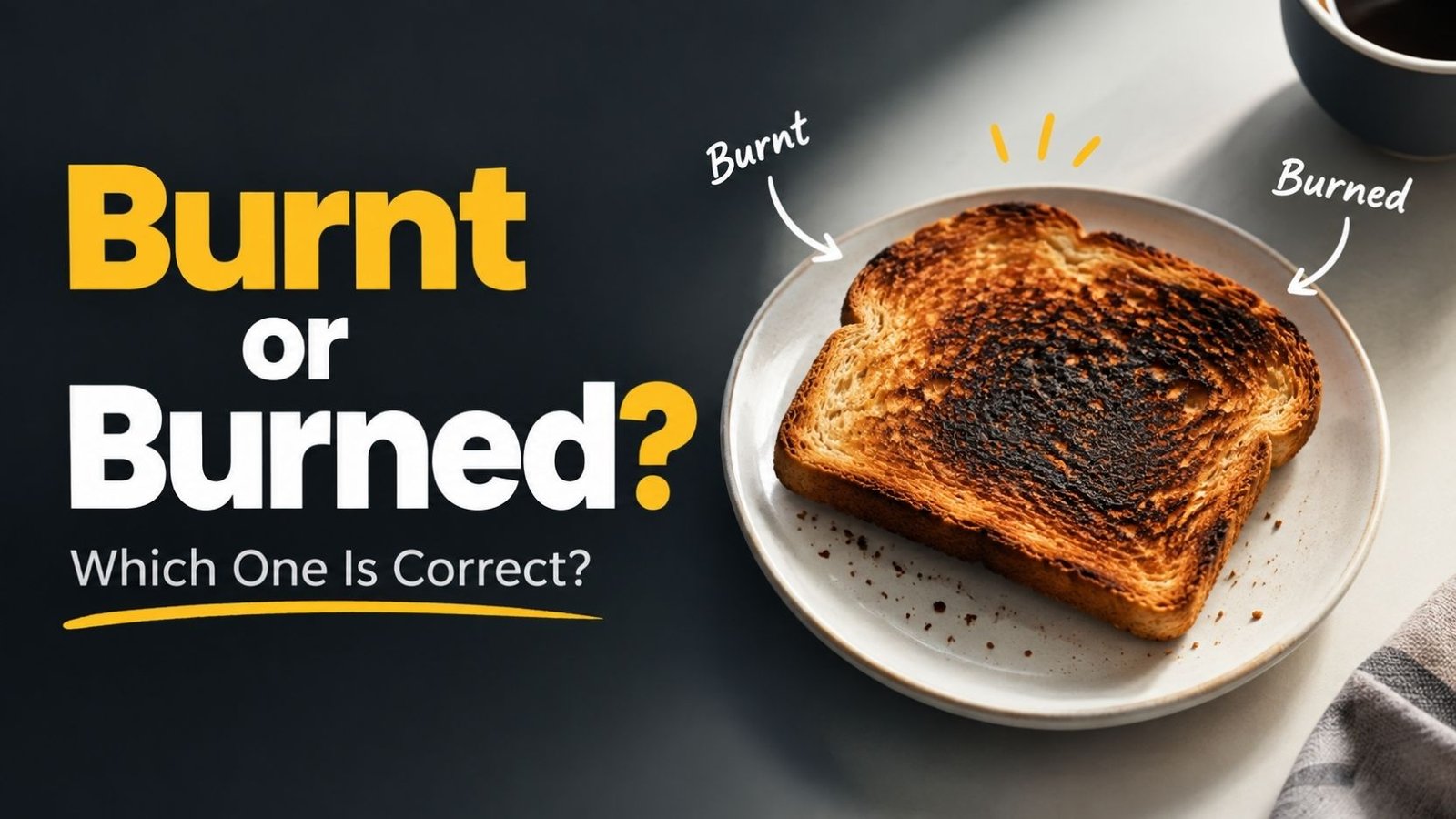
Both are correct. Burned and burnt are two accepted past tense forms of the verb “burn.” In American English, burned is the usual choice for the verb, while burnt is more common in British English and often appears as an adjective.
So you can say “I burned the toast” or “I burnt the toast,” and neither is wrong. The difference is mostly about region, habit, and how the word is used in a sentence. This guide shows you which form to pick, especially if you write for a US audience.
Quick Answer: Burnt or Burned?
Here is the short version:
- American English: Use burned for the verb. “She burned her hand.”
- British English: Burnt and burned are both common, and burnt is often preferred. “She burnt her hand.”
- As an adjective before a noun: Burnt is common in both. “Burnt toast,” “burnt orange.”
- In fixed phrases: Follow the standard form, such as “burnt sienna” and “burnt ends.”
💡 Tip: If you are writing for an American reader and you are unsure, choose burned.
Read More: Ambiance vs Ambience
Is Burnt or Burned Correct?
Yes, both are correct. Major dictionaries list burned and burnt as past tense and past participle forms of burn. Neither is a mistake.
Burn is an unusual verb because it has two accepted forms. Most English verbs add “ed” and stop there. Burn, however, follows a pattern shared by a few other verbs, which is why both versions survive today.
Verb Forms of Burn
| Form | Example |
| Base form | I burn candles in the evening. |
| Present participle | The candle is burning. |
| Past tense | He burned (or burnt) the dinner. |
| Past participle | The dinner has been burned (or burnt). |
When to Use Burned
Use burned when you want the standard American form, especially for the verb. It works for actions that happened once or finished in the past.
- “I burned my tongue on the soup.”
- “The fire burned for three hours.”
- “They burned the old letters.”
Burned also works well as a past participle after “have,” “has,” or “had.”
- “She has burned every candle in the house.”
- “We had burned the wood by midnight.”
Many American style guides favor burned for verb use. That is why you will see it in most US news writing.
When to Use Burnt
Use burnt when you are describing something with an adjective, or when you are following British habits. Burnt often sounds like a description of a result, not an action.
- “The kitchen smelled of burnt toast.”
- “He wore a burnt orange jacket.”
- “The burnt edges were hard to chew.”
In British English, burnt also appears as a verb.
- “I burnt the rice again.”
- “She has burnt her finger.”
Burnt or Burned in American English vs British English
This is the main source of confusion. Neither form is “more correct.” They are simply preferred in different places.
| Situation | American English | British English |
| Past tense verb | Burned | Burnt or burned |
| Past participle | Burned | Burnt or burned |
| Adjective before a noun | Burnt or burned | Burnt |
| Example | “I burned the cookies.” | “I burnt the biscuits.” |
Australian English leans toward burnt as well. Canadian English tends to sit between American and British habits.
Burnt or Burned as an Adjective
An adjective describes a noun. When burn describes a noun, both forms can work, but burnt is more common.
- burnt toast
- burnt popcorn
- burnt offering
Burned works too, and you will see it often in American writing.
- “He treated the burned area with cold water.”
- “The burned house stood empty for years.”
There is a small pattern here. Burnt often describes something with a lasting, finished quality, such as a color or a food. Burned often describes damage after a specific event, such as a fire.
Fixed Phrases and Food Terms
Some phrases always use burnt. You should not change them to burned.
| Phrase | Meaning |
| Burnt orange | A deep, reddish orange color |
| Burnt sienna | A reddish brown pigment and color |
| Burnt ends | Crispy, flavorful pieces of smoked brisket or pork belly, common in barbecue |
| Burnt toast | Toast that has been left too long |
| Burnt offering | A sacrifice made by fire, often in religious settings |
💡 Tip: If a phrase is a name, a color, or a menu item, keep the established spelling.
Read More: Lens or Lense
Burned Out or Burnt Out
Both are used for the same two meanings. The first is mental or physical exhaustion. The second is something that has stopped working because it ran out of fuel or power.
- “I feel burned out after months of overtime.”
- “The burned-out bulb needs replacing.”
In the United States, burned out is more common. In British English, burnt out is common as well. The related noun “burnout” is one word in both.
Burned Down or Burnt Down
Both are correct for something destroyed by fire.
- “The barn burned down last winter.”
- “The old mill burnt down in 1920.”
In American English, burned down is the usual choice. It also works as a plain statement of what happened: “The house burned down after the fire spread.”
Sunburn and Freezer Burn
These everyday words come up often, and the forms are fairly settled.
- Sunburned: Common in American English. “I got sunburned at the beach.”
- Sunburnt: Common in British and Australian English. The phrase “sunburnt country” is well known in Australia.
- Freezer burn: A noun for dry, discolored patches on frozen food. You can also say “freezer burned chicken” in the US, though “freezer burnt” appears in other regions.
If you are describing your own skin, American readers will expect “I got sunburned” or “I burned my hand.”
Calories Burned or Calories Burnt
For a US audience, write calories burned. It is the standard phrase on fitness apps, health sites, and in everyday speech.
- “Walking a mile burns a modest number of calories.”
- “How many calories did you burn on your run?”
Calories burnt is more common in British and Australian English. It is not wrong, but it will look unusual to many American readers.
Burned CD or Burnt CD
When you copy music onto a disc, American English usually says “burned a CD.” British English may say “burnt a CD.” This is the same split you see everywhere else.
- “I burned a CD for the road trip.”
- “He gave me a burnt CD of his favorite songs.”
Why Does Burn Have Two Past Forms?
Burn comes from Old English words connected to fire. Over time, many English verbs developed two past forms: one ending in “ed” and one ending in “t.” The “t” ending was often a shortened, spoken version.
Several verbs still show this pattern:
| Verb | “ed” form | “t” form |
| Burn | Burned | Burnt |
| Learn | Learned | Learnt |
| Spell | Spelled | Spelt |
| Dream | Dreamed | Dreamt |
In American English, the “ed” forms became dominant. In British English, the “t” forms stayed more common. That history explains why the choice feels regional today.
How to Pronounce Burned and Burnt
The two words sound slightly different at the end.
- Burned: Sounds like “burnd.” The final sound is a “d.” Phonetically, it is /bɜːrnd/.
- Burnt: Sounds like “burnt.” The final sound is a “t.” Phonetically, it is /bɜːrnt/.
Both have one syllable and the same vowel sound. Only the last sound changes.
Common Mistakes
Mistake 1: Thinking one form is always wrong
❌ Incorrect: “Burnt is not a real word.”
✅ Correct: Burnt is a real word and a standard past form of burn.
Mistake 2: Changing a fixed phrase
❌ Incorrect: “I love that burned sienna color.”
✅ Correct: “I love that burnt sienna color.”
The color name is established. Changing it will look like an error.
Mistake 3: Mixing forms in one piece of writing
❌ Incorrect: “He burned the toast and then burnt the eggs.”
✅ Correct: “He burned the toast and then burned the eggs.”
Mixing is not a grammar error. It just looks inconsistent, so pick one form for the verb and stay with it.
Mistake 4: Using burnt for a present action
❌ Incorrect: “I burnt every day.”
✅ Correct: “I burn candles every day.”
Burned and burnt are past forms. For habits in the present, use burn.
Read More: Invision or Envision
Burn in Figurative Expressions
Burn also appears in many figures of speech. In most of them, burned is the safer American choice.
- “Burned bridges” means damaged relationships.
- “Got burned” means to suffer a loss or be taken advantage of.
- “Burned by the experience” means hurt by something that went wrong.
You may also hear “burnt” in similar phrases in British English. The meaning stays the same.
A Note on the Library of Alexandria
People often ask, “Who burned the Library of Alexandria?” Historians do not agree on one answer. Several events have been blamed, including a fire during Julius Caesar’s campaign in 48 BC, later conflicts in the Roman period, and other disruptions over time. Many scholars think the library declined slowly instead of being destroyed in one moment. In writing, “was burned” is the standard American form.
Simple Rule to Remember
If you want a quick guide, use this checklist.
- Writing for Americans? Use burned for the verb.
- Describing a noun, like toast or a color? Burnt is fine.
- Using a set phrase, like burnt orange? Keep the standard form.
- Writing British or Australian English? Burnt is common and correct.
- Be consistent within one article or document.
Frequently Asked Questions
Is it burnt or burned?
Both are correct. American English prefers burned for the verb, while British English often uses burnt.
Which is the past tense of burn?
Burned and burnt are both accepted past tense forms. The same is true for the past participle.
Is burnt a word?
Yes. Burnt is a standard English word and appears in all major dictionaries.
Should I say burned out or burnt out?
Both are acceptable. Burned out is more common in the United States, and burnt out is common in British English.
Is it burned down or burnt down?
Both are used. Burned down is the usual American choice.
Is it sunburned or sunburnt?
Sunburned is common in American English. Sunburnt is more common in British and Australian English.
Is it calories burned or calories burnt?
In the United States, say calories burned. Calories burnt is mainly used in British and Australian English.
How do you pronounce burnt and burned?
Burned ends with a “d” sound, and burnt ends with a “t” sound. Both are one syllable.
Can I use burnt toast and burned toast?
Yes. Burnt toast is the more common phrase, but burned toast is not wrong.
Conclusion
Burnt or burned is not a question of right and wrong. Both are accepted past forms of the verb burn, and both can work as adjectives. The main difference is regional: Americans lean toward burned, and British speakers often choose burnt.
For most American writing, use burned for the verb and keep burnt for set phrases like burnt orange, burnt sienna, and burnt ends. Choose one form for your verb usage and stay consistent. That is all you need to write it with confidence.

Danish Raza is the author of Grammavio, a trusted resource for simple and easy-to-understand English grammar guides. He creates helpful content covering grammar rules, word meanings, vocabulary, and common grammar mistakes to help readers improve their English skills.



One Comment