
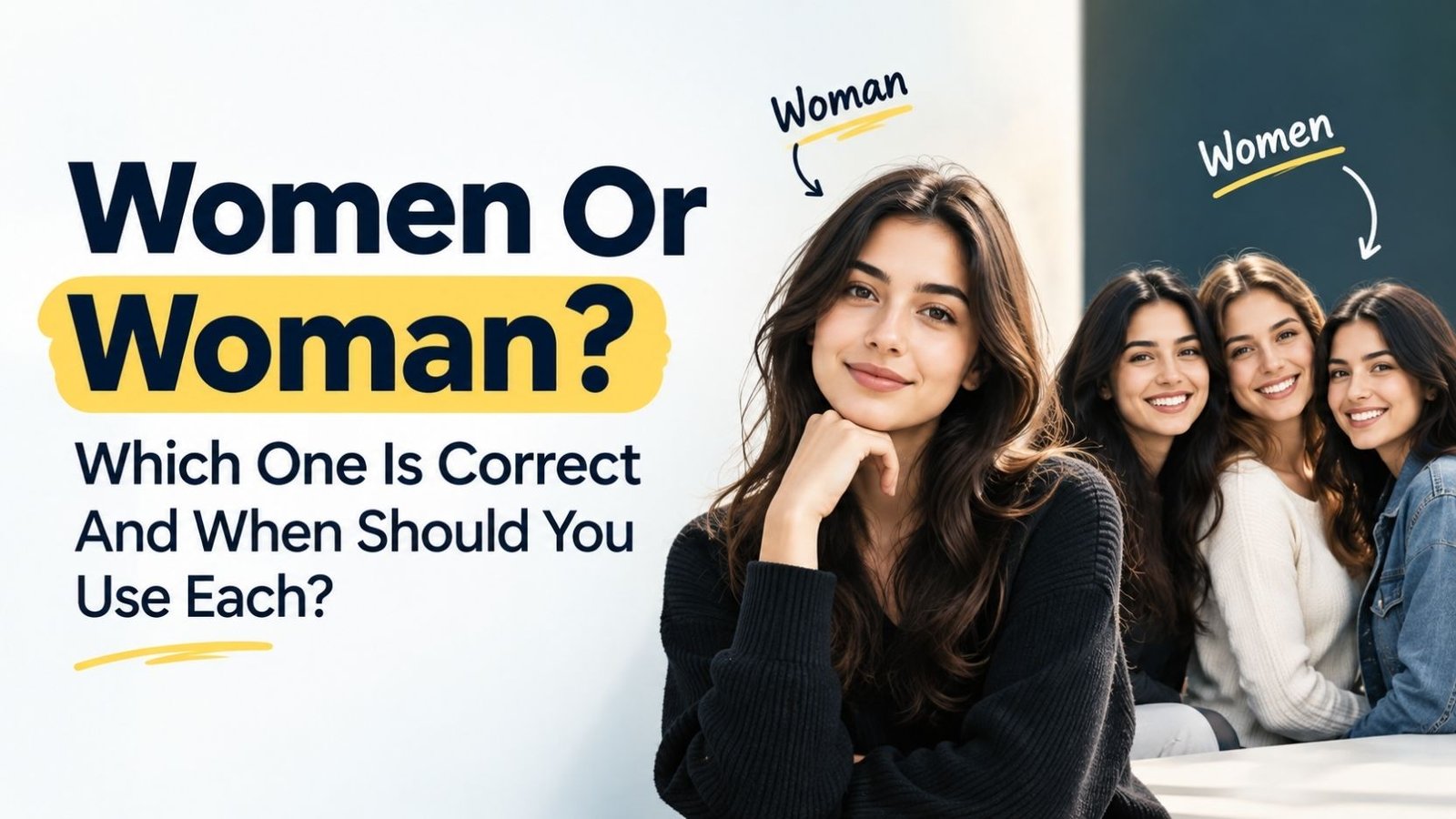
Both words are correct, but they are not interchangeable. Woman is the singular form, used for one adult female person. Women is the plural form, used for two or more. If you are talking about a single person, such as “She is a strong woman,” you use woman. If you are talking about more than one person, such as “They are strong women,” you use women.
This mix-up happens often because the two words look similar but sound quite different, and because the plural does not follow the usual rule of just adding an s. Understanding the difference matters for clear writing, correct grammar, and confident everyday communication, whether you are writing a sentence, a headline, or a simple text message.
Women Or Woman: The Simple Meaning
Woman means one adult human female. Women means more than one adult human female. That is the entire rule at its core.
- Woman: singular noun
- Women: plural noun
Here is a quick way to remember it:
- If you can replace the word with “she” or “her,” use woman.
- If you can replace the word with “they” or “them,” use women.
Example:
- Woman: “The woman at the counter smiled.”
- Women: “The women at the counter smiled.”
Notice that only one letter changes, but the pronunciation and meaning both shift completely.
Read More: Pricy Or Pricey
Women Or Woman Difference At A Glance
The table below shows the core difference in one place, so you can check it quickly.
| Form | Number | Example Sentence | Pronoun You Would Use |
| Woman | Singular | She is a talented woman. | she, her |
| Women | Plural | They are talented women. | they, them |
This is the fastest way to check which word fits your sentence. If your sentence talks about one person, woman is correct. If it talks about a group, women is correct.
Is Women Or Woman Plural?
Women is the plural form. Woman is the singular form. This confuses many people because most English plurals are formed simply by adding an s, like cat becomes cats or book becomes books. Woman does not follow that pattern.
Instead, woman changes its internal vowel sound to become women. This is called an irregular plural. English has a small group of nouns that behave this way, and woman is one of the more common examples.
Other irregular plurals that follow a similar pattern of changing an internal vowel include:
- Man becomes men
- Foot becomes feet
- Tooth becomes teeth
- Goose becomes geese
Woman fits into this same family of words, which is part of why the plural feels unusual compared to regular nouns.
Which Is Plural, Women or Woman?
To directly answer this common search: women is plural. Woman is singular. If you are ever unsure mid-sentence, ask yourself whether you mean one person or more than one. One person always takes woman. More than one person always takes women.
A simple test sentence:
- “One woman walked into the room.” (one person, singular)
- “Three women walked into the room.” (more than one person, plural)
Women Or Woman: How Each Word Is Pronounced
Pronunciation is one of the biggest reasons people mix these words up in speech and in writing. Even though the spelling looks close, the sounds are quite different.
- Woman is pronounced WUH-mun. The first syllable sounds like the word “wuh,” similar to the start of “wonder.”
- Women is pronounced WIH-min. The first syllable sounds like the word “wih,” similar to the start of “wisdom” or “winner.”
This is one of the more unusual patterns in English. The written difference between the two words looks small, changing only the first vowel letter, but the spoken difference is much clearer. Many English learners find it useful to focus on the first syllable sound rather than the spelling, since that is where the real difference lives.
In American English, both words are pronounced the same general way as in British English, though slight regional accent differences can exist. The core distinction, WUH for singular and WIH for plural, stays consistent across most English-speaking regions.
Woman Or Women: Part Of Speech And Grammar Role
Both words are nouns. Specifically, they are common nouns that refer to a person.
- Woman: singular common noun
- Women: plural common noun
Because they are nouns, they follow normal grammar rules for how nouns interact with verbs, articles, and pronouns, with one key exception: the irregular plural form itself.
Subject Verb Agreement
This is where many mistakes happen. The verb in a sentence must match whether you are using the singular or plural form.
Correct:
- The woman walks to work every day. (singular subject, singular verb)
- The women walk to work every day. (plural subject, plural verb)
Incorrect:
- The woman walk to work every day.
- The women walks to work every day.
A simple memory trick: singular subjects usually pair with verbs that end in s, like walks, runs, or talks. Plural subjects usually pair with verbs that do not end in s, like walk, run, or talk. This is the opposite of how nouns typically work, which is why it trips people up.
Articles
- Use “a” before woman, since it starts with a consonant sound: a woman.
- Do not use “a” before women, since it is plural: simply say women, or use “the women,” “some women,” or “many women.”
Read More: Unfazed Or Unphased
Women Or Woman: Common Sentence Patterns
Here are natural examples that show both words used correctly in different everyday contexts.
Singular examples with woman:
- She is an incredible woman.
- The woman on the phone sounded upset.
- Every woman deserves respect.
- He admired her as a strong, independent woman.
Plural examples with women:
- The women in this office work incredibly hard.
- Many women choose careers in medicine and law.
- The event celebrated women in leadership.
- Both women agreed on the final decision.
One Of The Most Beautiful Women Or Woman: Which Is Correct?
This is a common search because the phrase feels tricky. The correct version depends on what the full sentence is describing.
Use “one of the most beautiful women” when you are saying that a single person belongs to a larger group of beautiful people. The phrase “one of” signals that you are picking one example out of many, so the noun that follows must be plural.
Correct: “She is one of the most beautiful women I have ever met.”
Incorrect: “She is one of the most beautiful woman I have ever met.”
The logic is simple. “One of the most beautiful women” means: out of all beautiful women, she is one. Since you are referring to the larger group first, that group noun must be plural, even though the sentence is ultimately describing one person.
This same rule applies to similar phrases:
- One of the strongest women, not one of the strongest woman
- One of the kindest women, not one of the kindest woman
- One of the smartest women, not one of the smartest woman
Women Or Woman: Executive Or CEO Comparison
Readers sometimes search for women or woman alongside job titles, such as executive or CEO, to understand how the noun changes with number in professional contexts. The same singular and plural rule applies here as anywhere else.
- Singular: She is a woman executive. She became the company’s first woman CEO.
- Plural: Women executives are gaining more leadership roles. Women CEOs are still underrepresented in some industries.
Whether describing one leader or several, the same core rule stands: one person is a woman, more than one is women, and the surrounding sentence must match in number.
Common Mistakes With Women Or Woman
Below are frequent errors, along with the correct version and a short explanation.
❌ Incorrect: “She is a beautiful women.”
✅ Correct: “She is a beautiful woman.”
Why: The sentence describes one person, so it needs the singular form.
❌ Incorrect: “The woman are waiting outside.”
✅ Correct: “The women are waiting outside.”
Why: “Are” is a plural verb, so the subject must also be plural.
❌ Incorrect: “Many woman attended the conference.”
✅ Correct: “Many women attended the conference.”
Why: “Many” always signals more than one, so the plural form is required.
❌ Incorrect: “She is one of the most talented woman on the team.”
✅ Correct: “She is one of the most talented women on the team.”
Why: The phrase “one of the” requires a plural group noun afterward.
❌ Incorrect: “Every women should feel confident.”
✅ Correct: “Every woman should feel confident.”
Why: “Every” is always followed by a singular noun, even though it refers to a whole group conceptually.
This last rule surprises many people. Even though “every woman” sounds like it should include many people, grammatically it treats each person individually, one at a time, so the singular form is correct.
Women Or Woman: Quick Reference Table
| Situation | Correct Word | Example |
| Talking about one person | Woman | She is a woman. |
| Talking about more than one person | Women | They are women. |
| After “every” | Woman | Every woman matters. |
| After “many,” “several,” “some,” “these,” “those” | Women | Many women agree. |
| After “one of the” | Women | One of the bravest women. |
| Before a singular verb (is, was, walks) | Woman | The woman walks daily. |
| Before a plural verb (are, were, walk) | Women | The women walk daily. |
Women’s Day Or Woman’s Day: Which Is Correct?
This is a related and frequently searched question. The internationally recognized holiday is called International Women’s Day, using the plural possessive form, because it celebrates women as a whole group, not one individual.
“Woman’s Day” would only make sense if referring to a single woman’s personal day, which is not the meaning of the global observance. So for the holiday, Women’s Day is the standard and correct form.
Women’s Restroom Or Woman’s Restroom?
The same logic applies here. A restroom intended for use by women in general is correctly labeled the women’s restroom, using the plural possessive, since it serves a group of people rather than one individual.
Origin Of The Words Woman And Women
The words woman and women come from Old English. The original form was wifman, a combination of wif, meaning female, and man, which in Old English referred to a person in general, not specifically a male person. Over time, wifman evolved through Middle English into the modern spelling and pronunciation we use today, eventually splitting into the distinct singular form woman and plural form women.
This history explains why the word man appears inside both woman and women, even though modern man refers specifically to an adult male. In Old English, man was a broader, gender neutral term for a human being, and woman literally meant a female human being. The irregular plural pattern, where the internal vowel changes rather than an s being added, is also inherited from these older English forms, similar to how man became men.
Woman Or Women In Different Contexts
In Everyday Conversation
In daily speech, woman and women are used exactly as described above, based on whether you mean one person or more than one.
In Formal Or Professional Writing
Formal writing follows the same grammar rules, but is often more careful about subject verb agreement, since mismatches can look unprofessional in reports, emails, or official documents.
In Titles And Headlines
Titles sometimes use women even when referring to a broader theme rather than a specific number of people, such as in the title “Little Women,” which refers to a group of female characters within the story. This still follows the plural rule, since the title refers to more than one central woman character.
Read More: Puting Or Putting
Similar And Related Words
| Word | Meaning | How It Differs from Woman or Women |
| Female | A biological or descriptive term, can apply to humans or animals | Broader and more clinical than woman |
| Lady | A polite or formal term for a woman | More formal or old-fashioned in tone |
| Girl | Typically refers to a female child or young person | Refers to age, not just gender |
| Ladies | Plural of lady | Similar to women, but slightly more formal |
These words are related in meaning but are not perfect substitutes. Woman and women remain the most neutral, direct, and widely used terms for referring to adult female people in both singular and plural form.
Frequently Asked Questions
What does women or woman mean?
Woman means one adult female person. Women means more than one adult female person. The core difference is singular versus plural.
Is women or woman plural?
Women is plural. Woman is singular.
How do you pronounce woman and women?
Woman is pronounced WUH mun. Women is pronounced WIH min. The main difference is in the first syllable sound.
Which is correct, women or woman, in the phrase “one of the most beautiful”?
Women is correct. The phrase “one of the” always requires a plural noun afterward, as in “one of the most beautiful women.”
Do you say every woman or every women?
You say every woman. The word “every” is always followed by a singular noun, even though it refers to a group in meaning.
Is it women’s day or woman’s day?
It is Women’s Day, using the plural possessive form, since the day celebrates women as a group.
What type of word is woman or women?
Both are common nouns. Woman is the singular form and women is the plural form.
Why does the plural of woman not just add an s?
Woman follows an irregular English plural pattern, where the internal vowel sound changes instead of adding an s, similar to how man becomes men.
Can woman ever be used as a plural?
No. Woman is always singular. Using it to describe more than one person is grammatically incorrect.
What is the origin of the word woman?
Woman comes from the Old English word wifman, a combination of wif, meaning female, and man, an older word meaning person in general.
Final Thoughts
The difference between women and woman comes down to one simple idea: woman refers to one person, and women refers to more than one. Once you remember that this plural does not follow the usual add-an-s pattern, and instead changes its internal vowel, the confusion becomes much easier to avoid. Pronunciation offers another helpful clue, since woman sounds like WUH mun and women sounds like WIH min, giving you an audible way to check which form fits.
Whether you are writing a sentence, filling out a form, or simply speaking in conversation, checking whether you mean one person or several will always point you to the correct word. With the singular and plural rule in mind, along with the small grammar patterns covered here, using women or woman correctly becomes second nature.

Danish Raza is the author of Grammavio, a trusted resource for simple and easy-to-understand English grammar guides. He creates helpful content covering grammar rules, word meanings, vocabulary, and common grammar mistakes to help readers improve their English skills.



One Comment