
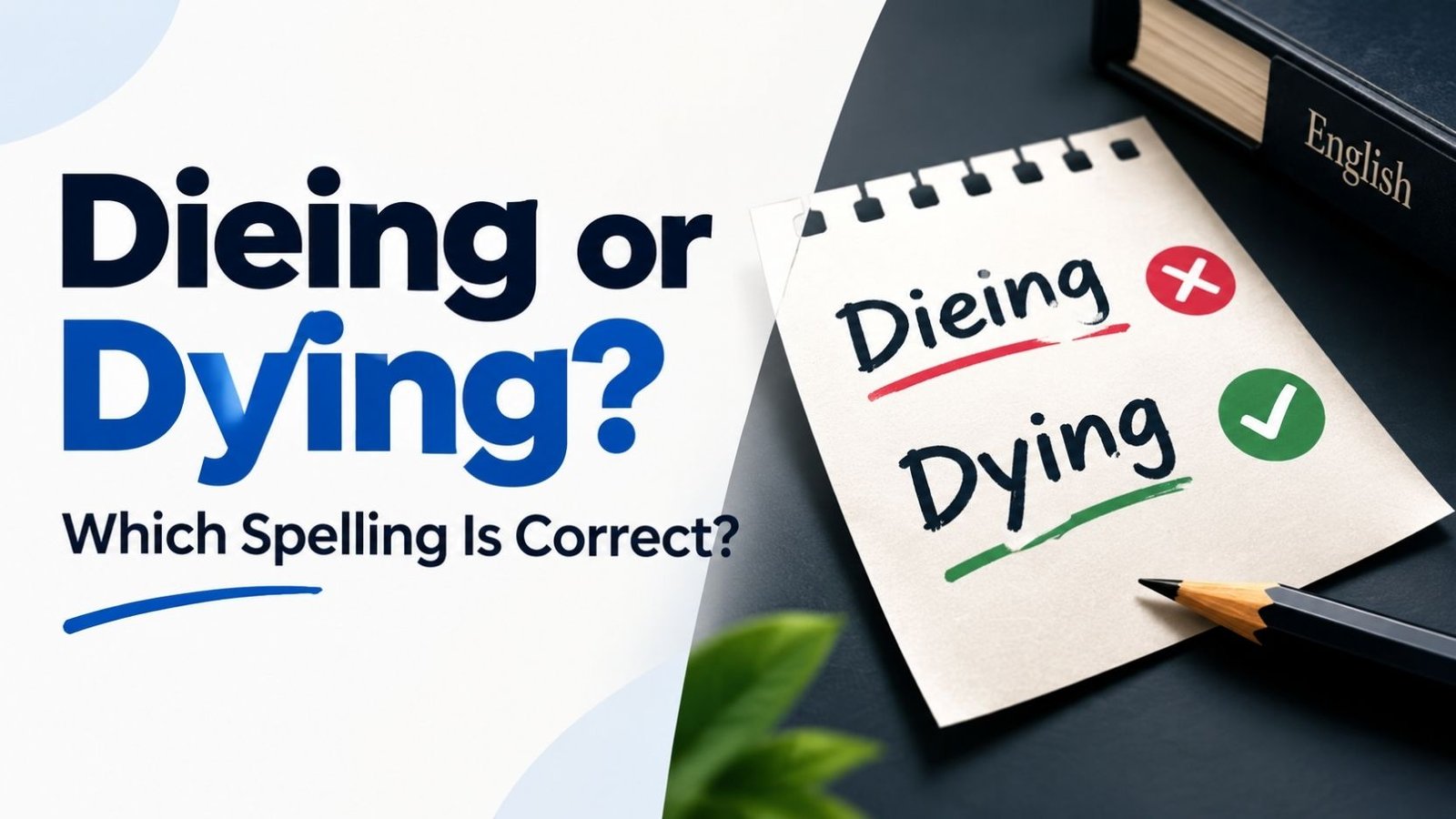
Dying is the correct spelling. Dieing is not a real word in standard English, even though many people type it that way by mistake. If you are writing about the end of life, running low on something, or losing your breath from laughter, dying is the form you need.
This mix-up happens for a simple reason. Most English verbs add ing directly to the base word. Die does not follow that pattern, and the exception trips up a lot of writers, including confident ones. Understanding why dying is correct, and why dieing keeps showing up anyway, makes the rule easy to remember for good.
This confusion sits alongside a related question that trips people up just as often: dying versus dyeing, which look almost identical but mean completely different things. Getting both pairs straight matters for anything from a text message to a hair salon appointment, so this guide covers the meaning, the grammar, the pronunciation, and the everyday situations where people get it wrong.
Dieing or Dying: The Quick Answer
| Spelling | Correct? | Why |
| Dying | Yes | Correct ing form of the verb die |
| Dieing | No | Common misspelling, not found in standard dictionaries |
| Dyeing | Yes, but a different word | Correct ing form of the verb dye, meaning to color something |
If you only remember one thing from this article, remember this: die becomes dying, not dieing. The i and e switch places and the e disappears before ing is added.
Read More: Traveled vs Travelled
What Does Dying Mean?
Dying is the present participle and gerund form of the verb die. It has a few related meanings depending on context.
Meaning 1: The physical process of death
This is the most literal and common meaning. It describes a person, animal, or plant that is in the process of losing its life.
Example: The old oak tree in the yard is dying after years of drought.
Meaning 2: Fading, weakening, or coming to an end
Dying is often used for things that are not literally alive but are losing strength, popularity, or relevance.
Example: Print newspapers are a dying industry in many countries.
Meaning 3: A strong desire or urge, used informally
In casual speech, people say they are dying to do something when they mean they want it very badly.
Example: I am dying to see that new movie this weekend.
Meaning 4: Laughing very hard, used informally
This is common in texting and online conversation. Saying “I’m dying” after a joke means you found it extremely funny, not that anything is actually wrong.
Example: That video was so funny, I was dying laughing.
Dying: Grammar and Part of Speech
Dying can function as two different parts of speech, depending on the sentence.
As a verb (present participle): It pairs with a form of “to be” to show an action in progress.
Example: She is dying to know the results.
As a gerund (acting like a noun): It represents the action itself as a concept.
Example: Dying is something every living thing eventually experiences.
As an adjective: It describes a noun directly.
Example: He whispered his dying wish to his family.
The base verb is die, an irregular verb in the sense that its spelling changes unusually when suffixes are added, even though its past tense (died) is regular.
| Form | Word | Example |
| Base form | Die | Plants die without water. |
| Present participle / gerund | Dying | The battery is dying fast. |
| Past tense | Died | The signal died mid call. |
| Past participle | Died | The tradition has died out. |
| Third person singular | Dies | The fire dies without fuel. |
Why Is It Dying and Not Dieing?
This is the question at the center of the confusion, and the answer comes down to a spelling rule most English speakers learn early but forget under pressure.
English has a general habit: when a verb ends in a silent e, you usually drop that e before adding ing. Take becomes taking. Write becomes writing. Hope becomes hoping.
Die does not end in a silent e in the usual sense. It ends in the letters ie. English spelling has a specific rule for verbs that end in ie: change the ie to y, then add ing. This keeps the word readable and avoids an awkward double vowel pattern.
So the transformation looks like this:
Die → remove ie → add y → dy → add ing → dying
The same rule applies to a small group of other verbs.
| Base Verb | Correct ing Form |
| Die | Dying |
| Lie | Lying |
| Tie | Tying |
| Vie | Vying |
Dieing would break this rule by simply adding ing onto die without changing the ie to y. That pattern does not exist in standard English spelling, which is why dieing is not found in dictionaries.
💡 Tip: If a verb ends in ie, think “ie becomes y” before you add ing. This one rule covers die, lie, tie, and vie.
Read More: Choosing or Chosing
Dying or Dieing: Common Mistakes
Here are the most frequent ways this error shows up, along with the correct version.
❌ Incorrect: My phone battery is dieing again.
✅ Correct: My phone battery is dying again.
❌ Incorrect: The plant is dieing because I forgot to water it.
✅ Correct: The plant is dying because I forgot to water it.
❌ Incorrect: I am dieing to try that new restaurant.
✅ Correct: I am dying to try that new restaurant.
❌ Incorrect: That joke had me dieing laughing.
✅ Correct: That joke had me dying laughing.
The mistake usually happens because writers apply the “just add ing” rule that works for most English verbs, without remembering the special case for words ending in ie.
Dying vs Dyeing: A Different Kind of Mix-Up
Dying and dyeing sound identical when spoken, which is exactly why they get confused so often in writing. But they come from two completely different base verbs and mean two completely different things.
| Word | Base Verb | Meaning | Example |
| Dying | Die | Coming to the end of life or fading away | The flowers are dying in the heat. |
| Dyeing | Dye | Applying color to something, like hair or fabric | She is dyeing her hair a new shade. |
The verb dye already ends in a true silent e, so it follows the normal rule of keeping the e when the ing would otherwise create confusion with a different word. If dye simply dropped the e, “dying” would result, and that would collide with the ing form of die. English keeps the e in dyeing specifically to prevent that overlap.
Dieing or Dyeing, Which Is Correct for Hair?
If you are talking about coloring hair, the correct spelling is dyeing, not dieing and not dying.
❌ Incorrect: I am dieing my hair red.
✅ Correct: I am dyeing my hair red.
This is one of the most searched versions of this mix-up, since “dying hair” and “dyeing hair” look and sound almost the same but mean very different things. Dying hair, taken literally, would suggest the hair itself is dying, which is not what most people mean when they book a salon appointment.
⚠️ Common mistake: Hair color context calls for dyeing (with an e before ing), not dying or dieing.
How to Pronounce Dying
Dying is pronounced with two syllables: DYE-ing.
- IPA: /ˈdaɪ.ɪŋ/
- Rhymes with: buying, crying, flying, trying
The first syllable sounds exactly like the word “die.” The second syllable is a soft “ing” sound. This pronunciation is the same in American English and British English, with no regional variation in how the word is spoken, even though spelling mistakes around it are common everywhere.
Dyeing is pronounced the same way as dying: DYE-ing, /ˈdaɪ.ɪŋ/. The two words are homophones, which is a major reason the spellings get swapped so often. You cannot tell them apart by ear. You can only tell them apart by context and correct spelling.
Dying: Origin and Word History
The word die entered English from Old Norse, a language spoken in Scandinavia during the medieval period. It replaced an earlier Old English word for the same concept over time, as Norse-influenced vocabulary blended into English following centuries of contact between English and Norse speakers in Britain.
The ing ending itself is a native English suffix used to form participles and gerunds, one of the oldest grammatical tools in the language. The spelling adjustment from ie to y before ing is not unique to die. It reflects a broader pattern in English spelling that developed to keep written words visually clear and pronounceable, avoiding unusual letter combinations like “ieing.”
This history explains why die behaves differently from most verbs when forming its ing version: the spelling rule is old, consistent, and applies to a small, stable group of words that all originally ended in ie.
Is Dieing a Word at All?
No. Dieing is not a recognized word in major dictionaries, including standard American and British English references. It does not appear as an alternate spelling, a regional variant, or an informal form. It is simply treated as a spelling error.
This differs from words that have two accepted spellings, such as color and colour, where both forms are valid depending on region. Dieing has no such status. Every major style guide and dictionary treats dying as the only correct form.
If you see “dieing” in writing, whether in a text message, a social media post, or a rough draft, it is worth correcting to dying, regardless of the surrounding context.
Dying: Examples in Different Contexts
In a medical or literal context: The doctor explained that the patient’s condition was terminal and that he was dying peacefully at home.
In a business or trend context: Analysts describe the video rental industry as a dying business model.
In casual conversation: I’m dying for a cup of coffee right now.
In humor or reaction: Everyone in the group chat was dying over that meme.
In literature or formal writing: The dying light of the sunset spread across the hills.
Notice how the core spelling, dying, stays the same across every context. Only the meaning shifts based on the sentence around it.
Dieing or Dying: Regional Usage (UK and US)
There is no difference between American and British English when it comes to this word. Both varieties of English use dying as the only correct spelling. Neither UK nor US dictionaries list dieing as an accepted alternative spelling.
This is worth noting because many spelling differences do exist between American and British English, such as color versus colour or organize versus organise. Dying is not one of them. Whether you are writing for a US audience or a UK audience, the spelling stays consistent.
Read More: Free Rein or Free Reign
Synonyms and Related Words
Depending on context, several words relate closely to dying, though none are exact substitutes in every situation.
| Word | Meaning | Difference from Dying |
| Perishing | Dying, often suddenly or due to harsh conditions | More formal or literary tone |
| Fading | Losing strength or visibility gradually | Used more for light, sound, or trends |
| Declining | Weakening or decreasing over time | Common in business or health contexts |
| Expiring | Coming to an end, especially of something with a set duration | Often used for contracts, subscriptions, or time limits |
These words can sometimes replace dying in a sentence, but each carries a slightly different tone or context. Dying remains the most direct and widely applicable term for the core meaning of approaching death or ending.
Frequently Asked Questions
Is it dieing or dying?
It is dying. Dieing is a common misspelling and is not a recognized word in standard English.
What does dying mean?
Dying means the process of losing life, or more broadly, losing strength, relevance, or existing state. It can also be used informally to express a strong desire or intense laughter.
Is dieing a real word?
No. Dieing does not appear in standard dictionaries. The correct spelling is always dying.
How do you spell dying correctly?
D-Y-I-N-G. The ie in die, changes to a y before adding ing.
What is the difference between dying and dyeing?
Dying relates to the verb die, meaning the end of life or fading away. Dyeing relates to the verb dye, meaning to apply color to something like hair or fabric.
How do you pronounce dying?
Dying is pronounced DYE-ing, with two syllables, the same way in both American and British English.
Is dying a noun or a verb?
Dying can function as a verb (present participle), a gerund (noun-like form), or an adjective, depending on the sentence.
Why do people write dieing instead of dying?
Most English verbs simply add ing to the base word. Writers often apply that common pattern to die out of habit, forgetting the special ie-to-y spelling rule.
Is it dying my hair or dyeing my hair?
It is dyeing my hair. Hair coloring uses the verb dye, so the correct spelling is dyeing, with an e before ing.
What other words follow the same spelling pattern as dying?
Lie becomes lying, tie becomes tying, and vie becomes vying. All verbs ending in ie follow this same rule.
Final Thoughts
Dying is the only correct spelling for the ing form of die, whether you are describing the literal end of life, a fading trend, or an informal expression like “dying to know.” Dieing is a spelling mistake that comes from applying the standard ing rule to a verb that follows a different pattern, and it does not appear in any major dictionary.
The easiest way to keep this straight is to remember the small group of verbs that behave the same way: die, lie, tie, and vie all swap their ie for a y before ing is added. Once that pattern clicks, dying will come naturally, and you will also be well equipped to tell it apart from its look-alike cousin, dyeing, the next time hair color or fabric comes up in conversation.

Danish Raza is the author of Grammavio, a trusted resource for simple and easy-to-understand English grammar guides. He creates helpful content covering grammar rules, word meanings, vocabulary, and common grammar mistakes to help readers improve their English skills.



One Comment