
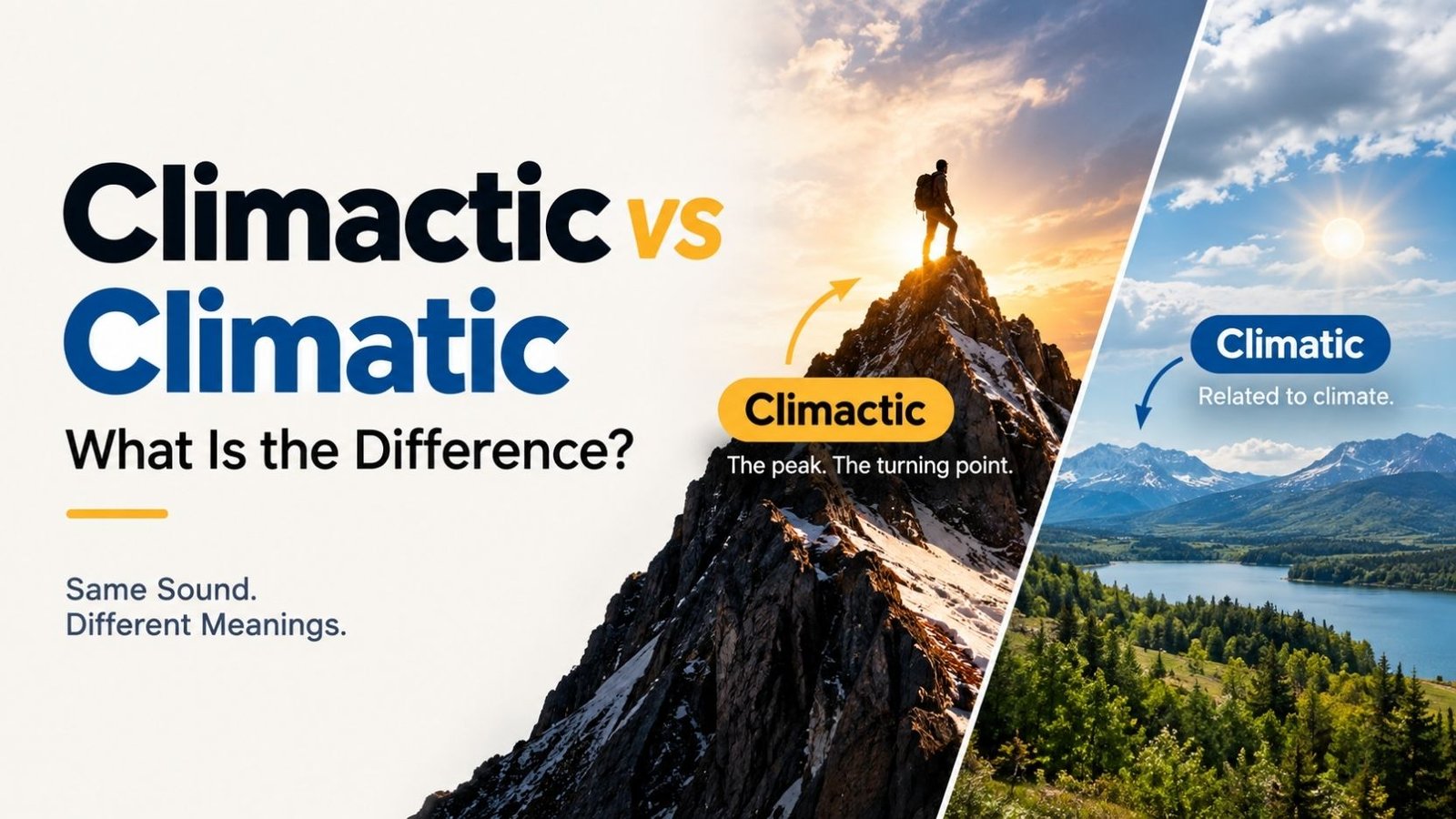
Climactic and climatic are two different adjectives. Climactic describes the peak or most intense point of something, such as a movie scene or a battle. Climatic describes something related to climate, such as weather patterns or regional conditions.
Many people mix them up because they look and sound almost the same. Only one letter changes the meaning completely. This guide shows you how to tell them apart, how to pronounce each one, and how to use them correctly.
Quick Answer: Climactic vs Climatic
| Word | Simple Meaning | Related Word | Example |
| Climactic | Relating to a climax, the highest point | Climax | The climactic battle ended the film. |
| Climatic | Relating to climate | Climate | Desert regions have harsh climatic conditions. |
💡 Quick tip: If you mean a high point in a story or event, use climactic. If you mean weather or climate, use climatic.
Read More: Vicious vs Viscous
Climactic Meaning
Climactic is an adjective. It describes the moment of greatest tension, excitement, or importance in a series of events. It comes from the noun climax.
Simple definition
Climactic means forming or relating to a climax. A climactic moment is the turning point or peak that everything else builds toward.
Where you will see it
- Stories, films, and novels: the climactic scene or the climactic showdown
- Sports: a climactic final game
- Video games: a climactic boss fight at the end of a level
- Real life: a climactic moment in a long process
Examples
- The hero faces the villain in the climactic scene.
- The climactic fight in a video game often has the hardest boss and the best music.
Climactic synonyms
| Word | Meaning | How It Differs |
| Culminating | Reaching a final high point | Stresses the end of a build up |
| Decisive | Settling the result | Stresses the outcome |
| Pivotal | Very important to what follows | Stresses importance, not the ending |
| Dramatic | Full of tension or excitement | Does not always mean the peak |
| Peak | The highest point | Simpler and more general |
Climatic Meaning
Climatic is also an adjective. It describes anything connected to climate. Climate means the usual weather conditions of a place over a long period.
Simple definition
Climatic means relating to climate. It is often used in science, geography, farming, building design, and testing.
Examples
- Farmers must adapt to changing climatic conditions.
- The region has several climatic zones.
Common phrases that use climatic
| Phrase | What It Refers To |
| Climatic zones | Areas with similar climate, such as tropical or polar |
| Climatic map | A map that shows climate types or patterns |
| Climatic conditions | Temperature, rainfall, humidity, and wind in an area |
| Climatic change | A shift in climate. Most writers today prefer the phrase climate change |
| Climatic chamber | A test chamber that controls heat, cold, and humidity |
| Climatic health | A general phrase about how climate affects human health |
| National Climatic Data Center | A former United States weather and climate data center |
About the National Climatic Data Center
The National Climatic Data Center was a United States agency that stored weather and climate records. In 2015 it was merged with other NOAA data centers to form the National Centers for Environmental Information. You will still see the old name in older articles and links.
Climatic chambers and test chambers
A climatic chamber is a sealed room or box. Engineers use it to test how products handle extreme heat, cold, and moisture. Phones, car parts, and medical devices are often tested this way. Here, climatic means the chamber recreates climate conditions on purpose.
Climatic heating and cooling
This phrase usually points to how climate affects the heating and cooling needs of a building. A home in a cold region needs more heating. A home in a hot region needs more cooling.
Climatic regions of Africa
Africa has a wide range of climatic regions. These generally include:
- Tropical rainforest, near the equator
- Savanna, with a wet season and a dry season
- Semi-arid areas, such as the Sahel
- Desert, such as the Sahara and the Namib
- Mediterranean climate, in the far north and southwest
- Highland climates, in mountain areas
Different sources group these regions in slightly different ways, so you may see other labels.
The Main Difference Between Climactic and Climatic
The difference comes down to what each word is built from. Climactic is built from climax. Climatic is built from climate.
| Feature | Climactic | Climatic |
| Part of speech | Adjective | Adjective |
| Built from | Climax | Climate |
| Core idea | Peak or turning point | Weather and climate |
| Typical topics | Stories, sports, games, events | Science, geography, weather, testing |
| Pronunciation | klai MAK tik | klai MAT ik |
Read More: Hear vs Here
How to Remember the Difference
Use the root word as a clue.
- Climactic has a hard “k” sound before the “t,” just like the “ks” sound at the end of climax.
- Climatic has the same “mat” sound as climate. Think of “weather” and “climate” together.
- Ask one question: is this about a high point or about weather? That tells you the answer.
⚠️ Common mistake: Writing “climatic” when you mean a thrilling peak. If the word describes a scene, a fight, or an ending, you almost always want climactic.
Climactic or Climatic? Which One Is Correct?
Neither word is always correct. The right choice depends on your meaning.
| Sentence | Correct Word |
| The ___ scene had everyone on the edge of their seats. | Climactic |
| The island has mild ___ conditions all year. | Climatic |
| The ___ final battle lasted twenty minutes. | Climactic |
| Scientists study ___ patterns in the Arctic. | Climatic |
Common Mistakes
❌ Incorrect: The movie had a climatic ending.
✅ Correct: The movie had a climactic ending.
The sentence is about the peak of the story, not the weather.
❌ Incorrect: The country has a wide range of climactic zones.
✅ Correct: The country has a wide range of climatic zones.
Zones based on weather are climatic.
❌ Incorrect: The ending felt anticlimatic.
✅ Correct: The ending felt anticlimactic.
Anticlimactic comes from anticlimax, which comes from climax.
Anticlimactic Meaning
Anticlimactic describes something disappointing that follows a build-up of excitement. It is the opposite of what people expected. The noun is anticlimax.
- The long wait for the results was anticlimactic because nothing changed.
- The big reveal felt like an anticlimax.
The spelling “anticlimatic” is a mistake. You may also see “anti climactic” written as two words, but the standard dictionary spelling is one word: anticlimactic.
So if someone searches “anti climactic or climatic,” the correct answer is anticlimactic.
Climactic vs Climax, Climate, and Climacteric
These words are close in spelling, so it helps to see them side by side.
| Word | Part of Speech | Meaning | Example |
| Climax | Noun | The highest point of something | The climax of the novel is shocking. |
| Climactic | Adjective | Relating to a climax | It was a climactic moment. |
| Climate | Noun | Long-term weather of a place | The climate here is dry. |
| Climatic | Adjective | Relating to climate | Climatic changes affect crops. |
| Climacteric | Noun or adjective | A critical period of change, often linked to life stages | Used mostly in medical or formal writing |
Climatic vs climate
Climate is a noun. Climatic is an adjective. Often, the noun climate works better as a modifier.
- ✅ Climate change affects coastal cities.
- ✅ Climatic conditions affect coastal cities.
- ✅ Climate zone and climatic zone are both used.
In modern writing, “climate change” is the standard phrase. “Climatic change” appears mostly in older or technical texts.
Climatic vs climatronic
Climatronic is not a regular English word. It is a brand name used by Volkswagen for its automatic climate control systems in cars. It has nothing to do with the meaning of climatic, even though it sounds similar.
Climactic vs viscous
Some people search for these two together because they look and sound a little alike. They are unrelated. Viscous means thick and sticky, like honey or heavy oil. Climactic means relating to a climax.
What Are Climatically Similar Areas Called?
A common school question asks: “Climatically and geographically similar conditions on the earth are called what?” The usual answer is climatic regions, also called climate zones. These are areas that share similar temperature, rainfall, and natural conditions.
How to Pronounce Climactic and Climatic
Both words stress the second syllable. The difference is in the middle sound.
| Word | Simple Pronunciation | IPA (American) |
| Climactic | klai MAK tik | /klaɪˈmæktɪk/ |
| Climatic | klai MAT ik | /klaɪˈmætɪk/ |
- Climactic has a clear “k” sound before the “t.”
- Climatic has no “k” sound. It flows from “mat” to “ik.”
- The first syllable in both words sounds like “cly,” as in “fly.”
Origin of Climactic and Climatic
Climactic
Climactic comes from climax. Climax comes from the Greek word klimax, which means ladder or staircase. It was first used in rhetoric to describe ideas that build step by step. Over time, it came to mean the highest point of a series.
Climatic
Climatic comes from climate. Climate comes from the Greek word klima, which meant slope or zone. Ancient thinkers used it for the tilt of the earth from the equator toward the poles. Later it came to mean the weather typical of a region.
Both words share a similar Greek ancestry, which is one reason they look so alike. They developed completely different meanings.
Read More: Addition vs Edition
Climactic vs Climatic Meaning in Urdu
For Urdu readers, here is a simple guide.
| Word | Urdu Meaning | Simple Idea |
| Climactic | عروج یا نقطۂ عروج سے متعلق | The peak of a story or event |
| Climatic | آب و ہوا یا موسم سے متعلق | Weather and climate |
If you see a story, match, or battle, think of climactic. If you see weather, geography, or science, think of climatic.
More Examples in Context
Climactic
- The climactic chase through the city lasted ten minutes.
- Fans waited all season for the climactic final.
Climatic
- The wine grapes grow well because of the local climatic conditions.
- Engineers tested the device in a climatic chamber at extreme temperatures.
Frequently Asked Questions
What is the difference between climactic and climatic?
Climactic relates to a climax, the highest point of a story or event. Climatic relates to climate, meaning weather patterns over time.
Is it climactic or climatic ending?
For a story, film, or game, the correct phrase is climactic ending. Climatic ending would be incorrect unless you were truly talking about the end of a climate period.
What does anticlimactic mean?
It means disappointing after a big build-up. The correct spelling is anticlimactic, not anticlimatic.
Is climactic a real word?
Yes. It is an adjective found in major dictionaries. It describes something that forms or relates to a climax.
Is climatic a real word?
Yes. It is an adjective that means relating to climate. It is common in science and geography.
How do you pronounce climactic?
It sounds like “klai MAK tik.” The stress falls on the second syllable.
Can I use climate instead of climatic?
Often yes. Phrases like climate zone and climate conditions are common. Climatic is still correct and widely used in formal and technical writing.
What is a climactic fight in a video game?
It is the final or most intense fight, usually a boss battle that closes a level or the entire game.
What is the difference between climate and climatic?
Climate is a noun that names the long-term weather of a place. Climatic is an adjective that describes something related to climate.
Conclusion
The difference between climactic and climatic is simple once you know the root of each word. Climactic comes from climax and describes the peak of a story, event, or game. Climatic comes from climate and describes anything connected to weather and regional conditions.
Next time you are unsure, ask what you are describing. If it is a thrilling high point, choose climactic. If it is weather, regions, or the environment, choose climatic.

Danish Raza is the author of Grammavio, a trusted resource for simple and easy-to-understand English grammar guides. He creates helpful content covering grammar rules, word meanings, vocabulary, and common grammar mistakes to help readers improve their English skills.



2 Comments