
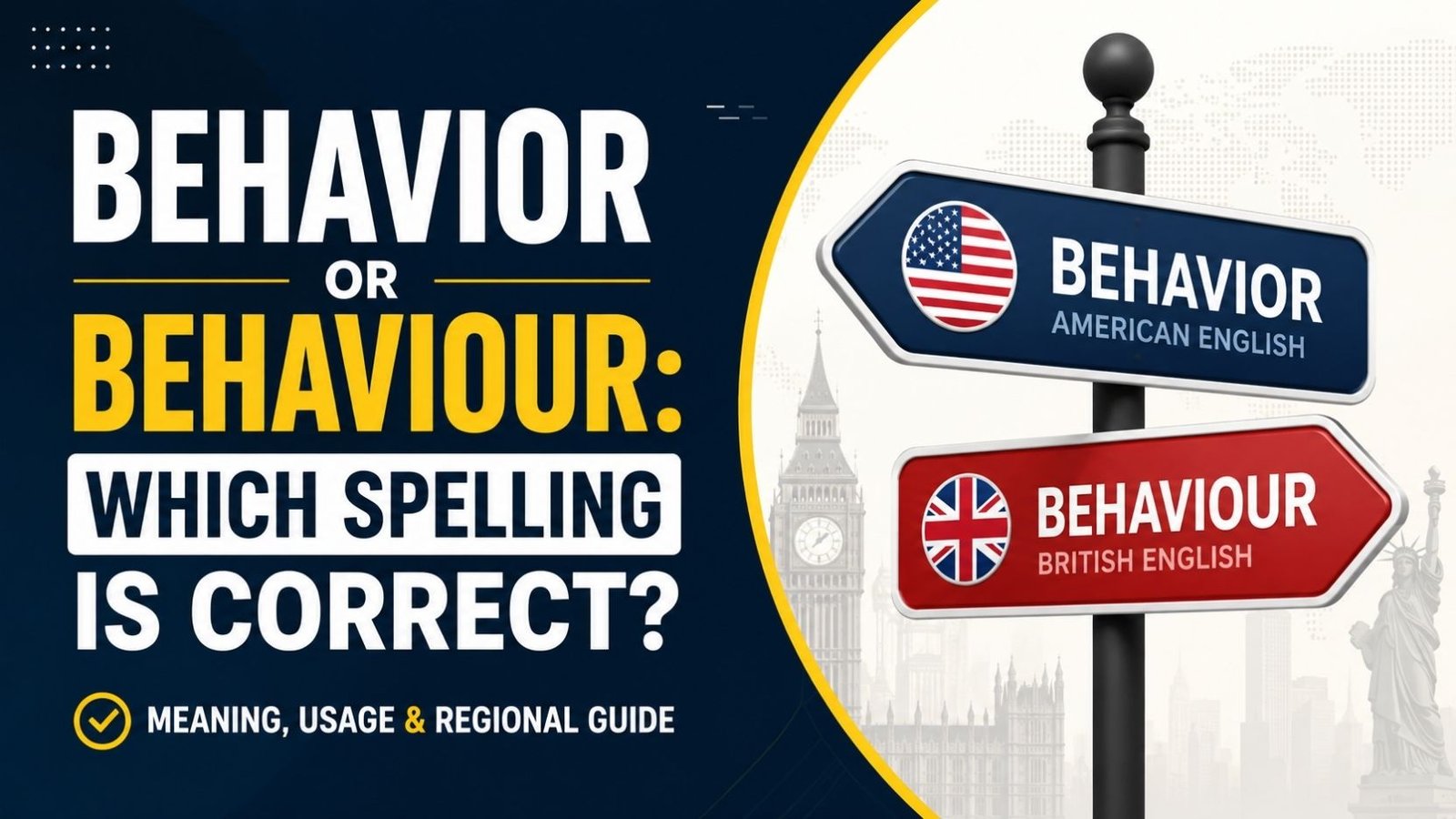
Both behavior and behaviour are correct. Neither one is a mistake. The only real difference is where you live and which style of English you follow. Behavior is the American spelling, and behaviour is the British spelling.
This small spelling difference confuses a lot of people because both versions look almost identical and sound exactly the same. Once you understand the regional pattern behind it, you will never have to second-guess yourself again. This guide explains the meaning, the grammar, the usage, and the exact rule each English-speaking country follows.
What Does Behavior Or Behaviour Mean?
Behavior, or behaviour, refers to the way a person, animal, or system acts or responds in a given situation. It describes actions, reactions, habits, and conduct.
The word covers a wide range of situations, including:
- How a person acts around others
- How an animal responds to its environment
- How a child acts at school or at home
- How a machine or system performs under certain conditions
- How a group of people acts in a social or professional setting
For example, a teacher might comment on a student’s behavior in class, while a scientist might study the behaviour of a chemical reaction. The meaning stays the same in both spellings. Only the letters change.
See More: Company-wide Or Companywide
Behavior Vs Behaviour: The Real Difference
The core difference between behavior and behaviour is not meaning, grammar, or pronunciation. It is a spelling convention, and that convention depends entirely on regional English standards.
American English tends to simplify certain word endings that came from French and Latin. British English generally keeps the older, fuller spelling. This is the same pattern you see in similar word pairs.
| American English | British English | Meaning |
| Color | Colour | The property of light reflected by an object |
| Favor | Favour | An act of kindness or approval |
| Honor | Honour | Respect or high regard |
| Behavior | Behaviour | The way someone acts or responds |
As the table shows, American English drops the letter u before r, while British English keeps it. This same rule applies to behavior and behaviour.
Which Spelling Should You Use?
The correct spelling depends on your audience, your country, and the style guide you are following. Here is a clear breakdown by region.
Behavior In The United States
In the United States, behavior is the standard and expected spelling. American dictionaries, schools, newspapers, and businesses use behavior without the letter u. If you are writing for a US audience, behavior is the correct choice.
Behaviour In The United Kingdom
In the United Kingdom, behaviour is the standard spelling. British dictionaries, schools, government documents, and media all use behaviour with the u included. UK English speakers who see behavior often assume it is a typo, even though it is simply the American form.
Behaviour In Canada
Canadian English generally follows British spelling conventions, so behaviour is the more common and accepted form. Canadian style guides, including major newspapers and government publications, typically use behaviour.
Behaviour In Australia
Australian English also follows British spelling patterns. Behaviour is the standard spelling used in Australian schools, media, and official writing. Australians rarely use the American form in formal contexts.
Behaviour Or Behavior In India
Indian English was historically shaped by British English, so behaviour remains the more traditional and widely taught spelling in Indian schools. However, because of heavy exposure to American media, software, and international business writing, many Indian writers now use behavior as well. Both spellings appear frequently in India, though behaviour is still considered the more formal choice in academic and government writing.
A Quick Reference Table
| Country or Region | Preferred Spelling |
| United States | Behavior |
| United Kingdom | Behaviour |
| Canada | Behaviour |
| Australia | Behaviour |
| India | Behaviour, with behavior also common |
| Ireland | Behaviour |
Grammar: Part Of Speech And Word Forms
Behavior and behaviour are both nouns. They are uncountable in most everyday use, which means they usually do not take a plural form when referring to a general pattern of conduct.
For example, you would say “The child’s behavior improved,” not “behaviors improved,” unless you are referring to multiple distinct types of actions in a more technical or scientific context, such as psychology.
Common Word Forms
| Form | American Spelling | British Spelling |
| A | Behavior | Behaviour |
| Behavioral | Behavioural | |
| Behaviorally | Behaviourally |
Notice that the adjective and adverb forms follow the same spelling pattern. American English writes behavioral and behaviorally without the u, while British English writes behavioural and behaviourally with the u.
How to Pronounce Behavior or Behaviour
Both spellings are pronounced exactly the same way. The spelling difference does not affect pronunciation at all.
The word is pronounced as: bih HAY vyer
It has three syllables, and the stress falls on the second syllable, HAY. This pronunciation is consistent whether you are speaking American English or British English.
Origin Of The Word
The word behavior, or behaviour, comes from Middle English. It developed from the earlier word “haviour,” which was related to the verb “have,” in the sense of holding or carrying oneself.
Over time, English speakers added the prefix “be” to form “behaviour,” strengthening the meaning to describe how someone conducts or carries themselves. The word has remained largely stable in meaning for centuries, even as its spelling split into two regional forms during the standardization of American and British English in the 1700s and 1800s.
Much of this spelling split traces back to American lexicographer Noah Webster, who intentionally simplified many British spellings to create a distinct American standard.
Examples Of Behavior Or Behaviour In A Sentence
Here are a few natural examples showing how the word works in real sentences. The American spelling is used first, followed by the British spelling for comparison.
- American: His behavior at the meeting surprised everyone.
- British: His behaviour at the meeting surprised everyone.
- American: The dog’s behavior changed after the training sessions.
- British: The dog’s behaviour changed after the training sessions.
- American: Consumer behavior data helps companies improve marketing strategies.
- British: Consumer behaviour data helps companies improve marketing strategies.
These examples show that the sentence structure never changes. Only the spelling of the word itself shifts based on regional English.
Common Mistakes To Avoid
Many writers make small errors when switching between American and British English. Here are the most common ones.
⚠️ Mixing spellings in the same document
❌ Incorrect: His behavior was unusual, and the teacher noted his behaviour again later.
✅ Correct: Pick one spelling style and use it consistently throughout the entire document.
⚠️ Misspelling the adjective form
❌ Incorrect: Behavioural, written as “behavorial”
✅ Correct: Behavioral in American English, or behavioural in British English.
⚠️ Assuming one spelling is wrong
❌ Incorrect: Believing behaviour is a misspelling of behavior
✅ Correct: Both spellings are fully correct, depending on regional standard.
Similar Words And Related Terms
A few related words follow the same regional spelling pattern as behavior and behaviour. Understanding these can help you stay consistent across an entire piece of writing.
| Word | American Spelling | British Spelling |
| Color | Color | Colour |
| Favor | Favor | Favour |
| Neighbor | Neighbor | Neighbour |
| Behavior | Behavior | Behaviour |
If you are writing for an American audience, apply the same simplified pattern across all of these words. If you are writing for a British, Canadian, Australian, or Irish audience, keep the u in each of these forms.
See More: Acception Vs Exception
Behavior Or Behaviour In Academic And Professional Writing
In academic writing, the correct spelling depends on the university or publication’s required style guide. American universities and journals almost always require behavior, following styles such as APA. British, Canadian, and Australian universities generally require behaviour, following styles such as Harvard referencing or Oxford style.
In business writing, the safest approach is to match the spelling used by your target audience or client. A company writing for American customers should use behavior, while a company writing for a British or Australian audience should use behaviour.
Frequently Asked Questions
Is it behavior or behaviour?
Both are correct. Behavior is the American spelling, and behaviour is the British spelling.
Which is correct, behavior or behaviour?
Neither spelling is more correct than the other. The right choice depends on the English standard you are following, American or British.
What does behavior or behaviour mean?
It means the way a person, animal, or system acts or responds in a particular situation.
Is behaviour the Australian spelling?
Yes. Australian English follows British spelling conventions, so behaviour is the standard form used in Australia.
Is behaviour used in Canada?
Yes. Canadian English generally follows British spelling, so behaviour is the more common and accepted form in Canada.
Is behavior or behaviour used in India?
Behaviour is the more traditional spelling taught in Indian schools, though behavior also appears often due to American influence.
How do you pronounce behavior or behaviour?
Both spellings are pronounced the same way: bih HAY vyer, with the stress on the second syllable.
What is the adjective form of behavior or behaviour?
The adjective form is behavioral in American English and behavioural in British English.
Can you mix behavior and behaviour in the same document?
No. For consistency and professionalism, choose one spelling style and use it throughout the entire piece of writing.
Where does the word behavior or behaviour come from?
It comes from Middle English, developing from the earlier word haviour, related to the verb have, meaning to hold or carry oneself.
Conclusion
Behavior and behaviour are two correct spellings of the same word, separated only by regional English standards. Behavior is used in the United States, while behaviour is used in the United Kingdom, Canada, Australia, and largely in India and Ireland. The meaning, pronunciation, and grammar remain identical in both versions, so the only real decision is which spelling matches your audience.
Once you know your target audience or region, choosing between behavior and behaviour becomes simple. Stick to one spelling consistently throughout your writing, match it to the style guide you are following, and you will always use the correct form with confidence.

Danish Raza is the author of Grammavio, a trusted resource for simple and easy-to-understand English grammar guides. He creates helpful content covering grammar rules, word meanings, vocabulary, and common grammar mistakes to help readers improve their English skills.



One Comment