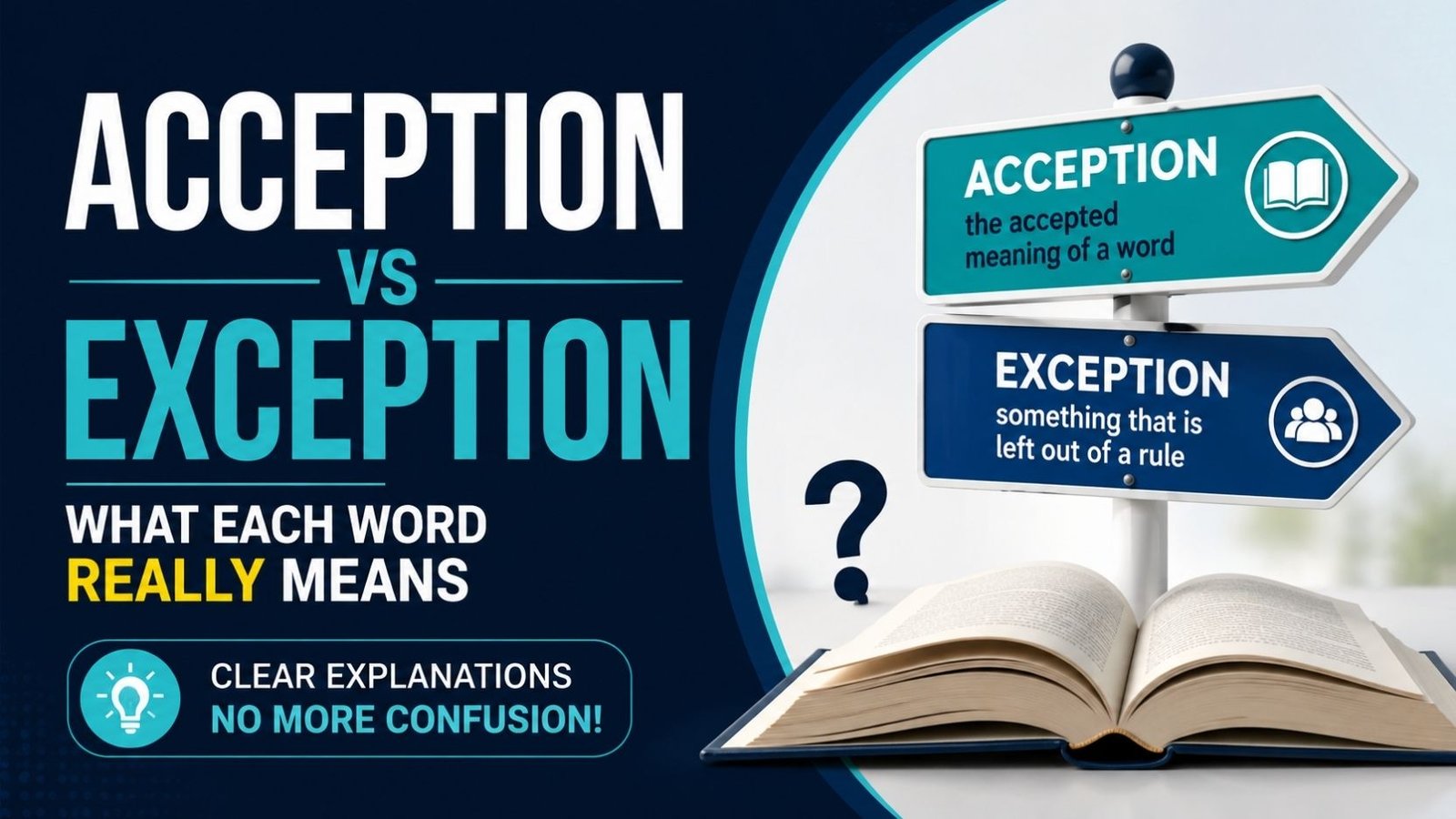
Acception and exception sound almost identical, and that is exactly why so many people mix them up. Exception is the common, everyday word. It means something that is left out or does not follow the usual rule. Acception is a real word too, but it is rare and mostly outdated. It means the accepted or received meaning of something.
Most of the time, when someone writes “make an acception,” they actually mean “make an exception.” This confusion happens because the two words look alike and share a Latin root. Understanding the real difference will help you write with confidence and avoid an easy mistake that even careful writers make.
What Does Acception Mean?
Acception is a noun. It refers to the accepted or generally understood sense of a word or idea. In simple terms, it means “acceptation,” which itself means the meaning that people generally agree a word carries.
Here is the core definition:
- Acception (noun): the received or accepted meaning of a word or phrase; an older, less common synonym of “acceptation.”
Major dictionaries, including Merriam-Webster, define acception simply as acceptation. Wiktionary and YourDictionary both label the word as obsolete in this sense, meaning it was once used but has mostly fallen out of everyday English.
There is a second, much rarer sense of acception. In old legal and religious writing, “acception of persons” meant favoritism or partiality, showing favor to one person over another unfairly. This phrase appears in early English Bible translations. Wiktionary notes that this use is considered rare and proscribed, which means style guides do not recommend it today.
So acception is not a made-up word. It is a genuine but old-fashioned term that has mostly been replaced by other words in modern English.
See More: Reenforce Vs Reinforce
Is Acception A Word?
Yes, acception is a real word. It appears in Merriam-Webster, the Oxford English Dictionary, Wiktionary, and other established dictionaries. However, it is labeled obsolete or rare in most of these sources.
This matters for one simple reason. A word can be technically real and still be the wrong choice for everyday writing. Acception exists, but almost no modern writer uses it on purpose. If you use it today, most readers will assume you meant a different word, usually “exception” or “acceptance.”
Acception Meaning In Simple Terms
If you strip away the formal dictionary language, acception simply means “the meaning people accept for a word.” Think of it as a fancier, older cousin of “acceptation.”
For example: older writers might have said a word “took its acception” from a certain context, meaning that context shaped how the word was understood. You will almost never see this construction in modern books, articles, or conversation.
Acception Vs Acceptance
People often confuse acception with acceptance as well, not just with exception. These two words are related but not identical.
| Word | Meaning | Common Today? |
| Acceptance | The act of accepting something, or approval of something | Yes, very common |
| Acception | The accepted meaning of a word; an old term for acceptation | No, rare and outdated |
Acceptance is the word you want in almost every situation. If someone accepts a gift, an apology, or an idea, that is acceptance. Acception refers specifically to word meaning, and even then, only in older texts.
What Does Exception Mean?
Exception is a common English noun. It means something that does not follow the general rule, or a case that is left out from a wider category.
Here is the core definition:
- Exception (noun): a person, thing, or case that is not included in a general statement or does not follow a rule that otherwise applies.
Exception comes from the Latin word “exceptio,” which relates to the verb “excipere,” meaning “to take out” or “to leave out.” This origin makes sense once you see the meaning: an exception is something taken out of the general rule.
Exception also has a second common use, especially in computer programming. In this technical context, an exception is an error or unusual event that interrupts the normal flow of a program.
Why People Confuse Acception And Exception
The confusion is understandable. Both words share the same “-ception” ending, and both trace back to Latin roots involving the idea of taking or receiving something. Wiktionary even lists exception as a homophone of acception, meaning the two words can sound alike depending on how they are pronounced.
There is another reason for the mix-up. Exception is far more common in daily speech and writing. Because acception looks similar but appears so rarely, many writers assume it must be a variant spelling of exception. It is not. They are two separate words with different histories and different meanings.
💡 Tip: If you are unsure which word to use, exception is almost always the correct choice in modern writing.
Acception vs Exception: Quick Comparison Table
| Feature | Acception | Exception |
| Meaning | The accepted meaning of a word; old term for acceptation | Something left out of a general rule |
| Common usage today | Rare, mostly obsolete | Very common |
| Part of speech | Noun | Noun |
| Typical modern use | Almost never used | Used constantly in speech and writing |
| Example phrase | “The word took on a new acception over time.” | “She made an exception to the rule.” |
How To Use Exception In A Sentence
Exception fits naturally into everyday sentences. Here are a few clear examples:
- The teacher made an exception and accepted the late paper.
- Every rule has an exception, and this situation is one of them.
- With the exception of Mia, everyone finished the race.
Notice how exception always points to something being excluded or treated differently from the norm. This is the meaning readers expect, and it is the meaning you should use in nearly every case.
How To Use Acception In A Sentence
Because acception is rare, real examples are hard to find outside older or academic texts. Here is a constructed example that reflects its dictionary meaning:
- Over the centuries, the word gained a new acception among scholars.
You will notice this sentence still sounds formal and old-fashioned. That is expected, since the word itself carries that tone. In ordinary conversation or writing, you would replace “acception” with “meaning” or “sense” instead.
Make An Exception Or Acception?
This is one of the most searched versions of this question, so it deserves a direct answer.
The correct phrase is “make an exception.”
“Make an acception” is not standard English. It is a common misspelling caused by confusing the two similar-looking words. If you are asking someone to bend a rule for a specific case, always use “exception.”
✅ Correct: Can you make an exception for me this time?
❌ Incorrect: Can you make an acception for me this time?
Common Mistakes With Acception And Exception
Here are the most frequent errors and how to fix them.
Mistake 1: Writing “acception” when you mean “exception.”
- Incorrect: There are no acceptions to this policy.
- Correct: There are no exceptions to this policy.
Mistake 2: Writing “acception” when you mean “acceptance.”
- Incorrect: I appreciate your acception of my apology.
- Correct: I appreciate your acceptance of my apology.
Mistake 3: Assuming acception is simply a misspelling.
Acception is a real, dictionary-recognized word. It is just extremely rare and mostly used in historical or academic contexts, not a plain typo.
⚠️ Common mistake: Autocorrect will often flag “acception” as an error simply because it is used so rarely, even though the word does technically exist.
See More: Emasculate Vs Demasculate
Pronunciation
Both words are pronounced in a very similar way, which adds to the confusion.
- Acception: ak-SEP-shun
- Exception: ik-SEP-shun
The stress falls on the second syllable in both words. The main difference in sound comes from the first syllable: “ak” for acception and “ik” for exception. Because the endings match so closely, many people genuinely cannot tell them apart in casual speech.
Origin And Word History
Both words trace back to Latin, which explains their similar structure.
Acception comes from the Latin word “acceptio,” related to “accipere,” meaning “to receive” or “to accept.” It passed through Middle French and Middle English before settling into its current form. Its earliest known use in English dates back to the 14th century.
Exception comes from the Latin word “exceptio,” related to “excipere,” meaning “to take out” or “to except.” This root explains why an exception is something taken out of a general category or rule.
Both words share the Latin base tied to “taking” or “receiving,” but the prefixes point them in different directions. “Ac-” relates to receiving or accepting, while “ex-” relates to taking out or excluding.
Acception In Modern Culture
Outside of dictionaries, “Acception” also exists as the title of a webtoon created by Coco Ouwerkerk, known online as Colourbee. The series follows a teenager named Arcus as he navigates high school, friendship, and self-expression.
This is simply the name of a comic series and has no connection to the grammatical meaning of the word acception. If you searched for “acception webtoon,” this is likely what you were looking for, separate from the language question covered in this article.
Similar And Related Words
A few other words sit close to acception and exception in meaning or spelling. Knowing the differences helps you choose the right word every time.
| Word | Meaning | When to Use It |
| Acceptance | The act of accepting something | Everyday situations involving approval or agreement |
| Acceptation | The generally accepted meaning of a word | Formal or linguistic discussion of word meaning |
| Exception | Something excluded from a general rule | Everyday situations involving rules or exclusions |
| Exceptional | Unusually good or rare | Describing outstanding quality or rarity |
Acceptation is worth noting here because it is the modern word that carries the same meaning as acception. If you need a word for “the accepted meaning of a term,” acceptation is the more recognized and readable choice today.
Acception And Exception In Everyday Vs Formal English
In everyday English, you will almost never need the word acception. Exception, on the other hand, appears constantly in casual conversation, business writing, and academic work.
In formal or historical English, particularly older religious, legal, or literary texts, acception appears more often, especially in the phrase “acception of persons,” meaning favoritism. Modern translations and modern legal writing generally replace this phrase with clearer wording, such as “partiality” or “favoritism.”
See More: Hide Or Hid
No Exceptions Or Acceptions?
This phrase should always be written as “no exceptions.” “Acceptions” is simply the plural form of the outdated word acception, and it does not fit this common expression. When people say a rule applies “with no exceptions,” they mean nothing is excluded from that rule. This is one more case where exception is the correct, expected word.
Frequently Asked Questions
What does acception mean?
Acception means the accepted or received meaning of a word. It is an old and rare term, mostly replaced today by “acceptation.”
Is acception a word?
Yes. It appears in established dictionaries like Merriam-Webster and the Oxford English Dictionary, though it is labeled rare or obsolete.
Is it exception or acception?
In almost every modern situation, exception is the correct word. Acception is a separate, much rarer word with a different meaning tied to word definitions.
How do you spell acception?
It is spelled a-c-c-e-p-t-i-o-n. Many people misspell it as “acception” when they actually mean “exception,” which is spelled e-x-c-e-p-t-i-o-n.
What is the difference between acception and exception?
Acception refers to the accepted meaning of a word and is rarely used today. Exception refers to something that does not follow a general rule and is used constantly in modern English.
Should I say “make an exception” or “make an acception”?
Always say “make an exception.” “Make an acception” is not correct in standard modern usage.
Is acception the same as acceptance?
No. Acceptance means approving or agreeing to something. Acception refers to the meaning of a word. They come from the same root but serve different purposes.
How do you pronounce acception?
It is pronounced ak-SEP-shun, with the stress on the second syllable, similar to how exception is pronounced.
Where does the word exception come from?
Exception comes from the Latin word “exceptio,” related to “excipere,” meaning “to take out.” This is why an exception refers to something excluded from a rule.
Why do people confuse acception and exception?
The two words look and sound similar, and both come from Latin roots involving taking or receiving. Because exception is common and acception is rare, many writers assume acception is simply a misspelling.
Final Thoughts
Acception and exception may look almost identical, but they mean very different things. Exception is the word you need in daily writing and conversation, describing anything that breaks from the usual rule. Acception is a genuine but outdated word that refers to the accepted meaning of a term, and it rarely appears outside old or academic texts.
If you remember one simple rule, remember this: when in doubt, choose exception. It is the word modern readers expect, and it will almost always match what you are trying to say. Acception still has its place in the history of English, but for everyday writing, exception is the clear and correct choice.

Danish Raza is the author of Grammavio, a trusted resource for simple and easy-to-understand English grammar guides. He creates helpful content covering grammar rules, word meanings, vocabulary, and common grammar mistakes to help readers improve their English skills.