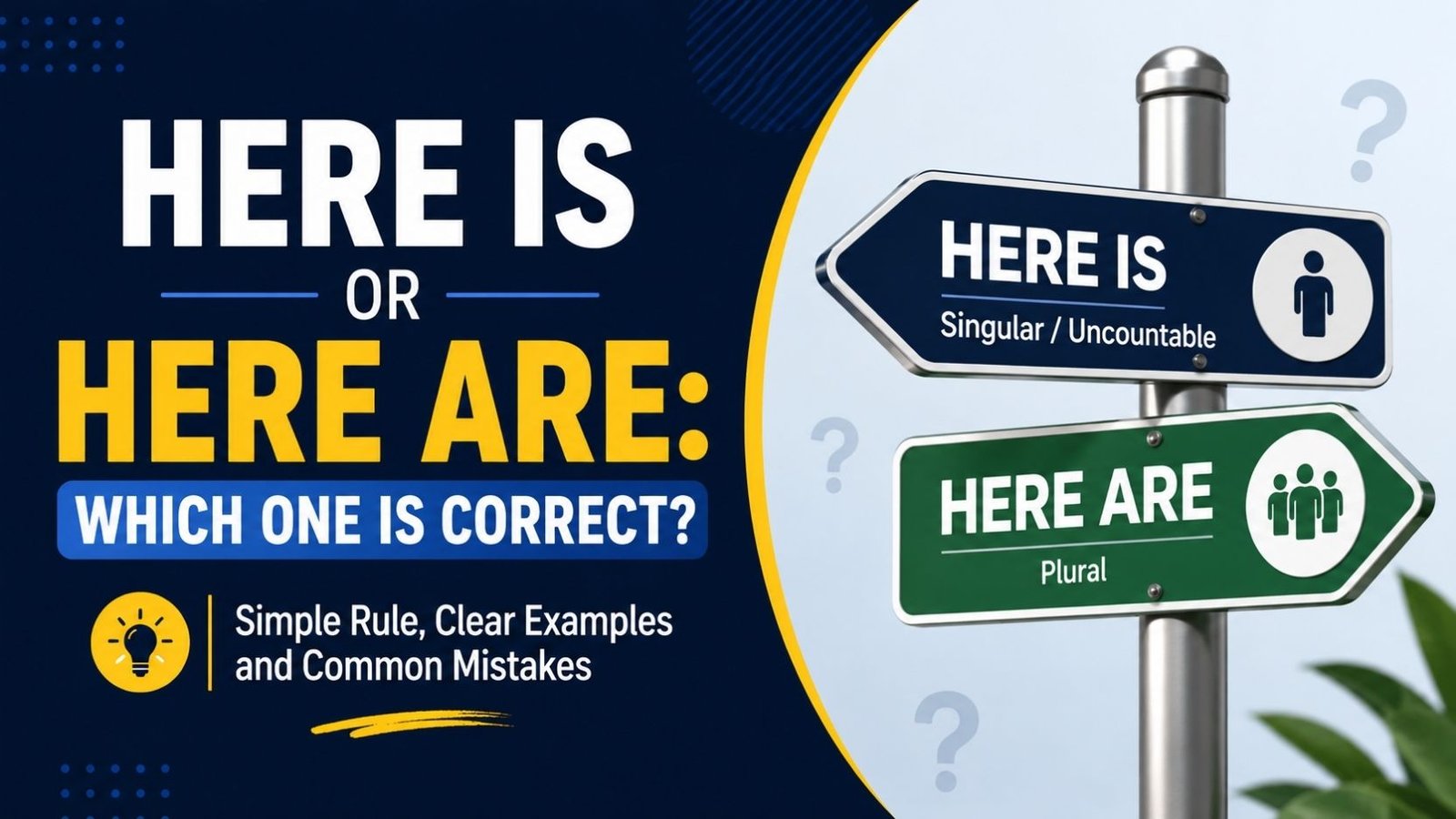
Here is or here are? The short answer is that both are correct, but they are used in different situations. You use “here is” when the word right after it is singular, and you use “here are” when the word right after it is plural. The choice depends entirely on the noun that follows.
This small grammar point trips up many writers because “here” comes first, and the mind naturally looks at “here” instead of looking ahead to the noun. Once you learn to check the noun that follows, the rule becomes automatic. This guide breaks it down clearly, with simple examples, common mistakes, and a quick reference table you can return to anytime.
Here Is or Here Are: The Simple Rule
The words “here is” and “here are” are not really about “here” at all. They are about the noun that comes right after them. This is called subject-verb agreement, and it applies even when the sentence starts with a word like “here” instead of the subject itself.
- Use “here is” when the noun that follows is singular.
- Use “here are” when the noun that follows is plural.
- Use “here is” before uncountable nouns, such as information or advice.
- Use “here are” before a list of two or more separate items.
Think of “here is” and “here are” as an introduction. Whatever word comes right after the introduction decides which form you need.
See More: Emasculate Vs Demasculate
Why “Here” Confuses The Verb Choice
In a normal English sentence, the subject usually comes before the verb. For example, “The book is on the table.” You can easily see that “book” is singular, so “is” feels natural.
But in sentences that start with “here,” the order flips. The verb comes first, and the subject comes after it. This is called inverted word order. Because the subject is hidden later in the sentence, many writers accidentally match the verb to “here” instead of matching it to the real subject.
Quick Reference Table
| Sentence Starter | Correct Form | Reason |
| Here is the book. | Here is | Book is singular |
| Here are the books. | Here are | Books is plural |
| Here is some information. | Here is | Information is uncountable |
| Here are the results. | Here are | Results is plural |
| Here is my hand. | Here is | Hand is singular |
| Here are my hands. | Here are | Hands is plural |
Here Is: When to Use It
Use “here is” whenever the noun right after it is singular or uncountable. This includes single objects, single people, single ideas, and mass nouns that do not have a plural form in normal use.
Examples:
- Here is the report you asked for.
- Here is a pen if you need one.
- Here is some advice for your interview.
- Here is the answer to your question.
- Here is my work, and I hope you like it.
Notice that “information,” “advice,” and “work” in these examples are uncountable. English treats them as singular ideas, even though they can describe many small pieces of information or effort. That is why “here is” fits naturally with them.
Here Are: When to Use It
Use “here are” whenever the noun right after it is plural. This includes multiple objects, multiple people, or multiple examples grouped together.
Examples:
- Here are the documents you requested.
- Here are three reasons why the plan failed.
- Here are your keys.
- Here are some signs you should pay attention to.
- Here are the top results for your search.
If you can count the items and there is more than one, “here are” is almost always the correct choice.
Here Is or Here Are: Step by Step Method
If you are ever unsure which form to use, follow this simple three step check.
- Look at the word that comes immediately after “here is” or “here are.”
- Decide whether that word is singular, uncountable, or plural.
- Match the verb: singular or uncountable takes “is,” plural takes “are.”
This method works every time because it forces you to look past “here” and focus on the real subject of the sentence.
See More: Reenforce Vs Reinforce
Here Is or Here Are: A List
This is one of the most common confusions. When you introduce a list, look at what comes right after “here is” or “here are,” not at the word “list” itself.
- Here is the list of names. (correct, because “list” is singular)
- Here are the names on the list. (correct, because “names” is plural)
Both sentences are grammatically correct. The difference comes from what word directly follows the phrase. “Here is the list” works because “list” is one single thing. “Here are the names” works because “names” is more than one item.
Common Mistakes
Incorrect: Here is the results of the test.
Correct: Here are the results of the test. Why: “Results” is plural, so it needs “are.”
Incorrect: Here are the information you requested.
Correct: Here is the information you requested. Why: “Information” is uncountable and treated as singular in English.
Incorrect: Here is your keys.
Correct: Here are your keys. Why: “Keys” is plural.
Incorrect: Here are a list of tips.
Correct: Here is a list of tips. Why: “List” is singular, even though it contains multiple tips.
Here Is Or Here Are With Uncountable Nouns
Some nouns cause confusion because they describe many small things, yet English still treats them as one unit. These are called uncountable or mass nouns, and they always pair with “here is.”
| Uncountable Noun | Correct Example |
| Information | Here is the information you need. |
| Advice | Here is some advice before you start. |
| News | Here is the news for today. |
| Homework | Here is your homework for tonight. |
| Furniture | Here is the furniture you ordered. |
A simple way to recognize an uncountable noun is that you cannot easily put a number directly in front of it. You would not naturally say “three informations,” so “information” stays singular.
Here Is Or Here Are In Everyday Speech
In casual spoken English, some native speakers say “here’s” before both singular and plural nouns, as in “here’s the keys.” This happens often in relaxed conversation. However, in formal writing, school work, business communication, and professional English, the grammatically correct form still follows the singular or plural rule. When accuracy matters, choose “here are” for plural nouns, even if you sometimes hear “here’s” used casually.
Here Is or Here Are: More Examples in Context
Singular examples:
- Here is the file you asked me to send.
- Here is my new address.
- Here is a quick tip that might help.
Plural examples:
- Here are the files from yesterday’s meeting.
- Here are a few tips that might help.
- Here are the young men who volunteered.
Uncountable examples:
- Here is the equipment for the project.
- Here is some feedback on your writing.
Similar Expressions To Know
| Expression | Meaning | Example |
| Here is or here are | Introducing something nearby | Here is your coffee. |
| There is or there are | Stating that something exists | There are two chairs in the room. |
| This is or these are | Pointing to something specific | This is my book. These are my books. |
“Here is” and “there is” follow the exact same singular and plural rule. If you understand one, you already understand the other.
See More: Acception Vs Exception
Idiomatic Uses Of “Here Is” And “My Work Here Is Done”
Not every use of “here is” follows a strict grammatical pattern tied to a following noun. Some phrases have become fixed idioms with their own meaning, separate from ordinary sentence construction.
- “My work here is done” is a common expression meaning that a task has been finished and the speaker is ready to leave or move on. It is often used humorously, even for small accomplishments.
- “What we have here is a failure to communicate” is a well known line from the 1967 film Cool Hand Luke, often quoted or referenced when two people clearly misunderstand each other.
- “Everyone here is lying” uses “here” as a location marker meaning “in this place,” combined with a singular collective idea, rather than describing a physical object being introduced.
These expressions are worth knowing separately, since they are idiomatic rather than simple examples of the singular and plural rule.
Frequently Asked Questions
Is it “here is” or “here are” the details?
It depends on how “details” is used. Since “details” is plural, the correct form is “here are the details.”
Is it “here is” or “here are” the list
“Here is the list” is correct because “list” is a singular noun, even though the list contains multiple items.
Is it “here is” or “here are” some information?
“Here is some information” is correct because “information” is an uncountable noun and is always treated as singular.
Is it “here is” or “here are” a few?
It depends on the noun after “a few.” For example, “here are a few examples” is correct because “examples” is plural.
Why does “here” affect the verb if it is not the subject?
“Here” is not the subject. The real subject comes after the verb because the sentence uses inverted word order. The verb must still agree with that hidden subject, not with “here.”
Can “here’s” be used before a plural noun
“Here’s” is a contraction of “here is,” so it technically should only be used before singular or uncountable nouns. It is common in casual speech before plural nouns, but this is considered informal and is best avoided in formal writing.
Is “here are the results” correct?
Yes. “Results” is a plural noun, so “here are the results” is the grammatically correct form.
What is the easiest way to remember the rule?
Ignore “here” and look only at the noun that follows it. If that noun is one thing, use “is.” If it is more than one thing, use “are.”
Conclusion
The choice between here is or here are always comes down to the noun that follows, not the word “here” itself. Singular and uncountable nouns pair with “here is,” while plural nouns pair with “here are.” Once you train yourself to check the noun first, the correct form becomes almost automatic, even in longer or more complicated sentences.
Whether you are writing an email, a report, or a simple text message, taking a moment to check the noun after “here” will help you avoid one of the most common small grammar mistakes in English. With a little practice, choosing between here is or here are will become second nature.

Danish Raza is the author of Grammavio, a trusted resource for simple and easy-to-understand English grammar guides. He creates helpful content covering grammar rules, word meanings, vocabulary, and common grammar mistakes to help readers improve their English skills.
One Comment