
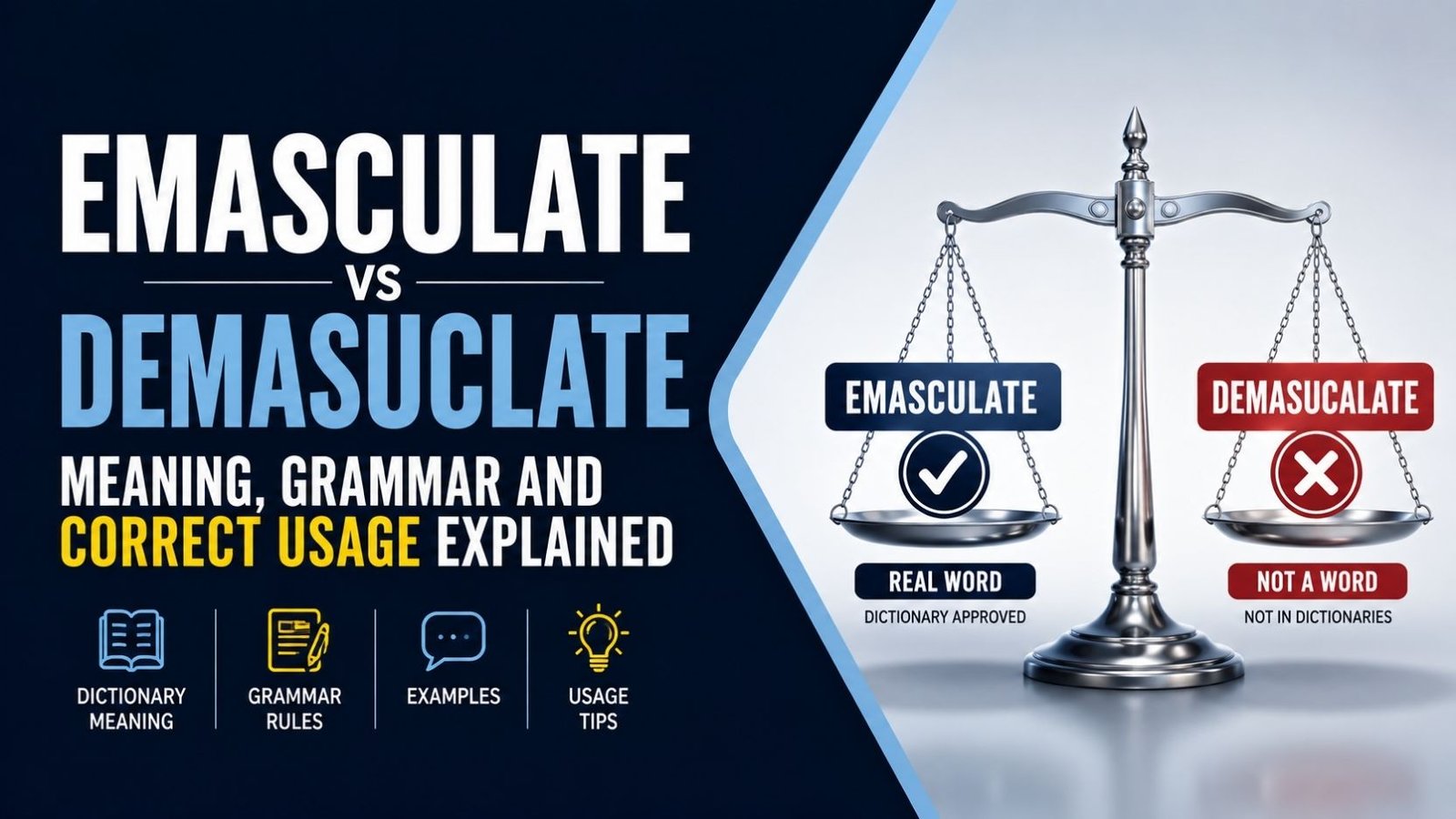
If you have ever paused mid-sentence wondering whether to write “emasculate” or “demasculate,” you are not alone. The short answer is simple: emasculate is the real, dictionary-recognized word. Demasculate is not a standard English word, even though it shows up often in casual writing and online conversation. This guide explains exactly what emasculate means, why demasculate keeps appearing anyway, and how to use the correct term with confidence.
This confusion matters more than it might seem, especially in professional or academic writing. Using a nonstandard word like demasculate can make a piece of writing look careless, even when the meaning is clear to most readers. Emasculate carries centuries of dictionary backing, a clear grammar profile, and well-documented usage across literature, psychology, and everyday speech. Once you understand its meaning and history, the difference between the two words becomes easy to remember for good.
Emasculate Vs Demasculate: Which One Is Correct?
Only one of these two words is accepted in standard English. Here is the direct comparison.
| Word | Is it a real word? | Where it comes from |
| Emasculate | Yes, found in Merriam-Webster, Oxford, Cambridge, and Collins | Latin “emasculare,” first used in English in the early 1600s |
| Demasculate | No, not found in any major dictionary | An informal blend, likely formed by mistakenly adding “de” to “masculate” |
Emasculate already contains the idea of removal built into its Latin root. Adding the prefix “de,” which usually signals removal or reversal, creates a word that duplicates a meaning the original term already carries. That redundancy is one reason “demasculate” has never been adopted by major dictionaries, even though people use it informally online.
See More: To Fast Or Too Fast
What Does Emasculate Mean?
Emasculate is a verb with more than one meaning, depending on context. Each meaning is explained separately below so they are easy to tell apart.
Meaning 1: To make someone feel less masculine
This is the most common modern use. It describes taking away a man’s confidence, authority, or sense of masculine identity, often through criticism, humiliation, or a loss of control.
Meaning 2: To weaken or reduce the effectiveness of something
This use applies to things rather than people. A law, a policy, a plan, or an organization can be “emasculated” when changes strip away its power or impact.
Meaning 3: To castrate, in a literal biological sense
This is the oldest and most literal meaning of the word. It refers to the physical removal of male reproductive organs, in humans or animals, and is now mostly used in medical, veterinary, or historical writing.
Meaning 4: A specific botanical term
In plant science, emasculate means to remove the male part of a flower, called the stamen, so the flower cannot pollinate itself. Plant breeders use this technique when they want full control over cross-pollination.
Is Demasculate A Word?
No. Demasculate does not appear in Merriam-Webster, Oxford, Cambridge, or Collins, and it has no formal entry as standard English. It shows up mainly on social media, in casual writing, and occasionally in crowdsourced references like Wiktionary and Urban Dictionary, where user-submitted entries loosely define it as “to remove masculinity from someone.”
Interestingly, some informal sources use “demasculate” or “remasculate” the opposite way, to mean regaining masculine confidence after an emasculating experience, which shows just how unstable and undefined the term really is.
Because there is no consistent, agreed-upon definition and no dictionary support, demasculate should be avoided in formal writing, academic work, and professional communication. Emasculate is the word to use instead.
Emasculate Grammar: Part Of Speech And Word Forms
Emasculate is a transitive verb, which means it needs a direct object. You cannot simply say “he emasculated.” You need to say what or who was emasculated.
| Form | Word | Example |
| Base verb | emasculate | Harsh criticism can emasculate even a confident leader. |
| Third person singular | emasculates | Her tone often emasculates her coworkers. |
| Past tense | emasculated | He felt emasculated after losing his job. |
| Present participle | emasculating | The meeting turned into an emasculating experience. |
| Noun form | emasculation | The emasculation of the policy left it powerless. |
| Adjective form | emasculated | An emasculated version of the original law. |
Emasculate can describe a person, an object, or an abstract idea such as a rule or a system, which is part of why it appears so often in writing about power, politics, and relationships.
How to Pronounce Emasculate
Emasculate is pronounced ih MASK yuh layt, with the stress on the second syllable.
In IPA, American English renders it as /ɪˈmæskjəˌleɪt/. The related noun, emasculation, shifts the stress slightly and is pronounced ih mask yuh LAY shun, or /ɪˌmæskjəˈleɪʃən/. British and American pronunciations are close enough that most listeners will not notice a difference.
See More: Might As Well Or Mine As Well
Origin And Etymology Of Emasculate
Emasculate entered English in the early 1600s, borrowed from the Latin word “emasculare.” That Latin term breaks down into two parts: the prefix “e,” a variant of “ex,” meaning “out” or “away from,” and “masculus,” meaning “male.” Put together, the original sense was literal and blunt: to remove maleness, in the physical sense of castration.
Over the following centuries, English speakers extended the word figuratively, using it to describe weakening a person’s confidence or stripping the power from a policy, law, or institution, which is the meaning most readers encounter today.
Emasculate In A Sentence: Examples
A few clear examples make the meaning easier to remember than a long explanation alone.
- His constant public criticism began to emasculate his younger brother’s confidence.
- Lawmakers argued that the amendment would emasculate the original bill, stripping it of any real enforcement power.
- The character in the novel feels emasculated after losing both his job and his role as provider.
- Veterinarians use a related medical procedure to emasculate certain male animals for health and behavioral reasons.
- Plant breeders emasculate a flower before cross pollinating it, to prevent it from fertilizing itself.
Emasculate In Different Contexts
The word shifts slightly in tone depending on where it appears.
In psychology and relationships
Here, emasculate usually describes an emotional experience. A man may say he “feels emasculated” after public criticism, a loss of authority, or a perceived loss of his traditional role, such as being a provider. Writers on relationships and masculinity use the word to discuss how identity and confidence are affected by conflict or humiliation.
In business and politics
In these settings, emasculate almost always applies to something abstract, such as a law, a department, a union, or an organization. To emasculate a policy means to weaken it so much that it no longer functions as intended, even if it technically remains in place.
In the Bible
The King James Bible and several modern translations use forms of “emasculate” in specific passages. Deuteronomy 23:1 restricts men who have been emasculated, in the literal, physical sense, from entering a certain religious assembly. In Galatians 5:12, the apostle Paul uses the word emasculate in a pointed, sharply worded statement directed at religious agitators who were pressuring new believers over circumcision, alluding to a form of self castration practiced by a pagan cult of the era. Both uses reflect the word’s original, literal meaning rather than its modern figurative sense.
In literature and everyday speech
Novelists and journalists often use emasculate figuratively, to show a character’s loss of confidence, authority, or identity within a relationship, a workplace, or a broader social structure.
Synonyms and Antonyms of Emasculate
Knowing related words helps you choose the right term for the right tone.
| Word | Relationship to emasculate | Difference |
| Weaken | Synonym | More neutral and general, without any gendered connotation |
| Undermine | Synonym | Focuses on gradually damaging trust, authority, or confidence |
| Unman | Close synonym | Older, more literary word with a very similar meaning |
| Unnerve | Related synonym | Focuses more on losing courage than losing masculine identity |
| Castrate | Literal synonym | Used mainly in the medical or biological sense |
| Strengthen | Antonym | Direct opposite, meaning to add power or effectiveness |
| Empower | Antonym | Focuses on giving someone confidence, authority, or control |
| Embolden | Antonym | Focuses specifically on increasing courage or confidence |
Is There A Female Equivalent Of Emasculate?
This is one of the most commonly asked questions about the word, and the honest answer is that English does not have a single, widely accepted equivalent. Writers and linguists have suggested words like “defeminize” or “unsex,” but neither one carries the same everyday recognition or emotional weight that emasculate has for men.
Some writers simply use “emasculate” for women too, since its figurative sense, to strip someone of confidence or authority, does not strictly require a male subject. Others argue this gap in the language reflects how differently masculinity and femininity have historically been framed in English, rather than any grammatical accident.
Emasculate Crossword Clue
Emasculate appears fairly often in crossword puzzles, usually as a clue pointing toward a shorter synonym. Common answers linked to this clue include words like “weaken,” “unman,” or “geld,” depending on the puzzle’s length requirements and difficulty level.
If you see “emasculate” as a clue, think about which of its meanings, weaken, castrate, or humiliate, fits the number of letters required.
Common Mistakes: Emasculate Vs Demasculate
Understanding the most frequent errors makes it easier to avoid them in your own writing.
❌ Incorrect: The new policy will demasculate the department’s authority.
✅ Correct: The new policy will emasculate the department’s authority.
❌ Incorrect: She felt completely demasculated after the confrontation.
✅ Correct: She felt completely emasculated after the confrontation.
💡 Tip: If a spell checker underlines “demasculate,” that is a strong sign you should switch to “emasculate” instead.
⚠️ Common mistake: Assuming that because “de” often means “remove,” adding it to “masculate” creates a valid word. Emasculate already carries that meaning of removal, so no extra prefix is needed.
See More: City Vs Town Vs Village
Frequently Asked Questions
Is demasculate a real word?
No. Demasculate is not listed in Merriam-Webster, Oxford, Cambridge, or Collins. Emasculate is the correct, dictionary-recognized term.
What does emasculate mean in simple terms?
It means to make someone feel less masculine, or to weaken something so it becomes less powerful or effective.
How do you use emasculate in a sentence?
Use it with a direct object, such as a person or a thing: “The criticism emasculated his confidence” or “The amendment emasculated the law.”
Is emasculate a noun or a verb?
Emasculate is primarily a verb. Its related noun form is emasculation, and its adjective form is emasculated.
How do you pronounce emasculate?
It is pronounced ih MASK yuh layt, with stress on the second syllable.
What is the opposite of emasculate?
Common antonyms include strengthen, empower, and embolden.
What is a synonym for emasculate?
Common synonyms include weaken, undermine, and unman, depending on context.
Where does the word emasculate come from?
It comes from the Latin word “emasculare,” formed from a prefix meaning “away from” and “masculus,” meaning “male.” It entered English in the early 1600s.
Is there a female equivalent of emasculate?
Not a single widely recognized one. Some writers use “defeminize” or “unsex,” but neither has the same everyday recognition as emasculate.
Why do people think demasculate is correct?
Because “de” commonly signals removal in English, as in words like deactivate or defrost, so people assume “demasculate” follows the same pattern. Emasculate already includes that meaning, which is why the extra prefix never became standard.
Conclusion
Emasculate is the only version of this word recognized by major dictionaries, while demasculate remains an informal, unofficial variant with no consistent definition. Emasculate carries several related meanings, from the literal sense of castration to the more common figurative sense of weakening a person’s confidence or stripping power from a law, policy, or institution. Its Latin roots, clear grammatical profile, and long history in literature, religious texts, and everyday speech all support its place as the accurate and professional choice.
Whenever you are unsure which word to use, default to emasculate, and choose the specific meaning- literal, figurative, or botanical- that matches your sentence. Skipping demasculate entirely will keep your writing accurate, credible, and easy for readers to trust.

Danish Raza is the author of Grammavio, a trusted resource for simple and easy-to-understand English grammar guides. He creates helpful content covering grammar rules, word meanings, vocabulary, and common grammar mistakes to help readers improve their English skills.
3 Comments