
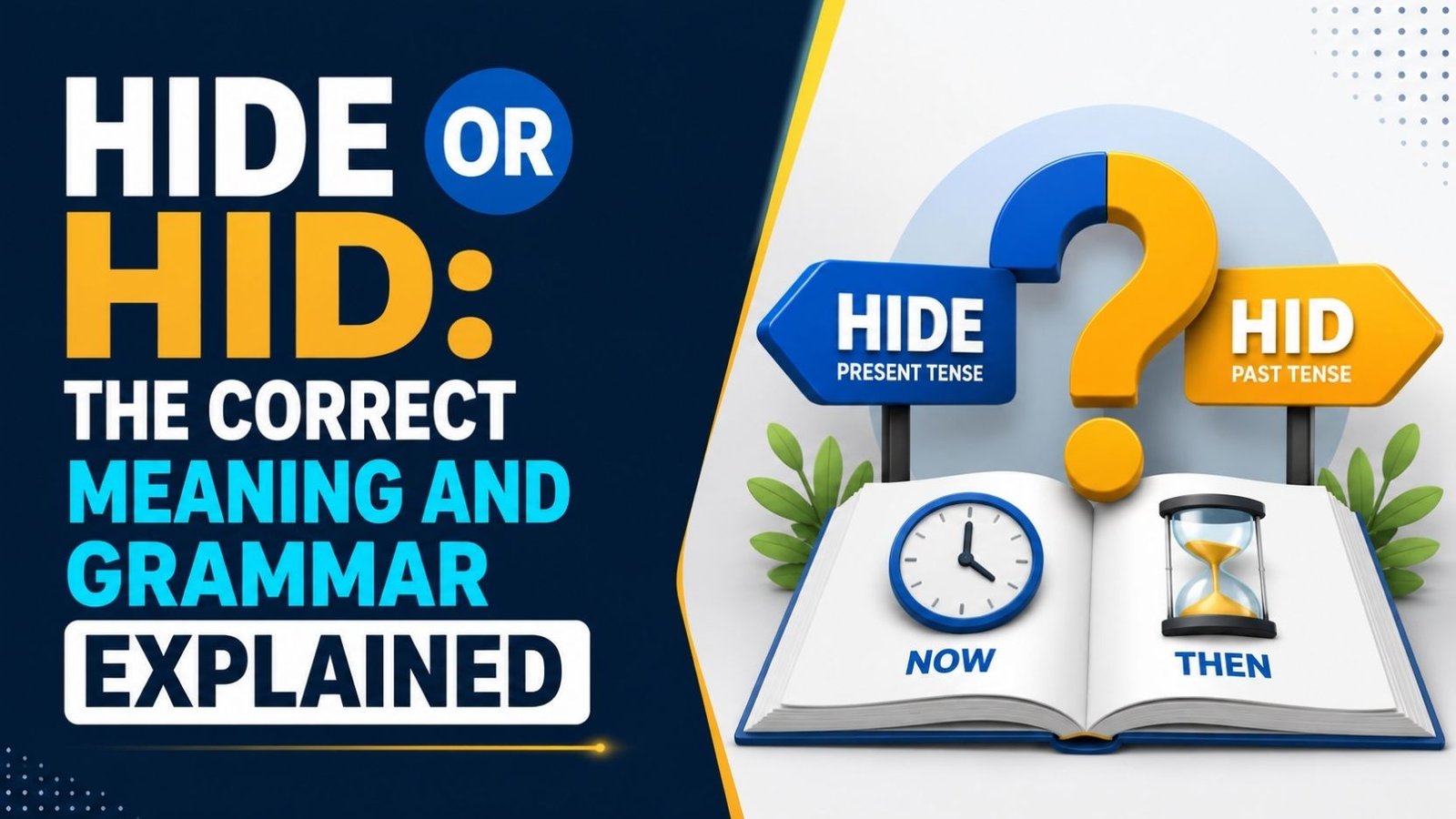
“Hide” and “hid” are not two different words with two different meanings. They are two forms of the same verb. “Hide” is the base form, and “hid” is its simple past tense. You use “hide” when talking about the present or the future, and you use “hid” when talking about something that already happened.
This mix-up is common because English past tense verbs do not always follow a simple pattern. “Hide” belongs to a group of irregular verbs, so its past form does not end in “-ed” like regular verbs do. Once you understand the pattern, the choice between hide and hid becomes automatic, even in tricky sentences like “I have hide or hid” or “he hid for thirty years.”
Hide or Hid: The Quick Answer
Before going deeper, here is the short version.
| Word | Type | When to Use |
| Hide | Base form (present tense, infinitive) | Right now, general truths, or after “will,” “can,” “to” |
| Hid | Simple past tense | Something that already happened and finished |
| Hidden | Past participle | Used with “has,” “have,” or “had,” or as an adjective |
If the action is happening now or has not happened yet, use “hide.” If the action is already finished, use “hid.” If you are using a helping verb like “has,” “have,” or “had,” you almost always need “hidden,” not “hid.”
See More: Naive Or Nieve
What Does Hide Mean?
“Hide” is a verb. It means to put something, or yourself, in a place where it cannot easily be seen or found.
Simple definition: to keep something out of sight, on purpose.
Common everyday uses of hide include:
- Hiding a physical object, such as keys or a gift
- Hiding a feeling, such as fear or excitement
- Hiding information from someone
- Hiding yourself during a game, like hide and seek
“Hide” can also be a noun. As a noun, it refers to the skin of a large animal, such as a cow hide. This meaning is common in phrases like “cow hide rug” or “rawlings heart of the hide,” where the word describes leather rather than an action.
What Does Hid Mean?
“Hid” is the simple past tense of the verb “hide.” It describes an action that started and finished in the past.
Simple definition: the past form of hide, used for completed actions.
For example:
- She hid the letter in a drawer.
- He hid behind the tree until his friends left.
- They hid their disappointment well.
“Hid” is only correct for the simple past tense. It is not used after “has,” “have,” or “had.” That job belongs to “hidden,” which many people confuse with “hid.”
Hide, Hid, Hidden: All Three Forms Explained
English irregular verbs often have three separate forms. “Hide” is one of them.
| Form | Grammar Name | Example Sentence |
| Hide | Base form / present tense | I hide my notes in this folder. |
| Hid | Simple past tense | I hid my notes in this folder yesterday. |
| Hidden | Past participle | I have hidden my notes in this folder. |
Notice the pattern. “Hid” stands alone as the main verb in a simple past sentence. “Hidden” always needs a helping verb such as “has,” “have,” or “had,” or it works as an adjective, as in “a hidden message.”
Hide or Hid: The Grammar Rule
The rule is simple once it is broken down.
- Use “hide” for the present tense, or after words like “will,” “can,” “should,” or “to.” Example: I will hide the box.
- Use “hid” for the simple past tense, with no helping verb. Example: I hid the box.
- Use “hidden” after “has,” “have,” or “had.” Example: I have hidden the box.
This same pattern applies to related phrases from search, including “i would have hide or hid,” “could have hide or hid,” “we have hide or hid,” and “should have hide or hid.” In every one of these, “hidden” is the correct word, not “hid.”
- Incorrect: I would have hide the money.
- Incorrect: I would have hid the money.
- Correct: I would have hidden the money.
- Incorrect: We have hide the evidence.
- Correct: We have hidden the evidence.
Hide Or Hid In Different Tenses
| Tense | Sentence Example |
| Present simple | She hides her phone when she studies. |
| Past simple | She hid her phone yesterday. |
| Present perfect | She has hidden her phone. |
| Past perfect | She had hidden her phone before he arrived. |
| Future simple | She will hide her phone later. |
I Have Hide or Hid: Which Is Correct?
Neither “I have hide” nor “I have hid” is fully correct in careful, standard English. The correct present perfect form is “I have hidden.”
- Incorrect: I have hide the truth.
- Incorrect: I have hid the truth.
- Correct: I have hidden the truth.
That said, “I have hid” does appear in casual speech and in some regional or older English. It is not considered standard in formal writing, so “I have hidden” is the safer choice for essays, emails, and professional communication.
He Hid for Thirty Years: Why This Sentence Is Correct
“He hid for thirty years” is grammatically correct. This sentence uses the simple past tense because it describes a completed period of hiding, without a helping verb like “has” or “had.” This phrasing often shows up in stories about people who avoided capture or exposure for a long stretch of time.
If you added a helping verb, the sentence would need to change: “He has hidden for thirty years” or “He had hidden for thirty years,” depending on the timeline you are describing.
See More: Might As Well Or Mine As Well
Common Mistakes with Hide and Hid
💡 Tip: If you are unsure, try removing any helping verb. If the sentence still sounds complete, “hid” is likely correct. If it sounds incomplete without “has,” “have,” or “had,” you need “hidden.”
❌ Incorrect: I have hide it somewhere safe.
✅ Correct: I have hidden it somewhere safe.
❌ Incorrect: Where did you hidden my shoes?
✅ Correct: Where did you hide my shoes? (Questions with “did” use the base form, not the past form.)
❌ Incorrect: She has hid the answer key.
✅ Correct: She has hidden the answer key.
⚠️ Common mistake: Many learners use “hid” after “has” or “have” because it feels like the natural past form. Remember that “hidden,” not “hid,” pairs with these helping verbs.
How To Pronounce Hide And Hid
- Hide is pronounced like “hyde,” rhyming with “side” or “ride.” In IPA, it is written as /haɪd/.
- Hid is pronounced with a short “i” sound, rhyming with “lid” or “kid.” In IPA, it is written as /hɪd/.
The difference comes down to vowel length. “Hide” has a long vowel sound, while “hid” has a short, quick vowel sound. This distinction matters because mispronouncing one as the other can genuinely confuse a listener about which tense you mean.
Origin Of The Word Hide
The verb “hide” comes from Old English “hydan,” which already carried the meaning of concealing something from view. This root connects to older Germanic language roots with a similar meaning of covering or protecting something by keeping it out of sight.
The noun form of “hide,” meaning animal skin, comes from a separate but related Old English word, “hyd,” which also referred to the skin or pelt of an animal. Over centuries, English speakers kept both meanings, which is why “hide” today can describe either an action or a material.
Hide And Seek: A Related Phrase
“Hide and seek” is a well known children’s game. One player closes their eyes and counts while the other players hide. Then that player tries to find, or seek, everyone who is hidden.
Some people write it as “hide and go seek,” which is a common regional variation, especially in parts of the United States. Both versions describe the same basic game, and neither is strictly more correct, though “hide and seek” is the more widely recognized standard term.
Run Hide Fight: A Different Kind Of Phrase
“Run hide fight” is a safety phrase, not a grammar question. It refers to a recommended response strategy for an active violent situation, often taught by security professionals and law enforcement agencies.
The phrase lists three options in a suggested order: try to run from danger first, hide if running is not possible, and fight only as a last resort. This phrase is unrelated to the hide versus hid grammar question, but it commonly appears in the same searches because it uses the word “hide” as well.
HID: A Different Meaning Entirely
Not every search for “hid” is about grammar. In many technology and automotive contexts, “HID” is an abbreviation, not the past tense of “hide.” It is written in capital letters and stands for different things depending on the field.
| Abbreviation | Full Meaning | Common Context |
| HID | High Intensity Discharge | Car headlights and bulbs, such as HID bulbs or HID lights |
| HID | Human Interface Device | Computer accessories, such as a HID keyboard device or HID compliant mouse |
| HID Global | A company name | Card readers and identity security products |
If you searched for “hid bulb,” “hid headlights,” “hid vs led,” “hid keyboard device,” or “hid card reader,” these all refer to this technical abbreviation, not the grammar term. Context makes the difference clear. A sentence describing an action, like “he hid the car keys,” uses the verb. A sentence describing equipment, like “the car has HID headlights,” uses the abbreviation.
Synonyms And Related Words
| Word | Meaning | Typical Usage |
| Concealed | Kept out of sight, often deliberately | Formal writing, legal contexts |
| Hidden | Past participle of hide, or something not visible | General usage, adjectives |
| Buried | Covered or placed underground or deeply out of sight | Physical objects, secrets |
| Disguised | Made to look different to avoid recognition | People, appearances |
| Tucked away | Placed somewhere out of the way | Casual, everyday speech |
These words share the general idea of concealment, but each carries a slightly different shade of meaning. “Concealed” often sounds more formal, while “tucked away” feels casual and gentle.
See More: Beginning Or Begining
Frequently Asked Questions
What does hide or hid mean?
“Hide” is the present tense of the verb, meaning to keep something out of sight. “Hid” is its simple past tense, describing a completed action of hiding.
Is hid the correct past tense of hide?
Yes. “Hid” is the correct simple past tense of “hide.” The past participle, used with “has,” “have,” or “had,” is “hidden.”
Is hide or hid a noun or a verb?
“Hide” can be both a noun and a verb. As a verb, it means to conceal something. As a noun, it refers to an animal’s skin, as in “cowhide.”
How do you pronounce hid?
“Hid” is pronounced /hɪd/, with a short vowel sound, rhyming with “kid” or “lid.”
What is the difference between hid and hidden?
“Hid” stands alone as the simple past tense verb. “Hidden” is the past participle and must be used with a helping verb like “has,” “have,” or “had,” or as an adjective.
Is I have hid correct English?
No, not in standard formal English. The correct present perfect form is “I have hidden.” “I have hid” appears in casual or regional speech but is not considered standard.
Is hide and seek or hide and go seek correct?
Both are used. “Hide and seek” is the more standard and widely recognized version, while “hide and go seek” is a common regional variation.
Does HID always mean the past tense of hide?
No. When written in capital letters, HID is often an abbreviation for High-Intensity Discharge, as in car headlights, or Human Interface Device, as in keyboards and mice.
What is the past tense of hide in a sentence?
An example sentence is: “He hid the gift before the party started.” This uses “hid” because the action is complete and there is no helping verb.
Why is he hid for thirty years grammatically correct?
It is correct because it uses the simple past tense without a helping verb. It describes a finished period of action, which is exactly what “hid” is meant to express.
Conclusion
The choice between hide and hid comes down to timing. “Hide” describes something happening now or in the future, while “hid” describes something that already happened, with no helping verb attached. When a helping verb like “has,” “have,” or “had” appears in the sentence, the correct word becomes “hidden,” not “hid.” Getting this right makes your writing and speech sound more natural and accurate.
Once you remember this simple three part pattern of hide, hid, and hidden, the confusion mostly disappears. You can apply the same logic to sentences like “he hid for thirty years,” “I have hidden the letter,” or “we should have hidden the evidence.” With a little practice, choosing the correct form becomes second nature, and you will use hide or hid correctly every time.

Danish Raza is the author of Grammavio, a trusted resource for simple and easy-to-understand English grammar guides. He creates helpful content covering grammar rules, word meanings, vocabulary, and common grammar mistakes to help readers improve their English skills.

One Comment