
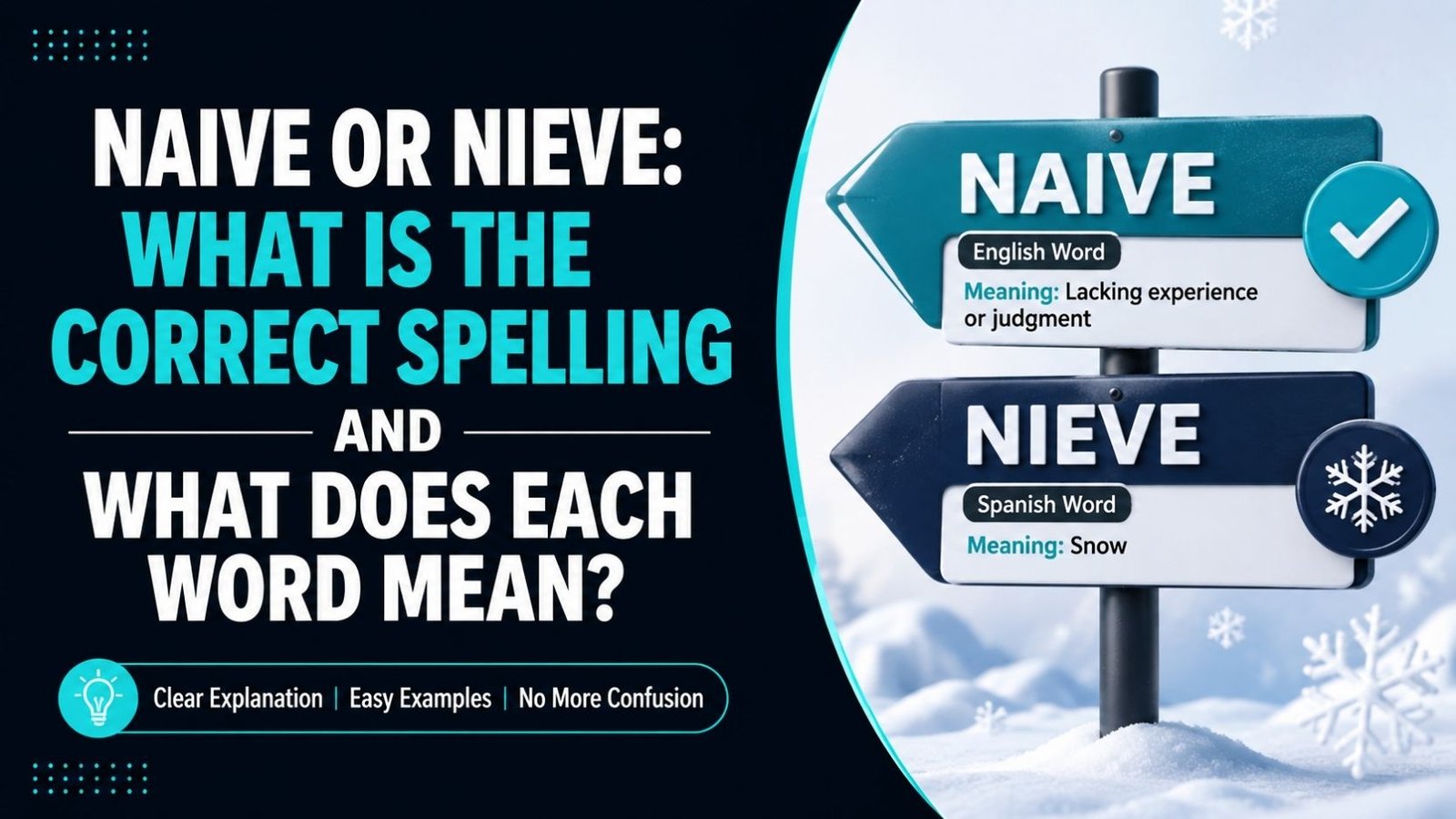
If you have typed “naive or nieve” into a search bar, you already suspect something is off with one of these spellings. The good news is that the confusion is easy to clear up. “Naive” is the correct English word for someone who lacks experience or judgment, while “nieve” is a completely different word that belongs to Spanish, not English.
These two words look alike because they share several letters in a different order. That small visual overlap is enough to trip up even confident writers. Once you understand where each word comes from and what it actually means, you will never mix them up again.
Naive Or Nieve: The Quick Answer
In English, the correct spelling is always naive (or naïve with the accent mark). It is an adjective that describes a person who is too trusting, inexperienced, or simple in their judgment.
Nieve is not an English word at all. It is Spanish for “snow.” You will see it in Spanish phrases like tormenta de nieve (snowstorm) or muñeco de nieve (snowman), but it has no connection to the English idea of being naive.
So if you are writing an English sentence, “naive” is the word you want. If you are reading or writing in Spanish, “nieve” is correct, but it means something entirely different.
What Does Naive Mean?
Naive describes someone who shows a lack of experience, wisdom, or good judgment. A naive person often believes things too easily, trusts people without enough reason, or does not fully understand how complicated a situation really is.
The word carries a gentle, sometimes sympathetic tone. It is not usually an insult in the harsh sense. Instead, it points to innocence or a simple way of seeing the world.
Part of speech: Adjective
Simple definition: Showing a lack of experience, understanding, or judgment; too trusting or simple in outlook.
For example, someone who believes every stranger online is telling the truth might be described as naive. The word suggests they mean well but have not learned to be cautious yet.
Naive In Different Contexts
The core meaning of naive stays consistent, but the tone can shift depending on how it is used.
In everyday conversation: Naive usually describes someone who is easily fooled or overly trusting. “He was naive to think the deal was that simple.”
In business or negotiation: Naive can describe an approach that ignores real risks. “Their pricing strategy was naive because it did not account for competitors.”
In art: Naive art refers to a style created by artists without formal academic training. The paintings often look simple, colorful, and direct, valued precisely because they avoid polished technique.
In psychology and philosophy: Naive realism is the idea that people see the world exactly as it is, without any distortion from perception or interpretation. Philosophers use the term to discuss how humans process reality.
In technology: Naive Bayes is a classification algorithm used in machine learning. It is called “naive” because it assumes that every feature in the data is independent of every other feature, which is rarely true in real life. Despite this simplified assumption, the naive Bayes classifier works well for many practical tasks like spam filtering and text classification.
Naive: Grammar And Word Forms
Naive is an adjective, so it describes a noun or pronoun. It does not change form based on number or gender in English.
| Form | Word | Example |
| Adjective | naive | She seemed naive about the risks. |
| Adverb | naively | He naively agreed to the plan. |
| Noun | naivety or naïveté | Her naivety surprised her coworkers. |
Both “naivety” and “naïveté” are accepted noun forms. “Naïveté” keeps the French spelling and pronunciation more closely, while “naivety” is a more anglicized version. Either one is correct in modern English.
Naive can also appear with or without the diaeresis mark over the “i” (naïve versus naive). Both spellings are accepted in English. American publications tend to drop the accent mark, while British and international style guides sometimes keep it.
How To Pronounce Naive
Naive is pronounced nye EEV, with the stress on the second syllable.
- IPA: /naɪˈiːv/
- Breakdown: nye (rhymes with “eye”) + EEV (rhymes with “leave”)
The two vowels are pronounced separately rather than blended, which is a clue to its French origin. Native English speakers sometimes shorten or soften the sound in casual speech, but the two syllable pronunciation with stress on “eev” is standard in both American and British English.
Origin Of Naive
Naive comes from the French word naïf (masculine) and naïve (feminine), meaning natural, innocent, or artless. French borrowed the word from Latin nativus, meaning “native” or “natural,” which is also the ancestor of the English word “native.”
English adopted the feminine French form, “naïve,” directly, which is why the word looks slightly different from typical English adjectives. Over time, English speakers began using “naive” for both men and women, dropping the French gender distinction entirely.
This Latin root explains the deeper meaning behind the word. Something “native” or “natural” has not been shaped, trained, or changed by outside experience. A naive person, in that same sense, has not yet been shaped by the hard lessons that experience usually teaches.
What Does Nieve Mean In Spanish?
Nieve is the Spanish word for snow. It is a common noun used across Spanish-speaking countries to describe frozen precipitation, as well as related weather and seasonal ideas.
Nieve also appears in food and drink contexts in some regions. In parts of Mexico and Latin America, “nieve” refers to a type of flavored ice or sorbet, similar to shaved ice or a simple frozen dessert. “Nieve de garrafa” specifically refers to a traditional style of hand churned Mexican ice cream, often made in small batches and sold from carts or local shops.
Here are some common Spanish phrases that use the word:
- Tormenta de nieve — snowstorm
- Copo de nieve — snowflake
- Muñeco de nieve — snowman
- Pronóstico de nieve — snow forecast
- Sal para nieve — rock salt used for melting snow
- Botas para nieve — snow boots
- Pala para nieve — snow shovel
None of these phrases relate to the English adjective naive. They are simply everyday Spanish expressions about winter weather, snow removal, and cold weather clothing.
Nieve is also used as a given name in Spanish speaking cultures, most often as a short form of Nieves, which is connected to the religious title “Nuestra Señora de las Nieves” (Our Lady of the Snows), a traditional title for the Virgin Mary in Catholic tradition.
Why People Confuse Naive and Nieve
The confusion between these two words almost always comes down to spelling, not meaning. Here is why the mix-up happens so often.
Similar letters, different order: Both words use the letters n, i, e, and v. The only real difference is how those letters are arranged and the vowel that follows.
English spelling irregularities: English is full of unusual vowel combinations. Words like “believe,” “receive,” and “naive” all play with the order of “i” and “e,” which makes it easy to second guess yourself.
Cross-language influence: Many English speakers have some exposure to Spanish through school, media, or daily life. Seeing “nieve” used correctly in a Spanish context can make it feel like a plausible English spelling, especially if you are typing quickly or relying on memory rather than checking.
Autocorrect and typing habits: Fast typing on a phone keyboard can easily swap two adjacent letters, turning “naive” into something that visually resembles “nieve” without the writer even noticing.
Understanding that these are two unrelated words from two different languages is the easiest way to stop the confusion permanently.
Naive or Nieve: Comparison Table
| Word | Language | Meaning | Example |
| Naive | English | Lacking experience or good judgment; overly trusting | She was naive to trust him so quickly. |
| Nieve | Spanish | Snow, or in some regions, a frozen dessert | Está cayendo mucha nieve hoy. |
This side by side view makes the difference clear. One word describes a personality trait in English. The other describes weather, or sometimes dessert, in Spanish.
Synonyms Of Naive
Several English words share meaning with naive, though each carries a slightly different shade of tone.
| Word | Meaning | Difference from Naive |
| Innocent | Free from guilt or corrupting knowledge | Focuses more on moral purity than poor judgment |
| Gullible | Easily deceived or tricked | Stronger emphasis on being fooled specifically |
| Credulous | Too ready to believe things without proof | More formal, focused on belief rather than character |
| Unsophisticated | Lacking refinement or worldly experience | Broader term, not limited to trust or judgment |
| Inexperienced | Lacking practice or exposure to a situation | Neutral, without the emotional tone of naive |
Antonyms Of Naive
Common opposites of naive include:
- Sophisticated
- Worldly
- Cynical
- Shrewd
- Experienced
- Skeptical
These words describe someone who has learned to be cautious, question motives, or read situations more carefully, the opposite of the trusting simplicity that “naive” suggests.
Common Mistakes with Naive
Incorrect: She was nieve about how the business world worked.
Correct: She was naive about how the business world worked.
Incorrect: His nieve optimism cost him the deal.
Correct: His naive optimism cost him the deal.
The correct form is always “naive” (or “naïve”) when describing a person’s lack of experience or judgment in English. “Nieve” should only appear in Spanish sentences about snow or, in some regional dialects, frozen desserts.
Another common mistake is confusing “naive” with “native.” These two words share the same Latin root, nativus, but they now mean very different things. “Native” refers to where someone or something originally comes from, while “naive” describes a lack of experience or sophistication.
Examples of Naive in a Sentence
- The new employee asked a naive question about company policy, not realizing how sensitive the topic was.
- It would be naive to assume the contract has no hidden risks.
- Critics called the painting naive because of its simple shapes and bold colors, a style closely tied to naive art.
- Her naively cheerful attitude made the team feel more relaxed during a stressful project.
These examples show how naive can describe people, questions, decisions, or even artistic style, always pointing back to a lack of experience or overly simple judgment.
Naive Bayes And Other Related Terms
Because “naive” appears in specialized fields, a few related terms are worth knowing.
Naive Bayes classifier: A popular machine learning method that predicts categories, such as spam or not spam, based on probability. It is called “naive” because it assumes each piece of data is unrelated to the others, a simplification that rarely matches real life but still produces useful results.
Naive nature in Pokémon: In the Pokémon games, “Naive” is one of the possible natures a Pokémon can have. It slightly increases Speed while slightly lowering Special Defense. This is a specific gaming term and has no connection to the everyday meaning of naive.
These specialized uses borrow the everyday meaning of naive, simplicity and a lack of complex adjustment, and apply it to a technical or gaming context.
Frequently Asked Questions
Is it spelled naive or nieve in English?
The correct English spelling is naive (or naïve). Nieve is a Spanish word meaning snow and is not used in English sentences.
What does naive mean in simple terms?
Naive means showing a lack of experience or good judgment, often because someone is too trusting or has not yet learned life’s harder lessons.
Is naive a noun or an adjective?
Naive is an adjective. The related noun forms are naivety and naïveté.
How do you pronounce naive?
Naive is pronounced nye EEV, with the stress on the second syllable.
What is the difference between naive and nieve?
Naive is an English adjective describing inexperience or poor judgment. Nieve is a Spanish noun meaning snow, and in some regions, a frozen dessert.
Is naïve with the accent mark correct?
Yes. Both “naive” and “naïve” are accepted spellings in English. The version with the accent mark reflects the word’s French origin.
What is the opposite of naive?
Common opposites include sophisticated, worldly, cynical, and experienced.
Does nieve ever mean anything other than snow?
In some Spanish speaking regions, particularly parts of Mexico, nieve can also refer to a flavored ice or sorbet style dessert, separate from its main meaning of snow.
Why do naive and nieve look so similar?
Both words use the same four letters, n, i, e, and v, just arranged differently. This visual overlap, combined with exposure to Spanish vocabulary, is the main reason people confuse the two.
Can naive describe something other than a person?
Yes. Naive can describe questions, decisions, art styles, strategies, or assumptions, anything that shows a simple or inexperienced approach.
Final Thoughts
The words naive and nieve are easy to confuse on the page, but they come from completely different languages and describe completely different things. Naive is the correct English adjective for describing someone who lacks experience or good judgment, often gently and understandably. Nieve, on the other hand, is simply the Spanish word for snow, used in everyday weather talk and, in some regions, to describe a frozen dessert.
Once you remember that one word lives in English and the other lives in Spanish, the spelling confusion disappears for good. The next time you are unsure whether to write naive or nieve, ask yourself whether you are describing a person’s judgment or the weather outside. That single question will always point you to the right word.

Danish Raza is the author of Grammavio, a trusted resource for simple and easy-to-understand English grammar guides. He creates helpful content covering grammar rules, word meanings, vocabulary, and common grammar mistakes to help readers improve their English skills.
One Comment