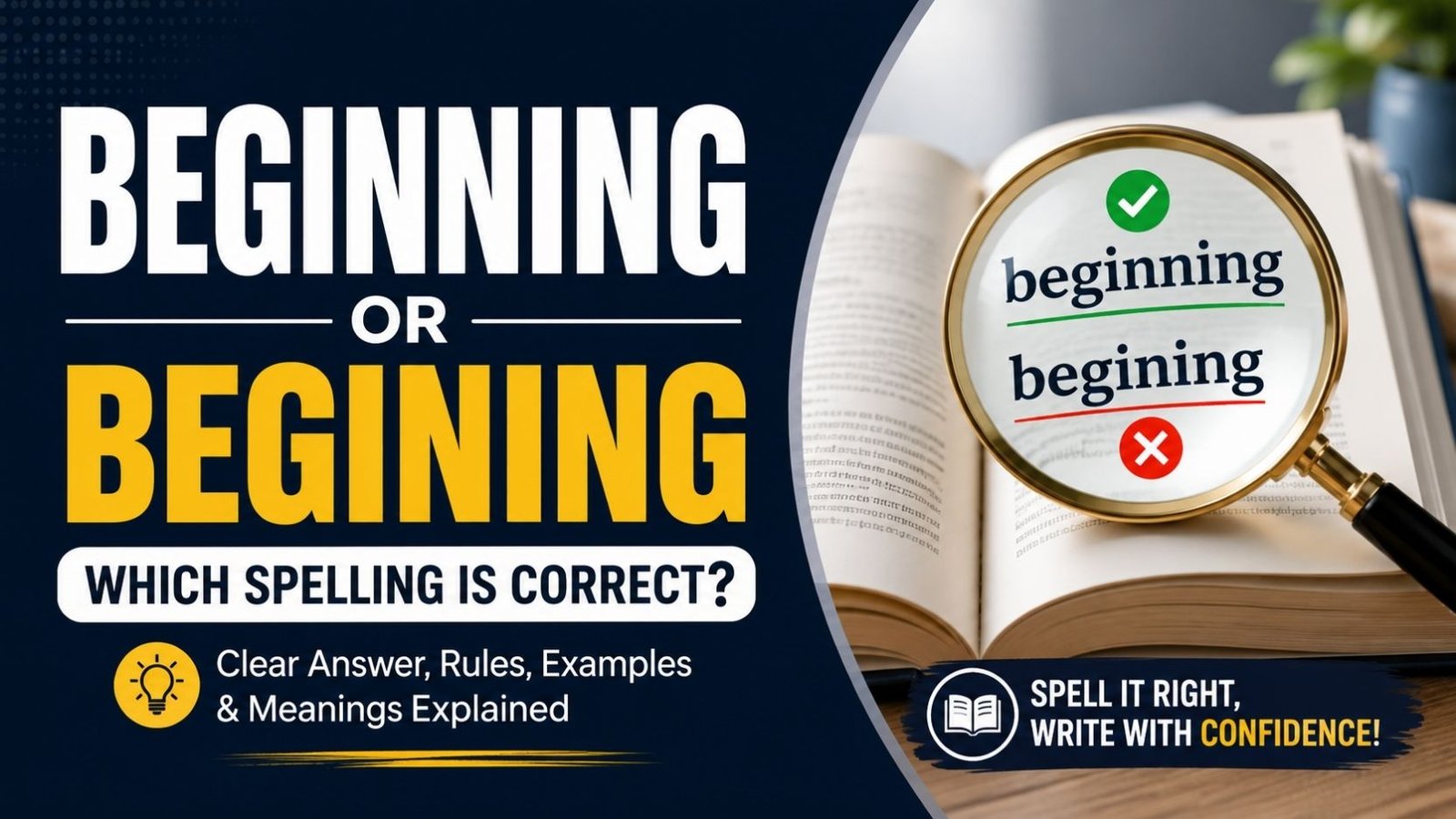
The correct spelling is beginning, not begining. Beginning uses two n letters, one before ing and one right after the first syllable. Begining, with only one n, is a common misspelling that many people type by mistake. If you remember that the base word begin already has one n, and English doubles the final consonant before adding ing, you will never confuse the two again.
This small spelling mix-up happens because the doubled n is easy to miss when typing quickly. It also happens because some similar words do not double their final letter before ing, which creates confusion. Understanding why beginning keeps two n letters will help you spell it correctly every time, whether you are writing an email, an essay, or a text message.
Beginning Or Begining: The Simple Answer
Beginning is the only correct spelling in standard English. You will find it in every major dictionary, including Merriam-Webster, Cambridge Dictionary, and Oxford English Dictionary. Begining does not appear as an accepted spelling anywhere. It is simply an error that comes from forgetting to double the n before adding ing.
Here is a quick reference table to make the difference clear.
| Spelling | Status | Reason |
| Beginning | Correct | Follows the doubling rule for one-syllable verbs ending in a single vowel plus consonant |
| Begining | Incorrect | Missing the required second n |
Why Beginning Has Two N Letters
The word beginning comes from the verb begin. To understand the spelling, it helps to look at a basic English spelling pattern.
When a short verb ends in a single vowel followed by a single consonant, and the stress falls on that final syllable, English usually doubles the final consonant before adding a suffix like ing or ed. Begin ends in the letter n, right after the vowel i, and the stress falls on that second syllable, so the n doubles.
Compare it with a word like listen. Listen ends in n too, but the stress falls on the first syllable, lis. Because of that, listen simply adds ing without doubling the n, giving you listening, not listenning.
This same doubling pattern explains other familiar words.
| Base Word | Stress Pattern | Correct Ing Form |
| Begin | Stress on second syllable | Beginning |
| Stop | One syllable, stressed | Stopping |
| Run | One syllable, stressed | Running |
| Open | Stress on first syllable | Opening, no doubling |
| Listen | Stress on first syllable | Listening, no doubling |
Once you notice this pattern, the spelling of beginning starts to feel automatic rather than something you need to memorize.
What Does Beginning Mean
Beginning has a few related meanings, and all of them connect to the idea of a starting point.
Meaning 1: The point where something starts. This is the most common meaning. It refers to the very first part of an event, a story, a process, or a period of time. For example, the beginning of the movie introduces the main character.
Meaning 2: The early stage of something. Beginning can also describe an early phase rather than a single exact moment. For example, we are still in the beginning stages of planning the project.
Meaning 3: A fresh start, often used symbolically. People often use beginning to talk about new opportunities or fresh starts in life. A new beginning suggests hope, change, or a fresh chapter.
These meanings overlap, but the context usually makes the intended sense clear.
Beginning As a Grammar Term: Part of Speech
Beginning can function as more than one part of speech, depending on how it is used in a sentence.
As a noun: Beginning most often works as a noun, referring to the start of something. Example: The beginning of the book felt slow.
As a gerund: Because beginning ends in ing and can act like a noun formed from a verb, it also works as a gerund. Example: Beginning a new job can feel stressful.
As a present participle: beginning can describe an ongoing action when paired with a form of the verb to be. Example: She is beginning her research this week.
Here is a simple comparison of these three grammatical roles.
| Usage | Function | Example Sentence |
| Beginning as a noun | Names a starting point | The beginning was confusing. |
| Beginning as a gerund | Acts like a noun from a verb | Beginning again takes courage. |
| Beginning as a participle | Shows continuous action | He is beginning to understand. |
How To Pronounce Beginning
Beginning is pronounced with three syllables: bih GIN ing. The stress falls on the middle syllable, GIN, which is also why the n doubles in spelling.
In IPA, it is written as /bɪˈɡɪnɪŋ/.
American and British pronunciations are nearly identical for this word, with only minor differences in vowel tone that do not affect spelling or meaning.
Origin Of The Word Beginning
Beginning comes from the Old English word beginnan, which meant to attempt or to undertake something. This word is related to older Germanic roots shared with words in Dutch and German that carry similar meanings of starting or attempting an action.
Over time, English speakers shaped beginnan into the modern verb begin, and the noun form beginning developed naturally from it by adding the ing ending, following the same doubling rule used across English.
The word has kept a stable meaning for centuries: the point where something starts.
Beginning In Different Contexts
The word beginning appears in many everyday and cultural contexts. Here are some of the most common ones.
In storytelling: Every story has a beginning, a middle, and an end. Writers often focus heavily on the beginning because it sets the tone for the rest of the narrative.
In religious and literary texts: The phrase in the beginning is widely known from the opening line of the Book of Genesis, which reads, in the beginning God created the heavens and the earth. This phrase is often referenced in literature, music, and everyday speech, even outside religious conversations.
In business And planning: professionals often talk about the early stages of a project as the beginning stages. This usage is common in meetings, project plans, and reports.
In personal growth: people often describe major life changes as a new beginning, such as starting a new career, moving to a new city, or recovering from a difficult period.
In pop culture: search interest around beginning also connects to titles and lyrics, such as the popular web novel and anime known as The Beginning After the End, and the song End of Beginning by Djo, performed by Joe Keery. These are proper titles, so they follow their own official capitalization and spelling, separate from the general grammar rules covered in this article.
Examples Of Beginning Used Correctly
Below are a few natural examples that show beginning used in different ways.
- The beginning of the meeting focused on budget updates.
- She is beginning to feel more confident about her English writing.
- A new beginning felt necessary after such a difficult year.
- The beginning of spring brings warmer weather and longer days.
Each example shows a real, natural sentence rather than a forced or repetitive one.
Common Mistakes With Beginning Or Begining
Many people misspell beginning because they forget the doubling rule.
Here are the most frequent mistakes.
❌ Incorrect: The begining of the story was slow.
✅ Correct: The beginning of the story was slow.
❌ Incorrect: We are just begining this project.
✅ Correct: We are just beginning this project.
❌ Incorrect: This is a new begining for our family.
✅ Correct: This is a new beginning for our family.
💡 Tip: If you are unsure while typing quickly, pause before adding -ing and check that the base word begin already ends in a doubled n plus ing, giving you two n letters total in beginning.
Beginning Or Beginnings: Singular And Plural Use
Beginning can also be used in its plural form, beginnings, when referring to more than one starting point or origin.
Example: The company had humble beginnings before becoming successful.
This plural form is common when talking about someone’s background or origins, rather than a single specific moment.
Synonyms And Related Words
Several words relate closely to beginning, though each carries a slightly different shade of meaning.
| Word | Meaning | Typical Usage |
| Start | A general starting point | Common in everyday speech |
| Onset | The start of something, often negative | Used for illness or bad situations, such as the onset of a stye or the onset of symptoms |
| Origin | Where something originally came from | Used for history or background |
| Outset | The very start of an event | Slightly more formal than start |
| Inception | The formal beginning of an organization or idea | Common in business or legal writing |
Beginning vs Starting: What Is the Difference
Beginning and starting are close synonyms, but they are used slightly differently.
Beginning often works well as a noun, such as the beginning of the year.
Starting is more commonly used as a verb form, such as we are starting the project today.
Both words are grammatically correct in most contexts, and the choice often comes down to natural phrasing rather than a strict rule.
Start vs Initiate: A Quick Comparison
Initiate is a more formal word than start, and it often applies to official or structured actions, such as initiating a legal process or initiating a new policy. Start is more casual and works in almost any everyday context. Beginning fits between the two, often used for narrative, emotional, or general time-related meanings rather than formal procedures.
Frequently Asked Questions
Is it beginning or begining?
Beginning is correct. Begining is a common misspelling and is not accepted in standard English.
Why does beginning have two n letters?
Because the base word begin ends in a single vowel plus consonant, and the stress falls on that final syllable, so English doubles the n before adding ing.
Is beginning a noun or a verb?
Beginning can be a noun, referring to a starting point, or it can function as a gerund or present participle formed from the verb begin.
How do you pronounce beginning?
It is pronounced bih GIN ing, with the stress on the middle syllable.
What is the plural form of beginning?
The plural form is beginnings, often used when referring to someone’s origins or background.
What is the difference between beginning and starting?
Beginning often works as a noun for a starting point, while starting is more commonly used as an active verb form. Both are correct in everyday English.
Where does the word beginning come from?
It comes from the Old English word beginnan, meaning to attempt or undertake, which developed into the modern verb begin and its noun form beginning.
Is begining ever an acceptable spelling variant?
No. Begining is not recognized in any major dictionary and is always considered a spelling mistake.
Final Thoughts
The correct spelling is always beginning, never begining. This word follows a simple and reliable English spelling rule: when a short verb ends in a single vowel plus consonant and carries the stress on that final syllable, the consonant doubles before adding -ing. Once you connect beginning to this pattern, the double n becomes easy to remember instead of something you have to guess.
Whether you are writing about the beginning of a story, the beginning stages of a new project, or a new beginning in your personal life, using the correct spelling helps your writing look polished and professional. Keep this simple rule in mind, and beginning will never trip you up again.

Danish Raza is the author of Grammavio, a trusted resource for simple and easy-to-understand English grammar guides. He creates helpful content covering grammar rules, word meanings, vocabulary, and common grammar mistakes to help readers improve their English skills.