
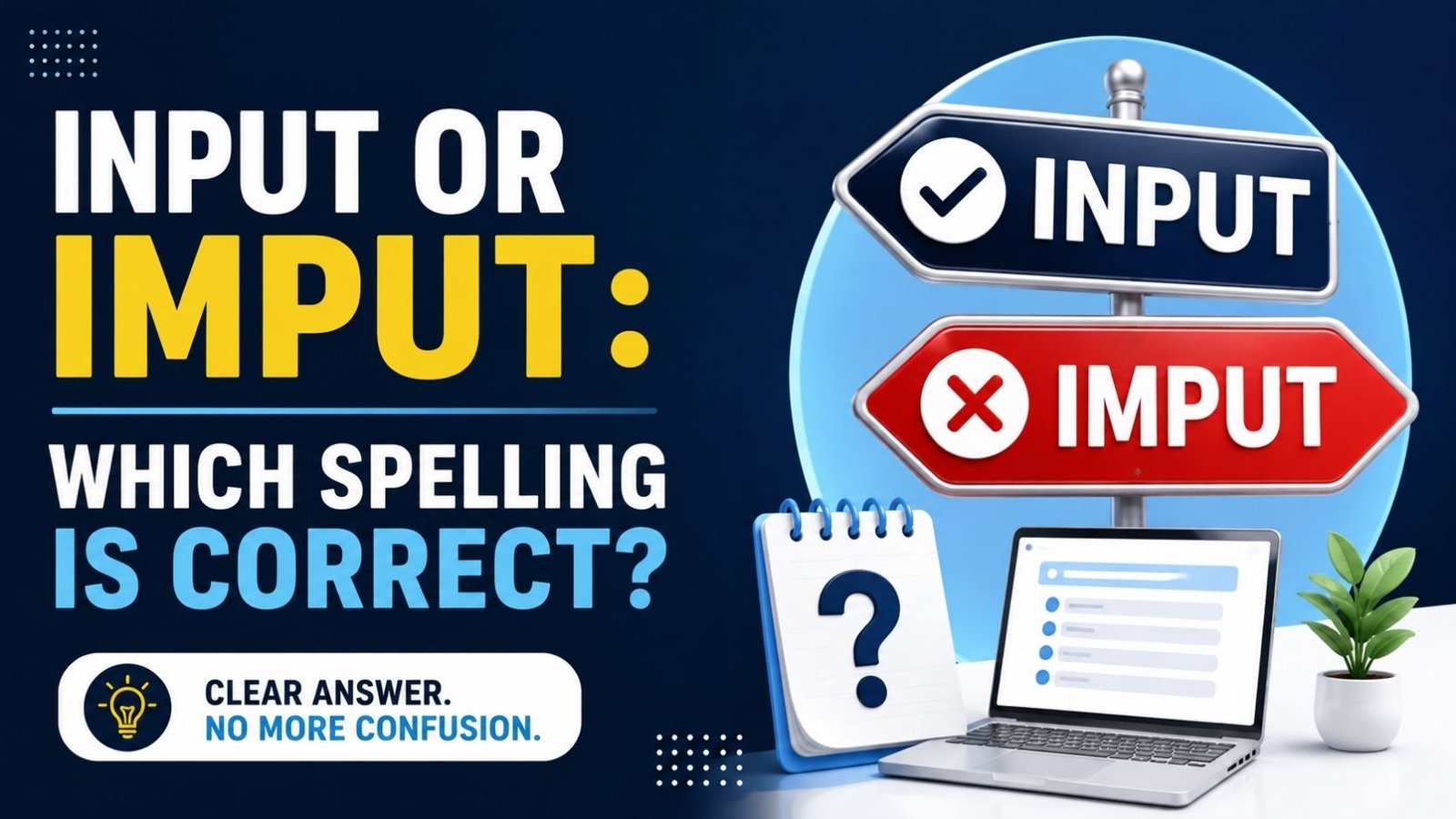
Input is the correct spelling. Imput is not a real English word, even though it sounds similar and shows up often in casual writing. If you have ever paused while typing an email or a form and wondered which one looks right, you are not alone. Many people mix up these two because they sound almost identical when spoken quickly.
Understanding this difference matters more than it seems. Input is a common word used in technology, business, education, and everyday conversation, so getting it right affects how professional your writing looks. Once you understand why imput is not a recognized word, you will never second-guess the spelling again.
What Does Input Mean?
Input has a few related meanings, and all of them connect to the idea of something being put into a system, process, or conversation.
As a noun, input refers to:
- Information, data, or material that is put into something, such as a computer or a machine
- Advice, opinions, or contributions that someone offers, such as feedback on a project
- Energy or effort added to a process
As a verb, to input something means to enter or feed information into a system, such as typing data into a spreadsheet or a computer program.
Here is a simple way to remember it: input is something you put in.
Is Imput A Word?
No, imput is not a word in standard English. It does not appear in major dictionaries such as Merriam-Webster, Oxford, or Cambridge. It is best described as a common misspelling of input, likely caused by the way the two words sound alike in fast speech.
Some people also confuse imput with the word impute, which is a completely different word with a different meaning. This mix-up is part of why imput continues to show up in casual writing, even though it has no accepted place in the English language.
Input vs Imput: Quick Comparison
| Word | Correct Spelling | Meaning | Part of Speech |
| Input | Yes | Data, information, or contribution put into something | Noun and verb |
| Imput | No | Not a recognized word; a misspelling of input | Not applicable |
If you remember only one thing from this article, remember this: input is correct, and imput should be avoided in all writing.
See More: Here Is Or Here Are
Why Do People Confuse Input And Imput?
There are a few clear reasons this mix up happens so often.
Sound similarity: When spoken at a normal pace, “input” and “imput” can sound nearly the same, especially in accents where the “n” and “m” sounds blend together before a “p” sound.
Confusion with impute: The real word impute means to attribute something to someone, often a fault or a quality. Because impute exists and sounds close to imput, some writers assume imput must be a legitimate variation of input.
Keyboard and typing errors: Because “n” and “m” sit next to each other on a standard keyboard, typing input as imput is an easy accidental slip that can become a habit if it goes uncorrected.
Regional or informal speech patterns: In relaxed or fast speech, some speakers naturally soften the “n” sound in input, which can make it sound closer to imput, even though the correct written form never changes.
Input: Grammar Breakdown
Input can function as both a noun and a verb, and its grammar behaves a little differently depending on which role it plays.
Input As A Noun
As a noun, input is usually uncountable when referring to general information or contribution.
- Correct: We need more input before making a decision.
- Incorrect: We need more inputs before making a decision (unless referring to multiple distinct data points, in which case “inputs” is acceptable in technical contexts).
In technical or scientific writing, input can be countable when referring to specific values or signals, such as “the system has three inputs.”
Input As A Verb
As a verb, input follows this pattern:
| Form | Example |
| Base form | I input the data every morning. |
| Past tense | I input the data yesterday. |
| Past participle | I have input the data already. |
| Present participle | I am inputting the data now. |
Notice that input does not change form in the past tense. It stays the same in both present and past tense, similar to words like “put” or “set.” This is one detail that trips up many writers, since the natural instinct is to add “ed” to form the past tense.
💡 Tip: If you are unsure whether to write “inputted” or “input” for the past tense, standard usage favors input, though inputted does appear in some informal and technical writing. Major style guides generally recommend input as the more widely accepted past tense form.
How To Pronounce Input
Input is pronounced as IN put, with the stress on the first syllable.
- American English: IN put
- British English: IN put
The pronunciation does not change significantly between American and British English, which is part of why the spelling confusion with imput is so common. Both syllables are short and clipped, and the “n” sound should be clearly articulated rather than blended into the following “p” sound.
Origin Of The Word Input
Input comes from a straightforward combination of two English words: “in” and “put.” The word developed in English to describe the act of putting something into a system or process. Its use expanded significantly during the twentieth century alongside the growth of computing and engineering, where “input” became the standard term for data or signals entering a system.
Because input is built from two familiar English words, it is easy to see why the correct spelling makes logical sense. There is no “m” anywhere in either root word, which is a helpful mental check when spelling it.
Input In Different Contexts
The exact meaning of input shifts slightly depending on where it is used, though the core idea of “something put in” stays consistent.
Input In Technology
In computing, input refers to data, commands, or signals entered into a computer or device. Keyboards, mice, microphones, and touchscreens are all considered input devices because they allow users to send information into a system.
Example: The keyboard is the most common input device for a desktop computer.
Input In Programming
In programming languages such as Python, input often refers to a specific function that collects data typed by a user while a program is running.
Example: In Python, the input function pauses a program and waits for the user to type something before continuing.
Input In Business And Teamwork
In professional settings, input usually means feedback, ideas, or opinions that someone contributes to a discussion or decision.
Example: Thank you for your input during the meeting; it helped us finalize the plan.
See More: Emasculate Vs Demasculate
Input In Sensory And Scientific Contexts
In psychology and biology, input can describe signals received by the senses or nervous system.
Example: Proprioceptive input helps the body understand where its limbs are positioned without needing to look.
Examples Of Input Used Correctly
- The computer only responds when it receives the correct input.
- Please give me your input before I submit the final report.
- She input the numbers into the spreadsheet carefully.
- Sensory input from the eyes and ears helps the brain build a picture of the surrounding world.
- The device has two input ports for connecting external speakers.
Common Mistakes With Input And Imput
❌ Incorrect: I need your imput on this decision.
✅ Correct: I need your input on this decision.
❌ Incorrect: The sensor collects imput from the environment.
✅ Correct: The sensor collects input from the environment.
❌ Incorrect: Please imput your details in the form.
✅ Correct: Please input your details in the form.
The correct form always uses “input,” regardless of context, tense, or formality. There is no situation in standard English where imput is the accepted spelling.
Input And Impute: A Different Kind Of Confusion
Since impute is a real word, it deserves a brief explanation to avoid further mix-ups.
| Word | Meaning | Example |
| Input | Data or contribution put into something | The team welcomed her input on the design. |
| Impute | To attribute a quality, fault, or cause to someone or something | It would be unfair to impute bad intentions to someone based on one mistake. |
These two words are unrelated in meaning despite sharing some letters. Input is about contribution or data, while impute is about attributing blame or cause. Neither one is spelled or used as “imput.”
Synonyms And Related Words For Input
| Word | Meaning | Difference From Input |
| Contribution | Something given or added to a greater effort | Broader term, often used for ideas, money, or effort |
| Feedback | Information or opinions given in response to something | Usually given after something has already happened |
| Data | Facts or information, especially for analysis | More specific to technical or statistical contexts |
| Suggestion | An idea offered for consideration | Smaller in scope than general input |
Input remains the most versatile of these terms because it applies naturally to both technical systems and everyday conversations.
See More: Thats Vs That’s
Frequently Asked Questions
Is it input or imput?
It is always input. Imput is not a recognized English word.
What does input mean?
Input means something put into a system, process, or conversation, such as data entered into a computer or feedback given during a discussion.
Is imput a word?
No, imput does not appear in standard dictionaries and is considered a misspelling of input.
Is input a noun or a verb?
Input can be both. As a noun, it refers to data or contribution. As a verb, it means to enter or feed information into something.
How do you pronounce input?
Input is pronounced IN put, with the stress on the first syllable.
What is the past tense of input?
The past tense is typically input, unchanged from the base form, though inputted is used informally in some contexts.
What is the difference between input and impute?
Input refers to data or contribution added to something, while impute means to attribute a cause, fault, or quality to someone or something. They are unrelated words that happen to look similar.
Why do people write imput instead of input?
The mix-up usually happens because of similar pronunciation, confusion with the word impute, or simple typing errors caused by the placement of “n” and “m” on a keyboard.
Can input be used in casual conversation?
Yes, input is common in everyday speech, especially when asking for someone’s opinion or feedback, such as “I would love your input on this.”
Is inputs a correct plural form?
In general writing, input is usually uncountable, but in technical contexts referring to multiple distinct data points or signals, inputs is acceptable.
Final Thoughts
Input is the only correct spelling, whether you are talking about data entered into a computer, feedback shared during a meeting, or signals received by the senses. Imput has no standing in dictionaries or formal grammar because it developed purely as a spelling error rather than a genuine word with its own meaning.
The easiest way to avoid this mistake going forward is to remember that input comes directly from “in” and “put,” two simple words with no “m” in sight. Whenever you are unsure, picture something being put in, and the correct spelling will follow naturally.

Danish Raza is the author of Grammavio, a trusted resource for simple and easy-to-understand English grammar guides. He creates helpful content covering grammar rules, word meanings, vocabulary, and common grammar mistakes to help readers improve their English skills.


