
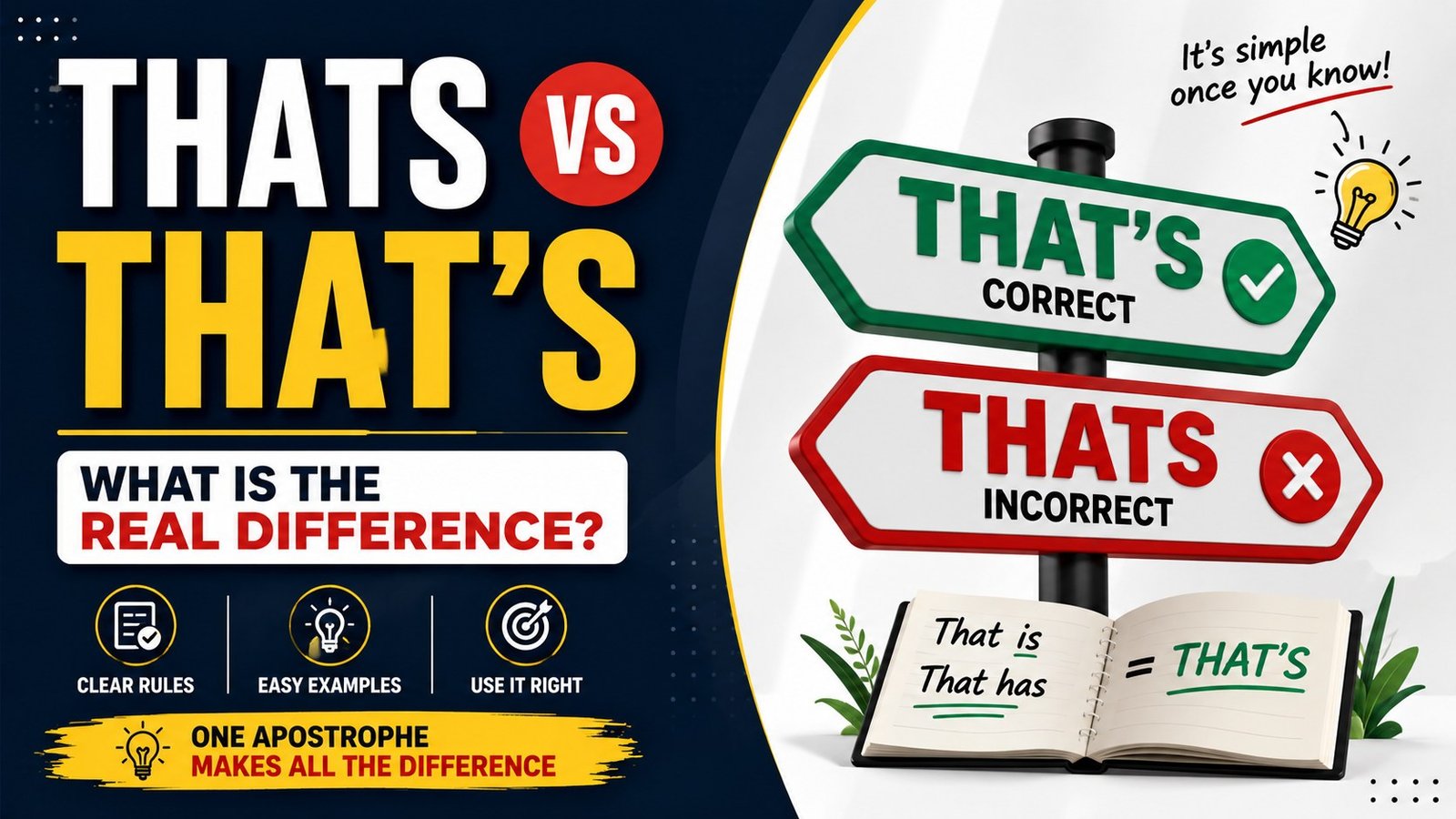
“Thats” is not a correct English word. “That’s” is the correct form, and it is a contraction of “that is” or “that has.” Many people search for “thats” because it feels natural to type, but standard English grammar always requires the apostrophe.
This mix-up happens for a simple reason. Contractions use apostrophes to show that a letter or letters have been removed. When the apostrophe is left out, the word looks shorter and quicker to type, especially on a phone. Understanding why the apostrophe matters makes the rule easy to remember for good.
The Short Answer
That’s is a contraction. It combines “that” with “is” or “has.” The apostrophe replaces the missing letters, so “that is” becomes “that’s,” and “that has” becomes “that’s” as well.
“Thats,” without an apostrophe, is a spelling mistake. It is not recognized as a standard word in any major dictionary. You will see it often in texting, social media captions, and song titles, but it is never correct in formal writing.
| Form | Status | Example |
| That’s | Correct | That’s a great idea. |
| Thats | Incorrect | That’s a great idea. |
See More: Here Is Or Here Are
Why The Apostrophe Matters
An apostrophe in a contraction is not decoration. It signals that letters have been dropped to shorten two words into one. Without it, the reader cannot tell if you meant a contraction, a plural, or a typo.
Compare these two sentences:
- That’s mine. (That is mine.)
- Thats mine. (Unclear, looks like a typing error.)
The apostrophe carries real meaning. Removing it does not just break a rule. It removes information the reader needs to understand the sentence quickly.
Meaning Of That’s
“That’s” has two main meanings, depending on what it is standing in for.
Meaning 1: That is
This is the most common use. It points to something and describes or identifies it.
Example: That’s my favorite song.
Meaning 2: That has
This use is less common but still correct, usually in perfect tense sentences.
Example: That’s been a long day.
Both meanings rely on context. Readers and listeners almost always understand which one is meant because of the words that follow.
Part Of Speech
“That’s” is not a single part of speech on its own, because it is a contraction made of two separate words joined together.
- “That” can function as a pronoun, determiner, or conjunction depending on the sentence.
- “Is” and “has” are both verbs.
So “that’s” is best described as a contraction combining a pronoun (or determiner) with a verb. This is why it always needs a subject and verb relationship to make sense in a sentence.
How To Use That’s In A Sentence
Using “that’s” correctly comes down to one habit: always keep the apostrophe when you are combining “that” with “is” or “has.”
Here are natural examples:
- That’s exactly what I meant.
- That’s the restaurant we talked about.
- That’s why I called you.
- That’s been sitting there for a week.
- That’s a shame.
Notice how each sentence would still make sense if you expanded the contraction back into two words. That is a simple test you can use to check yourself.
The Quick Expansion Test
If you are unsure whether to use “that’s” or “thats,” try expanding the word back into two full words.
- Take your sentence.
- Replace “that’s” with “that is” or “that has.”
- If the sentence still makes sense, “that’s” is correct.
- If it does not make sense, you may need a different word entirely, such as “thats” is simply never the answer.
Example: “Thats crazy” becomes “That is crazy.” Since it makes sense, the correct spelling is “That’s crazy.”
Thats vs That’s: Common Confusion Points
Many searches around this topic come from a mix of typing habits, autocorrect issues, and genuine uncertainty about grammar rules. Here are the most common points of confusion.
Is “thats” ever acceptable?
No. “Thats” is not accepted in standard American or British English. It appears frequently online because typing an apostrophe takes an extra step, and because song titles, video titles, and casual captions often drop it for style or speed. That does not make it grammatically correct.
Why do song titles and show titles sometimes drop the apostrophe?
Titles like “That’s So Raven” or “That’s My Boy” almost always keep the apostrophe correctly in official use. When you see “thats” in a search, it is usually the person typing casually, not the actual title. Always check official sources for exact title spelling.
Is “that’s” formal or informal?
“That’s” fits both formal and informal writing. Contractions like “that’s” are completely standard in everyday professional writing, emails, and conversation. Extremely formal documents, such as legal contracts, sometimes avoid contractions altogether and use “that is” or “that has” instead.
That’s vs Thats In Different Contexts
In conversation
“That’s” is used constantly in spoken English because contractions make speech flow naturally.
Example: “That’s amazing, tell me more.”
In writing
Both formal and informal writing accept “that’s.” Only highly formal or academic writing sometimes prefers the full form “that is.”
In song lyrics and titles
Many popular songs use “That’s” correctly in their official titles, such as “That’s Amore” or “That’s the Way of the World.” When searching for lyrics, the correct spelling with the apostrophe will match official releases.
In texting and social media
This is where “thats” appears most often. It is a shortcut, not a grammar rule. Autocorrect on many phones will still fix it automatically to “that’s.”
Common Mistakes
❌ Incorrect: Thats not fair.
✅ Correct: That’s not fair.
❌ Incorrect: I think thats the one.
✅ Correct: I think that’s the one.
❌ Incorrect: Thats been on my mind all day.
✅ Correct: That’s been on my mind all day.
The pattern is simple. Any time “that” is standing in for “that is” or “that has,” the apostrophe is required.
That’s vs Similar Confusing Words
| Word | Meaning | Example |
| That’s | Contraction of “that is” or “that has” | That’s my book. |
| Thats | Not a standard word | Should always be written as “that’s” |
| Thatd | Not a standard word | Should be written as “that’d” |
| Thatll | Not a standard word | Should be written as “that’ll” |
This pattern repeats across many contractions. “Thats,” “thatd,” and “thatll” are all common typing shortcuts, but none of them are recognized as correct spelling.
See More: Reenforce Vs Reinforce
That’s All Vs That’s It
These two phrases are close in meaning but used slightly differently.
“That’s all” usually means nothing more needs to be said or added.
Example: I just wanted to say hello, that’s all.
“That’s it” can mean the same thing, but it can also mean someone has reached a limit, or that something has been identified correctly.
Example: That’s it, I found the missing file.
Both phrases use the correct contraction “that’s,” never “thats.”
That’s a Pity Vs That’s a Shame
Both phrases express sympathy or mild disappointment about something.
“That’s a pity” is more common in British English.
“That’s a shame” is common in both British and American English.
Example: You missed the show? That’s a shame.
That’s Rough Vs That’s Tough
Both are casual expressions of sympathy, often used in spoken conversation.
“That’s rough” acknowledges that a situation is difficult or unpleasant.
“That’s tough” carries a similar meaning, sometimes with a slightly more resigned tone.
Example: You lost your keys again? That’s rough.
That’s Fine Vs That’s Okay
These two expressions are nearly interchangeable in everyday use.
“That’s fine” often signals full agreement or acceptance.
“That’s okay” can carry the same meaning, but sometimes softens a mild inconvenience.
Example: If you’re running late, that’s fine.
That’s Not Vs That Isn’t
Both phrases express the same negative meaning, but they come from different contraction patterns.
“That’s not” contracts “that is” and adds “not” afterward.
“That isn’t” contracts “is not” directly onto “that.”
Example: That’s not what I meant. / That isn’t what I meant.
Both are correct. The choice usually comes down to personal rhythm or emphasis.
Pronunciation
“That’s” is pronounced the same as the word “thats” would sound if spoken aloud, since pronunciation does not show apostrophes. The difference only matters in writing.
Simple pronunciation: thats (rhymes with “cats”)
This is one reason the misspelling is so common. Speech does not reveal the apostrophe, so writers sometimes forget it belongs there.
Origin Of That’s
“That’s” follows a pattern common in English contractions, where a verb like “is” or “has” gets shortened and joined to the word before it using an apostrophe. This pattern has existed in English for centuries, appearing in contractions such as “it’s,” “he’s,” and “she’s.”
The apostrophe itself marks the place where letters were dropped. In “that’s,” the letter “i” from “is” (or the letters “ha” from “has”) are removed, and the apostrophe stands in their place.
Is “Thats” A Word In Any Dictionary?
No major dictionary, including Merriam Webster, Oxford, or Cambridge, lists “thats” as a standard word. It is considered a misspelling of “that’s” in every context.
If you search for “thats,” most reliable dictionaries will redirect you to the correct entry for “that’s” or suggest it as the intended spelling.
See More: Acception Vs Exception
Quick Reference Table
| Question | Answer |
| Is “thats” correct grammar? | No |
| Is “that’s” correct grammar? | Yes |
| What does “that’s” stand for? | That is, or that has |
| Is “that’s” formal or informal? | Both, depending on context |
| Can “thats” ever replace “that’s”? | No |
Frequently Asked Questions
What does “that’s” mean?
“That’s” means “that is” or “that has.” It points to something and connects it to a description, action, or state.
Is “thats” a real word?
No. “Thats” is not a recognized word in standard English. The correct spelling is always “that’s.”
How do you use “that’s” in a sentence?
Use “that’s” whenever you are shortening “that is” or “that has.” For example: “That’s the book I mentioned.”
Is “that’s” a noun or a verb?
“That’s” is a contraction, not a single part of speech. It combines a pronoun or determiner with a verb.
How do you pronounce “that’s”?
It is pronounced the same as “thats” would sound if spoken, rhyming with “cats.”
What is the difference between “that’s” and “thats”?
“That’s” is the grammatically correct contraction. “Thats” is a common misspelling that drops the required apostrophe.
Why do so many song titles look like they use “thats”?
Most official song titles actually use the correct apostrophe, such as “That’s Amore” or “That’s the Way.” The version without an apostrophe usually comes from casual typing in searches, not the real title.
Is “that’s” used the same way in British and American English?
Yes. Both British and American English use “that’s” the same way, as a contraction of “that is” or “that has.”
Can “that’s” be used in formal writing?
Yes, in most formal writing. Only very strict formal contexts, like legal documents, sometimes avoid contractions altogether.
What is a simple way to remember the difference?
Expand the word back to two words. If “that is” or “that has” makes sense in the sentence, the correct spelling is always “that’s,” never “thats.”
Final Thoughts
The difference between “thats” and “that’s” comes down to one small but important mark. “That’s” is the correct, standard contraction of “that is” or “that has,” and it belongs in both casual and formal writing. “Thats” is simply a spelling slip that happens because contractions do not show up clearly when we speak, only when we write.
Once you remember the expansion test, checking whether “that is” or “that has” fits your sentence, you will never second guess the spelling again. Keep the apostrophe, and “that’s” will always be correct.

Danish Raza is the author of Grammavio, a trusted resource for simple and easy-to-understand English grammar guides. He creates helpful content covering grammar rules, word meanings, vocabulary, and common grammar mistakes to help readers improve their English skills.



2 Comments