
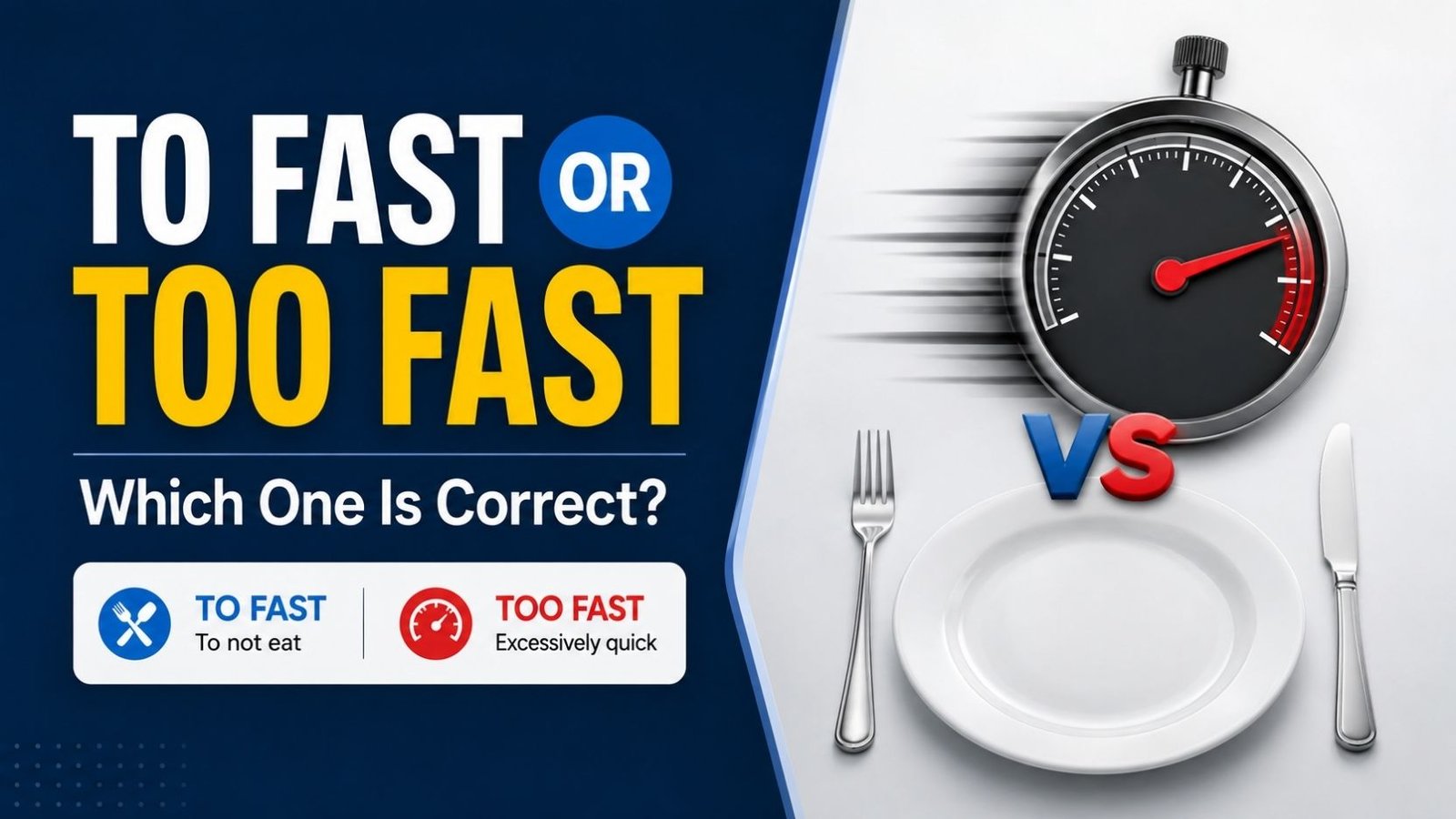
“To fast or too fast” is a spelling mix-up, not a grammar rule with two valid forms. Only one of these words fits a given sentence, and the choice depends entirely on meaning. “To fast” means to go without food, usually for health, religious, or medical reasons. “Too fast” means moving or happening at an excessive speed.
These two words sound almost identical when spoken, which is why so many people search for “to fast or too fast” before writing a sentence. Getting it right matters more than it might seem, because “to fast” and “too fast” describe completely different ideas. One is about eating. The other is about speed. Mixing them up can confuse the reader.
To Fast Or Too Fast: The Simple Answer
Here is the short version before the details.
- Use to fast when you mean the verb “fast,” as in not eating.
- Use too fast when you mean “excessively fast” or “faster than it should be.”
| Word | Part of Speech | Meaning | Example |
| To fast | Infinitive verb phrase | To not eat, often for a set period | She decided to fast before the blood test. |
| Too fast | Adverb + adjective/adverb pair | Excessively quick or rushed | He was driving too fast on the highway. |
If your sentence is about food, medical tests, religion, or self-discipline, you almost certainly want to fast. If your sentence is about speed, time passing, growth, or motion, you want too fast.
See More: Might As Well Or Mine As Well
What Does “To Fast” Mean?
“To fast” is the infinitive form of the verb “fast.” The word “to” here is not the preposition meaning “toward.” It is the small grammar marker that turns a verb into its infinitive form, the same way “to” works in “to eat,” “to sleep,” or “to run.”
Fasting means voluntarily going without food, and sometimes without drink, for a specific period of time. People fast for many reasons.
- Medical reasons, such as preparing for blood work or surgery
- Religious reasons, such as Ramadan, Lent, or Yom Kippur
- Health reasons, such as intermittent fasting for weight management
- Personal discipline or mental clarity
Example Sentences With “To Fast”
- Doctors often ask patients to fast for eight to twelve hours before a cholesterol test.
- Many Muslims choose to fast from sunrise to sunset during Ramadan.
- She wanted to fast once a week as part of her new health routine.
- It can be difficult to fast for a full day without proper preparation.
In every one of these sentences, “to fast” answers the question “to do what?” That is a strong sign you need “to,” not “too.”
What Does “Too Fast” Mean?
“Too fast” combines the adverb “too,” meaning “more than is needed or wanted,” with the word “fast,” which describes speed. Together, “too fast” means something is happening at a speed that is excessive, unsafe, or simply faster than expected.
This phrase applies to far more than driving. People use “too fast” to describe time, relationships, growth, technology, and everyday actions.
Example Sentences With “Too Fast”
- He was driving too fast in the rain, which made the car skid.
- Time seems to move too fast once you reach your thirties.
- She felt like the relationship was moving too fast for her comfort.
- The download finished too fast to be accurate, so he checked it again.
- Kids seem to grow up too fast these days.
Notice that in each example, “too fast” describes a rate or pace that has gone beyond what feels normal or acceptable.
Why People Confuse “To Fast” And “Too Fast”
The confusion comes from pronunciation, not meaning. “To,” “too,” and even “two” sound almost the same in everyday speech. Most English speakers do not pause to think about spelling while talking, so the mix-up shows up later, when the same thought gets written down.
There is also a habit effect. “Too fast” appears far more often in everyday writing, since people talk about speed, growth, and time constantly. “To fast” is used less often, mostly around health, religion, and medical topics. Because “too fast” is more familiar, some writers default to it even in sentences about not eating, which produces an easy but noticeable error.
Quick Trick To Remember The Difference
A simple test can settle the choice almost every time.
- If you can replace the word with “in order to” or if it follows a verb like “want,” “need,” “decided,” or “plan,” use to fast.
- Example: She decided to fast before the appointment. → She decided in order to fast. This still makes sense as a verb structure.
- If you can replace the word with “excessively” or “overly,” use too fast.
- Example: He was driving too fast. → He was driving excessively fast. This confirms the meaning of speed.
💡 Tip: If the sentence is about eating or not eating, think “to fast” like “to eat” or “to sleep.” If the sentence is about speed or pace, think “too fast” like “too loud” or “too slow.”
Common Mistakes With “To Fast” And “Too Fast”
Below are real patterns that show up in everyday writing, along with the correct version.
❌ Incorrect: The doctor told me too fast before the blood test.
✅ Correct: The doctor told me to fast before the blood test. Why: The sentence describes an instruction not to eat, which needs the infinitive verb form “to fast.”
❌ Incorrect: He was driving to fast down the highway.
✅ Correct: He was driving too fast down the highway. Why: The sentence describes excessive speed, which needs the adverb “too.”
❌ Incorrect: Kids grow up to fast these days.
✅ Correct: Kids grow up too fast these days. Why: This describes a pace of growth, not the act of not eating, so “too fast” is correct.
❌ Incorrect: I need too fast before my surgery tomorrow.
✅ Correct: I need to fast before my surgery tomorrow. Why: “Need” is followed by an infinitive verb, so “to fast” fits the grammar pattern.
“To Fast” And “Too Fast” In Different Contexts
Growing Up Too Fast
This is one of the most searched versions of the phrase. “Growing up too fast” is a common expression used to describe children who seem to mature, lose innocence, or take on adult responsibilities earlier than expected. It is also used more generally to express that time with loved ones feels short.
- Parents often say their children are growing up too fast.
- Many songs and books use the phrase “growing up too fast” as a theme about lost childhood or time slipping away.
The correct form here is always too fast, never “to fast,” since the phrase is about the speed of growth and time, not about eating.
Going Too Fast
“Going too fast” usually describes physical speed, such as driving, or a figurative pace, such as a relationship or a plan moving ahead faster than someone is comfortable with.
- He was going too fast around the curve.
- Some people feel a new relationship is going too fast if commitment happens within weeks.
Moving Too Fast
Similar to “going too fast,” this version often applies to relationships, careers, projects, or general life pace.
- Their engagement felt like it was moving too fast for her family.
- The project timeline is moving too fast for the team to keep up.
How Long To Fast Before A Blood Test
This is a genuine health-related question, and it belongs firmly in “to fast” territory, since it is about the verb “fast,” meaning not eating.
Most standard blood tests, including basic metabolic panels and lipid panels, commonly require a fasting period, though the exact number of hours can vary by test and by the ordering doctor. A typical range often mentioned by healthcare providers is around eight to twelve hours before certain tests such as a lipid panel or glucose test. However, fasting requirements are not identical for every test, and some tests need no fasting at all.
⚠️ Important: Always follow the specific instructions from your doctor or laboratory rather than a general online range, since requirements can differ based on the exact test ordered and individual health circumstances.
See More: Naive Or Nieve
To Fast For Religious Reasons
Fasting has deep roots in many religious traditions. In Islam, fasting during Ramadan involves abstaining from food and drink from dawn until sunset. In Christianity, fasting is practiced during periods such as Lent. In Judaism, fasting is observed on days such as Yom Kippur. In each of these contexts, the phrase “to fast” refers to the religious practice of intentionally not eating for spiritual reasons.
Grammar Breakdown: Why “To” And “Too” Work Differently
Understanding the grammar behind these two words makes the choice much easier in the future.
“To” as part of an infinitive verb “To” combines with a base verb to create an infinitive, such as “to eat,” “to run,” “to fast,” or “to sleep.” Infinitives often follow verbs like want, need, decide, plan, try, and love.
- I want to fast this weekend.
- She tried to fast for a full day.
“Too” as an adverb meaning excessively “Too” modifies adjectives or adverbs to show that something exceeds a desired or normal level. It commonly pairs with words like fast, slow, loud, big, small, late, and early.
- The music was too loud.
- We arrived too late.
- He was driving too fast.
A helpful pattern: if removing the word “to” or “too” from the sentence still leaves a complete, sensible thought once you swap in “very” or “excessively,” you are almost certainly dealing with “too.” If removing it breaks the verb structure entirely, you are dealing with “to.”
To Fast Or Too Fast: Side-by-Side Comparison
| Feature | To Fast | Too Fast |
| Word type | Infinitive marker plus verb | Adverb plus adjective or adverb |
| Core meaning | Not eating, often for a set period | Excessive speed or pace |
| Common topics | Health, religion, medical tests, discipline | Driving, time, growth, relationships, technology |
| Simple test | Can follow “want,” “need,” “decided” | Can be replaced with “excessively” |
| Typical example | She plans to fast tomorrow. | He drove too fast in the storm. |
Synonyms And Related Words
Related to “to fast”
- Abstain (from food)
- Go without eating
- Skip meals intentionally
- Observe a fast
These words share the meaning of voluntarily avoiding food, though “fast” specifically implies a defined period of time and often a deliberate purpose, unlike casual meal-skipping.
Related to “too fast”
- Excessively quick
- Overly rapid
- Too rushed
- Faster than expected
These phrases all point to speed or pace exceeding a comfortable or appropriate level, though some, like “too rushed,” lean more toward describing hurried actions rather than pure speed.
See More: Beginning Or Begining
Frequently Asked Questions
Is it “to fast” or “too fast”?
It depends on meaning. Use “to fast” when talking about not eating. Use “too fast” when talking about excessive speed or pace.
Is “to fast” grammatically correct?
Yes. “To fast” is the correct infinitive form of the verb “fast,” meaning to go without food.
What does “too fast too furious” mean?
This phrase is a play on the well-known “Fast and Furious” film franchise name, often used casually or humorously to describe something happening at a reckless or rushed pace. It is not a standard grammatical phrase.
Why do people say “growing up too fast” instead of “to fast”?
Because the phrase describes the speed at which someone matures, not the act of not eating. “Too fast” is always correct in this expression.
How long do you have to fast before blood work?
Requirements vary by test and provider, but many standard tests commonly ask for a fasting period of around eight to twelve hours. Always confirm the exact number of hours with the doctor or lab handling the test.
Is “too fast” an adverb or an adjective?
“Fast” itself can function as either an adjective or an adverb depending on the sentence. “Too” is always an adverb, and it modifies whichever role “fast” is playing in that sentence.
Can “to fast” ever describe speed?
No. “To fast” only refers to the verb meaning not eating. Speed is always expressed with “too fast” or simply “fast” without “too.”
Is fasting the same as skipping a meal?
Not exactly. Fasting usually implies a deliberate, often longer, and more structured period without food, sometimes tied to health, medical, or religious goals, while skipping a meal is typically a one-time, casual occurrence.
What is the difference between “to fast” and “too fast” in writing?
“To fast” is a verb phrase about eating behavior. “Too fast” is a description of pace or speed. They are never interchangeable, even though they sound alike when spoken.
Final Thoughts
The confusion between “to fast” and “too fast” comes down to sound, not logic. Once you separate the meanings, the choice becomes automatic: “to fast” belongs with eating, health, and religious practice, while “too fast” belongs with speed, time, and pace. Reading the sentence aloud and asking what the sentence is actually about- food or speed- solves the problem almost instantly.
Whether you are writing about preparing for a blood test, describing a fast driver, or talking about kids growing up too fast, the meaning of your sentence will always point you to the right word. Keep the simple test in mind: infinitive verb structure means “to fast,” and excessive pace means “too fast,” and you will rarely make this mistake again.

Danish Raza is the author of Grammavio, a trusted resource for simple and easy-to-understand English grammar guides. He creates helpful content covering grammar rules, word meanings, vocabulary, and common grammar mistakes to help readers improve their English skills.


2 Comments