
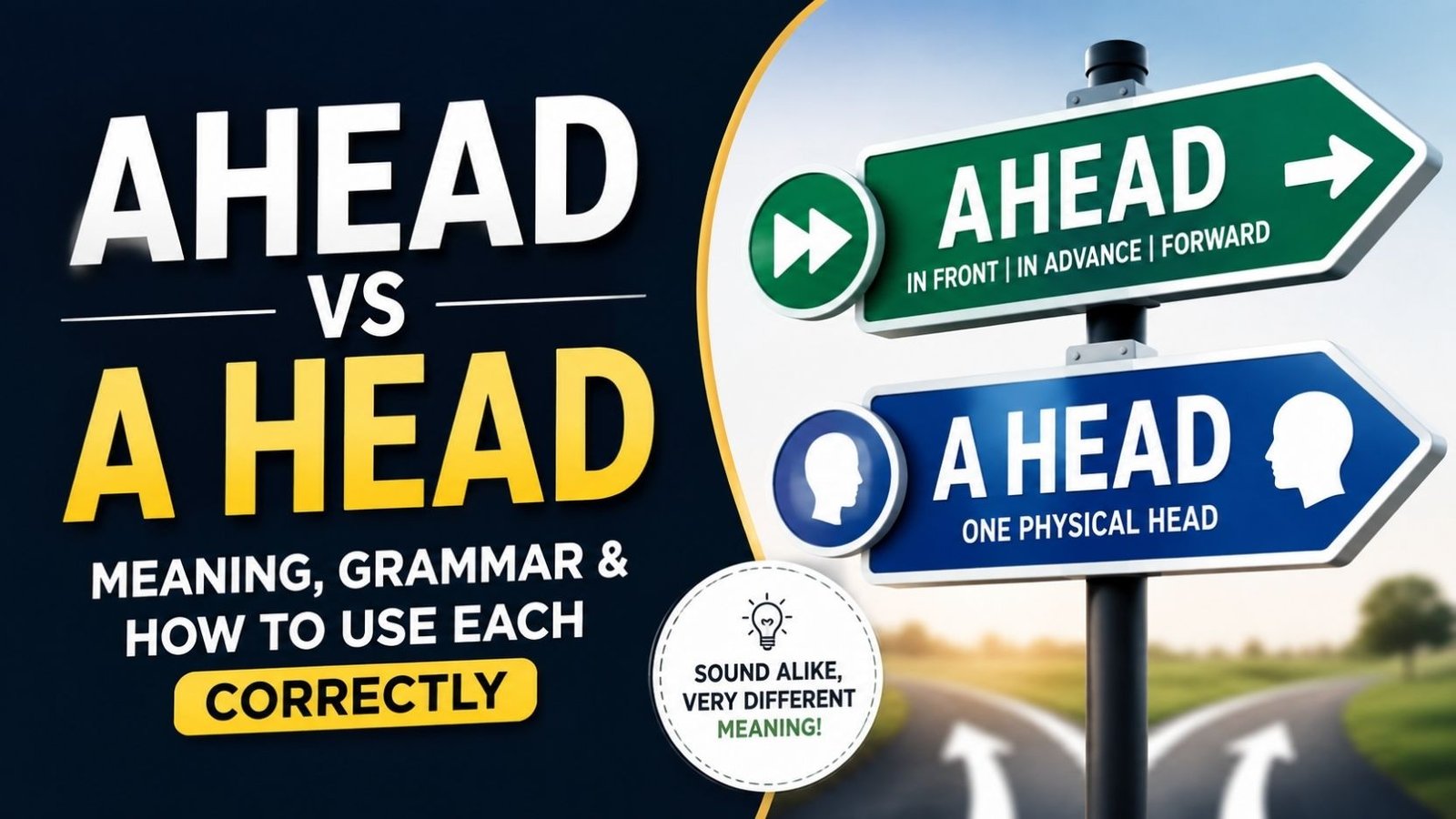
“Ahead” means in front, in advance, or moving forward in position or time. “A head” is simply the article “a” plus the noun “head,” referring to one physical head, whether it belongs to a person, an animal, or something shaped like one. These two forms sound alike when spoken quickly, which is why so many people search for ahead vs a head to confirm which one fits their sentence.
The confusion usually happens in speech first, then spreads into writing. Someone hears “get ahead” and “get a head” pronounced almost the same way, so the spelling starts to blur too. Understanding the difference matters because using the wrong one can quietly change the meaning of a sentence, sometimes in a way that sounds strange or even confusing to a reader.
Ahead vs A Head: The Core Difference
The easiest way to tell these apart is to look at what each one is doing in the sentence.
| Form | Part of Speech | What It Refers To | Example |
| Ahead | Adverb (sometimes adjective) | Position, direction, or time | She walked ahead of the group. |
| A head | Article + noun | One physical head | The horse has a head shaped like a triangle. |
“Ahead” never refers to an actual head. It always describes a position, a direction, or a point in time relative to something else. “A head,” on the other hand, always refers to a real head, whether that is a person’s head, an animal’s head, or a rounded object described using the word “head,” like a head of lettuce or a head of garlic.
See More: Seem Vs Seems
What Does Ahead Mean?
“Ahead” is an adverb. It describes movement, position, or timing rather than naming a thing. It answers the question “where” or “when,” not “what.”
Meaning 1: In front, in a forward position. This is the most common use. It describes physical position relative to something else.
Example: The runner in the red shirt is ahead of everyone else.
Meaning 2: In advance of a schedule or expectation This use relates to time rather than physical space.
Example: The project finished two weeks ahead of schedule.
Meaning 3: In a leading or superior position This use describes rank, score, or progress compared to others.
Example: Our team is ahead by ten points.
Meaning 4: Toward the future This use looks forward in time, often in phrases like “the year ahead” or “plan ahead.”
Example: We need to think about the months ahead.
These meanings all share one thing in common: “ahead” always compares a position to something else. It is relational. Nothing physically shaped like a head is involved.
What Does A Head Mean?
“A head” is not one word. It is the indefinite article “a” combined with the noun “head.” Because “head” starts with a consonant sound, it takes “a” rather than “an.”
Meaning 1: A person’s or animal’s physical head This is the literal, most direct meaning.
Example: The statue has a head made of marble.
Meaning 2: A rounded unit of certain vegetables Some vegetables are measured or described in “heads,” like garlic or lettuce.
Example: The recipe calls for a head of garlic.
Meaning 3: A leader or person in charge “Head” can mean someone who leads a group or department, and “a head” refers to one such person.
Example: The company just hired a head of marketing.
Meaning 4: Per person, as in “a head” for counting This use appears in counting contexts, such as pricing or headcount.
Example: Tickets cost twenty dollars a head.
In every case, “a head” points to something countable and physical, or a role tied to a person. That is the opposite of “ahead,” which never names a physical thing.
Ahead vs A Head: Side-by-Side Examples
Seeing both forms in similar sentences makes the difference clearer.
| Sentence with Ahead | Sentence with A Head |
| He is ahead in the race. | He has a head for numbers. |
| Plan ahead for the trip. | The chef needs a head of cabbage. |
| She looked ahead at the road. | She turned a head shape into the drawing. |
| They are ahead of schedule. | There is a head of state visiting today. |
Notice that “ahead” never fits into a sentence where you could touch or point to the word being described. “A head” almost always does, unless it refers to a leadership role.
Grammar: Why Ahead Is One Word And A Head Is Two
This is where the real confusion starts. “Ahead” formed centuries ago by combining the preposition “a” (an old form meaning “on” or “in”) with “head,” creating a single fused word. Over time, English speakers stopped seeing it as two separate parts and started treating it as one adverb.
“A head,” by contrast, keeps the article and noun as two separate grammatical units. You can insert words between them, such as “a large head” or “a shaved head.” You cannot do this with “ahead.” There is no such phrase as “a large head of schedule,” because “ahead” is not built from an article plus a noun in modern English, even though it once was historically.
A simple grammar test: if you can add a describing word between “a” and “head” and the sentence still makes sense, you need the two-word form. If adding a word breaks the sentence, you need the one-word form “ahead.”
See More: Behavior Or Behaviour
How to Pronounce Ahead And A Head
Both forms are pronounced almost identically in fast, natural speech, which is a major reason people mix them up in writing.
- Ahead: uh-HED (stress on the second syllable)
- A head: uh HED (same sound pattern, but said as two separate words)
The IPA for “ahead” is /əˈhɛd/. The IPA for “a head” is /ə hɛd/, spoken with a very short pause or slight separation between the article and the noun. In casual conversation, that separation often disappears, which is exactly why writers need to rely on meaning and grammar rather than sound alone.
Common Mistakes with Ahead vs A Head
⚠️ These mix-ups happen often, even among fluent English speakers.
❌ Incorrect: She is a head of the class in math.
✅ Correct: She is ahead of the class in math. Why: The sentence describes her position or ranking, not a physical head.
❌ Incorrect: The barber gave him ahead shave.
✅ Correct: The barber gave him a head shave. Why: “Head shave” refers to a physical head being shaved, so it needs the article “a.”
❌ Incorrect: We are planning a head for next year.
✅ Correct: We are planning ahead for next year. Why: This describes preparing in advance, a meaning tied to time, not to a physical head.
💡 Quick tip: If the sentence is about location, timing, or rank, use “ahead.” If the sentence is about a real head or a leader, use “a head.”
Ahead of vs Ahead: Do You Need “Of”?
“Ahead” is often followed by “of” when comparing one thing to another.
- Ahead of schedule
- Ahead of the competition
- Ahead of time
“Ahead” can also stand alone without “of” when no direct comparison is being made.
- Go ahead.
- Look ahead.
- Move ahead.
The word “of” is needed only when “ahead” is directly comparing two things or introducing what something is ahead of.
Synonyms and Related Words
| Word | Meaning | Difference from Ahead |
| Forward | Moving in a front direction | Often used for physical or general motion, less about comparison |
| Beforehand | Earlier than a set time | Focuses specifically on advance timing, not position |
| Leading | In first place or in charge | Used more for rank or leadership than simple position |
| Advance | To move forward or happen early | Can function as a verb, unlike “ahead” |
These words overlap with “ahead” in some contexts but are not always interchangeable. “Beforehand,” for example, works well for timing but sounds awkward when describing physical position in a race.
Ahead vs Before: What Is the Difference?
“Ahead” and “before” both relate to earlier position or time, but they are used differently.
“Before” is a preposition or conjunction that introduces a point of comparison directly.
Example: Finish your homework before dinner.
“Ahead” needs the word “of” to make the same kind of comparison.
Example: Finish your homework ahead of dinner.
Both sentences work, but “before” sounds more natural for simple time comparisons, while “ahead of” often carries a stronger sense of getting something done early or gaining an advantage.
See More: Company-wide Or Companywide
“Ahead” in Everyday Phrases
Many common English expressions use “ahead” as part of a fixed phrase. Understanding these helps clarify why the one-word form is correct in each case.
- Go ahead: giving permission or encouragement to proceed
- Stay ahead: keeping a leading position
- Fall behind vs get ahead: opposite outcomes in progress or ranking
- Think ahead: planning for the future
- Straight ahead: directly in front, without turning
None of these phrases can be written with “a head” instead, because none of them refer to a literal head.
Frequently Asked Questions
What does ahead mean in a sentence?
“Ahead” means in front, in advance, or in a leading position. It describes where something is located or how far along it is compared to something else.
Is ahead a noun or an adverb?
“Ahead” is primarily an adverb. It can occasionally function as a predicate adjective, as in “the road ahead,” but it is never a noun.
What is the difference between ahead and a head?
“Ahead” describes position, timing, or rank. “A head” refers to a literal head, whether human, animal, or a rounded object like a head of garlic.
How do you use ahead in a sentence?
Use “ahead” to describe forward movement, advance timing, or leading position, such as “She finished ahead of the deadline.”
Why do ahead and a head sound the same?
Both are pronounced with a similar stress pattern in fast speech, since “ahead” historically formed from the words “a” and “head” joined together.
Is it correct to say “a head start” or “ahead start”?
The correct phrase is “a head start,” written as two words, because it refers to an early beginning, not the adverb “ahead.”
What does “ahead of the curve” mean?
It means being more advanced or informed than others, often in trends, technology, or ideas.
Can ahead be used at the start of a sentence?
Yes. Sentences like “Ahead of the meeting, she prepared her notes” are correct and common in formal writing.
Is “plan ahead” redundant?
No. “Plan” refers to preparing, while “ahead” specifies that the preparation happens in advance of a future event. The phrase is standard English.
What is a “head start” grammatically?
It is a noun phrase, made of the article “a,” the noun “head,” and the noun “start,” meaning an early advantage before others begin.
Final Thoughts
“Ahead” and “a head” may sound identical when spoken casually, but they serve completely different roles in a sentence. “Ahead” is a single adverb describing position, timing, or rank, while “a head” is a two-word combination naming a literal head or a leadership role. Once you focus on what the sentence is actually describing, whether it is a location or a physical object, the correct choice becomes clear almost every time.
The next time you are unsure which form to use, ask yourself a simple question: is this sentence about being in front or early, or is it about an actual head? That one distinction, checked before you write, will keep ahead vs a head from ever causing confusion again.

Danish Raza is the author of Grammavio, a trusted resource for simple and easy-to-understand English grammar guides. He creates helpful content covering grammar rules, word meanings, vocabulary, and common grammar mistakes to help readers improve their English skills.



One Comment