
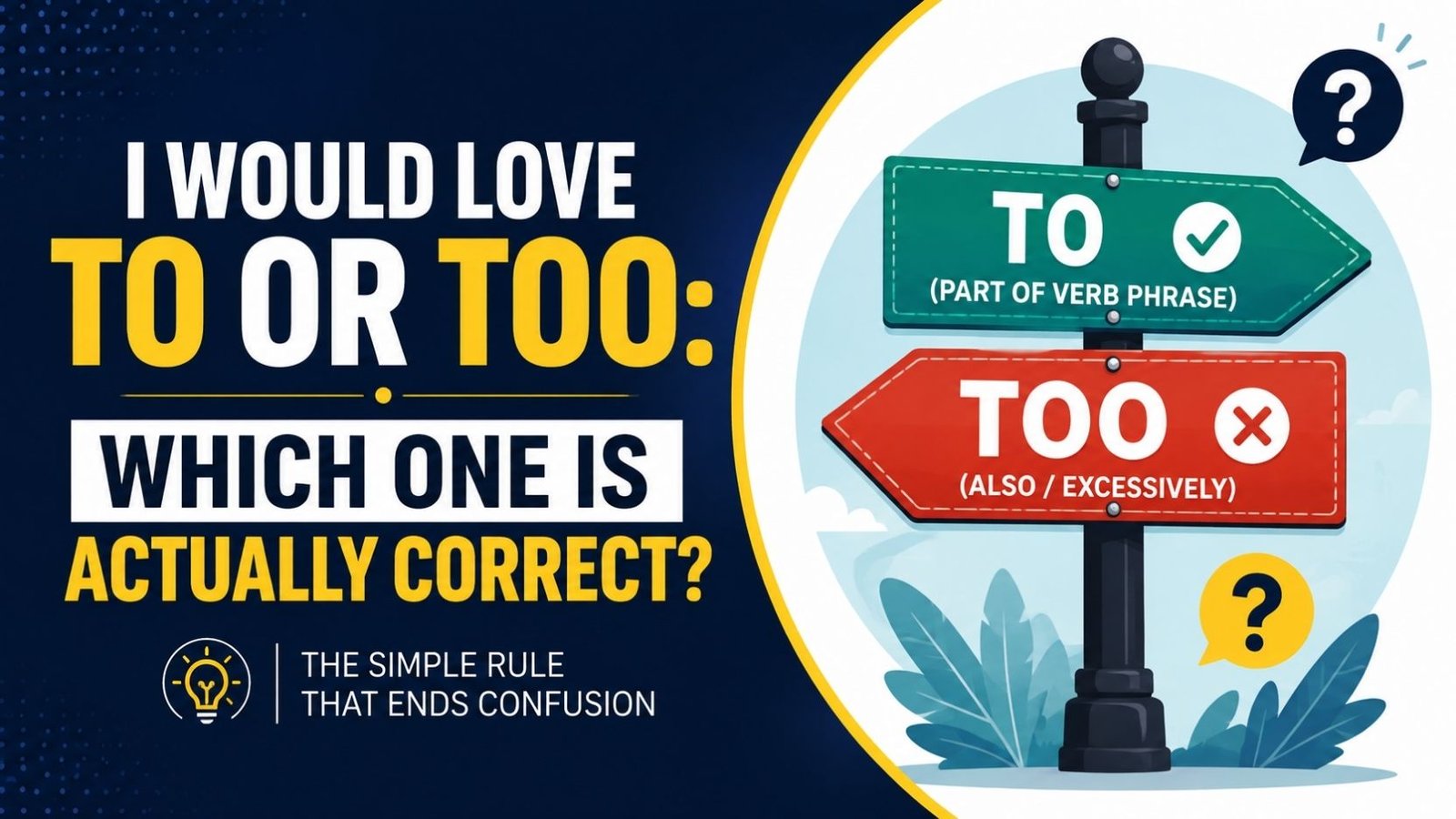
The correct phrase is “I would love to,” not “I would love too.” This confusion happens because “to” and “too” sound exactly the same when spoken out loud. In writing, though, they do different jobs. “To” completes the verb phrase, while “too” means “also” or “excessively.” Once you understand this small difference, you will never mix them up again.
This mistake is one of the most common spelling slips in everyday English, even among fluent speakers. It matters because “I would love to” and “I would love too” technically mean different things on paper. Getting it right makes your writing look polished, whether you are texting a friend, replying to an invitation, or writing a professional email.
What Does “I Would Love To” Actually Mean?
“I would love to” is a warm, enthusiastic way of accepting an offer, invitation, or suggestion. It expresses genuine excitement or willingness to do something. The word “to” here is part of an infinitive phrase, and the main verb after it is simply left out because it is already understood from context.
For example, if someone asks, “Do you want to come to the party?”, you might reply, “I would love to.” The full sentence would technically be “I would love to come to the party,” but English speakers naturally drop the repeated part.
Quick definition: “I would love to” means “I am very willing and happy to do that.”
See More: Seem Vs Seems
Why “I Would Love Too” Is Incorrect
“Too” is an adverb, not part of a verb phrase. It cannot follow “love” in this kind of sentence because there is nothing for it to logically attach to. “Too” only makes sense when it means “also” or “excessively,” and neither meaning fits after “love” in this expression.
Compare these two sentences:
- Incorrect: “I would love too.”
- Correct: “I would love to.”
The incorrect version leaves the sentence grammatically incomplete. Readers instinctively expect a verb after “to,” such as “go,” “join,” “help,” or “meet.”
To Vs Too: The Core Grammar Rule
Understanding the difference between “to” and “too” solves this confusion permanently. These two words are homophones, meaning they sound identical but have completely different meanings and grammatical functions.
| Word | Function | Meaning | Example |
| To | Preposition or part of an infinitive verb | Shows direction, purpose, or connects two verbs | “I would love to help.” |
| Too | Adverb | Means “also” or “excessively” | “I want to come too.” |
Notice that “too” is spelled with two letter O’s, and it also carries “extra” meaning, whether that extra meaning is “also” or “more than needed.” That small trick can help you remember which spelling to use.
When to Use “To”
Use “to” when it connects to a verb, as in an infinitive phrase, or when it shows direction or purpose.
- “I would love to visit Paris.”
- “She plans to call you later.”
- “We are heading to the airport.”
When to Use “Too”
Use “too” when you mean “also” or when you mean “more than what is needed or wanted.”
- “I would love to come too.” (meaning “as well”)
- “The coffee is too hot to drink.” (meaning “excessively”)
Is It “I Would Love To Or Too”? A Simple Test
If you are ever unsure which word fits your sentence, try this quick test. Read your sentence and ask whether a verb naturally follows the word. If a verb belongs there, use “to.” If the word simply adds the idea of “also,” use “too.”
Example test:
“I would love [to/too] see you this weekend.”
Since “see” is a verb that logically follows, the correct choice is “to.” The sentence becomes, “I would love to see you this weekend.”
Another example:
“I want to go, and I would love to come [to/too].”
Here, “too” fits because it means “as well.” The sentence becomes, “I would love to come too.”
Common Sentence Patterns Compared
The table below shows how “I would love to” and “I would love to… too” are actually used correctly in real conversations, since many searches confuse the two structures.
| Sentence Pattern | Correct Form | What It Means |
| Accepting an invitation | “I would love to.” | Willing and happy to do it |
| Adding agreement after someone else | “I would love to join you too.” | You also want to join |
| Responding to “Would you like to come?” | “Yes, I would love to.” | A direct, enthusiastic yes |
| Expressing shared enthusiasm | “Me too, I would love to.” | You feel the same way |
Examples Of “I Would Love To” In Real Sentences
These examples show how naturally this phrase fits into everyday speech and writing.
- “I would love to grab coffee sometime this week.”
- “I would love to hear more about your trip.”
- “If you’re free Friday, I would love to catch up.”
- “I would love to help you move this weekend.”
Each example works because a verb, such as “grab,” “hear,” “catch up,” or “help,” directly follows “to.”
See More: Scarry or Scary
Yes, I Would Love To: A Common And Correct Response
“Yes, I would love to” is a complete and grammatically correct way to accept an invitation or offer. It is warmer and more personal than a plain “yes,” and it clearly signals enthusiasm rather than reluctant agreement.
You will often see this phrase in replies to texts, emails, and casual invitations. It works well because the listener already knows what activity is being discussed, so repeating the verb is unnecessary.
How To Say “I Would Love To” In A Professional Way
In formal or workplace communication, “I would love to” still works, but some writers prefer slightly more formal alternatives depending on the tone of the message.
| Professional Alternative | Best Used When |
| “I would be happy to.” | Slightly more formal, still warm |
| “I would welcome the opportunity to.” | Business emails, job-related replies |
| “I am glad to.” | Short, polite, professional |
| “I would be delighted to.” | Formal invitations or events |
These alternatives keep the same accepting tone while matching a more polished, professional register.
Synonyms And Other Ways To Say “I Would Love To”
Depending on the situation, you can replace “I would love to” with other expressions that carry a similar meaning but fit different levels of formality.
- “I would be thrilled to.”
- “I would gladly.”
- “Count me in.”
- “That sounds great, I’m in.”
- “I would jump at the chance to.”
Casual conversations often favor short expressions like “count me in,” while emails and formal replies favor “I would be happy to” or “I would welcome the opportunity to.”
“I Would Love To” In Spanish
Speakers learning English sometimes search for how this phrase translates into other languages. In Spanish, “I would love to” is commonly translated as “me encantaría.” This phrase carries the same enthusiastic, willing tone as the English version, and it is typically followed by an infinitive verb, just like in English.
For example, “I would love to see you” becomes “me encantaría verte.”
Common Mistakes With “I Would Love To or Too”
Even confident English speakers make small errors with this phrase. Here are the most frequent mistakes and their corrections.
❌ Incorrect: “I would love too see you.”
✅ Correct: “I would love to see you.”
❌ Incorrect: “I would love too, if that works.”
✅ Correct: “I would love to, if that works.”
❌ Incorrect: “Yes I would love too.”
✅ Correct: “Yes, I would love to.”
The mistake almost always happens because “too” and “to” sound the same, so writers rely on how the sentence sounds rather than how it should be spelled.
Pronunciation Note
“To” and “too” are pronounced identically in natural speech, roughly as “too,” with a long “oo” sound. Since pronunciation gives no clue about spelling, the only reliable way to choose the correct word is by checking the grammar of the sentence, not the sound.
Quick Reference: I Would Love To Or Too
Use this short summary whenever you need a fast answer.
- “I would love to” is always correct before a verb or when standing alone as a reply.
- “I would love to… too” is correct when adding “also” after the full phrase.
- “I would love too” by itself, with no verb and no meaning of “also,” is incorrect.
See More: Ahead Vs A Head
Frequently Asked Questions
Is it “I would love to” or “I would love too”?
The correct phrase is “I would love to.” “Too” is only correct if you are adding the meaning of “also,” as in “I would love to come too.”
What does “I would love to” mean?
It means you are happy and willing to do something. It expresses enthusiasm rather than simple agreement.
Is “I would love too” ever correct?
Only as part of a longer sentence where “too” means “also,” such as “I would love to join too.” On its own, “I would love too” is incorrect.
What is a synonym for “I would love to”?
Common alternatives include “I would be happy to,” “I would be delighted to,” and “I would gladly.”
How do you say “I would love to” professionally?
You can say “I would be happy to,” “I would welcome the opportunity to,” or “I would be delighted to” in formal settings.
Why do people confuse “to” and “too”?
Because they are homophones. They sound exactly the same when spoken, so the confusion comes from writing, not pronunciation.
Is “yes I would love to” grammatically correct?
Yes. “Yes, I would love to” is a complete, correct, and natural way to accept an invitation.
What part of speech is “to” in this phrase?
In “I would love to,” the word “to” functions as part of an infinitive verb phrase, even though the main verb is often left out.
How do you say “I would love to” in Spanish?
The most common translation is “me encantaría,” which carries the same meaning of enthusiastic willingness.
Final Thoughts
The confusion between “I would love to” and “I would love too” comes down to one simple grammar rule. “To” belongs with a verb, while “too” means “also” or “excessively.” Once you remember that “to” connects to an action and “too” adds extra meaning, the correct choice becomes automatic.
Whether you are replying to an invitation, writing a professional email, or simply chatting with a friend, “I would love to” is almost always the phrase you want. Keep the small spelling difference in mind, and this common mix-up will never trip you up again.

Danish Raza is the author of Grammavio, a trusted resource for simple and easy-to-understand English grammar guides. He creates helpful content covering grammar rules, word meanings, vocabulary, and common grammar mistakes to help readers improve their English skills.



3 Comments