
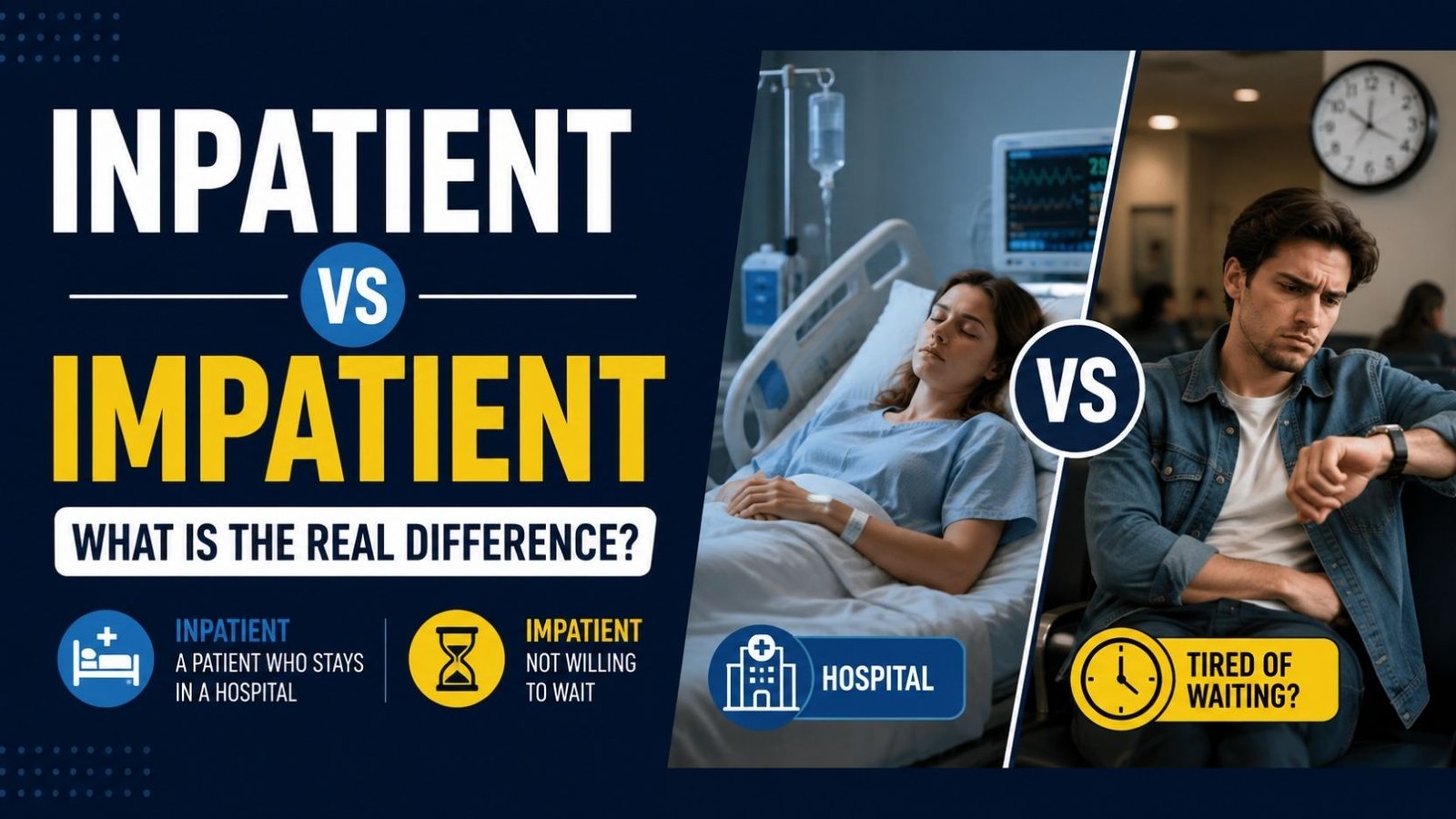
Inpatient and impatient sound almost the same, but they mean completely different things. Inpatient describes a person who stays in a hospital for treatment. Impatient describes a person who does not want to wait. One word belongs to medicine. The other belongs to everyday emotion.
People mix these words up because they look alike on paper and sound similar out loud. This confusion shows up in job applications, medical forms, school essays, and casual writing. Once you understand the small difference in spelling and the big difference in meaning, you will never confuse them again.
Inpatient vs Impatient: Quick Answer
Here is the fastest way to remember the difference.
| Word | Type of Word | Simple Meaning |
| Inpatient | Noun or adjective | A patient who stays overnight in a hospital for treatment |
| Impatient | Adjective | Not willing to wait calmly; easily annoyed by delay |
💡 Tip: If the sentence is about a hospital stay, use inpatient. If the sentence is about someone’s mood or patience level, use impatient.
What Does Inpatient Mean?
Inpatient refers to a person who is admitted to a hospital or medical facility and stays there, usually overnight or longer, to receive treatment.
The word can work as a noun or as an adjective.
- As a noun: “The inpatient was moved to a private room.”
- As an adjective: “She needed inpatient care after the surgery.”
Inpatient care is different from a quick doctor’s visit. It means a person is formally admitted, given a bed, and monitored by medical staff over a period of time.
See More: Labelled Or Labeled
Inpatient Meaning In A Medical Context
In healthcare, the word inpatient is a formal status. It tells insurance companies, doctors, and hospital staff that a person has been officially admitted rather than just visiting for a short procedure.
Common examples include:
- Inpatient rehab: a residential program where a person lives at the facility during treatment
- Inpatient mental health: hospital based care for serious psychiatric conditions
- Inpatient psychiatric hospital: a facility where patients stay full time under supervision
- Inpatient alcohol rehab: a live in program for alcohol addiction treatment
- Inpatient hospice: end of life care provided while the patient stays at a hospice facility
Inpatient Vs Outpatient
This comparison comes up often because the two terms are almost always discussed together in healthcare settings.
| Term | Meaning | Typical Length of Stay |
| Inpatient | Patient is admitted and stays at the facility | Overnight or longer |
| Outpatient | Patient receives treatment and goes home the same day | A few hours, no overnight stay |
The difference between inpatient and outpatient usually comes down to admission status and length of stay, not the seriousness of the condition alone. A person having minor same day surgery is typically an outpatient. A person recovering from major surgery, childbirth, or a psychiatric crisis is typically an inpatient.
✅ Correct: He was admitted as an inpatient after the accident.
✅ Correct: She had outpatient surgery and went home that evening.
What Does Impatient Mean?
Impatient means unwilling or unable to wait calmly. It describes a feeling of restlessness, frustration, or irritation caused by delay.
Impatient is an adjective. It describes a person, a tone, a gesture, or a mood.
- “He grew impatient waiting in line.”
- “Her impatient tone surprised everyone.”
Common Uses Of Impatient
Impatient often appears in everyday conversation, not medical writing. It describes personality traits, temporary moods, or reactions to slow situations.
- Impatient person: someone who struggles to wait or tolerate delay
- Impatient driver: someone who reacts with frustration to traffic or slow drivers
- Impatient customer: someone who becomes annoyed by wait times
⚠️ Common Mistake: Writing “inpatient” when you mean “impatient,” especially in casual texting or fast typing. Spell check does not always catch this because both are real words.
Inpatient Vs Impatient: Side by Side Examples
Seeing both words in similar sentence structures makes the difference clearer.
| Sentence with Inpatient | Sentence with Impatient |
| The hospital admitted her as an inpatient. | She became impatient after a long wait. |
| Inpatient treatment lasted three weeks. | His impatient tone upset the customer. |
| He is receiving inpatient psychiatric care. | The impatient child kept asking, “Are we there yet?” |
Notice that inpatient always connects to a hospital, facility, or medical admission. Impatient always connects to a feeling or behavior related to waiting.
Why These Two Words Get Confused
The confusion happens for three simple reasons.
- The words share almost every letter except the first two.
- Both are pronounced with a similar rhythm and stress pattern.
- Autocorrect and predictive text sometimes swap one word for the other.
Understanding the prefix helps clear this up. In is a prefix that often means “in” or “into,” which fits the idea of being admitted into a hospital. Im is a variation of the prefix in used before certain consonants, and in impatient it means “not,” similar to its use in words like impossible or imperfect.
So impatient literally breaks down as “not patient.” Inpatient breaks down as a patient who is “in” a hospital.
See More: I Would Love To Or Too
How to Pronounce Inpatient And Impatient
The pronunciation is very close, which adds to the confusion in spoken English.
- Inpatient: IN pay shent
- Impatient: im PAY shent
The stress falls on the second syllable in both words, but listen closely to the first sound. Inpatient starts with a clear “in” sound. Impatient starts with a softer “im” sound.
Grammar Breakdown
Understanding the grammar helps you use each word correctly in a sentence.
Inpatient
- Part of speech: noun or adjective
- Plural form: inpatients
- Example as noun: “The inpatients were served breakfast at eight.”
- Example as adjective: “He needs inpatient monitoring.”
Impatient
- Part of speech: adjective only
- Adverb form: impatiently
- Noun form: impatience
- Example: “She impatiently tapped her foot while waiting.”
❌ Incorrect: “He felt very inpatient about the delay.”
✅ Correct: “He felt very impatient about the delay.”
❌ Incorrect: “She was admitted as an impatient.”
✅ Correct: “She was admitted as an inpatient.”
Synonyms and Related Words
Knowing related words can help you choose the right term and avoid repeating the same word too often.
| Word | Related Term | Difference |
| Inpatient | Hospitalized | Hospitalized is more general and can describe any hospital stay, not just formal admission status |
| Inpatient | Residential | Residential treatment often refers to long-term live-in programs, especially for rehab or mental health |
| Impatient | Restless | Restless focuses on physical fidgeting, while impatient focuses on emotional frustration with waiting |
| Impatient | Irritable | Irritable is broader and does not always relate to waiting, while impatient specifically involves delay |
Impatient In Everyday Culture
Impatient often appears outside medical or formal writing, especially in nature, entertainment, and casual speech.
- Impatiens (note the different spelling) are a popular flowering garden plant, often just called “impatient flowers” in casual conversation, though the correct plant name is impatiens.
- The Very Impatient Caterpillar is a well known children’s book that plays on the word impatient to teach kids about patience.
- Impatient is commonly used in memes and GIFs to express frustration with slow loading screens, long lines, or delayed replies.
These cultural references use the emotional meaning of impatient, never the medical meaning of inpatient.
Quick Reference Table
| Category | Inpatient | Impatient |
| Meaning | Hospital admitted patient | Unwilling to wait calmly |
| Word type | Noun or adjective | Adjective |
| Used in | Medical and healthcare contexts | Everyday emotional or behavioral contexts |
| Example | Inpatient rehab program | Impatient customer in line |
| Opposite concept | Outpatient | Patient |
Common Mistakes To Avoid
- ❌ Using “inpatient” to describe someone’s mood or personality
- ❌ Using “impatient” to describe a hospital stay or medical admission
- ❌ Spelling “impatiens” (the flower) as “impatient flower” in formal writing
- ❌ Assuming both words are interchangeable because they look similar
A simple memory trick: inpatient has the word “patient” fully intact, referring to an actual medical patient. Impatient changes the beginning to signal “not patient,” describing a lack of patience.
See More: Emerse Or Immerse
Frequently Asked Questions
What does inpatient mean?
Inpatient means a person who is admitted to a hospital or medical facility and stays there for treatment, usually overnight or longer.
What does impatient mean?
Impatient means unwilling to wait calmly. It describes frustration, restlessness, or annoyance caused by delay.
Is inpatient a noun or an adjective?
Inpatient can be both. As a noun, it refers to the patient themselves. As an adjective, it describes the type of care, such as inpatient treatment.
Is impatient a noun or an adjective?
Impatient is an adjective. The related noun form is impatience, and the related adverb form is impatiently.
What is the difference between inpatient and outpatient?
Inpatient means the person is admitted and stays at the facility, usually overnight or longer. Outpatient means the person receives treatment and goes home the same day without an overnight stay.
How do you pronounce inpatient and impatient?
Inpatient is pronounced, “IN pay shent.” Impatient is pronounced “im PAY shent.” The difference is in the first syllable.
Why do people confuse inpatient and impatient?
The words look and sound similar, and autocorrect sometimes changes one into the other. The meanings, however, are completely different: one is medical, and one is emotional.
Is it “inpatient rehab” or “impatient rehab”?
It is inpatient rehab. This refers to a residential treatment program where a person stays at the facility, not a description of someone’s patience level.
What is the correct spelling for the garden flower?
The garden flower is spelled impatiens, not impatient flower, although many people say “impatient flowers” in casual speech.
Can someone be both an inpatient and impatient at the same time?
Yes. A person admitted to a hospital as an inpatient can also feel impatient while waiting for test results or discharge. The words describe two different things happening at once.
Final Thoughts
Inpatient and impatient may look similar, but they describe two very different ideas. Inpatient belongs to the world of hospitals, medical admission, and treatment programs. Impatient belongs to the world of emotions, behavior, and the simple experience of not wanting to wait.
The easiest way to keep them straight is to look at the first few letters and think about context. If the sentence involves a hospital, a treatment program, or a medical stay, choose inpatient. If the sentence involves a feeling, a mood, or a reaction to waiting, choose impatient. With this simple check, you will use both words correctly every time.

Danish Raza is the author of Grammavio, a trusted resource for simple and easy-to-understand English grammar guides. He creates helpful content covering grammar rules, word meanings, vocabulary, and common grammar mistakes to help readers improve their English skills.



One Comment