
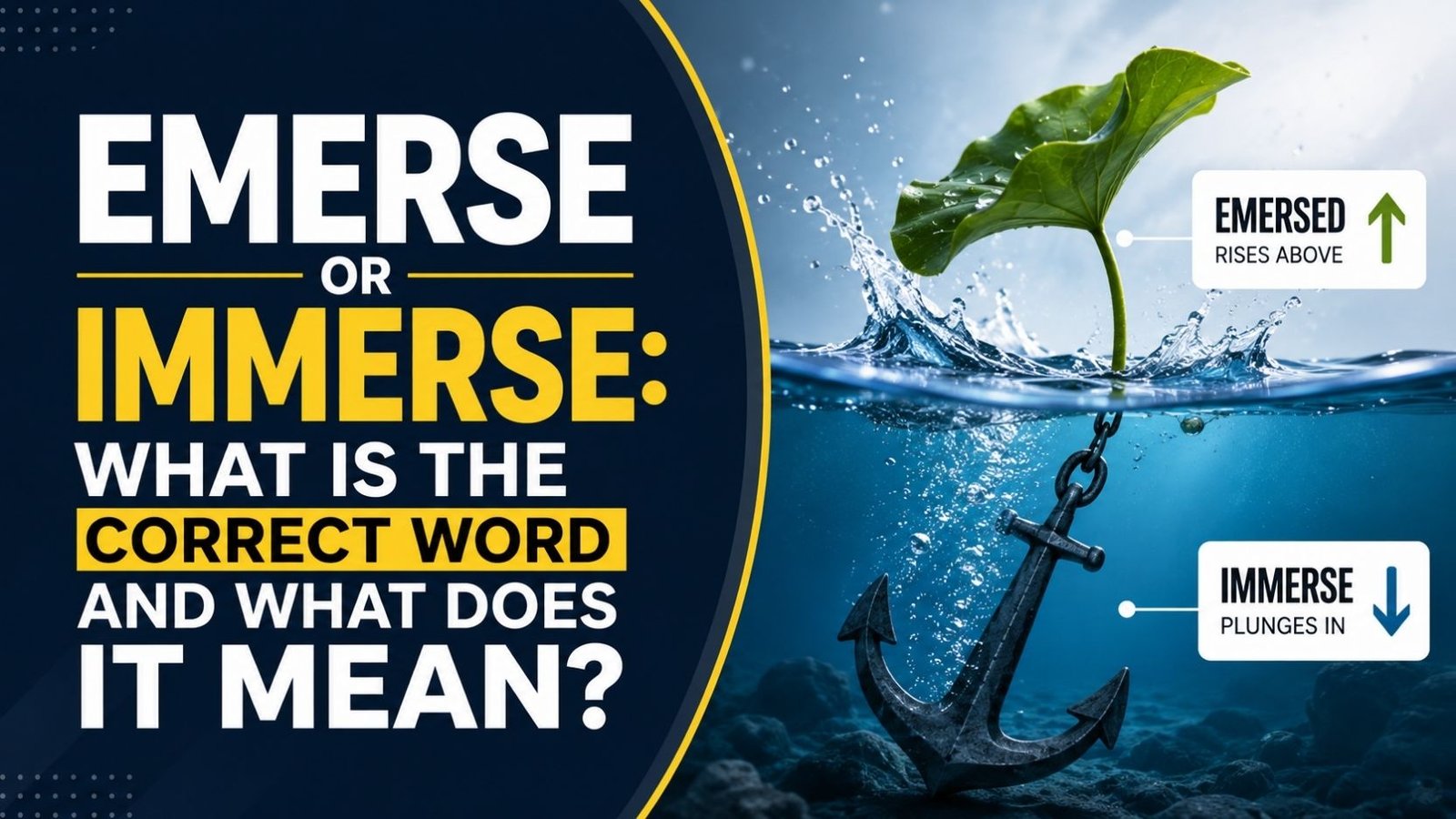
Immerse is the word you want in almost every situation. It means to plunge something fully into liquid, or to involve yourself completely in an activity. Confusion between emerge and immerse happens because the two words look and sound so similar. But only one of them belongs in everyday writing and speech.
Emerse does exist, though not the way most people assume. It shows up mainly as “emersed,” a technical term used in botany and science. Understanding why these words get mixed up will help you use the right one every time, without a second thought.
Emerse Or Immerse: The Quick Answer
Here is the short version before we go deeper.
| Word | Status | Meaning | Where You See It |
| Immerse | Standard English word | To fully submerge something in liquid, or to become fully absorbed in an activity | Everyday writing, speech, education, culture |
| Emerse | Not a standard headword | Sometimes used informally to mean “rise above a surface,” but dictionaries list the adjective form instead | Rare, mostly a spelling slip |
| Emersed | Standard English word | Standing out of or rising above a surface, such as water | Botany, biology, scientific writing |
If you are choosing between emerse or immerse for a sentence about dipping something in water, studying a subject, or learning a language, immerse is correct almost every time.
See More: Dought Vs Doubt
What Does Immerse Mean?
Immerse is a verb. It has two main meanings, and both are common.
Meaning 1: To submerge something in liquid
This is the literal, physical sense. You put an object fully under the surface of a liquid, usually water.
- She immersed the paintbrush in a jar of water.
- The technician immersed the sensor in the cooling fluid.
Meaning 2: To involve yourself completely in an activity
This is the figurative sense, and it is extremely common in modern English, especially around learning and culture.
- He immersed himself in the language during his year abroad.
- The students immersed themselves in the research project.
Both meanings share the same core idea: total involvement, with nothing left outside.
Immerse: Grammar Basics
| Feature | Detail |
| Part of speech | Verb (transitive) |
| Base form | Immerse |
| Past tense | Immersed |
| Present participle | Immersing |
| Third-person singular | Immerses |
| Common structure | Immerse + object + “in” + something |
Immerse is a transitive verb, which means it needs an object. You immerse something or someone — you do not simply “immerse” on its own.
- Correct: She immersed herself in her studies.
- Incorrect: She immersed in her studies.
That second sentence is one of the most common mistakes English learners make with this word. English usually requires a reflexive pronoun like “herself” or “himself” when the sentence has no other object.
What Does Emerse Mean?
This is where things get interesting, and where most emerse or immerse searches actually lead.
“Emerse” on its own is not a standard entry in major dictionaries such as Merriam-Webster or Collins. What you will find instead is “emersed,” the adjective form. Merriam-Webster defines emersed as standing out of or rising above a surface, such as a fluid. Collins gives a similar definition, specifically for aquatic plants whose leaves or stems protrude above the water.
So while “emerse” itself is rarely treated as a headword, the related and recognized word “emersed” is real, and it means the opposite of submerged.
Where Emersed Comes From
Emersed comes from the Latin word emersus, the past participle of emergere, meaning “to rise out” or “to come forth.” That is the same root behind the everyday word “emerge.” First recorded use of “emersed” traces back to the late 1600s.
How Emersed Is Actually Used
You will mostly encounter emersed in specific, technical contexts.
- Botany: Emersed aquatic plants grow with their roots underwater but their leaves and stems above the surface. Water lilies are a familiar example.
- Biology and ecology: Scientists use emersed to describe organisms or plant parts positioned above a liquid line.
- General or poetic writing: Occasionally, a writer uses “emersed” to describe something rising into view, though this is uncommon outside science writing.
Because emersed is a specialist word, most readers will never need it in daily conversation. That is exactly why “emerse” so often gets typed by accident when someone actually means “immerse.”
💡 Tip: If you are writing about water, focus, or learning, you almost certainly want immerse. Save emersed for botany or biology contexts only.
Emerse or Immerse: Are They Opposites?
In a technical sense, yes. Immerse means going into a liquid. Emersed means rising or standing out of one. They come from related but opposite Latin roots:
- Immerse comes from immergere, meaning “to dip into” or “to plunge in.”
- Emersed comes from emergere, meaning “to rise out.”
That single letter swap, “im” versus “e,” carries a completely different direction of movement. Immerse points inward and downward. Emersed points outward and upward.
Emerse vs Immerse: Side-by-Side Comparison
| Feature | Immerse | Emerse / Emersed |
| Standard dictionary entry | Yes | Only as “emersed” |
| Direction of meaning | Into liquid, or into an activity | Out of or above a surface |
| Common usage | Everyday, frequent | Rare, technical |
| Typical field | General English, education, culture | Botany, biology |
| Sample sentence | She immersed herself in the novel. | The plant produces emersed leaves above the waterline. |
Is Emerse A Real Word?
This is one of the most searched questions tied to this topic, so it deserves a direct answer.
Emerse, spelled exactly that way, is not listed as a standard word in major English dictionaries. What dictionaries do recognize is emersed, the adjective describing something rising above a surface. In casual writing, “emerse” almost always appears because a writer meant to type “immerse” and made a spelling slip, often influenced by the similar-looking word “emerge.”
So the honest answer is this: emerse is not a mistake in the sense of being meaningless, since “emersed” is a genuine, dictionary-recognized word. But typing “emerse” when you mean “immerse” is a spelling error, not a valid alternative spelling.
Emerse Faé: A Different Kind Of “Emerse”
If your search brought you here because of a name rather than a definition, this section is for you. Emerse Faé is a real person, a former professional footballer from France who became head coach of the Ivory Coast national football team. He led the team to victory at the Africa Cup of Nations.
In his case, “Emerse” is simply a given name, unrelated to the English word discussed in this article. It shares no grammatical or etymological connection to “immerse” or “emersed.” If you were searching for information about him specifically, know that this article covers the language question only, not sports news or biography.
How To Pronounce Immerse And Emersed
Getting the sound right can also help you remember the spelling.
| Word | Pronunciation Guide | Rhymes With |
| Immerse | ih-MURS | Purse, curse, verse |
| Emersed | ee-MURST | Reversed, dispersed |
Notice the stress falls on the second syllable in both words. The difference sits entirely in that opening sound: a soft “ih” for immerse, and a clearer “ee” for emersed.
See More: Refer Or Reffer
Immerse In A Sentence: Examples
A few clear examples make the meaning stick faster than a long explanation.
- The chef immersed the vegetables in ice water to stop the cooking process.
- To improve quickly, immerse yourself in conversations with native speakers.
- The company immersed new employees in a two-week training program.
- Divers must immerse their equipment before testing it for leaks.
Emersed In A Sentence: Examples
- The emersed leaves of the lotus plant stay dry even though the roots sit underwater.
- Botanists studied how emersed growth differs from fully submerged growth.
Notice how narrow and specific these examples are compared to the immerse examples above. That contrast reflects how each word is actually used in real writing.
Common Mistakes With Emerse Or Immerse
Here are the mistakes people make most often, along with the correct version.
❌ Incorrect: He wants to emerse himself in a new culture.
✅ Correct: He wants to immerse himself in a new culture.
❌ Incorrect: She emersed the fabric in dye overnight.
✅ Correct: She immersed the fabric in dye overnight.
❌ Incorrect: The app helps you emerse in a foreign language.
✅ Correct: The app helps you immerse yourself in a foreign language.
⚠️ Common mistake: Dropping the reflexive pronoun. Many learners write “immerse in” instead of “immerse yourself in” or “immerse oneself in.” Unless there is already a direct object in the sentence, English usually needs that reflexive form.
❌ Incorrect: I want to immerse in painting.
✅ Correct: I want to immerse myself in painting.
Immerse Vs Emerge: Another Common Mix-Up
Emerse or immerse confusion often overlaps with a second mix-up: immerse versus emerge. These two are unrelated in meaning, even though they share letters.
| Word | Meaning | Example |
| Immerse | To plunge into liquid, or become fully absorbed | She immersed herself in the project. |
| Emerge | To come out or become visible | The sun emerged from behind the clouds. |
Emerge is where the “e” in the mistaken spelling “emerse” likely comes from. Writers blend the sound and meaning of “emerge” with the spelling of “immerse,” and “emerse” is the accidental result.
Synonyms For Immerse
These words share the figurative sense of immerse, meaning to become fully absorbed or involved.
| Word | Meaning | Difference From Immerse |
| Absorb | To take in fully, mentally or physically | Slightly more passive; often about attention |
| Engross | To occupy someone’s attention completely | Stronger focus on mental attention specifically |
| Submerge | To put completely under liquid | Almost always literal, rarely figurative |
| Plunge | To move quickly and forcefully into something | Carries a sense of speed or suddenness |
| Steep | To soak thoroughly, or become deeply involved | Common in both cooking and figurative contexts |
None of these words are true substitutes for emersed. Since emersed describes a specific physical position, it does not have many close synonyms outside scientific vocabulary. The closest related term is “exposed,” though that word lacks the specific connection to liquid and surfaces.
See More: Excited Or Exited
Emerse Or Immerse: Quick Reference Box
📌 Remember this:
- Immerse: the word you almost always want. To submerge, or to fully engage.
- Emersed: the real but rare word for something rising above a surface, mainly in botany.
- Emerse: usually a spelling mistake for immerse, influenced by the word emerge.
Frequently Asked Questions
What does emerse or immerse mean?
Immerse means to submerge something in liquid or to become fully involved in an activity. Emerse is not a standard dictionary word on its own; the related term “emersed” means rising above a surface, mainly used in botany.
Is emerse a real word?
Not as a standalone dictionary entry in most major dictionaries. The adjective “emersed” is real and recognized, describing something standing above a liquid surface, such as certain plant leaves.
How do you spell emerse correctly if you mean immerse?
Write “immerse,” with a double “m” and an “i” at the start. That is the standard English word for submerging something or becoming fully involved.
What is the difference between immerse and emerse?
Immerse means going into a liquid or an activity completely. Emersed, the recognized related word, means the opposite: rising or standing above a surface.
Is immerse the same as submerse?
They are closely related. Both describe placing something under liquid, though “submerse” is used less often in everyday English and appears more in scientific or technical writing.
How do you use immerse in a sentence?
Use it with an object or a reflexive pronoun, such as “She immersed the cloth in water” or “He immersed himself in his studies.”
What part of speech is immerse?
Immerse is a transitive verb, meaning it needs an object to complete its meaning.
Is emerse or immerse used in British English differently than American English?
No. Both American and British English treat immerse as the standard spelling. Neither variety recognizes “emerse” as a standard alternative.
Why do people confuse emerse and immerse?
The confusion usually comes from blending “immerse” with the similar-sounding word “emerge,” along with the fact that “emersed” is a genuine, if rare, English word describing the opposite action.
Is Emerse Faé related to the word emerse?
No. Emerse Faé is a personal name belonging to a former footballer and national team coach. It has no grammatical connection to the English words immerse or emersed.
Final Thoughts
Emerse or immerse is really a question with one clear answer for everyday writing: use immerse. It is the standard, dictionary-recognized verb for submerging something in liquid or throwing yourself completely into an activity, whether that is a language, a hobby, or a job. Emerse, spelled that way, is not a recognized standalone word, though its cousin “emersed” is real and useful in the narrow world of botany and biology.
Next time you type this word, picture the double “m” in immerse as two things pressed closely together, fully surrounded. That small image is often enough to stop the mistake before it reaches the page. Whether you are writing an essay, an email, or a caption, choosing immerse will almost always be the accurate, natural choice.

Danish Raza is the author of Grammavio, a trusted resource for simple and easy-to-understand English grammar guides. He creates helpful content covering grammar rules, word meanings, vocabulary, and common grammar mistakes to help readers improve their English skills.



3 Comments