
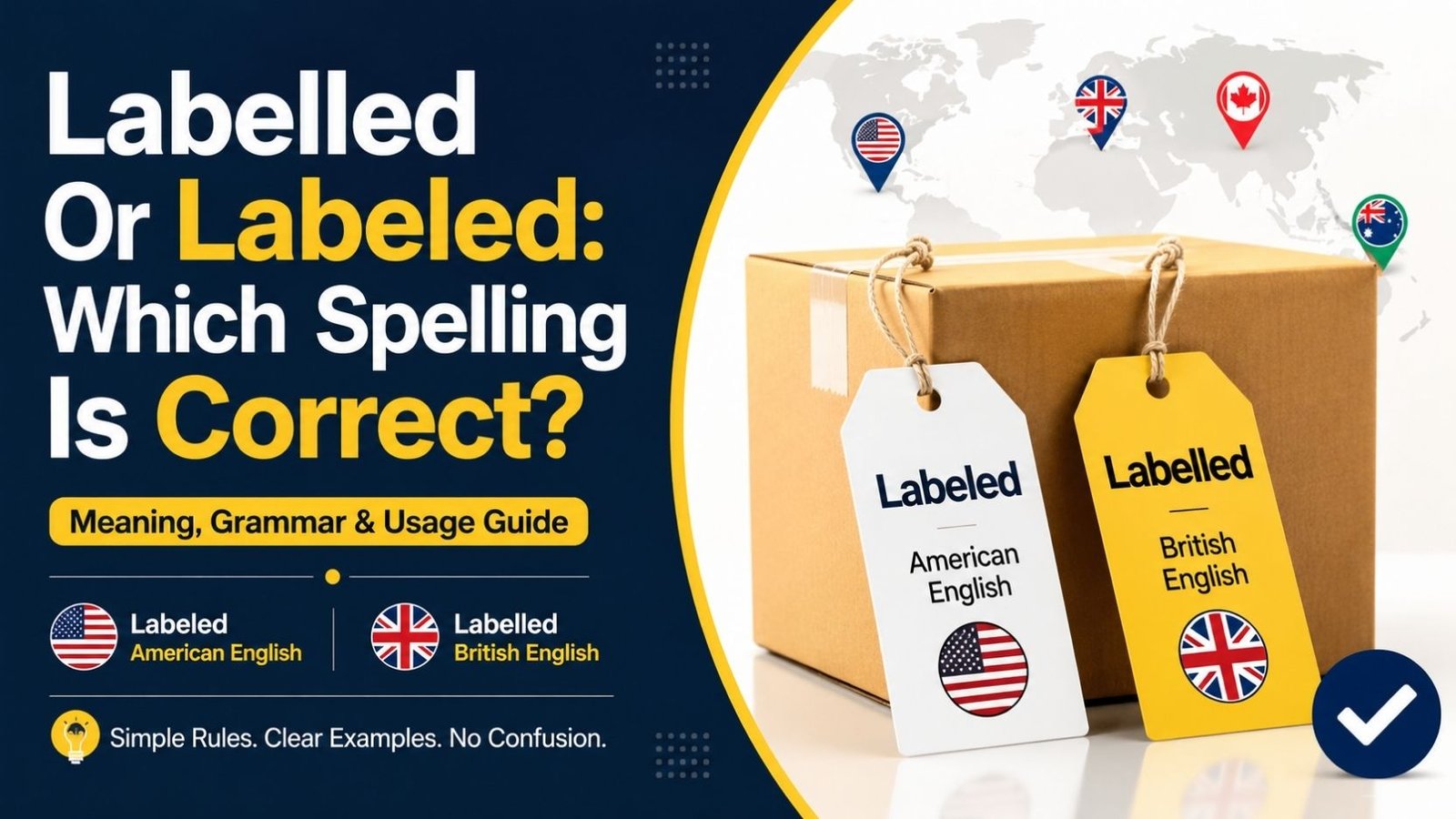
If you have ever paused mid-sentence wondering whether to write labelled or labeled, you are not alone. Both spellings exist, and both are correct, but they belong to different versions of English. The short answer is that labeled is the standard American spelling, while labelled is the standard British, Canadian, and Australian spelling.
The difference comes down to regional spelling conventions rather than meaning. Both words describe the same action, attaching a label to something or describing it in a certain way. Understanding which one to use, and when, helps you write with more confidence in emails, school assignments, product descriptions, and everyday communication.
Labelled Or Labeled: The Simple Answer
Here is the quick version before we go deeper.
- Labeled is used in American English. This is the spelling you will see in United States newspapers, textbooks, and official documents.
- Labelled is used in British English, Canadian English, and Australian English. This is the spelling common across the United Kingdom, Canada, Australia, and most Commonwealth countries.
Neither spelling is wrong. The correct choice depends entirely on which audience you are writing for. If your readers are in the United States, use labeled. If your readers are in the United Kingdom, Canada, Australia, or another Commonwealth country, use labelled.
This pattern is not unique to this word. It follows a well-known rule in English spelling that affects many similar verbs, which we will explain in the grammar section below.
See More: Emerse Or Immerse
What Does Labelled Or Labeled Mean?
Before looking further at spelling, it helps to understand the actual meaning of the word, since both spellings share the exact same definition.
Meaning 1: To attach a label or tag to something
This is the most literal meaning. It refers to physically placing a label on an object so people can identify what it is, what it contains, or how to use it.
Example: The bottles were labeled with the expiration date.
Meaning 2: To describe or classify something with a particular term
This meaning is used when someone gives a name, category, or description to a person, idea, or situation, often in a way that sticks.
Example: Critics labeled the film a disappointment.
Meaning 3: To mark parts of a diagram, chart, or image with names
This meaning is extremely common in science and education. Diagrams such as a labeled microscope, a labeled heart, a labeled brain, or a labeled skeleton show the different parts of an object with their correct names written next to them.
Example: The biology textbook included a labeled diagram of the animal cell.
All three meanings apply equally to both spellings. The word does not change meaning depending on which version of English you use.
Labelled Or Labeled: American English Vs British English
The core reason for the spelling difference goes back to a rule about doubling consonants before adding an ending like ed or ing.
In American English, following rules largely shaped by Noah Webster’s early spelling reforms, a final consonant is usually doubled only when the stress falls on the last syllable of the word. Since the word label is stressed on the first syllable, American English does not double the l, giving labeled and labeling.
In British English, and in Canadian and Australian English, the final l is doubled regardless of where the stress falls, as long as the word ends in a single vowel followed by l. This produces labelled and labelling.
The table below makes the regional pattern easy to see.
| Region | Preferred Spelling | Example Sentence |
| United States | Labeled | The package was labeled fragile. |
| United Kingdom | Labelled | The parcel was labelled fragile. |
| Canada | Labelled | The file was labelled for review. |
| Australia | Labelled | The box was labelled with a warning. |
| India | Labelled (British influence common) | The sample was labelled correctly. |
Because Canada, Australia, and the United Kingdom generally follow British spelling conventions, labelled is the more widely used spelling around the world, even though labeled dominates in the United States.
Grammar: Part Of Speech And Word Forms
Understanding how labelled or labeled functions grammatically makes it easier to use correctly in different sentence types.
Base verb: label
Past tense: labeled (US) or labelled (UK)
Past participle: labeled (US) or labelled (UK)
Present participle or gerund: labeling (US) or labelling (UK)
Third person singular present: labels
Label can also function as a noun, referring to the physical tag or sticker itself, such as a price label or a warning label. When used as a verb, it becomes labeled or labelled once it is put into the past tense.
This same doubling pattern shows up in other common English verbs, which is useful to know if you want to spell related words correctly too.
| Base Word | American Spelling | British Spelling |
| Travel | Traveled | Travelled |
| Cancel | Canceled | Cancelled |
| Model | Modeled | Modelled |
| Signal | Signaled | Signalled |
If you already know whether you follow American or British spelling for one of these words, the same rule applies consistently to labelled or labeled.
How To Use Labelled Or Labeled In A Sentence
Seeing the word in context makes the correct usage much clearer. Below are natural examples using both spellings.
American English examples:
- The teacher labeled each folder with a student’s name.
- All ingredients must be labeled clearly on the packaging.
- He was unfairly labeled as difficult after one bad meeting.
British English examples:
- The teacher labelled each folder with a pupil’s name.
- All ingredients must be labelled clearly on the packaging.
- He was unfairly labelled as difficult after one bad meeting.
Notice that the sentence structure, tone, and meaning stay identical. Only the spelling of the single word changes based on regional convention.
Labelled Or Labeled Diagrams In Science And Education
Many people search for labelled or labeled specifically in the context of school diagrams, since this word appears constantly in science education. A labelled diagram, or labeled diagram, is an illustration where each part is marked with its correct name, usually connected by a line pointing to that part.
This applies to many common classroom topics, including:
- A labeled or labelled microscope, showing parts such as the eyepiece, objective lens, and stage
- A labeled or labelled heart, showing chambers, valves, and major blood vessels
- A labeled or labelled brain, showing regions such as the cerebrum, cerebellum, and brainstem
- A labeled or labelled animal cell or plant cell, showing structures like the nucleus, mitochondria, and cell wall
- A labeled or labelled skeleton, showing individual bones such as the femur, humerus, and scapula
- A labeled or labelled periodic table, showing element names, symbols, and atomic numbers
If you are a student or teacher creating or requesting these materials, the spelling you use should simply match the English variant used in your country or school system. American schools will typically say labeled diagram, while schools in the United Kingdom, Canada, Australia, and many parts of the Commonwealth will say labelled diagram.
See More: Excited Or Exited
How To Pronounce Labelled Or Labeled
Despite the spelling difference, both versions are pronounced the same way.
Labeled or labelled is pronounced as LAY buld, with the stress on the first syllable. The extra l in the British spelling does not change how the word sounds when spoken aloud. Native speakers from any English speaking country will pronounce it identically regardless of which spelling they write.
Origin Of The Word Label
The word label comes from Old French label or lambel, which referred to a strip of cloth or ribbon. This term likely developed from a Germanic root related to strips of fabric used as identifying bands or decorations.
By the late Middle Ages, English speakers had adopted label to describe a small strip attached to an object to identify or describe it, a meaning that has remained largely unchanged for centuries. The verb form, meaning to attach such a strip or to describe something with a term, developed naturally from the noun.
The spelling split between labeled and labelled emerged much later, during the eighteenth and nineteenth centuries, as American and British English spelling gradually diverged through separate dictionary traditions.
Common Mistakes With Labelled or Labeled
Even confident writers occasionally slip up with this word. Here are frequent mistakes to watch for.
⚠️ Mistake 1: Mixing spelling systems in the same document
Incorrect: The item was labeled correctly, and the labelling process took two days.
Correct (American): The item was labeled correctly, and the labeling process took two days. Correct (British): The item was labelled correctly, and the labelling process took two days.
Once you choose one spelling system, use it consistently throughout the entire document.
⚠️ Mistake 2: Assuming one spelling is objectively wrong
Incorrect assumption: Labelled is a misspelling of labeled.
Correct explanation: Labelled is not a misspelling. It is the standard spelling in British, Canadian, and Australian English.
⚠️ Mistake 3: Confusing label as a noun with labeled or labelled as a verb form
Incorrect: She put a labeled on the jar.
Correct: She put a label on the jar. The jar was labeled with its contents.
Labelled or Labeled vs Similar Words
A few related words sometimes cause confusion alongside labelled or labeled.
| Word | Meaning | Difference From Labelled or Labeled |
| Label | The noun form, meaning a tag or sticker | Used as a thing, not an action |
| Mislabeled or mislabelled | Labeled incorrectly | Adds the prefix mis to show an error |
| Unlabeled or unlabelled | Not labeled at all | Adds the prefix un to show absence of a label |
| Tagged | Marked with a tag, often digital | Broader term, often used online or in data contexts |
These related words follow the exact same American versus British spelling pattern as the main word, so once you know your preferred spelling system, it applies consistently across the whole family of words.
See More: Dought Vs Doubt
Frequently Asked Questions
Is it labelled or labeled?
Both are correct. Labeled is used in American English, while labelled is used in British, Canadian, and Australian English.
Which one is correct, labelled or labeled?
Neither spelling is more correct than the other. The right choice depends on which regional version of English you are writing in.
What does labelled or labeled mean?
It means to attach a label to something, to describe something with a particular term, or to mark the parts of a diagram with names.
How do you spell labelled or labeled in the United States?
In the United States, the standard spelling is labeled, with a single l.
How do you spell labelled or labeled in the United Kingdom?
In the United Kingdom, the standard spelling is labelled, with a double l.
Is labelled or labeled used in Canada?
Canadian English generally follows British spelling conventions, so labelled is the more common choice in Canada.
Is labelled or labeled used in Australia?
Australian English follows British spelling, so labelled is the standard form used in Australia.
How do you pronounce labelled or labeled?
Both spellings are pronounced the same way, as LAY buld, with the stress on the first syllable.
What is the difference between labeling and labelling?
Labeling is the American spelling of the present participle, while labelling is the British, Canadian, and Australian spelling. Both mean the same thing.
Can I use labelled or labeled interchangeably in one document?
It is best to pick one spelling system and stay consistent throughout a single piece of writing, especially in formal or academic work.
Conclusion
Labelled or labeled is a case where two spellings can both be correct, depending entirely on regional English conventions. Labeled is the standard form in American English, while labelled is standard across British, Canadian, and Australian English. The meaning, pronunciation, and grammar function stay exactly the same no matter which spelling you choose.
The most useful habit is simply staying consistent. Pick the spelling that matches your audience, whether that is American readers, British readers, or another English speaking region, and use it throughout your writing. Once you know this simple regional rule, you will never have to second guess labelled or labeled again.

Danish Raza is the author of Grammavio, a trusted resource for simple and easy-to-understand English grammar guides. He creates helpful content covering grammar rules, word meanings, vocabulary, and common grammar mistakes to help readers improve their English skills.



One Comment