
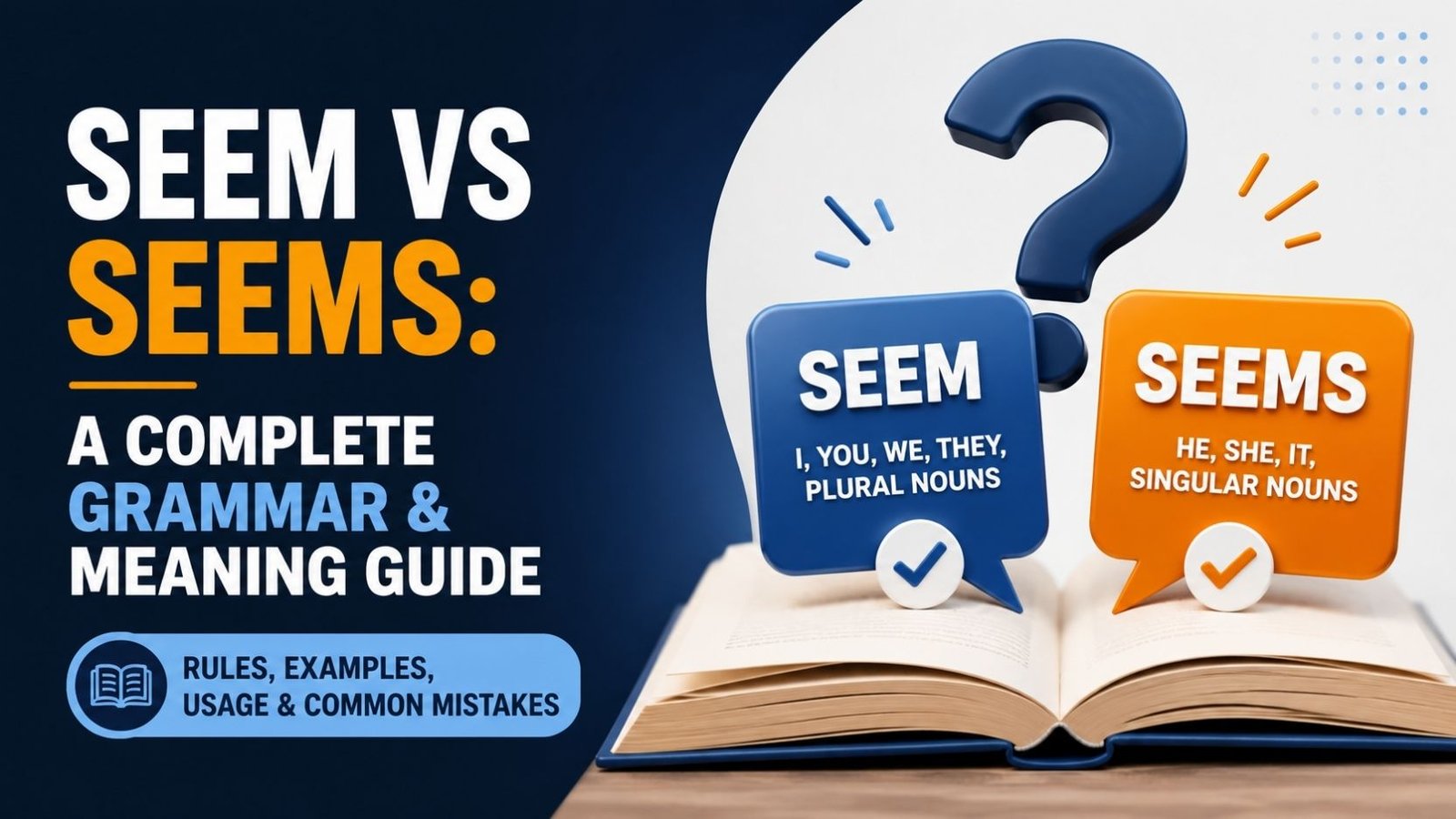
Seem and seems are two forms of the same verb, and the choice between them depends entirely on subject agreement. You use seem with plural subjects and with I, you, we, and they. You use seems with singular subjects like he, she, it, or a single person’s name. Both words describe something that appears true based on the evidence available, without stating it as a definite fact.
Getting this right matters more than it might first appear. A small subject-verb agreement mistake like “she seem tired” instead of “she seems tired” can make writing look careless, even when the meaning is perfectly clear. Understanding when to use seem vs seems also helps with related expressions, from casual conversation to song lyrics, idioms, and formal writing. This guide breaks the rule down simply, then covers pronunciation, related words, common mix-ups, and real examples.
What Does Seem Mean?
Seem is a linking verb. It connects the subject of a sentence to a description, and it shows that something appears to be true based on how it looks, sounds, or feels, rather than something that has been confirmed as fact.
Here is the simplest way to think about it:
- Seem means to give the impression of being something, without stating it as a certainty.
For example, “You seem happy today” does not guarantee the person is happy. It means the speaker observes signs that suggest happiness. This small difference between observation and certainty is the core idea behind the word.
See More: Scarry or Scary
Seem vs Seems: The Core Grammar Rule
The difference between seem and seems comes down to subject-verb agreement, one of the most basic rules in English grammar. Seem is the base form, used in the present tense with plural subjects and with the pronouns I, you, we, and they. Seems is the third-person singular form, used with he, she, it, or any singular noun.
| Subject | Correct Form | Example |
| I | seem | I seem confused by this. |
| You | seem | You seem tired today. |
| He / She / It | seems | She seems happy about the news. |
| We | seem | We seem to agree on this. |
| They | seem | They seem ready for the trip. |
| Singular noun (a name, a thing) | seems | The plan seems solid. |
| Plural noun | seem | The results seem accurate. |
💡 Quick Tip: If you can replace the subject with “he” or “it” and the sentence still sounds natural, use seems. If you can replace it with “they” or “we,” use seem.
When To Use Seem Vs Seems
Knowing the rule is one thing. Applying it naturally takes a bit more context. Here are the situations where each form shows up most often.
Use Seem When:
- The subject is I, you, we, or they.
- The subject is a plural noun, such as “the students,” “the numbers,” or “the reviews.”
- You are giving a general statement without a specific singular subject.
Example: “The instructions seem confusing to new users.”
Use Seems When:
- The subject is he, she, or it.
- The subject is a singular noun, such as “the movie,” “the app,” or a person’s name.
- The sentence uses an impersonal “it,” as in “it seems.”
Example: “It seems like a good idea.”
It Seems Vs There Seems
Two phrases that often cause confusion are “it seems” and “there seems.” Both are grammatically correct, but they are used in slightly different situations.
“It seems” is used to introduce an opinion, impression, or piece of information, often followed by “that” or “like.”
- It seems that the meeting was rescheduled.
- It seems like everyone already knew.
“There seems” is used to point out the existence of something, usually followed by “to be.”
- There seems to be a problem with the printer.
- There seems to be some confusion about the schedule.
Both phrases use the singular form seems because “it” and “there” function as singular subjects in these constructions.
It Seems Vs It Would Seem
“It would seem” is a more cautious, formal version of “it seems.” It softens a statement and adds distance, often used when the speaker is not fully certain or wants to sound more polite.
- It seems he forgot the meeting. (Direct observation)
- It would seem he forgot the meeting. (More formal, more tentative)
“It would seem” is common in academic writing, journalism, and formal speech, while “it seems” works well in everyday conversation.
Seem Vs Seam: A Common Mix-Up
Seem and seam sound identical, which makes them a classic pair of homophones. Despite the same pronunciation, they have completely different meanings and spellings.
| Word | Part of Speech | Meaning | Example |
| Seem | Verb | To appear to be true | You seem tired. |
| Seam | Noun | A line where two pieces of fabric or material are joined | The seam on this jacket is loose. |
❌ Incorrect: The idea doesn’t seam right.
✅ Correct: The idea doesn’t seem right.
A simple way to remember the difference: seam relates to sewing and joining materials, while seem relates to appearance and impression.
How To Pronounce Seem And Seems
Both words are pronounced the same way in terms of the base sound, with seems simply adding the “z” sound at the end.
- Seem: pronounced “seem” (rhymes with “team” and “dream”)
- Seems: pronounced “seemz” (the final “s” sounds like a “z”)
There is no difference between American and British pronunciation for this word. It stays consistent across English-speaking regions.
Seem Synonym: Words With A Similar Meaning
Several words share a similar meaning with seem, though each carries a slightly different shade of tone or formality.
| Word | Meaning | Difference From Seem |
| Appear | To give an impression based on how something looks | Slightly more formal, often used in writing |
| Look | To give a visual impression | More casual, focused on appearance |
| Sound | To give an impression based on how something is described | Used specifically for spoken or written information |
| Come across as | To create a certain impression through behavior | More conversational, often used for personality |
See More: Brite Vs Bright
Seem Vs Appear Vs Look
These three words are often used interchangeably, but they have subtle differences.
- Seem is the most general. It works for feelings, ideas, situations, and appearances.
- Appear is often used in more formal or written contexts, and it leans toward visual or observable impressions.
- Look is almost always tied to visual appearance specifically.
Example comparison:
- She seems upset. (General impression, could be based on tone, behavior, or words)
- She appears upset. (Slightly more formal, often based on visible signs)
- She looks upset. (Based specifically on her facial expression or appearance)
Does Not Seem To: Synonym Options
When looking for alternatives to “does not seem to,” writers often reach for phrases like “does not appear to,” “fails to,” or “shows no sign of.” Each carries a slightly different weight, so the best choice depends on tone. “Does not appear to” works well in formal writing, while “shows no sign of” adds more emphasis.
Common Mistakes With Seem And Seems
Even confident English speakers slip up occasionally with this pair. Here are the most frequent errors.
❌ Incorrect: He seem fine.
✅ Correct: He seems fine. Why: “He” is a singular subject, so it requires seems.
❌ Incorrect: They seems happy.
✅ Correct: They seem happy. Why: “They” is a plural pronoun, so it requires seem.
❌ Incorrect: The results seems clear.
✅ Correct: The results seem clear. Why: “Results” is plural, even though it ends in “s,” so it takes seem, not seems.
❌ Incorrect: The idea don’t seem right.
✅ Correct: The idea doesn’t seem right. Why: “Idea” is singular, so the negative auxiliary must also be singular: “doesn’t,” not “don’t.”
⚠️ Common Trap: Words that end in “s” are not always plural. “News,” “results,” and “series” can trip people up because of how they look, not how they function grammatically. Always check whether the subject is actually singular or plural in meaning, not just in spelling.
“You Seem Pretty Sad” And Similar Phrases in Songs and Culture
The phrase “you seem pretty sad for a girl in love” appears in a well known song by Olivia Rodrigo, where it is used as an observation about someone whose emotional state doesn’t match how they claim to feel. This is a natural, correct use of seem: the speaker is describing an impression based on outward behavior, not stating a certain fact. Grammatically, “you seem” is correct because the subject is “you,” which always pairs with the base form seem, regardless of whether it refers to one person or several.
Other well-known expressions use the same grammar pattern correctly:
- “The owls are not what they seem” (a memorable line associated with the show Twin Peaks) uses “they seem” because the subject, “the owls,” is plural.
- “All that we see or seem” is a phrase drawn from classic poetry, using “seem” because the subject “we” requires the base form.
- “There is a way that seems right to a man,” a well-known line often associated with the Book of Proverbs, uses “seems” because “a way” is a singular subject.
- “Sorry seems to be the hardest word,” a song popularized by Elton John, uses “seems” because “sorry” functions as a singular subject in that sentence.
These examples show that the seem versus seems rule holds steady across poetry, scripture, music, and television, because the grammar rule doesn’t change based on genre. It only changes based on the subject.
Seem In Reassuring: Everyday Situations
Outside of grammar and lyrics, “seems fine” is one of the most common phrases people search for when they are worried about a pet, a child, or a situation that looks okay on the surface but still causes concern. Phrases like “my cat keeps throwing up but seems fine,” “my dog ate grapes but seems fine,” or “my baby fell off the bed but seems fine” all use seems correctly, since the subject in each case, cat, dog, or baby, is singular.
It’s worth noting that “seems fine” describes an outward impression only. It does not confirm that everything is actually fine internally. This is exactly why the word seem exists: it separates what appears true from what is medically or factually confirmed. If a pet or child has had a concerning incident, such as eating something toxic or experiencing a fall, “seeming fine” is not a substitute for checking with a veterinarian or doctor, since some symptoms take time to appear.
Origin Of Seem
Seem comes from Middle English, where it developed from an Old Norse word meaning “to befit” or “to be fitting.” Over time, the meaning shifted from describing what was proper or suitable to describing what appears to be the case.
This connects to the idea of something matching an expectation or an impression, which is close to how the word functions today. The shift happened gradually as English absorbed influence from Old Norse during periods of contact between English and Scandinavian speakers in medieval Britain.
See More: Natzi Or Nazi
Seem Vs Seems: Quick Reference Table
| Situation | Correct Word | Example Sentence |
| Subject is singular (he, she, it, a name) | Seems | The teacher seems patient. |
| Subject is plural (they, we, multiple nouns) | Seem | The teachers seem patient. |
| Subject is “I” or “you” | Seem | I seem to have lost my keys. |
| Formal, cautious statement | It would seem | It would seem the report was incomplete. |
| Pointing out existence of something | There seems | There seems to be a delay. |
| Introducing an opinion or impression | It seems | It seems like a fair decision. |
Frequently Asked Questions
What does seem mean?
Seem means to give the impression of being true or real, based on observation, without stating it as a confirmed fact.
What is the difference between seem and seems?
Seem is used with plural subjects and with I, you, we, and they. Seems is used with singular subjects like he, she, it, or a singular noun.
Is seems a noun or a verb?
Seems is a verb. Specifically, it is the third-person singular present tense form of the linking verb seem.
How do you use seem vs seems in a sentence?
Match the form to the subject. Use “she seems happy” for a singular subject and “they seem happy” for a plural subject.
Is it “it seem” or “it seems”?
It is always “it seems,” since “it” is treated as a singular subject in English grammar.
What is a good synonym for seem?
Appear, look, and sound are common alternatives, though each has a slightly different tone and context.
Is “seem” and “seam” the same word?
No. They are pronounced the same but spelled differently and mean different things. Seem relates to appearance or impression, while seam refers to a stitched line joining fabric or material.
Why do people say “seems fine” instead of “is fine”?
“Seems fine” reflects an outward impression rather than a guaranteed fact. It leaves room for something to be true on the surface while still uncertain underneath.
Is “there seem” or “there seems” correct?
“There seems” is correct when followed by a singular idea, as in “there seems to be an issue.” “There seem” is correct with a plural idea, as in “there seem to be several issues.”
Conclusion
The difference between seem and seems always comes down to subject agreement. Seem pairs with I, you, we, they, and plural nouns, while seems pairs with he, she, it, and singular nouns. This single rule applies whether you’re writing a formal report, texting a friend, or noticing that a lyric or quote uses the word correctly. Once this pattern feels familiar, choosing between seem and seems becomes automatic rather than something you have to stop and check.
Beyond the grammar, seem is a genuinely useful word because it lets you describe an impression without overstating what you actually know. Whether you’re saying a pet seems fine after a scare, a plan seems solid, or someone seems sad despite their words, the word gives you a way to speak honestly about appearances while leaving room for the full truth to still be uncertain.

Danish Raza is the author of Grammavio, a trusted resource for simple and easy-to-understand English grammar guides. He creates helpful content covering grammar rules, word meanings, vocabulary, and common grammar mistakes to help readers improve their English skills.



2 Comments