
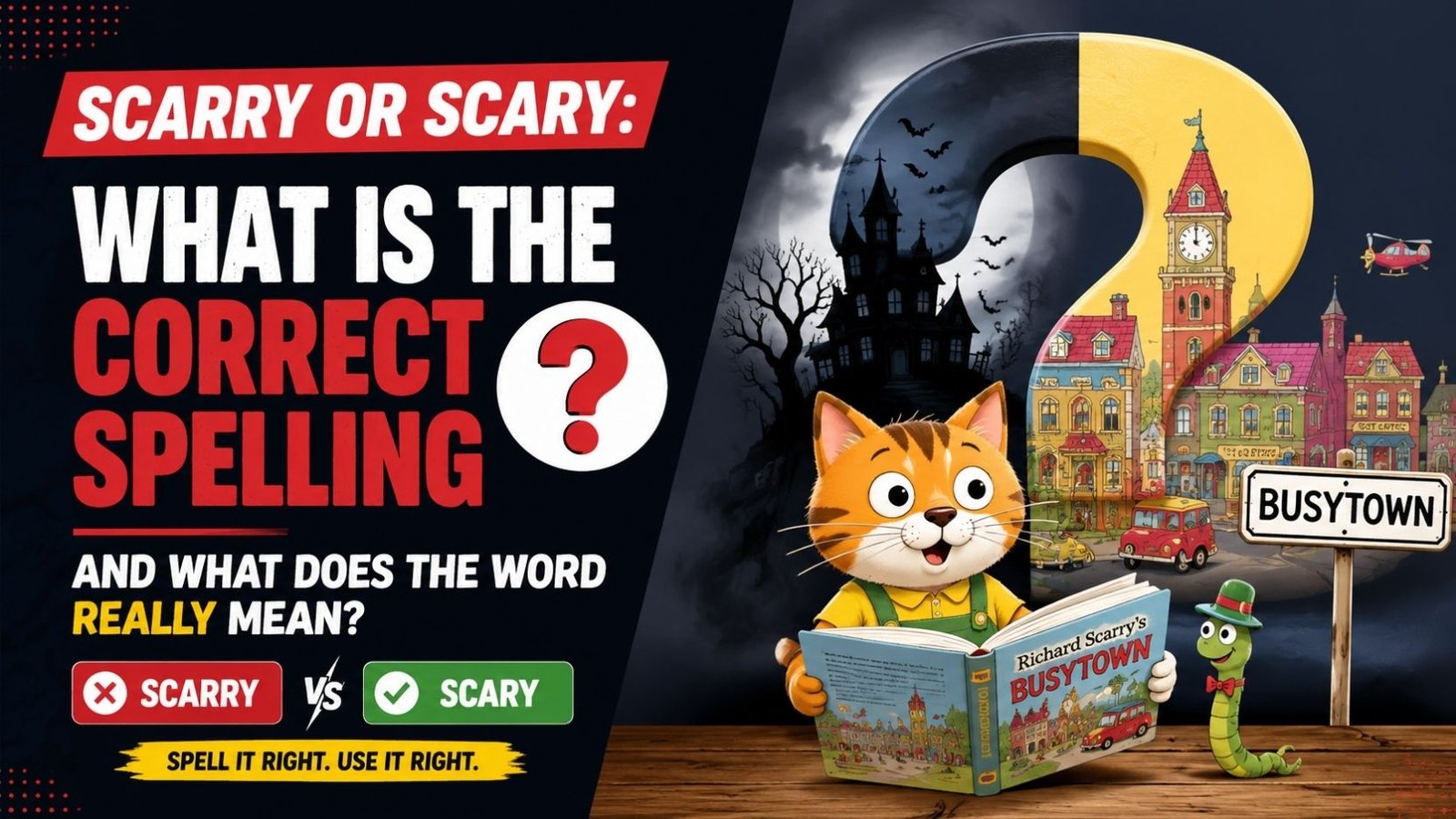
If you have typed “scarry” into a search bar and then paused, wondering whether that second r belongs there, you are not alone. The correct spelling is scary, with one r, and it is the only form recognized in standard English dictionaries. Scarry shows up constantly online anyway, partly because of a simple typing habit and partly because Scarry is also a real surname, most famously belonging to children’s author Richard Scarry.
This guide clears up both sides of the confusion. You will learn exactly why scary is correct, how the word works grammatically, where it came from, and how to avoid the common typo for good. You will also learn who Richard Scarry was, since so many people searching “scarry” are actually looking for him, his Busytown books, or the classic characters he created, not a horror-movie adjective at all.
Quick Answer: Scarry Or Scary
Scary is the correct English word. It is an adjective that describes something causing fear, unease, or alarm, and it appears in every major dictionary, including Merriam-Webster and the Oxford English Dictionary.
Scarry is not a standard English word. When people type it, they are almost always doing one of two things: misspelling scary, or referring to the surname Scarry, as in Richard Scarry, the American author and illustrator behind Busytown.
| Term | Status | What it means |
| Scary | Correct spelling | Adjective meaning frightening or causing fear |
| Scarry | Not a dictionary word | Usually a misspelling of scary, or the surname Scarry |
See More: Natzi Or Nazi
What Does Scary Mean?
Scary means causing fear, fright, or nervousness. It describes anything, real or imagined, that makes a person feel afraid or on edge.
The word covers a wide emotional range. A scary movie might involve monsters or jump scares. A scary situation, like a job interview or a medical test, does not involve danger in the traditional sense, but it still triggers the same uneasy feeling.
Examples:
- The abandoned house at the end of the street looks scary at night.
- Public speaking feels scary to a lot of people, even confident ones.
- That was a scary moment on the highway when the car in front braked suddenly.
Scary is an adjective, and it almost always describes a noun directly, either before it (“a scary noise”) or after a linking verb (“the noise was scary”).
Why Scarry Is Not A Word
Scarry looks plausible because English does sometimes double a consonant before adding y, as in words like carry, berry, and marry. That pattern, though, does not apply here.
Scary is built from the verb scare plus the suffix -y. Scare already ends in a single consonant sound, so no doubling rule kicks in. The correct construction is simply scare + y, which gives scary, not scarry.
Because scarry is not recognized in any major dictionary, spell-checkers and grammar tools will flag it automatically. If you are writing anything formal, a resume, an email, a school paper, always correct scarry to scary before you send it.
There is one major exception to keep in mind: Scarry is a legitimate surname. It is not a misspelling when it refers to a person’s actual last name, such as Richard Scarry, Elaine Scarry, or Eddie Scarry. Context tells you which situation you are dealing with.
Grammar Of The Word Scary
Scary follows regular adjective rules in English.
| Form | Word | Example |
| Base form | Scary | The clown looked scary. |
| Comparative | Scarier | This movie is scarier than the last one. |
| Superlative | Scariest | That was the scariest ride at the park. |
Comparative and superlative note: Because scary ends in a consonant plus y, the y changes to i before adding -er or -est. That gives scarier and scariest, not scaryer or scaryest. You will sometimes see “more scary” or “most scary” in casual speech, and it is not grammatically wrong, but scarier and scariest are the standard, more natural choices in both American and British English.
Scary is only an adjective. It is not a verb, and it is not a noun. The related verb is scare (“The movie scared me”), and the related noun describing the feeling is fear or fright, not “scary” itself.
Common Mistakes
⚠️ People mix up scary and scarry more often in casual texting and social media than in formal writing, but the mistake is easy to fix once you know the pattern to watch for.
❌ Incorrect: That show was really scarry.
✅ Correct: That show was really scary.
❌ Incorrect: He gave me a scarry look.
✅ Correct: He gave me a scary look.
❌ Incorrect: This is the scaryer part of the story.
✅ Correct: This is the scarier part of the story.
💡 Tip: If you remember that scary comes from scare with just one r, the extra r in scarry stops making sense, and the correct spelling becomes automatic.
How To Pronounce Scary
Scary is pronounced with two syllables.
- American English: /ˈsker.i/, roughly “SKAIR-ee”
- British English: /ˈskeə.ri/, roughly “SKAIR-ee” with a slightly softer vowel
The stress always falls on the first syllable. There is no separate or alternate pronunciation for scarry, since it is not a recognized word on its own.
See More: Behavior Or Behaviour
Origin Of The Word Scary
Scary is a relatively modern formation compared to many English words. It comes directly from the verb scare, which entered English in the medieval period, likely influenced by an Old Norse word related to sudden fright.
Once scare was established as a verb, English speakers formed the adjective by adding the common -y suffix, the same pattern used to turn rain into rainy or luck into lucky. This gives scary a fairly transparent, logical origin: something that scares you is, by definition, scary.
The word has stayed remarkably stable over time. Its meaning, spelling, and pronunciation have not shifted much, which is part of why the scarry misspelling stands out so clearly to dictionaries and spell-checkers today.
Synonyms And Related Words
Several words overlap with scary, but each carries a slightly different shade of meaning.
| Word | Meaning | How it differs from scary |
| Frightening | Causing sudden fear | Very close to scary, often used interchangeably |
| Terrifying | Causing intense, overwhelming fear | Stronger than scary; suggests extreme fear |
| Creepy | Causing unease or a sense of wrongness | Focuses on discomfort rather than outright fear |
| Spooky | Eerie, often tied to ghosts or the supernatural | Lighter and more playful than scary |
| Alarming | Causing concern or worry | Often used for serious or urgent situations, not just fear |
Scary vs. creepy: This is one of the most common comparisons readers search for. Scary usually describes something that produces a direct, immediate fear response, like a jump scare or a dangerous situation. Creepy describes a more lingering, uneasy feeling, the sense that something is subtly wrong, even if nothing overtly dangerous has happened. A dark alley at night can feel creepy without anything scary actually occurring in it.
Scary In Different Contexts
In everyday conversation: Scary is casual and widely used to describe anything from spiders to first dates. “That was scary” works for almost any mildly frightening experience.
In storytelling and horror writing: Writers use scary alongside more vivid, specific descriptions to build atmosphere. A skilled scary story usually relies on pacing and detail rather than the word scary itself, which can feel flat if overused.
In emotional or figurative use: People often use scary for non-physical fears, like a scary diagnosis, a scary financial decision, or a scary conversation they have been avoiding. This figurative use is extremely common and completely standard.
Who Is Richard Scarry?
Many people searching “scarry” are not thinking about spelling at all. They are trying to find Richard Scarry, one of the best-known children’s book authors and illustrators of the twentieth century.
Richard Scarry was born in Boston, Massachusetts, in 1919. After serving in the United States Army during World War II, he moved to New York City to work as a commercial artist. He eventually connected with the publisher behind Little Golden Books, which launched his career illustrating children’s stories.
Scarry went on to create the fictional world of Busytown, a bustling town populated by anthropomorphic animal characters. His breakthrough came with Richard Scarry’s Best Word Book Ever, a densely illustrated picture book packed with labeled objects and scenes that helped young children learn new vocabulary. He later created What People Do All Day, Cars and Trucks and Things That Go, and dozens of other titles.
His most beloved characters include:
- Lowly Worm – a friendly, shoe-wearing earthworm and one of Scarry’s signature creations
- Huckle Cat – a young cat who often serves as the reader’s guide through Busytown
- Goldbug – a small, gold-colored beetle hidden somewhere on almost every page, encouraging children to search and find him
- Mr. Frumble – a clumsy pig prone to comic mishaps, usually behind the wheel of a car
Scarry illustrated more than 150 books over his career, and his work has sold well over 100 million copies worldwide, translated into dozens of languages. In 1968, he moved his family to Switzerland, where he continued working until his death in 1994. His son, Richard “Huck” Scarry, is also an illustrator and continues to work on Busytown-related books today.
The Busy World Of Richard Scarry
Busytown was adapted into an animated television series, The Busy World of Richard Scarry, which first aired in the 1990s. The show follows Huckle Cat, Lowly Worm, and their friends through everyday adventures, songs, and gentle life lessons, closely mirroring the tone and characters of Scarry’s original books.
The series has appeared over the years on various streaming and on-demand platforms, including ad-supported services and rental or purchase options through major digital storefronts. Availability changes fairly often and varies by country, so the most reliable way to check current options is to search the show’s title directly on your preferred streaming platform or a streaming availability tracker.
Other People Named Scarry
Scarry is an established surname beyond Richard Scarry, which is another reason the word “scarry” shows up so often in searches.
- Elaine Scarry is an American academic, best known as a professor at Harvard University and the author of scholarly works examining pain, beauty, and violence, including her widely cited book The Body in Pain.
- Eddie Scarry is an American journalist and photographer known for his political commentary and reporting.
None of these uses are misspellings. When “Scarry” appears as part of a proper name, the double r is simply how that particular family name is spelled, unrelated to the adjective scary.
See More: Where Or Were
Scary Movie And The Word Scary In Pop Culture
Several of the most searched phrases connected to this topic point to the Scary Movie franchise, a long-running series of horror-comedy parody films that began in 2000. The franchise, created largely by the Wayans family, pokes fun at popular horror movies through exaggerated, comedic scenes.
The series has continued to expand over the years, with a sixth installment reuniting much of the original cast and creative team decades after the first film. As with any active film franchise, exact release details, cast additions, and streaming availability continue to change, so checking a current entertainment source is the best way to confirm up-to-date specifics.
Other well-known scary-themed entertainment includes Scary Stories to Tell in the Dark, a classic collection of horror short stories for young readers, and seasonal attractions like Knott’s Scary Farm, a haunted-themed event held annually at Knott’s Berry Farm in California.
Frequently Asked Questions
Is scarry a real word?
No. Scarry is not recognized in standard English dictionaries. It is a common misspelling of scary, except when it refers to the surname Scarry.
What does scary mean?
Scary means causing fear, fright, or unease. It describes anything, real or emotional, that makes someone feel afraid.
Is scary a noun or a verb?
Scary is an adjective. It is not a noun or a verb. The related verb is scare, and the related noun for the feeling is fear or fright.
How do you spell the comparative form of scary?
The comparative form is scarier, and the superlative form is scariest. The y changes to i before adding the ending.
Is “more scary” grammatically correct?
It is understandable and not technically wrong, but scarier is the more natural and standard comparative form in both American and British English.
What is the difference between scary and creepy?
Scary usually describes an immediate, direct fear response. Creepy describes a lingering sense of unease or wrongness, even without an obvious threat.
Who is Richard Scarry?
Richard Scarry was an American children’s author and illustrator, best known for creating the fictional town of Busytown and characters like Lowly Worm, Huckle Cat, and Goldbug.
Why do so many people search “scarry” when they mean Richard Scarry?
Because Scarry is genuinely how his surname is spelled, with two r’s. It is correct in that context, even though the same spelling is incorrect when used as an adjective.
How do you pronounce scary?
Scary is pronounced “SKAIR-ee,” with the stress on the first syllable, in both American and British English.
Conclusion
Scary is the only correct spelling when you mean something that causes fear, and scarry has no independent meaning as an adjective in standard English. The confusion mostly comes down to a simple, understandable typing habit, since English doubles consonants in similar-looking words like carry and berry, just not in this one. Once you connect scary back to its root word, scare, the correct spelling becomes easy to remember for good.
At the same time, Scarry is not always wrong. It is a legitimate surname, most notably belonging to Richard Scarry, whose Busytown books and characters have introduced generations of children to reading. Whether you came here to fix a spelling mistake or to learn more about the author behind Lowly Worm and Goldbug, the key takeaway is simple: scary describes fear, and Scarry, with a capital S, describes a person.

Danish Raza is the author of Grammavio, a trusted resource for simple and easy-to-understand English grammar guides. He creates helpful content covering grammar rules, word meanings, vocabulary, and common grammar mistakes to help readers improve their English skills.



2 Comments