
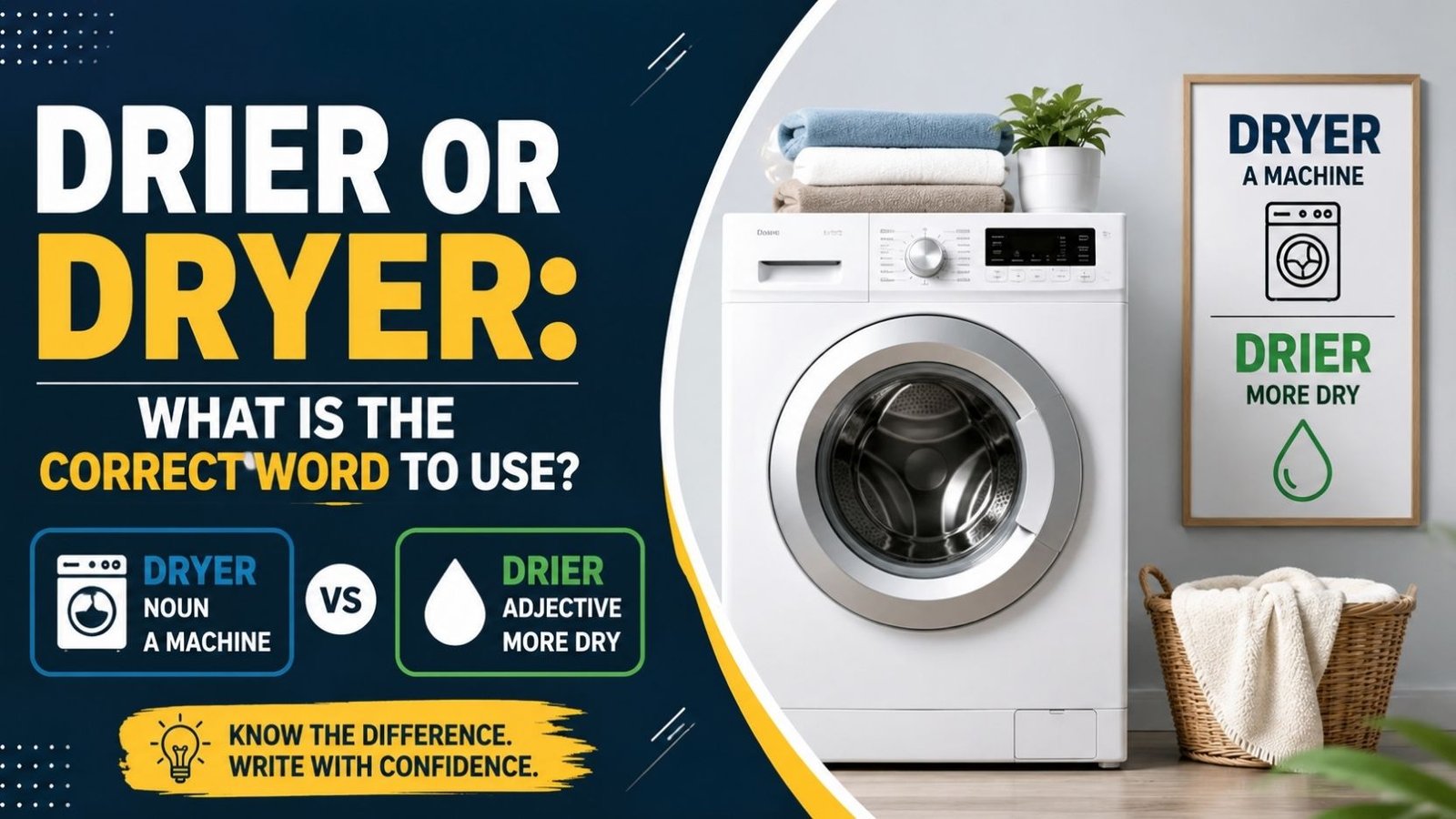
Drier or dryer? Both spellings are correct, but they usually mean different things. Dryer is a noun. It names a machine, like a clothes dryer or a hair dryer. Drier is normally an adjective. It is the comparative form of dry, meaning “more dry.”
So if you are talking about a machine, dryer is almost always the right choice in American English. If you are comparing how dry something is, drier is the word you want. This distinction is small, but it changes the meaning of a sentence, so it is worth understanding clearly before you write or speak.
Quick Answer: Drier or Dryer?
Here is the short version before we go deeper.
- Dryer = a noun. A machine that removes moisture, such as a clothes dryer or hair dryer.
- Drier = an adjective. The comparative form of dry, used to compare how dry two things are.
- In American English, dryer is the standard spelling for the machine. Drier is rarely used this way in the United States.
- In British English, drier sometimes appears as a noun too, especially in phrases like tumble drier. But dryer is still common there as well.
If you remember one rule, remember this: dryer names a thing; drier compares two things.
Drier or Dryer: The Core Difference
The confusion between these two words comes from the fact that they are pronounced the same way. Both are said as “DRY er.” Because they sound identical, many people are unsure which spelling fits their sentence.
The difference lies entirely in grammar, not in sound.
| Word | Part of Speech | Meaning | Example |
| Dryer | Noun | A machine or device that dries something | I bought a new dryer for the laundry room. |
| Drier | Adjective (comparative) | More dry than something else | This desert air is drier than the coast. |
Once you separate the two by function rather than by sound, the choice becomes much easier.
See More: Trainning Or Training
Is It Drier Or Dryer? How To Decide In A Sentence
Ask yourself one simple question: am I naming a thing, or am I comparing dryness?
If you are naming a thing, such as an appliance, use dryer.
- I need to fix my dryer.
- The hair dryer stopped working this morning.
- Put the towels in the dryer.
If you are comparing how dry something is compared to something else, use drier.
- The towel felt drier after an hour in the sun.
- This summer has been drier than last summer.
- My skin gets drier in winter.
A helpful trick is to try replacing the word with “more dry.” If the sentence still makes sense, drier is correct. “My skin gets more dry in winter” works, so drier is the right word. “I bought a new more dry for the laundry room” does not work, so dryer is correct there instead.
Drier or Dryer Machine: Which Spelling Is Correct?
When you are talking about an actual appliance, dryer is the standard and expected spelling in American English.
This applies to:
- Clothes dryer or tumble dryer
- Hair dryer or blow dryer
- Hand dryer in public restrooms
- Freeze dryer used in food preservation
- Spray dryer used in industrial processing
- Air dryer used with compressed air systems
In the United States, writing “clothes drier” or “hair drier” will look like a spelling mistake to most readers, even though some dictionaries still list drier as an older or alternate noun form. For clear, modern American writing, stick with dryer whenever you mean a machine.
Drier or Dryer for Clothes
A clothes dryer, also called a tumble dryer, is the appliance used to dry laundry after washing. In American English, this is always spelled dryer. British English speakers sometimes write tumble drier instead, and both forms are understood in the UK, though dryer remains widely used there too.
Hair Drier or Dryer
The handheld device used to dry hair is called a hair dryer in standard American usage. You may still see hair drier in some older British texts, but dryer is now the more common spelling across both American and British English for this product.
Washer and Drier or Washer and Dryer
When referring to a combined laundry set, the correct American spelling is washer and dryer. This phrase describes two appliances: the washing machine and the clothes dryer.
Drier or Dryer UK: Does British English Spell It Differently?
British English is more flexible with this word than American English.
In the UK, you will sometimes see:
- Tumble drier (as a noun for the machine)
- Tumble dryer (also correct and common)
Both spellings appear in British writing, product packaging, and everyday conversation. However, even in the UK, dryer is generally considered the more standard and widely accepted spelling for the appliance, while drier remains firmly the comparative adjective in both American and British English.
If you are writing for a UK audience, either spelling for the machine will usually be understood. If you are writing for a US audience, dryer is the safer and more expected choice.
Drier or Dryer Weather: Comparing Dryness
When talking about weather, climate, or moisture levels, drier is the correct word because you are comparing degrees of dryness.
- This region has drier weather than the coast.
- The forecast predicts drier conditions next week.
- Autumn tends to be drier than spring where I live.
You would not use dryer here, because you are not referring to a machine. You are comparing how dry the weather is compared to another time or place.
Drier or Dryer Skin: Comparing Moisture Levels
The same logic applies to skin. When comparing how dry your skin is, drier is correct.
- My skin feels drier in the winter months.
- Her skin looked drier after using that new soap.
- Cold air can make skin drier than usual.
Here again, you are not naming an object. You are comparing a condition, so the comparative adjective drier fits.
Dry, Drier, Driest: Understanding Comparative and Superlative Forms
Drier belongs to a small grammar pattern used with short adjectives ending in a consonant plus y. To form the comparative and superlative, English usually changes the y to i and adds er or est.
| Base Form | Comparative | Superlative |
| Dry | Drier | Driest |
| Happy | Happier | Happiest |
| Easy | Easier | Easiest |
This is the same pattern that turns happy into happier and easy into easiest. Dry follows the identical rule, becoming drier and driest.
See More: Labelled Or Labeled
Drier Than or Dryer Than?
Since drier is the comparative adjective, it is always paired with than when comparing two things.
- This towel is drier than that one.
- The Sahara is drier than most other deserts.
“Dryer than” is incorrect in careful writing, because dryer is a noun, and nouns do not typically pair with than in a comparison of degree.
Common Mistakes With Drier and Dryer
Even careful writers mix these words up because they sound the same. Here are the most frequent mistakes.
❌ Incorrect: My hair drier broke last night.
✅ Correct: My hair dryer broke last night.
❌ Incorrect: This towel is more dryer than that one.
✅ Correct: This towel is drier than that one.
❌ Incorrect: I need to buy a new drier for my clothes.
✅ Correct: I need to buy a new dryer for my clothes.
❌ Incorrect: The weather has been dryer than usual.
✅ Correct: The weather has been drier than usual.
💡 Tip: If you can swap the word for “more dry” and the sentence still makes sense, use drier. If you are naming a machine or object, use dryer.
Drier or Dryer in Technical and Industrial Contexts
Outside everyday language, drier appears as a noun in a few specific technical fields, and this is worth understanding separately from the grammar rule above.
- Filter drier: A component used in refrigeration and air conditioning systems to remove moisture and contaminants from refrigerant. Also written as filter dryer, but filter drier is extremely common in HVAC industry terminology.
- Receiver drier: A part in automotive air conditioning systems that filters and dries the refrigerant. This term is standard in the auto repair industry, and drier is the accepted spelling here.
- Japan drier: A traditional term in painting and varnishing for a substance added to paint to speed up drying time. This is a long-established industry name, and drier is the historical spelling used.
These are specialized, industry-specific exceptions. Outside of HVAC, automotive, and painting trades, dryer remains the standard noun spelling for machines and appliances.
| Term | Field | Meaning |
| Filter drier | HVAC and refrigeration | A part that removes moisture from refrigerant |
| Receiver drier | Automotive air conditioning | A component that filters and dries refrigerant |
| Japan drier | Painting and varnishing | An additive that speeds up paint drying |
| Freeze dryer | Food and pharmaceutical processing | A machine that removes moisture through freezing and vacuum |
Notice that freeze dryer, the machine used to preserve food, follows the standard modern spelling with dryer, while the older trade terms above kept the historical drier spelling.
Pronunciation of Drier and Dryer
Both words are pronounced the same way in everyday speech.
- Drier: DRY er
- Dryer: DRY er
There is no pronunciation difference between the two. This is exactly why the spelling confusion exists. Since your ears cannot tell you which word is correct, you have to rely on grammar and context instead.
Origin of the Words Drier and Dryer
Both words come from the same root, the adjective dry, which has Old English origins going back to the word drȳge. Over time, English speakers formed two directions from this same root.
Drier developed naturally through the standard comparative adjective pattern, the same pattern used for happy or easy. Dryer developed as a noun form, created by adding the agent suffix er to describe something that performs the action of drying, similar to how “teach” becomes “teacher” or “work” becomes “worker.”
Because English allows the same “er” ending to serve two different grammatical jobs, comparative adjectives and noun agents, the two words ended up looking almost identical, which is the root cause of the ongoing confusion today.
Drier or Dryer: Side-by-Side Summary Table
| Situation | Correct Word | Example |
| Talking about a laundry machine | Dryer | The dryer finished the load. |
| Talking about a hair tool | Dryer | She used a dryer to style her hair. |
| Comparing dryness of weather | Drier | This week is drier than last week. |
| Comparing dryness of skin | Drier | Winter air makes skin drier. |
| HVAC or automotive part | Drier | The receiver drier needs replacing. |
| Comparing two towels | Drier | This towel is drier than the other one. |
See More: 4rth Or 4th
Frequently Asked Questions
Is it drier or dryer?
It depends on meaning. Dryer is a noun for a machine, such as a clothes dryer. Drier is the comparative adjective meaning “more dry.”
Is drier a real word?
Yes. Drier is the standard comparative form of the adjective dry, and it also appears as a noun in some technical fields like HVAC and automotive repair.
What is the difference between drier and dryer?
Dryer names an object or appliance. Drier compares the dryness of two things. They sound the same but serve different grammatical roles.
Is it clothes drier or clothes dryer?
In American English, clothes dryer is standard. Clothes drier appears occasionally in British English but is less common than dryer even there.
Is it hair drier or hair dryer?
Hair dryer is the standard modern spelling in both American and British English.
How do you use drier in a sentence?
Use drier when comparing dryness, such as “This climate is drier than my hometown.”
Is dryer than correct grammar?
No. Since dryer is a noun, it should not be paired with than for comparison. Use drier than instead, as in “drier than usual.”
Why do drier and dryer sound the same?
They share the same root word, dry, and the same “er” ending, even though one is a comparative adjective and the other is a noun. This overlap in spelling pattern is why they sound identical.
Is filter drier spelled correctly?
Yes. Filter drier is the accepted industry term in HVAC and refrigeration, even though it uses the adjective spelling for what is technically a part or component.
Which spelling should I use for a hand dryer in a bathroom?
Hand dryer is correct. This refers to the machine, so the noun spelling applies.
Final Thoughts
The choice between drier or dryer comes down to one clear grammar rule. Dryer is a noun that names a machine, like a clothes dryer or hair dryer. Drier is a comparative adjective that describes something as more dry than something else. Since both words sound identical when spoken, the only reliable way to choose correctly is to look at what role the word plays in your sentence.
If you are naming an object, reach for dryer. If you are comparing dryness between two things, reach for drier. A few technical fields, like HVAC and automotive repair, keep the older drier spelling for parts such as filter driers and receiver driers, but in everyday American English, this simple rule will guide you correctly almost every time.

Danish Raza is the author of Grammavio, a trusted resource for simple and easy-to-understand English grammar guides. He creates helpful content covering grammar rules, word meanings, vocabulary, and common grammar mistakes to help readers improve their English skills.



One Comment