
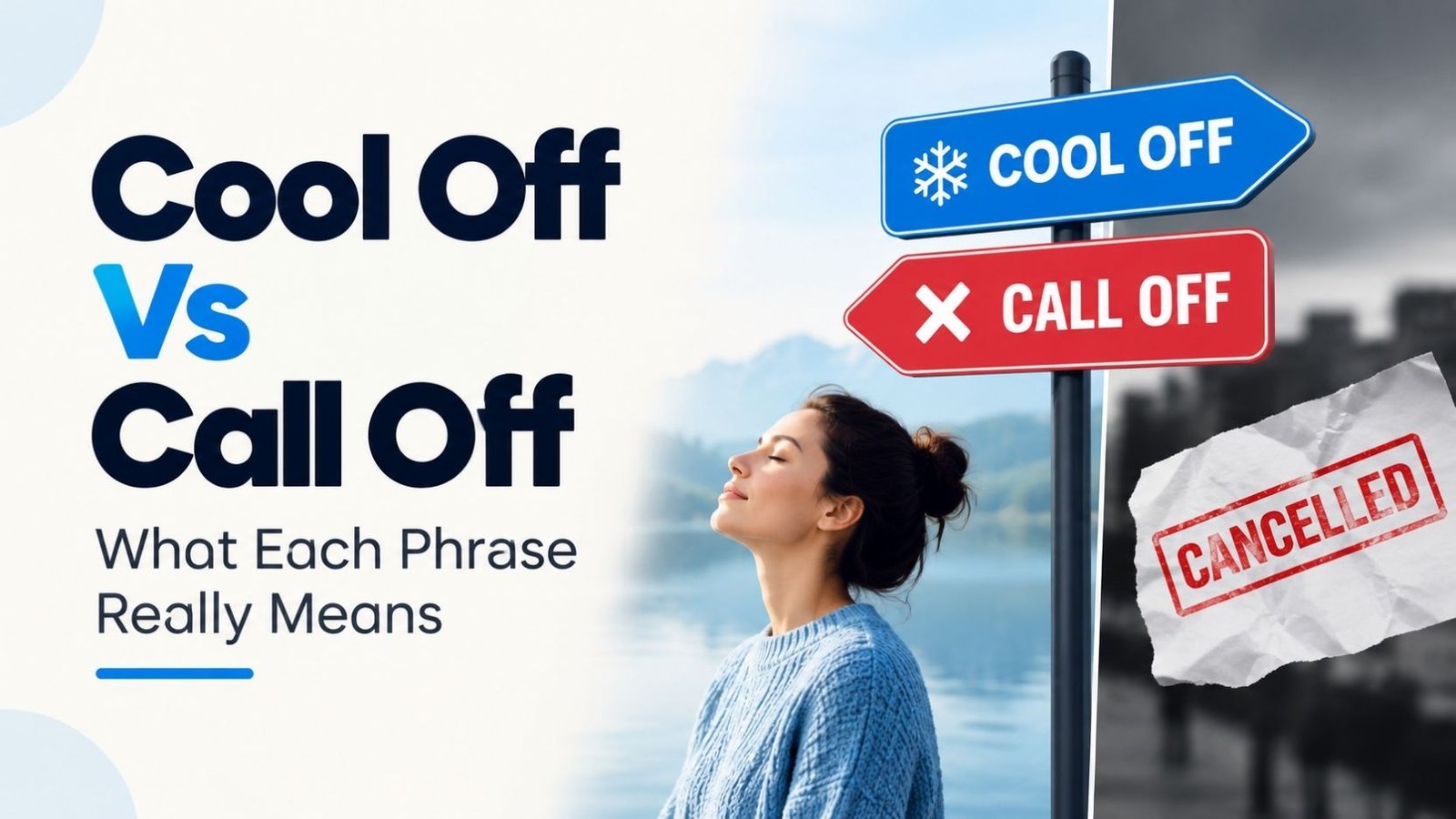
“Cool off” and “call off” sound alike, but they mean two very different things. Cool off usually means to become calmer, less angry, or physically cooler. Call off usually means to cancel something that was planned. People often mix these two phrases up because they share a similar rhythm and both start with a short, common verb.
Understanding the difference matters more than it seems. If you tell someone you need to “cool off” after an argument, you mean you need time to calm down. If you say you need to “call off” the relationship, you mean you want to end it completely. One phrase describes a pause. The other describes a stop.
What Does Cool Off Mean?
At its core, cool off means to become less hot, either physically or emotionally.
Meaning 1: To lower in temperature
This is the literal meaning. A room, a drink, an engine, or the weather can cool off when the temperature drops.
Example: The weather usually cools off after sunset.
Meaning 2: To become calmer after being angry or upset
This is the emotional meaning, and it is the one people search for most often.
Example: She needed a few minutes to cool off before continuing the conversation.
Meaning 3: To lose enthusiasm or interest
Sometimes cool off describes a fading interest in a person, a plan, or an activity.
Example: His interest in the project began to cool off after the first month.
All three meanings share one idea: something that was intense becomes less intense. Heat fades, anger fades, or excitement fades.
Read More: Girls Vs Girl’s Vs Girls’
What Does Call Off Mean?
Call off means to cancel or stop something that was previously arranged or agreed upon.
Example: They had to call off the picnic because of the storm.
This phrase is direct. It does not describe a gradual change like cool off does. Call off signals a clear decision to stop an event, plan, agreement, or search.
Common things people call off include:
- A wedding
- A meeting
- A search
- A strike
- A relationship
- A shift at work
Cool Off Vs Call Off: Quick Comparison
| Phrase | Core Meaning | Type of Change | Example |
| Cool off | Become calmer or less hot | Gradual | He went for a walk to cool off after the fight. |
| Call off | Cancel something planned | Sudden, final | They decided to call off the trip. |
The biggest difference is finality. Cooling off is temporary. It suggests a pause, not an ending. Calling off is final. It suggests an ending, not a pause.
Cool Off Vs Call Off In A Relationship
This is one of the most searched comparisons, so it deserves a clear, direct answer.
Cool off in a relationship means the couple is taking space or time apart, usually to calm down after conflict or to think clearly. The relationship is not over. Communication may be reduced, but the couple typically plans to reconnect later.
Call off in a relationship means one or both people have decided to end it. There is no plan to reconnect. A call off is usually associated with breakups or canceled engagements and weddings.
How Many Days Should A Cool Off Period Last?
There is no fixed rule, since every relationship is different. However, many relationship counselors and communication experts suggest a cool off period between a few hours and a few days is often enough to reduce emotional intensity without letting distance grow into disconnection. Longer cool off periods are sometimes used after serious conflicts, but they usually work best when both people agree on a general timeframe rather than leaving it open ended.
Benefits Of A Cool Off Period In A Relationship
- Reduces the chance of saying something hurtful in anger
- Gives both people time to think clearly
- Lowers stress and emotional reactivity
- Creates space for a calmer conversation later
- Prevents small disagreements from escalating
What Is The Best Reply To Cool Off?
If a partner asks for space to cool off, a calm and respectful reply works best. Something like acknowledging their need for space, agreeing to talk again after some time, and avoiding pressure usually keeps the situation from getting worse. Reacting with anger or repeated messages tends to have the opposite effect and can turn a temporary cool off into a bigger conflict.
How To Say Cool Off In Different Contexts
The phrase changes slightly depending on what is cooling off.
| Context | What It Means |
| A person | Becoming calmer after anger or excitement |
| A room | The temperature dropping |
| A device | The internal temperature dropping after use |
| An animal | The body temperature lowering after heat exposure |
| A relationship | Taking space after conflict |
| Interest or excitement | Losing enthusiasm gradually |
How To Cool Off A Room Without AC
When someone searches this, they usually want practical, non electrical cooling methods. Common approaches include closing curtains during peak sun hours, using cross ventilation with open windows at night, placing a bowl of ice in front of a fan, and reducing heat sources like ovens or extra lighting during the day.
How To Cool Off A Phone
A phone that overheats usually needs less direct interaction rather than more effort to cool it down artificially. Removing the case, closing background apps, avoiding direct sunlight, and pausing heavy tasks like gaming or video recording are common recommendations for letting a phone return to a safe temperature naturally.
How Do Animals Cool Off?
Different animals regulate heat in different ways.
- Dogs cool off mainly through panting, since they do not sweat the way humans do. Access to shade and water also helps them cool off.
- Cats cool off by grooming themselves, since saliva evaporating from their fur has a cooling effect. They also seek cooler surfaces and shaded areas.
- Chickens cool off by panting, spreading their wings away from their bodies, and seeking shade, since they are especially sensitive to heat.
Cool Off Road Vehicles: A Different Meaning Entirely
Not every search for “cool off road” is about temperature. Many people are actually searching for off road vehicles, and the words get grouped together in search engines. This includes:
- Cool off road SUVs
- Cool off road trucks
- Cool off road vehicles
In this context, “cool” is simply an adjective describing an impressive or stylish off road vehicle. It has nothing to do with temperature or emotion. If you are researching vehicles rather than language meaning, this phrase is unrelated to the grammar topic of cool off as a phrasal verb.
Cool Off Clothing
Some searches also relate to a clothing brand or clothing line that uses the name “Cool Off.” This typically refers to apparel marketed for hot weather, athletic cooling, or breathable fabric designed to help the wearer stay comfortable in heat.
This use of the phrase is a product name rather than a grammar or meaning topic, so it should not be confused with the phrasal verb.
Cool Off Vs Cool Down: Is There A Difference?
These two phrases overlap significantly, but there is a subtle difference in common usage.
- Cool off is more often used for people, emotions, and short bursts of heat.
- Cool down is more often used for physical activity, exercise, engines, and gradual temperature drops over a longer period.
Example: After the workout, she took time to cool down. Example: After the argument, he needed to cool off.
Both phrases are correct in many situations, and native speakers often use them interchangeably. The difference is more about common pattern than strict grammar rule.
Read More: Country Vs State
Grammar: Is Cool Off A Verb?
Yes. Cool off is a phrasal verb, formed by combining the verb “cool” with the particle “off.” Phrasal verbs often carry a meaning that is different from the individual words alone.
| Form | Example |
| Base form | cool off |
| Present tense | cools off |
| Past tense | cooled off |
| Present participle | cooling off |
Example sentence: The engine is cooling off after the long drive.
Call off follows the same phrasal verb pattern.
| Form | Example |
| Base form | call off |
| Present tense | calls off |
| Past tense | called off |
| Present participle | calling off |
Example sentence: They called off the event due to bad weather.
Reasons To Call Off Work
Many people search for call off specifically related to missing a work shift. This is one of the most common everyday uses of the phrase.
Good Reasons To Call Off Work
- Illness or injury that prevents safe or effective work
- A family emergency
- A serious personal matter that requires immediate attention
- Car trouble that prevents safe travel
- A medical appointment that cannot be rescheduled
How To Call Off Work
Most workplaces expect a few basic steps when calling off:
- Notify your manager or supervisor as early as possible.
- Follow the specific method your workplace requires, such as a phone call, text, or app.
- Give a brief and honest reason.
- Confirm whether documentation is required, especially for illness.
- Follow up if your absence extends beyond one day.
How To Call Off Work Sick
When calling off due to illness, clarity and timing matter most. A short, direct message explaining that you are unwell and unable to work, sent as early as your workplace policy requires, is generally the most professional approach. Some workplaces may also require a doctor’s note for extended absences.
How To Call Off With No Caller ID
Some workplaces use automated call off lines that do not require the caller’s number to be visible, especially large retail employers. If a specific number is used for calling off, such as certain large retailers’ call off systems, that number is usually provided directly by the employer rather than found through general search, since these systems vary by company and location.
⚠️ Common Mistake: Do not confuse “call off” with “call in.” Calling in usually means contacting your workplace to report an absence, while calling off refers to the act of canceling your shift itself. In everyday use, many workplaces use these phrases interchangeably, but the core meaning of call off remains cancellation.
Common Mistakes With Cool Off And Call Off
❌ Incorrect: I need to call off before we talk again.
✅ Correct: I need to cool off before we talk again.
❌ Incorrect: They cooled off the wedding after the fight.
✅ Correct: They called off the wedding after the fight.
The mistake usually happens because both phrases involve stopping or pausing something. The key difference to remember is permanence. Cool off is temporary. Call off is final.
Similar Words And Related Phrases
| Phrase | Meaning | Difference From Cool Off Or Call Off |
| Calm down | Become less upset | Focuses only on emotion, not temperature |
| Cancel | Stop something planned | More formal than call off |
| Take a break | Pause an activity or relationship | Less specific about emotional state |
| Back out | Withdraw from a plan or agreement | Often implies withdrawal before commitment |
| Postpone | Delay to a later time | Implies the event will still happen later |
Read More: Supposedly Or Supposably
Frequently Asked Questions
What does cool off mean?
Cool off means to become calmer after being angry or excited, or to become physically cooler in temperature.
What does call off mean?
Call off means to cancel something that was previously planned or arranged.
Is cool off the same as call off?
No. Cool off is temporary and usually emotional or physical. Call off is final and usually refers to cancellation.
How long should a cool-off period last in a relationship?
There is no fixed rule, but many people find a period ranging from a few hours to a few days helpful, as long as both people understand the general timeframe.
Is cool off a phrasal verb?
Yes. Cool off combines the verb “cool” with the particle “off” to create a phrasal verb with its own distinct meaning.
What is a good excuse to call off work?
Illness, family emergencies, and situations that prevent safe travel are commonly accepted reasons, though policies vary by workplace.
What is the difference between cool off and cool down?
Cool off is more commonly used for people and short-term situations, while cool down is more commonly used for physical activity and gradual temperature changes, though both are often used interchangeably.
Do dogs and cats cool off the same way?
No. Dogs mainly cool off through panting, while cats cool off through grooming, since saliva evaporation helps lower their body temperature.
What does it mean when someone says they are cooling off on someone?
It usually means their romantic interest or enthusiasm is fading gradually, rather than ending suddenly.
Can call off also mean postpone?
Not exactly. Call off usually means canceling entirely, while postpone means delaying to a later date. If an event is expected to happen later, postpone is the more accurate word.
Final Thoughts
Cool off and call off may look similar, but they describe very different actions. Cool off is about temperature or emotion settling down, while call off is about ending or canceling something completely. Once you notice this difference, the two phrases become easy to tell apart in everyday conversation, at work, and in personal relationships.
Whether you are dealing with a heated argument, a hot afternoon, a canceled shift, or a canceled event, choosing the right phrase helps you communicate clearly. Cool off tells people you need a pause. Call off tells people something is not happening at all. Keeping that distinction in mind will help you use both phrases correctly and confidently.

Danish Raza is the author of Grammavio, a trusted resource for simple and easy-to-understand English grammar guides. He creates helpful content covering grammar rules, word meanings, vocabulary, and common grammar mistakes to help readers improve their English skills.


