
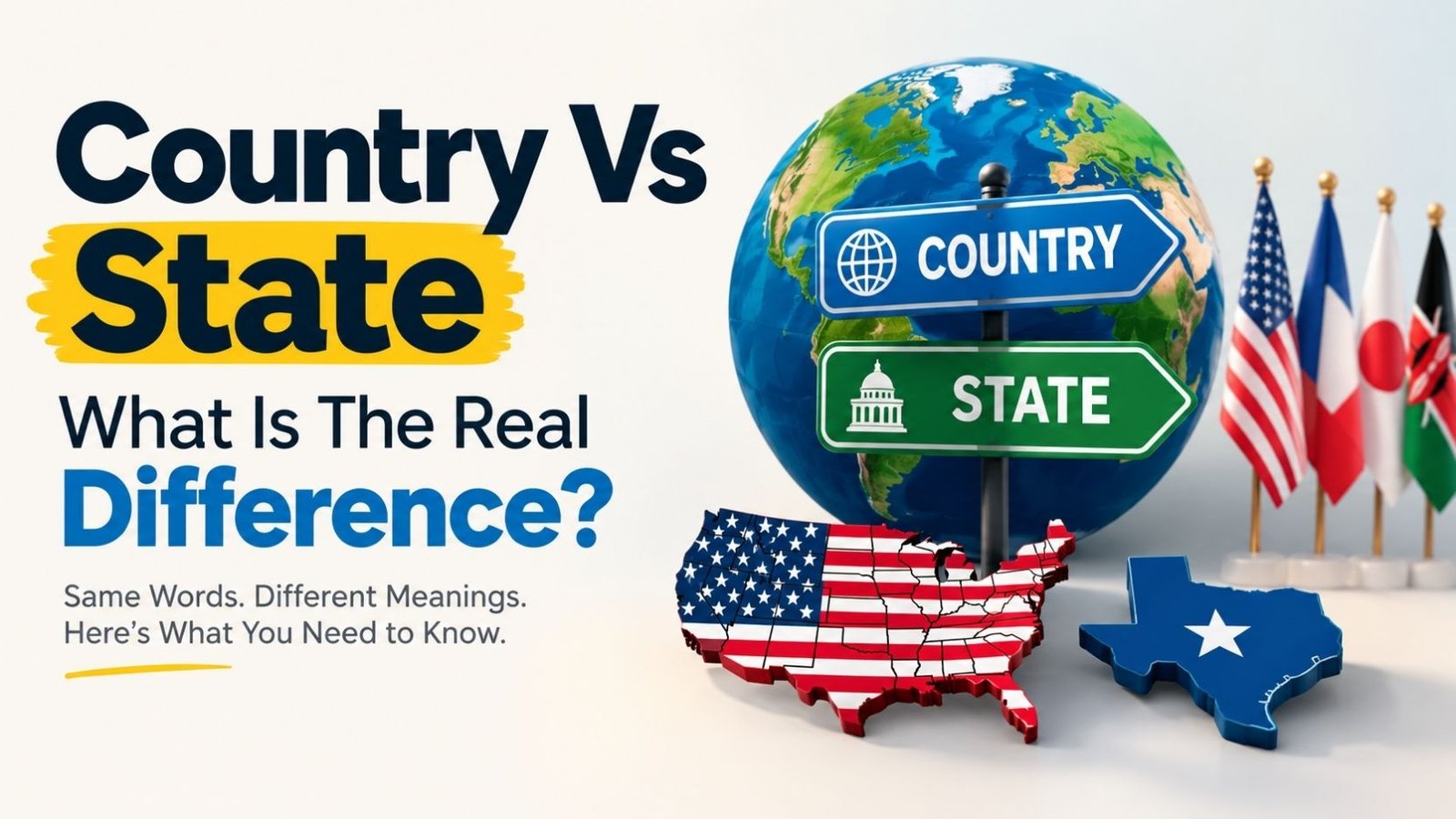
A country is an independent political unit with its own government, borders, and sovereignty. A state, in the American sense, is one of the fifty regions that make up the United States and does not have independent sovereignty on the world stage. In everyday English, “state” can also mean any sovereign nation, which is why the two words sometimes overlap in meaning. Understanding the difference matters because it affects how you read the news, fill out forms, and talk about geography correctly.
The confusion usually starts because English uses “state” in two very different ways. Diplomats and political scientists use “state” as a formal synonym for an independent country, as in “member state of the United Nations.” Ordinary Americans use “state” to mean Texas, Ohio, or California, which are internal divisions of one country. Once you separate these two uses, the whole topic becomes much easier to follow.
Country Meaning: The Simple Definition
A country is a geographic area recognized as an independent nation with its own government, laws, currency, military, and borders. It controls its own foreign policy and does not answer to any higher political authority.
Key features of a country include:
- Full sovereignty, meaning no outside government can override its laws
- Its own head of state or head of government
- Defined borders recognized by other countries
- The right to sign treaties and join international organizations
- Usually its own currency, though some countries share one, like eurozone nations
The United States, France, Japan, and Kenya are all examples of countries. Each one governs itself completely and interacts with other countries as an equal, independent actor.
Read More: Canceled Or Cancelled
State Meaning: Two Different Uses
This is where most confusion begins, because “state” carries two separate meanings depending on context.
Meaning 1: State as a synonym for country In political science, diplomacy, and international law, a “state” is any sovereign, self-governing political entity. This is the meaning behind phrases like “member states of the United Nations” or “nation-state.” In this sense, France, Japan, and Kenya are all states.
Meaning 2: State as a part of a country In American English, a “state” usually refers to one of the fifty regions that together form the United States, such as New York or Florida. These states have their own governments, but they do not have full sovereignty. They cannot declare war, issue their own passports, or leave the country unilaterally. Their authority exists only within the framework of the national constitution.
So a country is always sovereign, while a state can mean either a sovereign nation, in the formal political sense, or a non-sovereign region inside a larger country, in the everyday American sense.
Country vs State: Quick Comparison Table
| Feature | Country | State (US sense) |
| Sovereignty | Full and independent | None; part of a larger country |
| Government | National government | Regional government under federal law |
| Foreign policy | Sets its own | Cannot set independent foreign policy |
| Military | Has its own armed forces | No independent military |
| Currency | Usually its own | Shares national currency |
| UN membership | Can join as a member | Cannot join independently |
| Example | United States, Japan | Texas, Ohio, California |
Why the United States Uses the Word “State”
This naming choice goes back to the founding of the country. Before 1776, the thirteen colonies were separate British territories. When they declared independence, they briefly functioned almost like thirteen small, self-governing countries loosely tied together under the Articles of Confederation. The word “state” stuck from that period because these regions genuinely acted like sovereign states at first.
When the Constitution replaced the Articles in 1789, the states gave up most of their sovereign powers to a stronger federal government. They kept the name “state,” even though they were no longer independent in the way a country is. This is why the term can feel misleading today. It is a historical label, not a current description of political independence.
Country vs State vs Nation: How the Three Compare
People often add “nation” into this comparison, and it introduces a third layer of meaning.
- Country refers to a defined territory with borders and a government.
- State refers to the political and legal structure that governs a territory, whether sovereign or not.
- Nation refers to a group of people who share a common identity, such as language, culture, history, or ethnicity, regardless of political borders.
A “nation-state” is a country where the political borders and the cultural nation largely match, such as Japan. Some nations exist without their own country, such as the Kurdish nation, which spans parts of several countries. Some countries contain multiple nations within their borders, such as the United Kingdom, which includes English, Scottish, and Welsh national identities inside one sovereign state.
| Term | Focus | Example |
| Country | Territory and government | United States |
| State | Political structure, sovereign or regional | France, or Ohio |
| Nation | Shared people and identity | Kurdish nation |
Country vs State vs City: Where Cities Fit In
Cities sit below states in the same political system. A city is a smaller administrative unit, usually governed by a mayor and city council, and it operates under the laws of its state, which in turn operates under the laws of its country.
Think of it as three layers stacked on top of each other:
- Country: sets national laws, currency, and foreign policy. Example: United States.
- State: manages regional laws such as education and local taxes. Example: California.
- City: handles local services like police, zoning, and utilities. Example: Los Angeles.
Los Angeles is a city inside California, which is a state inside the United States, which is a country. Each level has real authority, but that authority narrows as you move from country down to city.
Continent vs Country vs State: Adding Scale
A continent is the largest geographic category, a broad landmass that contains many countries. Africa, Asia, Europe, North America, South America, Australia, and Antarctica are the seven continents.
- Continent: a large landmass, such as Europe, containing dozens of countries.
- Country: an independent nation within a continent, such as Germany.
- State: a region within one country, such as Bavaria in Germany, or Georgia in the United States.
So the full scale runs from largest to smallest: continent, then country, then state, then city.
Read More: Definitely Or Definately
Constituent Country vs State: A Special Case
Some countries use the phrase “constituent country” instead of “state” for their internal divisions, and this adds another wrinkle to the comparison.
The United Kingdom is the clearest example. It is made up of four constituent countries: England, Scotland, Wales, and Northern Ireland. Each one is called a “country” in everyday speech, and each has its own distinct identity, sports teams, and in some cases its own parliament. However, none of them is sovereign on its own. Only the United Kingdom as a whole has a seat at the United Nations, controls its own military, and sets foreign policy.
This is different from a US state in name only. Functionally, a UK constituent country and a US state are similar: both are non-sovereign regions inside one larger sovereign country. The difference is purely in vocabulary. The UK chose to call its regions “countries” for historical and cultural reasons, while the US chose to call its regions “states.”
Georgia Country vs State: A Common Point of Confusion
This comparison shows up often in searches because two very different places share the exact same name.
Georgia the country is a sovereign nation located in the Caucasus region, bordered by Russia, Turkey, Armenia, and Azerbaijan, with the Black Sea to its west. It has its own government, currency, and capital city, Tbilisi. It covers roughly 69,700 square kilometers and has a population in the range of a few million people.
Georgia the US state is one of the fifty states in the southeastern United States. Its capital is Atlanta, it does not have its own currency or foreign policy, and its population is considerably larger than the country of Georgia, at more than ten million residents according to recent census figures.
| Feature | Georgia (country) | Georgia (US state) |
| Location | Caucasus region, Eastern Europe/Western Asia | Southeastern United States |
| Capital | Tbilisi | Atlanta |
| Sovereignty | Fully independent nation | Region within the United States |
| Currency | Georgian lari | US dollar |
| Approximate population | A few million | More than ten million |
If someone writes “Georgia country vs state,” they are almost always trying to confirm that these are two unrelated places that happen to share a name, not two versions of the same location.
Sovereign State vs Country: Are They the Same Thing?
In formal political language, yes. A sovereign state and a country describe the same idea: an independent political entity that controls its own territory and government without answering to another power. “Sovereign state” is the more technical term used in international law and political science, while “country” is the everyday word most people use in conversation.
You will sometimes see the phrase “is a sovereign state a country” in search results, and the direct answer is that a sovereign state is a country, just described using more formal language. The reverse is also true in ordinary usage: when someone says “country,” they almost always mean a sovereign state.
Country vs State in Political Science
Political science uses “state” as its core technical term, and it defines a state by four requirements:
- A defined territory with recognized borders
- A permanent population
- A functioning government
- The capacity to interact with other states, including through diplomacy
Under this definition, “state” and “country” are treated as interchangeable in most academic writing. A political scientist writing about “the state” is usually referring to what a general audience would call “the country” or “the government of the country.” This is different from the everyday American use of “state” to mean a regional government like Texas or New York, and readers should keep the two contexts separate to avoid confusion.
Read More: Country Vs Continent
Common Mistakes With Country and State
Incorrect: Georgia the state has its own president and currency.
Correct: Georgia the country, has its own president and currency; Georgia the US state does not.
Why: Only sovereign countries have their own head of state and independent currency. A US state operates under federal law and uses the US dollar.
Incorrect: The United Kingdom is a state, not a country, because England and Scotland are inside it.
Correct: The United Kingdom is a country made up of four constituent countries.
Why: The United Kingdom itself is the sovereign country. England and Scotland are internal divisions that are informally called “countries,” but they are not sovereign on their own.
Incorrect: All countries are called nations, and all nations are countries.
Correct: A nation refers to a group of people with shared identity, while a country refers to a governed territory; the two do not always match.
Why: some nations, like the Kurdish people, exist without their own sovereign country.
Frequently Asked Questions
What is the main difference between a country and a state?
A country is always a sovereign, independent nation. A state, in the American sense, is a non-sovereign region inside one country. In political science, however, “state” can also mean a sovereign country.
Is Georgia a country or a state?
Both. Georgia is a sovereign country in the Caucasus region, and Georgia is also a separate, unrelated state in the southeastern United States. They share a name but are not connected.
Is a US state considered a country?
No. A US state, such as Texas or California, is a regional government inside the United States. It does not have independent sovereignty, its own military, or its own seat at the United Nations.
What is the difference between a nation and a state?
A nation refers to a group of people who share culture, language, or identity. A state refers to a political and legal structure governing a territory. The two can overlap, as in a nation-state, but they are not the same thing.
Is a sovereign state the same as a country?
Yes. “Sovereign state” is the formal political science term for what most people simply call a “country.”
What is a constituent country?
A constituent country is a region that is informally called a “country” while remaining part of a larger sovereign nation. England, Scotland, Wales, and Northern Ireland are constituent countries of the United Kingdom.
How many countries are there compared to US states?
There are 50 states in the United States, all part of one country. Globally, there are 195 widely recognized sovereign countries, according to most international counts.
Why does the US call its regions “states” instead of “provinces”?
The term dates back to the American Revolution, when the original thirteen colonies briefly acted as separate, self-governing states before uniting under the Constitution. The name remained even after they gave up most of their independent authority.
What is bigger, a country or a continent?
A continent is bigger. A continent, such as Asia or Europe, is a large landmass containing many separate countries.
Can a state become a country?
In rare cases, yes, but only through a formal process such as a declaration of independence that gains international recognition, or a negotiated separation. A US state cannot currently do this under the Constitution without a much larger legal and political process.
Conclusion
The difference between country and state comes down to sovereignty. A country always governs itself independently, with its own laws, currency, and foreign policy. A state, in the everyday American sense, is a smaller region inside one sovereign country, while in political science, “state” can also serve as a formal synonym for country itself. Once you separate these two uses of the word, comparisons like Georgia country vs state, or country vs state vs nation, become much easier to understand.
The next time you see the word “state” in a sentence, check the context before assuming what it means. If the sentence is about international politics, treaties, or the United Nations, “state” likely means an independent country. If the sentence is about the United States specifically, “state” almost certainly means one of the fifty internal regions, like Ohio or Georgia. That single distinction clears up most of the confusion between these closely related words.

Danish Raza is the author of Grammavio, a trusted resource for simple and easy-to-understand English grammar guides. He creates helpful content covering grammar rules, word meanings, vocabulary, and common grammar mistakes to help readers improve their English skills.



3 Comments