
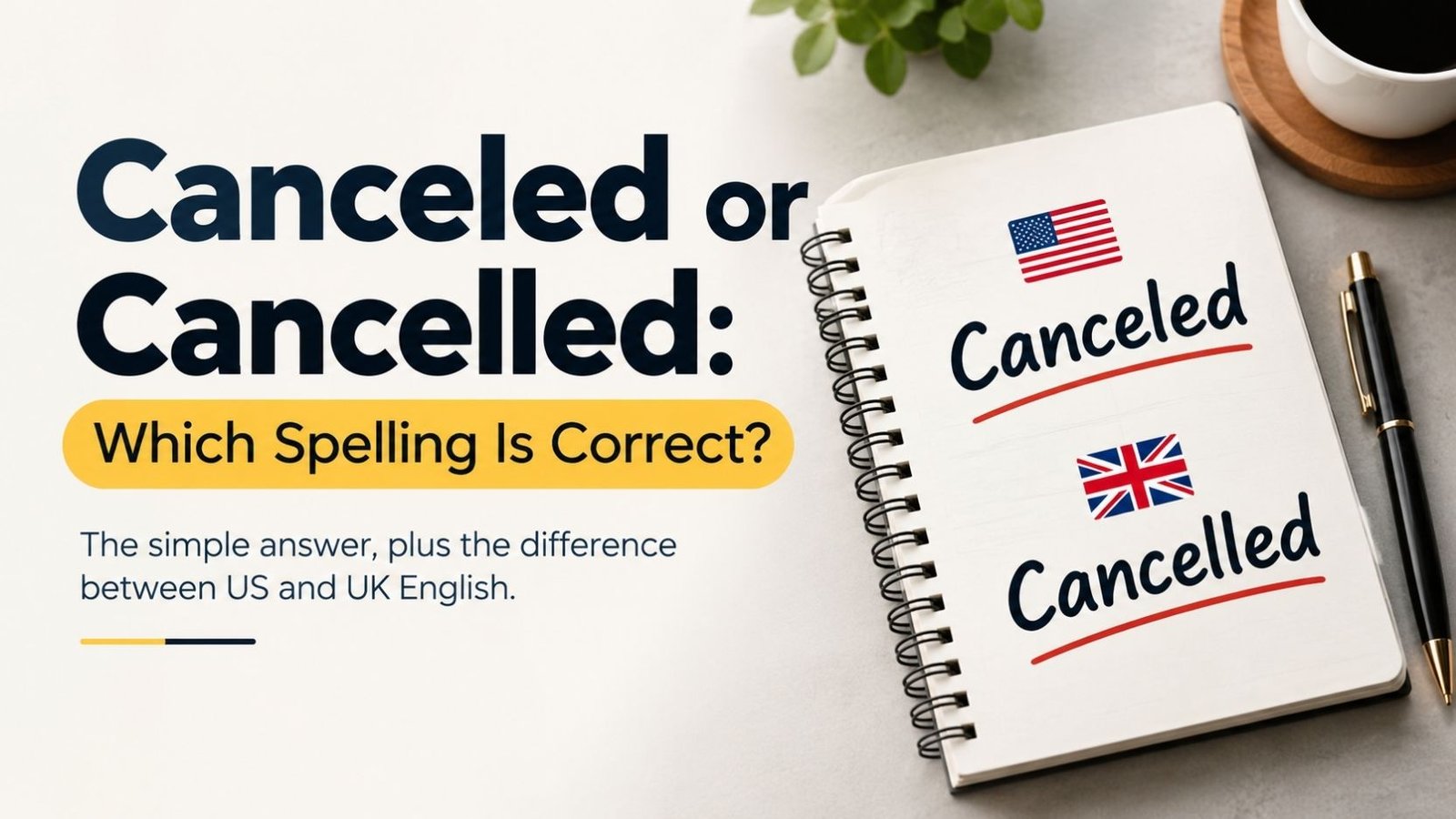
Both canceled and cancelled are correct spellings of the same word. The difference comes down to region, not accuracy. Americans usually write canceled, with one L, while British, Canadian, and Australian English favor cancelled, with two Ls. Neither version is a typo, and neither one is “more correct” than the other.
This small spelling difference confuses a lot of writers, especially online, where American and British sources mix together. Knowing which form to use matters for professional writing, school assignments, and search engine style guides like AP style. It also helps explain why you’ll see both spellings in headlines about canceled flights, canceled shows, or canceled events.
Quick Answer: Canceled or Cancelled
| Spelling | Region | Style Guide |
| Canceled | United States | AP Style, most US publishers |
| Cancelled | United Kingdom, Canada, Australia | Oxford, British style guides |
If you’re writing for a US audience, use canceled. If you’re writing for a UK, Canadian, or Australian audience, use cancelled. Both spellings mean the same thing: to call off, stop, or end something that was planned.
See More: Definitely Or Definately
What Does Canceled or Cancelled Mean?
The word means to stop something that was planned or scheduled before it happens. It can also mean to make something invalid or to remove it officially.
A few common uses:
- A meeting that will no longer happen is canceled or cancelled.
- A subscription that a person stops paying for gets canceled.
- A check that a bank marks as void has been canceled.
- A television show that a network pulls from its lineup is canceled.
The core idea stays the same across every context: something planned or active comes to an end before it was supposed to.
Why Are There Two Spellings?
The short answer is spelling rules. English has different conventions for adding suffixes like ed or ing to verbs that end in a consonant preceded by a vowel, such as cancel.
American English usually follows a simpler rule. When the stress falls on the first syllable of the word, as it does in cancel, the final consonant is not doubled before adding ed. That gives you canceled.
British English tends to double the final consonant regardless of where the stress falls, especially for words ending in l. That gives you cancelled.
This is not a random quirk. It’s part of a broader pattern. Words like traveled/travelled, modeled/modelled, and labeled/labelled follow the exact same American versus British split.
Canceled or Cancelled: Which Is Correct in the US?
In the United States, canceled is the standard and preferred spelling. It appears in:
- AP Style, used by most American news organizations
- US dictionaries as the primary American entry
- Everyday American writing, business emails, and school work
If you’re writing for an American audience, stick with canceled. Using cancelled in US content isn’t wrong exactly, but it will look slightly foreign to American readers, similar to writing colour instead of color.
Canceled or Cancelled: Which Is Correct in the UK?
In British English, cancelled is the standard spelling. This applies across:
- UK newspapers and publishers
- Oxford English Dictionary as the primary British entry
- Canadian and Australian English, which generally follow British conventions
So if your audience is in the UK, Canada, Australia, or another Commonwealth country, cancelled is the expected form.
Canceled or Cancelled: AP Style Rule
AP style, the guide most American journalists and content writers follow, is clear on this point. Canceled is the correct AP style spelling, with one L.
This rule also extends to related word forms:
| Word Form | AP Style (US) | British Style |
| Base verb | Cancel | Cancel |
| Past tense | Canceled | Cancelled |
| Present participle | Canceling | Cancelling |
| Noun | Cancellation | Cancellation |
Notice that cancellation keeps two Ls in both American and British English. This is the one part of the word family where spelling doesn’t split by region. AP style and every major dictionary agree: it’s always cancellation, never cancelation.
See More: Lose Vs Loose
Canceled or Cancelled: Table of Word Forms
| Form | American English | British English |
| Present tense | Cancel | Cancel |
| Past tense | Canceled | Cancelled |
| Past participle | Canceled | Cancelled |
| Present participle | Canceling | Cancelling |
| Noun (event of stopping) | Cancellation | Cancellation |
| Person who cancels | Canceler | Canceller |
Grammar: Part of Speech and Sentence Structure
Cancel is a regular verb. It follows the standard pattern of adding ed to form the past tense, with the spelling variation explained above.
Basic sentence patterns:
- Subject + cancel + object: She canceled the meeting.
- Passive form: The meeting was canceled.
- Present participle form: He is canceling his subscription.
In each of these examples, either spelling works, depending on whether you’re following American or British conventions. The grammar itself doesn’t change. Only the letter count changes.
Canceled or Cancelled in a Sentence
Here are a few natural examples showing both spellings in context.
American English examples:
- The airline canceled more than two hundred flights due to the storm.
- Her doctor’s appointment was canceled at the last minute.
- The network canceled the show after one season.
British English examples:
- The concert was cancelled because of poor ticket sales.
- They cancelled their trip after the warning was issued.
- The match got cancelled due to heavy rain.
Both sets of examples are grammatically correct. The only difference is the regional spelling convention being followed.
Common Mistakes With Canceled or Cancelled
❌ Incorrect: Cancled
✅ Correct: Canceled (US) or Cancelled (UK)
The most common typing mistake is dropping a letter entirely, writing something like cancled or canceld. Neither of these is a real word in any English variety.
❌ Incorrect: Cancellation spelled as Cancelation
✅ Correct: Cancellation
Even though canceled drops a letter in American English, cancellation does not follow the same pattern. It keeps double L in both American and British English. This trips up a lot of writers who assume the whole word family drops the second L in the US.
❌ Incorrect: Mixing spellings within the same document
✅ Correct: Picking one spelling and using it consistently
If you’re writing for a US company, use canceled and canceling throughout. If you’re writing for a UK-based company, use cancelled and cancelling throughout. Switching back and forth in the same piece of writing looks inconsistent, even though both spellings are individually correct.
Pronunciation
Both spellings are pronounced the same way. There is no difference in how canceled and cancelled sound out loud.
- Pronunciation: KAN-suld
- Stress falls on the first syllable
- The extra L in the British spelling is silent; it doesn’t add a sound
This is one reason the two spellings coexist so easily. Since they sound identical, the written difference rarely causes confusion in speech, only in text.
Synonyms and Related Words
| Word | Meaning | Difference From Cancel |
| Postpone | Delay something to a later time | Cancel ends it; postpone only delays it |
| Abort | Stop something already in progress | Often used for missions, processes, or launches |
| Terminate | End something formally | More formal, often used for contracts |
| Call off | Informal way to cancel | Common in everyday speech |
| Revoke | Officially withdraw a right or agreement | Used for licenses, permissions, or approvals |
Postpone is the word people confuse with cancel most often. Canceling means something will not happen at all. Postponing means it will happen later, just not as originally planned.
Canceled or Cancelled in Pop Culture and Modern Usage
The word shows up constantly in entertainment and current events, which is part of why so many people search for the correct spelling. Headlines about a canceled TV series, a canceled flight, or a canceled show follow the exact same spelling rules explained above. A US entertainment outlet will typically write that a series was canceled, while a UK outlet covering the same story will write cancelled.
There’s also the informal, modern usage of “canceled” or “cancelled” tied to public backlash against a person or brand, sometimes called being “canceled” in a cultural or social sense. This usage follows the same regional spelling rules as the traditional meaning. It simply refers to public disapproval or a loss of support rather than an appointment or event being called off.
Canceled or Cancelled: Regional Summary
| Region | Preferred Spelling |
| United States | Canceled |
| United Kingdom | Cancelled |
| Canada | Cancelled (follows British convention) |
| Australia | Cancelled |
| India | Cancelled (follows British convention) |
Canada and India generally follow British spelling conventions for this word, even though American spelling has influenced some Canadian usage over time. When in doubt, match the spelling convention your audience expects.
See More: You Did Well Vs You Did Good
Frequently Asked Questions
Is it canceled or cancelled?
Both are correct. Canceled is the standard American spelling. Cancelled is the standard British, Canadian, and Australian spelling.
Which is correct, canceled or cancelled?
Neither spelling is more correct than the other. Correctness depends on regional convention. American English uses canceled; British English uses cancelled.
What is the AP style spelling of canceled or cancelled?
AP style uses canceled, with a single L, since AP style follows American English conventions.
How do you spell canceled or cancelled correctly?
Spell it as canceled if you’re writing for a US audience. Spell it as cancelled if you’re writing for a UK, Canadian, or Australian audience.
Is cancellation spelled with one L or two?
Cancellation always has two Ls in both American and British English. This is different from canceled and cancelling, which vary by region.
Does canceled or cancelled change meaning based on spelling?
No. Both spellings mean exactly the same thing: to stop or call off something planned. The meaning never changes based on which spelling you use.
Is canceled or cancelled used in the US?
Canceled, with one L, is the standard spelling used in the United States, including in AP style and most American publishing.
What part of speech is cancel?
Cancel is a verb. Canceled or cancelled is its past tense and past participle form, depending on the spelling convention used.
How do you pronounce canceled or cancelled?
Both spellings are pronounced the same way: KAN-suld, with stress on the first syllable.
What is the difference between canceled and cancelling?
Canceled or cancelled is the past tense form. Canceling or cancelling is the present participle form, used for ongoing action, as in “she is canceling her plans.”
Conclusion
Canceled and cancelled are both correct spellings of the same word, and the choice between them comes down to which style of English you’re writing in. American English, along with AP style, uses canceled with a single L. British English, along with Canadian and Australian English, uses cancelled with two Ls. The meaning, pronunciation, and grammar stay exactly the same no matter which version you choose.
The easiest way to stay consistent is to pick the spelling that matches your audience and stick with it throughout your writing. If you’re American, use canceled. If you’re writing for a British, Canadian, or Australian reader, use cancelled. Either way, you’ll be spelling the word correctly.

Danish Raza is the author of Grammavio, a trusted resource for simple and easy-to-understand English grammar guides. He creates helpful content covering grammar rules, word meanings, vocabulary, and common grammar mistakes to help readers improve their English skills.



4 Comments