
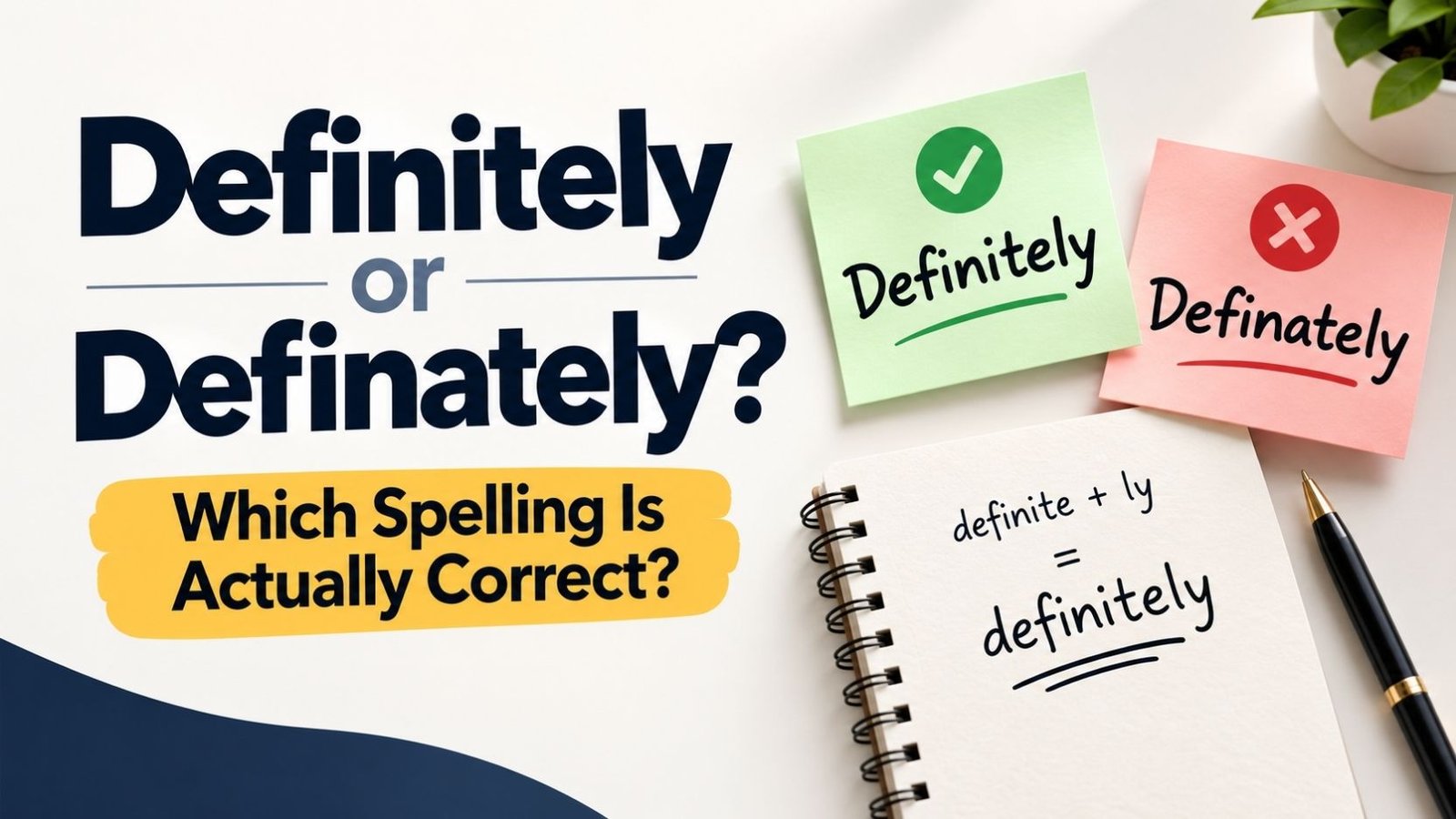
If you have ever paused mid-sentence wondering whether to write “definitely” or “definately,” you are not alone. This is one of the most commonly misspelled words in the English language, and the confusion makes sense once you understand why it happens. The short answer is that only one spelling is correct.
Definitely is the correct spelling. Definately is a common misspelling that does not appear in any standard dictionary. People often write definately because it matches how the word sounds when spoken quickly, especially the middle syllable that gets blurred in everyday speech.
This mix-up is not a sign of poor grammar skills. It happens because the human ear does not always match the way English words are actually spelled. Understanding the correct form helps you write with more confidence in emails, essays, texts, and professional documents. Once you see the pattern behind the word, the correct spelling becomes much easier to remember for good.
Definitely or Definately: What Does the Word Actually Mean?
Definitely is an adverb. It means without doubt, certainly, or in a way that leaves no question about something. People use it to add strong confidence to a statement.
Here are a few natural examples:
- I will definitely be there by six.
- That was definitely the best meal I have had this year.
- She is definitely the right person for the job.
In each example, the word adds certainty. Remove it, and the sentence still makes sense, but it loses that confident tone. This is one reason definitely is used so often in daily conversation. It quickly signals that the speaker is sure about what they are saying.
See More: You Did Well Vs You Did Good
Is It Definitely or Definately? The Simple Rule
Here is the easiest way to remember the correct spelling.
The word definitely comes from the base word “definite,” which means clear, fixed, or exact. When you add the suffix “ly” to definite, you get definitely.
- definite + ly = definitely
Definately does not follow this pattern. There is no root word called “definate,” so the spelling has no real foundation in English. This is the simplest test you can use. If you can connect the word back to “definite,” you will always land on the correct spelling.
Definitely vs Definately: A Quick Comparison
| Spelling | Correct or Incorrect | Reason |
| Definitely | Correct | Built from the root word definite, plus the suffix ly |
| Definately | Incorrect | Not a real root word; based on how the word sounds, not how it is built |
This table shows why the confusion exists. The incorrect spelling is not random. It is influenced by pronunciation rather than word structure.
Why Do So Many People Spell It Definately?
There is a clear reason this mistake is so widespread, and it comes down to how English speakers pronounce the word in casual speech.
When people say “definitely” quickly, the middle part of the word often softens. The “i” sound can start to blend and sound closer to an “a.” This creates a mismatch between what the ear hears and what the eye expects to see on the page.
A few reasons this happens so often:
- Fast, casual speech blurs the middle syllables.
- Many people learn the word by sound before they learn it by spelling.
- Autocorrect on phones sometimes fails to catch the error if typed quickly.
- Some regional accents pronounce the middle vowel in a way that leans toward “a.”
None of these reasons make definately correct. They simply explain why the mistake feels natural to so many writers.
How Do You Spell Definitely? Breaking It Down Letter by Letter
If you want a reliable way to spell definitely correctly every time, it helps to break the word into smaller pieces.
d e f i n i t e l y
Notice the pattern: definite, then ly.
A simple memory trick many writers use is this short phrase:
“There is a ‘finite’ inside definitely.”
The word finite means having limits or being fixed. Since finite sits inside definitely, it can help you remember the correct middle letters, especially the “i” that some people mistakenly replace with an “a.”
Definitely or Definately: UK Usage
In UK English, definitely is the correct spelling as well. There is no British variation that allows definately as an accepted alternative. Some readers search for definitely or definately UK because they assume British and American English might spell the word differently, similar to color and colour. That is not the case here.
Definitely is spelled the same way in both American English and British English. Only the meaning and usage remain consistent, while pronunciation can vary slightly depending on region and accent.
Definitely or Definately: What Do Dictionaries Say?
Every major dictionary, including well established sources used across the UK and the US, lists only one correct spelling: definitely. Definately does not appear as an accepted variant, informal form, or regional spelling in any standard dictionary.
This matters because some words do have multiple accepted spellings depending on the region, such as color versus colour, or realize versus realise. Definitely is not one of those words. There is only one correct written form, regardless of accent or location.
Common Mistakes With Definitely and Definately
Understanding common mistakes can help you avoid them in the future. Here are the most frequent errors writers make with this word.
⚠️ Mistake 1: Spelling by sound instead of structure
❌ Incorrect: I will definately call you tomorrow.
✅ Correct: I will definitely call you tomorrow.
Why: The correct spelling follows the root word definite, not the way the word sounds when spoken quickly.
⚠️ Mistake 2: Assuming definately is an informal spelling
❌ Incorrect: Definately is just the casual way to spell it.
✅ Correct: Definitely is the only accepted spelling in formal and informal writing.
Why: Unlike some words with casual spellings, definitely does not have an informal alternative.
⚠️ Mistake 3: Confusing definitely with defiantly
❌ Incorrect: She defiantly agreed to help.
✅ Correct: She definitely agreed to help.
Why: Defiantly means to act with open resistance or rebellion, while definitely means with certainty. These two words look similar but mean completely different things.
See More: Bougie Or Boujee
Definitely Meaning in Everyday Context
Definitely often shows up in casual conversation to add emphasis or confidence. Here is how it can shift meaning slightly depending on context.
In agreement “Are we still meeting today?” “Definitely.”
Here, definitely stands alone as a strong, confident yes.
In description “That movie was definitely worth watching.”
Here, definitely strengthens an opinion, making it sound more certain.
In planning “I will definitely finish the report by Friday.”
Here, definitely signals a firm commitment rather than a vague possibility.
Most Definitely: What Does It Mean?
Most definitely is a phrase used to express strong agreement or certainty, often in a more emphatic or enthusiastic way than definitely alone.
Example: “Do you want to come to the party?” “Most definitely.”
This phrase is common in spoken English and adds warmth or enthusiasm to a response. It is grammatically correct and widely used in both casual and semi formal conversation, though it is generally too informal for strict academic or business writing.
Synonyms for Definitely
If you want to avoid repeating definitely too often in your writing, several natural alternatives express similar certainty.
| Synonym | Simple Meaning | Common Usage |
| Certainly | Without doubt | Formal and everyday speech |
| Absolutely | Completely true | Strong emphasis in conversation |
| Undoubtedly | Beyond question | Formal writing |
| For sure | Casual certainty | Informal speech |
| Without question | No room for doubt | Written and spoken English |
Each of these words carries a similar sense of confidence, though tone and formality shift slightly depending on the word chosen.
Definitely Maybe: A Common Phrase and Cultural Reference
Definitely maybe is a phrase that sounds contradictory at first, since definitely suggests certainty while maybe suggests doubt. In casual use, people say this phrase to express a mix of hope and hesitation, almost like saying “probably, but I am not fully certain yet.”
The phrase is also widely recognized because of Oasis Definitely Maybe, the debut studio album by the British rock band Oasis, released in 1994. The album became one of the most influential releases in British rock music and is often referenced by fans searching for definitely maybe oasis or oasis definitely maybe. This cultural reference is separate from the grammar meaning of the phrase, but it explains why so many searches connect the two.
Definitely Science: A Note on Context Specific Searches
Some readers search for definitely science expecting a specific definition tied to scientific writing. In most cases, definitely functions the same way in scientific contexts as it does in everyday English. It expresses certainty about a result, observation, or conclusion.
Example: “The experiment definitely confirmed the original hypothesis.”
There is no separate scientific definition of the word. Its meaning stays consistent across academic, professional, and casual writing.
Pronunciation of Definitely
Definitely is pronounced with four syllables:
deh – fih – nit – lee
The stress falls on the first syllable, “deh.” In fast or casual speech, the middle syllables can blend together, which is part of why the spelling gets confused. Slowing down while saying the word can help reinforce the correct spelling, since you will hear the “i” sound more clearly rather than a blended “a” sound.
Origin of Definitely
Definitely comes from the word definite, which traces back to the Latin word definitus, meaning “defined” or “limited.” Over time, English speakers added the suffix “ly” to definite to create an adverb form, resulting in definitely.
This origin explains why the “definite” root remains the key to spelling the word correctly. The suffix “ly” is simply added to the end without changing the middle letters, which is where most spelling mistakes happen.
Definitely or Definately: A Quick Self Check
Before publishing or sending any message, you can use this short mental checklist:
- Does the word contain “definite” followed by “ly”? If yes, it is spelled correctly.
- Are you relying on how the word sounds rather than how it is built? If yes, double check the spelling.
- Would autocorrect catch this mistake, or did you type quickly without noticing? Take a moment to review before sending.
This simple habit can prevent the mistake from slipping into emails, resumes, and other important writing.
See More: Lose Vs Loose
Frequently Asked Questions
Is it definitely or definately?
Definitely is the correct spelling. Definately is a common misspelling and does not appear in standard dictionaries.
What does definitely mean?
Definitely means without doubt, certainly, or in a way that leaves no question about something. It is used to express strong confidence in a statement.
How do you spell definitely correctly every time?
Remember that definitely comes from the root word definite plus the suffix ly. Thinking of the word as definite + ly helps avoid the common definately mistake.
Is definately ever an accepted alternative spelling?
No. Definately is not accepted in formal writing, informal writing, American English, or British English. It is considered a spelling error in every context.
Is most definitely grammatically correct?
Yes, most definitely is grammatically acceptable, especially in spoken and informal English. It expresses strong agreement or certainty, though it is generally too casual for formal writing.
What is the difference between definitely and defiantly?
Definitely means with certainty, while defiantly means acting with open resistance or rebellion. These words sound somewhat similar but have very different meanings.
Is definitely a noun, verb, or adverb?
Definitely is an adverb. It modifies verbs, adjectives, or entire statements to express certainty.
Does British English spell definitely differently than American English?
No. Definitely is spelled the same way in both British and American English. There is no regional variation for this word.
What is a simple synonym for definitely?
Common synonyms include certainly, absolutely, and undoubtedly, all of which express a similar sense of certainty.
Why do so many people misspell definitely as definately?
The mistake usually happens because of pronunciation. When the word is spoken quickly, the middle syllable can sound like “a” instead of “i,” leading to the incorrect spelling.
Final Thoughts
Definitely is the only correct spelling of this word, in both American and British English, and in every level of formal or casual writing. Definitely, while a common mistake, has no basis in the word’s actual structure and does not appear in any recognized dictionary. The confusion almost always comes from pronunciation rather than an actual grammar rule, which is why so many careful writers still get it wrong from time to time.
The easiest way to lock in the correct spelling is to remember the word’s simple structure: definite plus ly. Keeping that root word in mind, along with a quick mental check before hitting send, is usually enough to avoid the mistake for good.

Danish Raza is the author of Grammavio, a trusted resource for simple and easy-to-understand English grammar guides. He creates helpful content covering grammar rules, word meanings, vocabulary, and common grammar mistakes to help readers improve their English skills.



4 Comments