
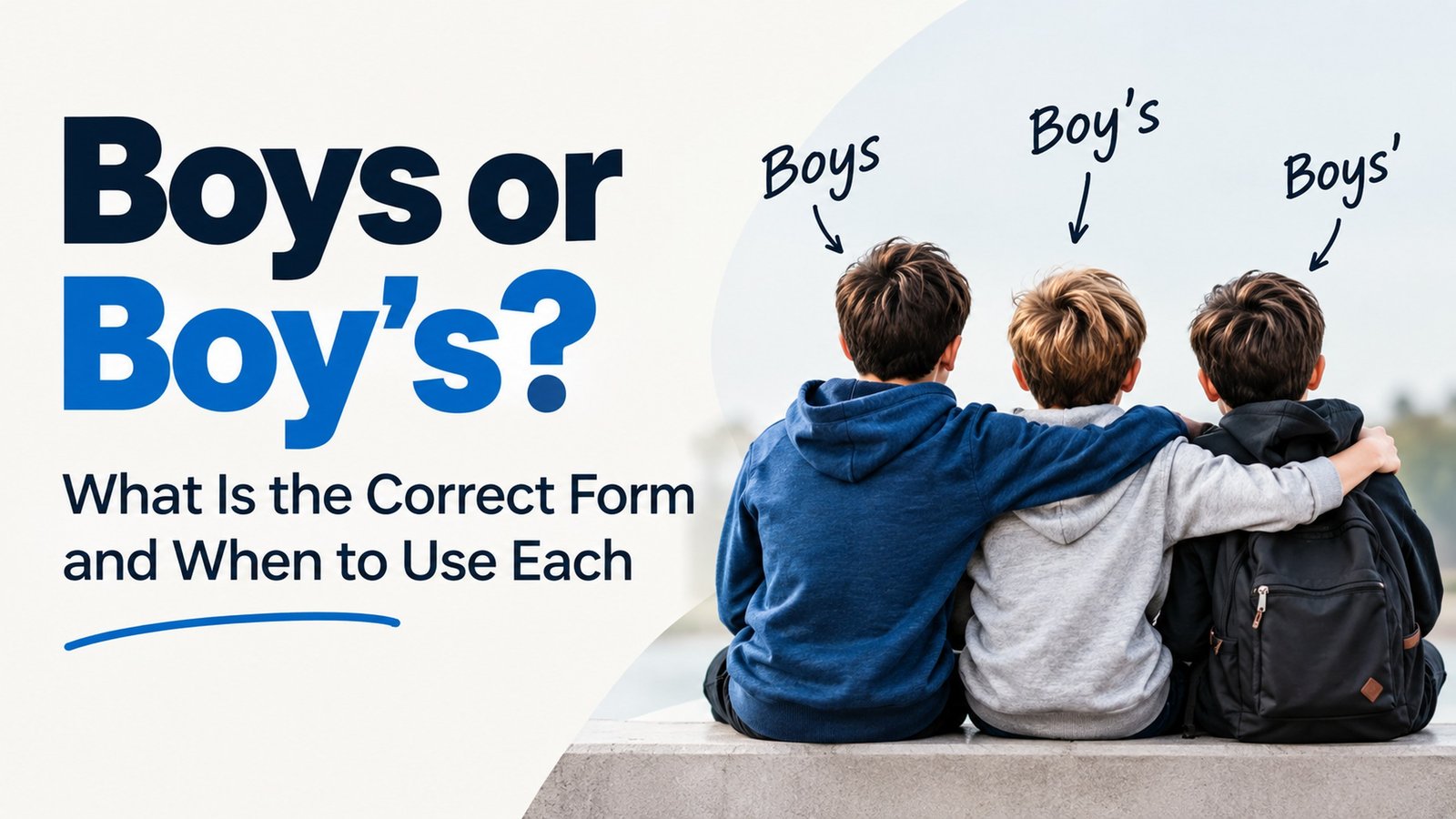
“Boys” is the plural form of “boy,” used for two or more boys. “Boy’s” is the singular possessive form, used when something belongs to one boy. Most people searching for boys or boy’s are trying to confirm which spelling fits their sentence, especially when writing quickly or checking a name, title, or caption.
This distinction matters because the two words sound identical but mean completely different things in writing. Getting it wrong can confuse a reader, weaken a resume or caption, or make a school assignment look careless. The good news is that the rule is simple once you understand the small difference an apostrophe makes.
Boys or Boy’s: The Quick Answer
Here is the short version before the full explanation.
- Boys means more than one boy. No apostrophe. Example: The boys played soccer after school.
- Boy’s means something belongs to one boy. Apostrophe before the “s.” Example: The boy’s backpack was left on the bus.
- Boys’ means something belongs to more than one boy. Apostrophe after the “s.” Example: The boys’ locker room was being repainted.
If you are only checking one sentence, ask yourself: am I talking about many boys, or something owned by a boy? That single question solves most of the confusion.
What Does “Boys” Mean?
“Boys” is simply the plural noun form of “boy.” It refers to two or more male children or young males. It does not show ownership and never needs an apostrophe.
Part of speech: Plural noun
Simple meaning: More than one boy
Example sentences:
- The boys ran to the park after class.
- Three boys signed up for the chess club.
- Her sons are both boys.
There is no apostrophe in “boys” because plural nouns in English usually just add an “s.” You only add an apostrophe when you are showing possession, not when you are simply making a word plural.
What Does “Boy’s” Mean?
“Boy’s” is the singular possessive form of “boy.” It shows that something belongs to one specific boy. The apostrophe goes before the “s” because the owner is singular.
Part of speech: Possessive noun (singular)
Simple meaning: Belonging to one boy
Example sentences:
- The boy’s shoes were untied.
- That is my boy’s favorite toy.
- The boy’s teacher praised his essay.
A helpful trick: if you can replace “boy’s” with “his” or “belonging to the boy,” the possessive form with an apostrophe before the “s” is correct.
See More: Definitely Or Definately
What Does “Boys'” Mean?
This is the form many people forget to ask about, even though it appears constantly in real writing. “Boys'” is the plural possessive form. It means something belongs to more than one boy, and the apostrophe goes after the “s.”
Part of speech: Possessive noun (plural)
Simple meaning: Belonging to more than one boy
Example sentences:
- The boys’ bikes were parked outside.
- This is the boys’ clubhouse.
- The coach collected the boys’ jerseys after the game.
So there are actually three related forms, not two, and knowing all three prevents most mistakes.
Boys, Boy’s, and Boys’ at a Glance
| Form | Meaning | Apostrophe Placement | Example |
| Boys | More than one boy | No apostrophe | The boys are outside. |
| Boy’s | Belongs to one boy | Before the “s” | The boy’s jacket is blue. |
| Boys’ | Belongs to more than one boy | After the “s” | The boys’ jackets are blue. |
How to Tell the Difference: A Simple Test
Whenever you are unsure which form to use, ask three questions in order.
- Am I talking about more than one boy, with no ownership involved? Use “boys.”
- Does something belong to exactly one boy? Use “boy’s.”
- Does something belong to two or more boys? Use “boys’.”
If none of these apply, and you are just naming or counting boys, you almost always want the plain plural form, “boys,” with no apostrophe at all.
💡 Tip: Apostrophes in English are almost never used to make a word plural. They are used to show possession or to mark a contraction, like “it’s” for “it is.” This one fact clears up most boys or boy’s confusion instantly.
See More: Lose Vs Loose
Common Mistakes with Boys or Boy’s
Even confident writers slip up here because the words sound the same when spoken aloud.
❌ Incorrect: The boy’s played outside all afternoon.
✅ Correct: The boys played outside all afternoon.
Why: No one owns anything in this sentence, so no apostrophe is needed.
❌ Incorrect: That is the boys bike, not mine.
✅ Correct: That is the boy’s bike, not mine.
Why: The bike belongs to one boy, so the possessive form needs an apostrophe before the “s.”
❌ Incorrect: The boys’ is playing in the yard.
✅ Correct: The boys are playing in the yard.
Why: This sentence needs the simple plural, not a possessive form.
❌ Incorrect: All the boy’s toys were on the floor.
✅ Correct: All the boys’ toys were on the floor.
Why: If more than one boy owns the toys, the apostrophe goes after the “s.”
A quick way to catch these mistakes while proofreading is to read the sentence aloud and ask what the apostrophe is actually doing. If it is not showing ownership, it probably should not be there.
“Boys” In Everyday And Cultural Use
Outside of grammar exercises, “boys” appears constantly in everyday language, band names, TV titles, and casual phrases. Most of these uses are the simple plural noun, with no possessive meaning at all.
Boys will be boys is an informal expression used to excuse typical, sometimes mischievous behavior in young males. It uses the plain plural form twice and contains no apostrophe.
Girls and boys, or boys and girls, are both acceptable orderings in casual speech, though “boys and girls” is the more traditional phrasing in classrooms and announcements. Neither version uses an apostrophe.
All boys, or all the boys, both work grammatically. “All boys” is a general statement, while “all the boys” refers to a specific known group. Context decides which one fits.
Boys club (no apostrophe in casual use) refers informally to a group, environment, or organization associated with or dominated by males. Some formal organizations style it as “Boys Club” without punctuation, so it is worth checking the specific name if you are referencing an official group.
Boys day and boys love follow the same plural pattern. “Boys day” describes an outing or event for boys, and “boys love” is a term used informally in some media contexts. Neither needs an apostrophe in standard use.
Band, Show And Group Names: Is It “The” Boys Or Just “Boys”?
Many popular names include the word “boys,” and readers often want to know the exact official spelling. These are proper nouns, so they follow the actual registered or branded name rather than a general grammar rule.
- The Beach Boys is the correct, official band name, always including “The.”
- The Backstreet Boys is the group’s full official name, though it is frequently shortened to “Backstreet Boys” in casual speech.
- Beastie Boys is typically written without “The” as part of the group’s official branding, even though people sometimes add it in conversation.
- The Boys is the title of the popular superhero television series, and it is always capitalized as a title with “The” included.
- Pep Boys is a retail brand name and does not use “The” as part of its official title.
- Trailer Park Boys is a television series title, written without “The” in its official branding.
Because these are brand and title names, the safest approach is to match the spelling the company, band, or studio actually uses rather than applying a general grammar rule. When in doubt, check the official website, poster, or album cover.
Pronunciation
“Boys” and “boy’s” are pronounced exactly the same way: rhyming with “toys,” with one syllable. The apostrophe changes meaning and spelling, but it never changes how the word sounds when spoken. This is exactly why the written form matters so much in emails, essays, and captions, since a listener would never notice the difference, but a reader will.
Similar and Related Words
| Word | Meaning | How It Differs from Boys |
| Boy | One male child or young male | Singular, no apostrophe |
| Boyhood | The period of being a boy | Refers to a stage of life, not people |
| Boys’ club | A group associated with males | A fixed phrase using plural possessive |
| Lads | Informal British word for boys | More casual, mainly used in UK English |
Understanding these related words helps writers choose the most natural term for their tone, whether formal, casual, or regional.
See More: You Did Well Vs You Did Good
Frequently Asked Questions
Is it boys or boy’s?
It depends on meaning. Use “boys” for more than one boy with no ownership involved. Use “boy’s” when something belongs to a single boy.
What is the plural of boy?
The plural of “boy” is “boys,” formed by simply adding an “s,” with no apostrophe.
What is the possessive form of boy?
For one boy, the possessive is “boy’s.” For more than one boy, the possessive is “boys’.”
Is boys’ with an apostrophe after the s correct?
Yes. “Boys'” is correct when something belongs to two or more boys, and the apostrophe goes after the “s” because the group is plural.
Do you say boys club or boys’ club?
In casual writing, “boys club” is common without punctuation, but the grammatically precise possessive form is “boys’ club,” since the club belongs to a group of boys.
Is it the Beach Boys or Beach Boys?
The band’s official name is “The Beach Boys,” and “The” is part of the correct title.
Is it the Backstreet Boys or Backstreet Boys?
The group’s full official name is “The Backstreet Boys,” though “Backstreet Boys” is widely used in everyday speech.
How do you use boys in a sentence?
Use “boys” whenever you are referring to more than one boy without showing ownership, such as “The boys walked to school together.”
Is boys will be boys grammatically correct?
Yes. It is an informal, commonly used expression, and both instances of “boys” are simple plural nouns with no apostrophe needed.
What is the difference between all boys and all the boys?
“All boys” makes a general statement about boys as a group, while “all the boys” refers to a specific, already known group of boys.
Final Takeaway
Getting boys or boy’s right comes down to one clear rule: “boys” is plural with no apostrophe, “boy’s” shows something belongs to one boy, and “boys'” shows something belongs to more than one boy. Once a writer separates the idea of counting boys from the idea of ownership, the correct spelling becomes obvious almost every time.
Whether you are writing a school paper, a caption about “the boys,” or double-checking a band name like the Beach Boys or Backstreet Boys, the same small apostrophe rule applies. Keep the three forms in mind, run through the quick test whenever you hesitate, and your writing will stay clear, correct, and easy for any reader to follow.

Danish Raza is the author of Grammavio, a trusted resource for simple and easy-to-understand English grammar guides. He creates helpful content covering grammar rules, word meanings, vocabulary, and common grammar mistakes to help readers improve their English skills.



2 Comments