
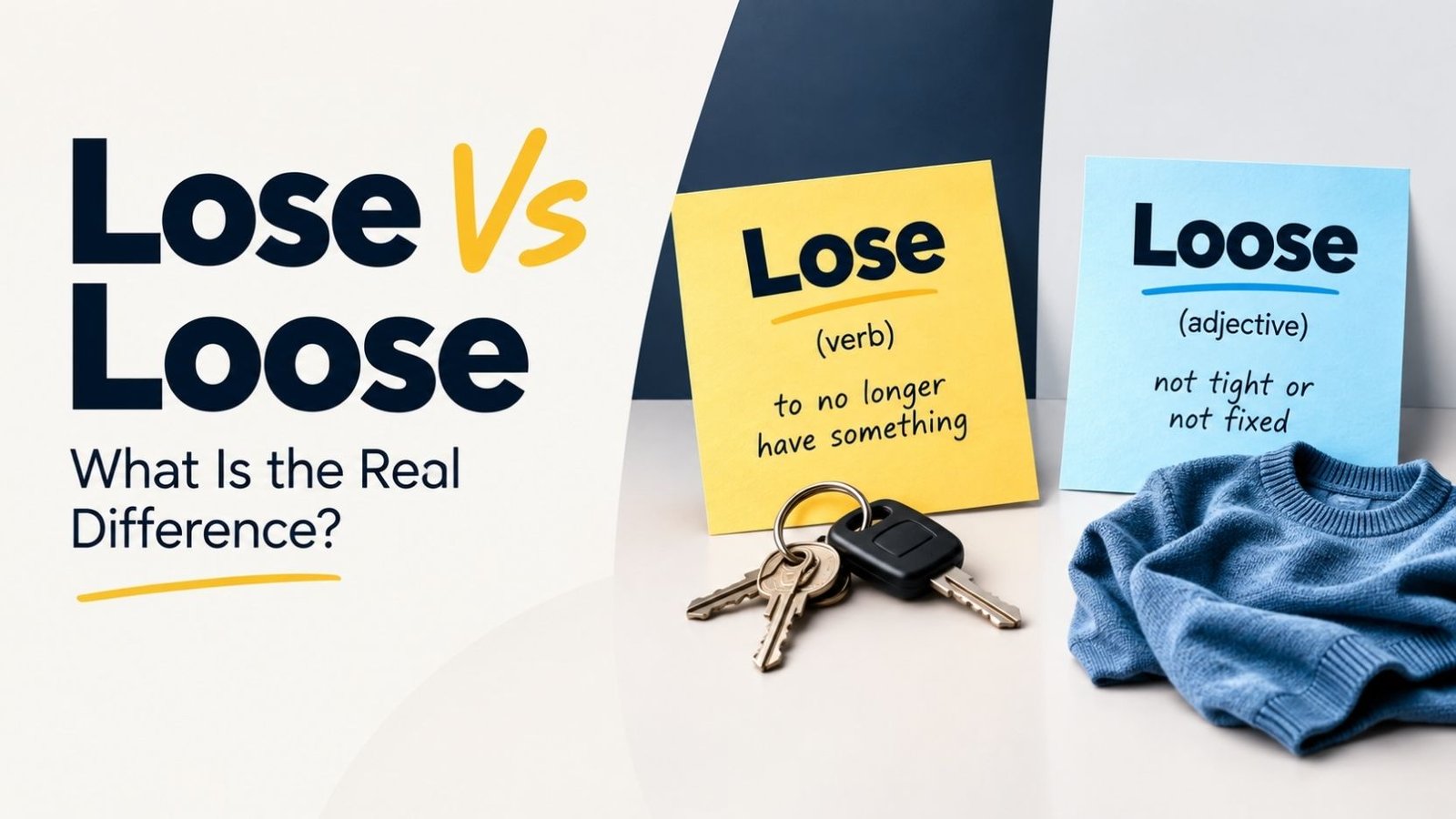
Lose and loose are two of the most confused word pairs in English. Lose is a verb that means to no longer have something, to fail to win, or to misplace an item. Loose is mainly an adjective that describes something not tight, not fixed, or not fastened. They look almost identical on the page, but they do not mean the same thing, and they are not pronounced the same way either.
This mix-up happens to native speakers and English learners alike. The spelling difference is just one letter, yet the meaning gap is wide. Understanding lose versus loose properly will help you write with confidence, avoid embarrassing typos, and sound more natural in everyday English, whether you are texting a friend, writing an essay, or drafting a work email.
Lose Vs Loose: The Quick Answer
Here is the simplest way to remember it.
- Lose is a verb. It means to no longer have something, to be defeated, or to misplace something. Example: “Did you lose your keys again?”
- Loose is an adjective. It means not tight or not firmly fixed in place. Example: “This shirt feels loose on me.”
If the sentence needs an action word, use lose. If the sentence needs a describing word, use loose.
See More: Shown Vs Showed
Lose Meaning
Lose is a verb. It describes an action or a change of state, not a quality or a description.
It generally covers three related ideas.
Meaning 1: To no longer have something. This is the most common use. It applies to objects, opportunities, relationships, or abstract things.
Example: “I always lose my phone charger.”
Meaning 2: To fail to win. This applies to games, competitions, arguments, or contests. Example: “Our team is going to lose the match if we don’t score soon.”
Meaning 3: To be deprived of something, often through circumstance. This applies to jobs, weight, time, or people.
Example: “She did not want to lose her job during the layoffs.”
Each of these meanings shares the same root idea: something that was present is now gone.
Loose Meaning
Loose is mainly an adjective. It describes a physical or figurative state of not being tight, fixed, or contained.
Meaning 1: Not tightly fastened or attached.
Example: “The doorknob feels loose, so I need to tighten the screw.”
Meaning 2: Not fitting closely to the body.
Example: “I prefer loose clothing when the weather is hot.”
Meaning 3: Free from restraint or confinement.
Example: “The dog got loose and ran into the street.”
Loose can also work as a verb in formal or older English, meaning to set free or to release, as in “loose the arrow.” This use is far less common in everyday speech, so most readers only need the adjective form.
Lose Vs Loose Grammar
The grammar difference is the easiest way to tell these words apart.
| Word | Part of Speech | Function in a Sentence |
| Lose | Verb | Shows an action: to lose, loses, losing, lost |
| Loose | Adjective (rarely a verb) | Describes a noun: a loose thread, a loose knot |
Lose is irregular. Its forms are lose, lost, and lost, not “losed.”
- Present: “I lose my patience easily.”
- Past: “I lost my patience yesterday.”
- Past participle: “I have lost my patience before.”
Loose, as an adjective, follows normal adjective rules. It can appear before a noun or after a linking verb.
- Before a noun: “a loose button”
- After a linking verb: “The button is loose.”
Loose can also be made comparative and superlative, since it is an adjective.
- Comparative: looser
- Superlative: loosest
Example: “This belt is looser than my old one.”
Lose cannot take comparative or superlative forms, because verbs do not work that way.
Lose Vs Loose Vs Loss
A third word often joins this confusion: loss.
| Word | Part of Speech | Meaning | Example |
| Lose | Verb | To no longer have something | “Don’t lose your ticket.” |
| Loose | Adjective | Not tight or not fixed | “The rope is loose.” |
| Loss | Noun | The state or fact of losing something | “The loss of the game was disappointing.” |
Loss is the noun form connected to lose. You experience a loss when you lose something. Loose is unrelated to this word family in meaning, even though it looks similar in spelling.
Lose Vs Loose Vs Lost
Lost is simply the past tense and past participle of lose. It is not a separate word family member the way loss is.
- “I lose my umbrella every winter.” (present)
- “I lost my umbrella last week.” (past)
- “I have lost three umbrellas this year.” (past participle)
Loose never changes into lost. If you see “lost” in a sentence, it always connects back to the verb lose, never to loose.
See More: Time Frame Or Timeframe
How to Pronounce Lose and Loose
Pronunciation is actually the clearest clue for telling these words apart, even though the spelling suggests otherwise.
- Lose rhymes with “shoes.” It uses a Z sound at the end. IPA: /luːz/
- Loose rhymes with “goose.” It uses an S sound at the end. IPA: /luːs/
💡 Tip: If the word ends with a soft Z buzzing sound, it is lose. If it ends with a hissing S sound, it is loose.
This pronunciation difference exists in both American and British English, so the distinction holds across dialects.
Origin of Lose and Loose
The two words come from different roots, which explains why their meanings never overlap despite the similar spelling.
Lose comes from the Old English word “losian,” which meant to perish or to be lost. This word is related to “loss” and to the older Germanic root connected to destruction or separation.
Loose comes from the Old Norse word “lauss,” which meant free, untied, or not bound. This root is related to words like “loosen” and “release.”
Because these words descended from separate origins, their spellings only became similar by coincidence over centuries of English spelling changes, not because they share meaning.
Lose Vs Loose Weight
One of the most searched versions of this confusion is “lose weight” versus “loose weight.” The correct phrase is always lose weight.
- Correct: “I want to lose weight before summer.”
- Incorrect: “I want to loose weight before summer.”
Weight is something you have and then no longer have, which fits the verb lose perfectly. Loose weight is not a standard English phrase, even though it appears often in casual writing and social media captions.
Lose Vs Loose Examples
Seeing both words in full sentences side by side makes the difference easier to remember.
Lose examples:
- “You will lose points if you submit the assignment late.”
- “He does not want to lose touch with his old friends.”
- “If the team keeps missing shots, they will lose the game.”
Loose examples:
- “The screws on this chair are loose.”
- “She wore a loose braid for the summer wedding.”
- “Keep the leash loose so the dog can walk comfortably.”
Common Mistakes With Lose and Loose
This confusion usually comes from the spelling, not the meaning. Most people already know the difference in speech but slip up while typing quickly.
❌ Incorrect: “I always loose my keys.”
✅ Correct: “I always lose my keys.”
❌ Incorrect: “Don’t loose hope.”
✅ Correct: “Don’t lose hope.”
❌ Incorrect: “My pants are lose.”
✅ Correct: “My pants are loose.”
⚠️ Common mistake: Writers often type loose when they mean lose because loose looks more familiar or feels more complete with the double O. A quick pronunciation check almost always solves the problem. Say the word out loud. If it ends in a Z sound, write lose.
How to Remember Lose Vs Loose
A few simple memory tricks can help this stick permanently.
- Lose has one O, and you lose one thing at a time. Fewer letters, fewer possessions.
- Loose has two O’s, like two loops in a loose knot. More letters, more room, more looseness.
- Lose rhymes with “shoes,” and you can lose your shoes.
- Loose rhymes with “goose,” and a goose can run loose.
These small associations connect spelling to meaning in a way that sticks better than a plain grammar rule.
Similar and Related Words
Understanding nearby words can reinforce the difference even further.
| Word | Meaning | Difference From Lose or Loose |
| Loosen | To make something less tight | A verb form of loose, showing gradual action |
| Losing | The present participle of lose | Describes an ongoing action, not a state |
| Loser | A person who loses | A noun built from the verb lose |
| Loosely | In a loose or relaxed manner | An adverb form of loose |
None of these related words change the core distinction. Anything built from lose keeps the losing or missing meaning. Anything built from loose keeps the not tight meaning.
Lose Vs Loose According to Major Dictionaries
Reliable dictionaries agree on this distinction without exception.
Merriam-Webster defines lose primarily as a verb meaning to be unable to find, to fail to win, or to be deprived of. It defines loose primarily as an adjective meaning not fastened, not confined, or not tight.
Cambridge Dictionary follows the same pattern, listing lose as a verb tied to losing possession or losing a contest, and loose as an adjective tied to the absence of tightness or restraint.
Because both major dictionaries classify these words under different parts of speech with different meanings, there is no legitimate disagreement in standard English usage. The confusion is entirely a spelling issue, not a definition issue.
See More: Offerred Or Offered
Frequently Asked Questions
What does lose vs loose mean?
Lose is a verb meaning to no longer have something or to fail to win. Loose is an adjective meaning not tight or not securely fixed.
How do you use lose vs loose in a sentence?
Use lose for actions, such as “I don’t want to lose this game.” Use loose for descriptions, such as “The knot is too loose.”
Is loose a verb or an adjective?
Loose is mainly an adjective. It can rarely function as a formal verb meaning to release, but this use is uncommon in everyday English.
Is lose a noun or a verb?
Lose is a verb. The related noun is loss.
How do you pronounce lose and loose?
Lose rhymes with “shoes” and ends in a Z sound. Loose rhymes with “goose” and ends in an S sound.
What is the difference between lose, loose, and loss?
Lose is a verb, loose is an adjective, and loss is a noun describing the result of losing something.
Is it lose weight or loose weight?
It is always lose weight. Loose weight is not standard English.
Why do people confuse lose and loose?
The spelling looks similar, differing by only one letter, even though the pronunciation and meaning are completely different.
What is the past tense of lose?
The past tense of lose is lost, not “losed.”
Can loose ever mean the same as lose?
No. They never share meaning. Loose describes tightness, while lose describes losing something.
Final Thoughts on Lose Vs Loose
The difference between lose and loose comes down to grammar and pronunciation. Lose is a verb tied to losing something or failing to win, and it ends with a Z sound. Loose is an adjective tied to a lack of tightness or restraint, and it ends with an S sound. Once you separate them by function, the confusion mostly disappears.
The next time you are unsure which word fits, say the sentence out loud first. If the word describes an action, like losing a game or losing your patience, use lose. If the word describes a physical state, like a loose sweater or a loose screw, use loose. This one habit will clear up almost every mix up between these two words for good.

Danish Raza is the author of Grammavio, a trusted resource for simple and easy-to-understand English grammar guides. He creates helpful content covering grammar rules, word meanings, vocabulary, and common grammar mistakes to help readers improve their English skills.



One Comment