
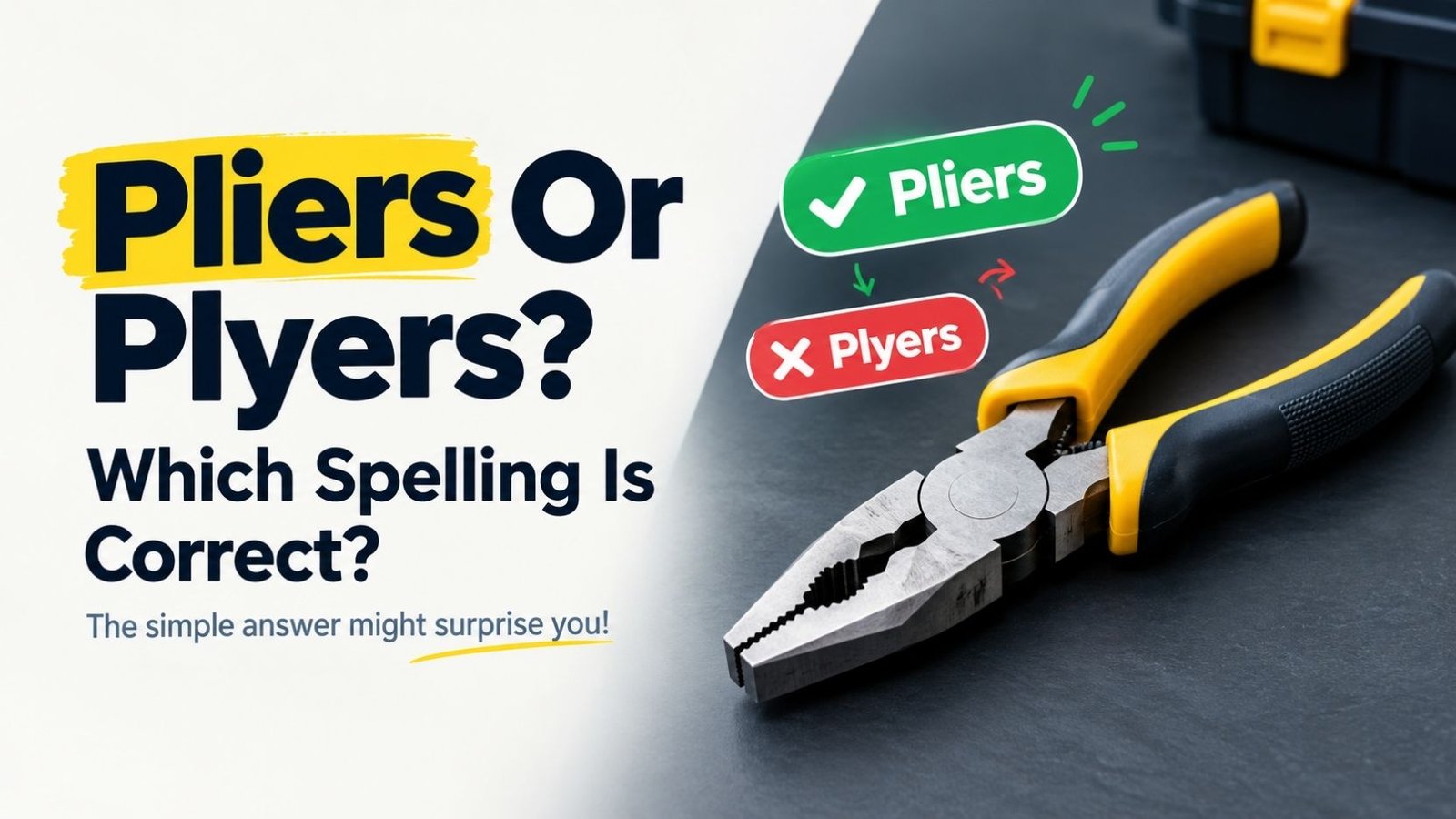
If you have ever reached for a tool and paused to wonder whether it is spelled pliers or plyers, you are not alone. The correct spelling is pliers. Plyers is a common misspelling that shows up often in casual writing, online listings, and everyday speech, but it does not appear in standard dictionaries. Pliers is the only accepted spelling in American English and British English alike.
Knowing the correct spelling matters more than it might seem. Pliers is a widely searched tool name, and using the wrong spelling in writing, product listings, or professional documents can look careless. It also affects how easily people find accurate information when searching. Getting this simple detail right helps you communicate clearly, whether you are writing a shopping list, a product description, or a school assignment.
What Does Pliers Mean?
Pliers is the name of a hand tool with two handles and two jaws that meet at a pivot point. You squeeze the handles together, and the jaws grip, bend, cut, or pull whatever is between them. It is one of the most common tools found in toolboxes, garages, and workshops around the world.
The simplest definition looks like this:
Pliers: A hand tool used for gripping, bending, twisting, or cutting objects, made of two pivoted arms that close together when squeezed.
People use pliers for many everyday tasks. Some examples include:
- Gripping a small object that is hard to hold with fingers
- Bending or shaping wire
- Pulling out a stubborn nail
- Cutting thin wire or cable
- Loosening or tightening a nut when a wrench is not available
Read More: Modeling Vs Modelling
Pliers Or Plyers: Spelling Explained
This is the part most readers are searching for, so here is the direct answer.
Pliers is correct. Plyers is incorrect.
The confusion happens because the word sounds similar to “plier,” and English speakers sometimes assume the plural follows a simple pattern like “flyer” or “player.” But pliers does not come from the word “ply” the way “flyer” comes from “fly.” The spelling has stayed consistent across dictionaries, style guides, and manufacturer packaging for a very long time.
| Spelling | Correct? | Notes |
| Pliers | Yes | Standard spelling in all major dictionaries |
| Plyers | No | Common misspelling, not found in dictionaries |
| Plier | Rare, informal | Sometimes used loosely for a single tool, but “pliers” is preferred even for one tool |
💡 Tip: If you are ever unsure, remember that pliers is always spelled with an “i” before the “ers,” never a “y.”
Why the Mistake Happens
A few reasons explain why people write plyers instead of pliers.
First, pronunciation plays a role. When spoken quickly, “pliers” can sound like it might be spelled with a “y.” Second, autocorrect and spellcheck tools do not always catch it, especially in fast typing or voice-to-text situations. Third, many people have simply seen the misspelling online often enough that it starts to look familiar, even though it is still wrong.
None of these reasons make plyers a valid alternative spelling. Dictionaries, grammar guides, and hardware manufacturers all use pliers.
Grammar Of The Word Pliers
Pliers has a specific grammatical quirk that trips up many writers, so it deserves its own explanation.
Is Pliers Singular or Plural?
Pliers is what grammarians call a plurale tantum, which simply means a noun that is always plural in form, even when referring to one item. This happens because the tool has two matching parts, similar to scissors, glasses, or tongs.
Because of this, pliers always takes a plural verb.
- Correct: The pliers are on the workbench.
- Incorrect: The pliers is on the workbench.
If you need to refer to a single tool clearly, the common phrase is “a pair of pliers.”
- Correct: I bought a pair of pliers yesterday.
- Also correct: These pliers work well for small wires.
Part Of Speech
Pliers is a noun. It does not function as a verb, adjective, or adverb in standard English.
How To Pronounce Pliers
Pliers is pronounced with two syllables: PLY-erz.
- American English: /ˈplaɪ.ərz/
- British English: /ˈplaɪ.əz/
The first syllable rhymes with “sky” or “fly.” The second syllable is soft, similar to “erz” at the end of “flyers.” Saying it correctly can also help you remember the spelling, since the “i” sound before “ers” matches the written form pliers, not plyers.
Origin Of The Word Pliers
The word pliers comes from the verb “ply,” which in earlier English meant to bend or to work with flexibility. This connects directly to what the tool does: it bends, folds, and manipulates materials.
The tool name developed from “plier,” an agent noun meaning “one that bends” or “a bending thing.” Over time, English speakers added the plural “s,” and the plural form became the standard way to refer to the tool, much like scissors and tongs. This is also why pliers is treated as a plural noun even when talking about a single tool.
Read More: Canceled Or Cancelled
Types Of Pliers
Because pliers show up in so many trades and hobbies, there are many specialized versions. Below are some of the most common types, along with what makes each one useful.
| Type of Pliers | Main Use |
| Slip joint pliers | General gripping and adjustable jaw width for everyday tasks |
| Needle nose pliers | Reaching into tight spaces and handling small parts |
| Locking pliers | Clamping an object firmly in place without holding the handles |
| Lineman pliers | Cutting, gripping, and twisting wire, common in electrical work |
| Channel lock pliers | Adjustable gripping for pipes and larger objects |
| Cutting pliers | Cutting wire, cable, or small metal pieces |
| Snap ring pliers | Installing or removing snap rings and retaining rings |
| Hog ring pliers | Closing hog rings, often used in upholstery and fencing |
| Oil filter pliers | Gripping and turning oil filters during maintenance |
| Adjustable pliers | Adjusting jaw size for different object thicknesses |
Fishing pliers deserve a special mention, since anglers use them to remove hooks, cut fishing line, and crimp weights. They usually combine a cutting edge with a gripping jaw, and many are made from corrosion resistant material because they are used near water.
Pliers In A Sentence
Seeing the word used naturally can help reinforce the correct spelling and usage.
- The electrician used lineman pliers to strip the wire.
- She reached for the needle nose pliers to bend the small hook.
- He grabbed a pair of pliers from the toolbox.
- These locking pliers hold the pipe steady while I work.
- I need adjustable pliers for this larger bolt.
Pliers Vs Plyers: Quick Comparison
⚠️ Common mistake: Writing “plyers” in emails, product titles, or search queries.
✅ Correct: pliers, needle nose pliers, locking pliers, lineman pliers
❌ Incorrect: plyers, needle nose plyers, locking plyers, lineman plyers
Even though many people search using the misspelled version, reliable sources, manufacturers, and retailers consistently use pliers in their official naming.
Synonyms And Related Words
While pliers has no exact one word synonym, a few related tools serve similar purposes depending on the task.
| Word | Meaning | Difference From Pliers |
| Tongs | A tool with two arms used for gripping, often without a pivot lock | Usually lacks a hinge and cutting edge |
| Forceps | A pincer tool, often used in medical or precision settings | Typically smaller and more delicate |
| Wrench | A tool for turning nuts and bolts | Designed for turning, not general gripping or cutting |
| Clamp | A device that holds objects firmly in place | Often stationary rather than handheld and manual |
These words are related in function but are not interchangeable with pliers in most contexts.
Pliers Around The World
In many countries, including Pakistan, pliers are a standard household and workshop tool, commonly sold in hardware markets under the same English name. Local pronunciation may vary slightly, but the spelling used on packaging and in retail listings generally follows the standard English form, pliers.
Common Mistakes To Avoid
Beyond the spelling issue, a few other mistakes are worth noting.
⚠️ Mistake 1: Using a singular verb with pliers.
❌ Incorrect: The pliers is broken.
✅ Correct: The pliers are broken.
⚠️ Mistake 2: Assuming “plier” alone is standard.
❌ Less common: I need a new plier.
✅ Standard: I need a new pair of pliers.
⚠️ Mistake 3: Spelling it as plyers in written content.
❌ Incorrect: These plyers work great.
✅ Correct: These pliers work great.
Read More: Cool Off Vs Call Off
Frequently Asked Questions
Is it pliers or plyers?
It is pliers. Plyers is a common misspelling and is not found in standard dictionaries.
What does pliers mean?
Pliers is a hand tool with two pivoted handles and jaws, used for gripping, bending, twisting, or cutting objects.
Is pliers singular or plural?
Pliers is always treated as plural, even when referring to one tool. It takes a plural verb, as in “the pliers are useful.”
How do you pronounce pliers?
Pliers is pronounced PLY-erz, with the first syllable rhyming with “sky.”
What is a pair of pliers?
“A pair of pliers” is the standard phrase used to refer to a single pliers tool, similar to “a pair of scissors.”
What are the three types of pliers most commonly used?
Three widely used types are slip joint pliers, needle-nose pliers, and lineman pliers, though many specialized versions exist for specific tasks.
Where does the word pliers come from?
Pliers come from the verb “ply,” meaning to bend, reflecting the tool’s ability to bend and manipulate materials.
Can plier be used instead of pliers?
“Plier” without the “s” is rarely used in standard English. Pliers is the accepted form, even for a single tool.
What is the difference between needle nose pliers and lineman pliers?
Needle-nose pliers have long, narrow jaws for reaching tight spaces, while lineman pliers have shorter, stronger jaws built for cutting and gripping heavier wire.
Why do people misspell pliers as plyers?
The misspelling likely comes from pronunciation patterns and similarity to words like “flyer,” even though pliers does not follow that spelling pattern.
Conclusion
Pliers is the correct spelling, and plyers is a misspelling that does not appear in dictionaries or professional writing. The word refers to a hand tool used for gripping, bending, cutting, and twisting, and it is always treated as plural, even when talking about a single tool. Understanding its spelling, pronunciation, and grammar helps you use the word correctly in speech, writing, and everyday tasks.
Whether you are shopping for needle nose pliers, describing a repair job, or simply trying to write the word correctly, remembering that pliers takes an “i,” not a “y,” will keep your writing accurate. The next time you see plyers written somewhere, you will know it is a mistake, and you will know exactly why pliers is the spelling that belongs in its place.

Danish Raza is the author of Grammavio, a trusted resource for simple and easy-to-understand English grammar guides. He creates helpful content covering grammar rules, word meanings, vocabulary, and common grammar mistakes to help readers improve their English skills.



2 Comments