
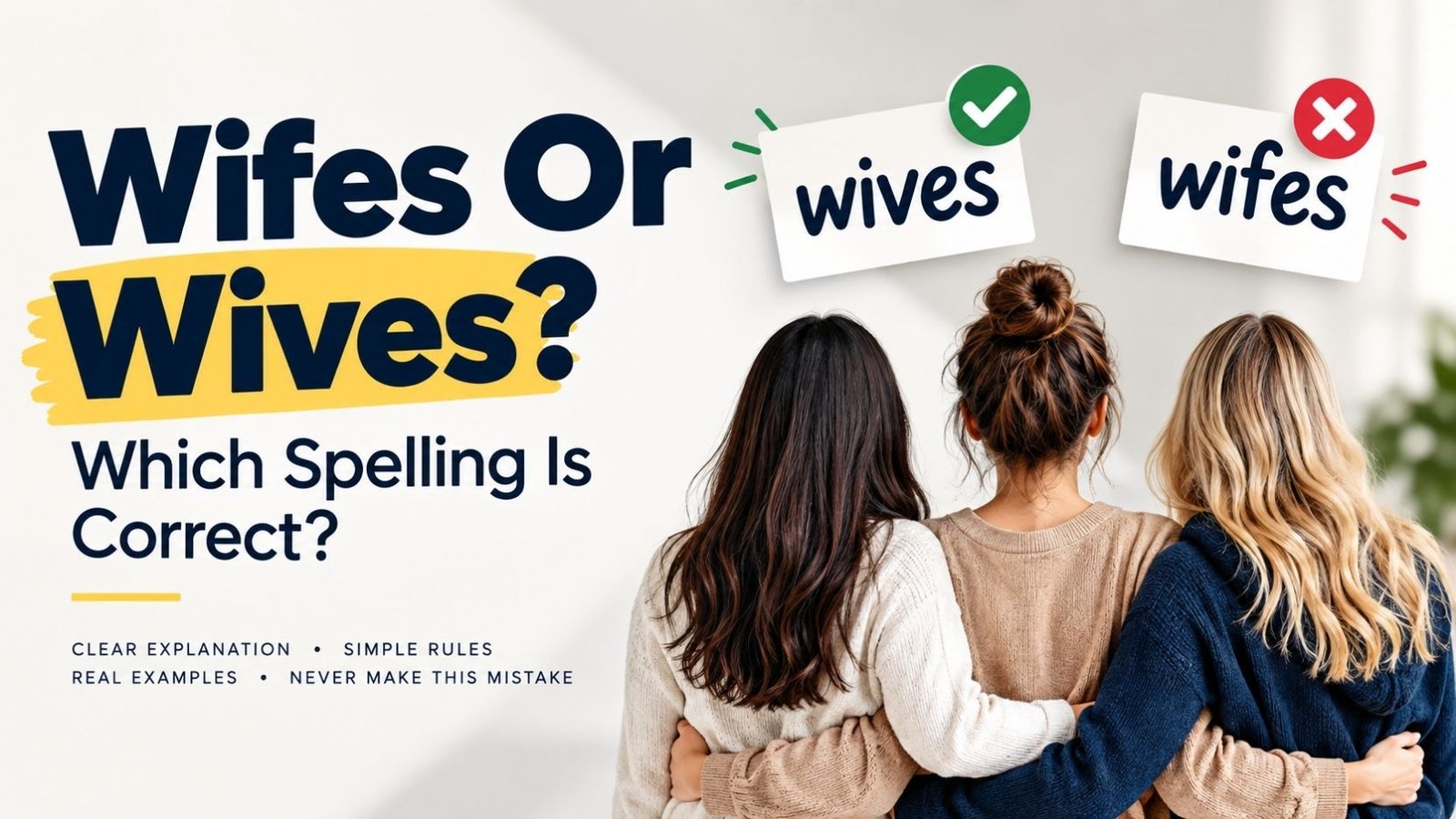
The correct plural of wife is wives, not wifes. Wifes or wives is a common spelling confusion because most English nouns simply add an s to form a plural. Wife follows a different pattern, since it ends in- fe, and that ending changes the spelling rule. So whenever you are talking about more than one wife, wives is the only correct form.
This mix-up happens for a simple reason. Many English speakers apply the regular plural rule out of habit, without thinking about words that end in f or fe. Understanding why wives is correct, and why wifes is not a real word, makes it much easier to avoid the mistake in the future, whether you are writing a text message, an email, or a formal document.
What Does Wifes or Wives Actually Mean?
Wives is the plural form of the noun wife. A wife is a woman who is married to someone. When you are referring to two or more married women, you always use wives.
Wifes is not a standard English word. It shows up often in casual writing and search queries, but no major dictionary lists it as a correct or accepted spelling. If you see wifes in a sentence, it is almost always a spelling mistake for wives.
Read More: Pliers Or Plyers
Is Wifes A Word?
No, wifes is not a recognized English word. Dictionaries such as Merriam-Webster, Cambridge, and Oxford list wife as the singular form and wives as the only correct plural. There is no separate entry for wifes in standard American or British dictionaries.
The confusion usually comes from how plurals normally work in English. Most nouns become plural just by adding an s, like book to books or car to cars. Wife does not follow that simple pattern, which is exactly why the spelling trips people up.
Why Wife Becomes Wives: The Grammar Rule
English has a specific rule for nouns that end in f or fe. In many of these words, the f or fe changes to v before adding es. This is a well-established pattern in English spelling, not an exception invented for this one word.
Here is how the rule works in practice.
- Wife becomes wives
- Life becomes lives
- Knife becomes knives
- Leaf becomes leaves
- Half becomes halves
Not every word ending in f or fe follows this pattern. Some words simply add an s, such as roof becoming roofs or chief becoming chiefs. Because of these exceptions, it helps to remember specific words rather than relying on the rule alone. Wife is one of the words that always follows the f to v change.
Quick Reference Table
| Singular | Plural | Rule Applied |
| Wife | Wives | fe changes to ves |
| Life | Lives | fe changes to ves |
| Knife | Knives | fe changes to ves |
| Roof | Roofs | Regular, adds s only |
| Chief | Chiefs | Regular, adds s only |
Wifes Or Wives: Grammar Explained Simply
Wife is a singular noun. Wives is its plural form. There is no version of this word spelled wifes in correct English grammar, in any tense or context.
Here is the simple rule in one line: when a noun ends in fe, and it follows the changing pattern, drop the fe and add ves. Wife minus fe leaves wi, and adding ves creates wives.
This rule applies whether you are writing about two wives, several wives, or many wives in general. The spelling never changes to wifes, no matter how the sentence is structured.
Correct Examples Of Wives In A Sentence
Seeing the word used correctly in real sentences makes the rule easier to remember.
- Both of my brothers have wonderful wives.
- The two wives sat together at the dinner table.
- Several wives in the group organized a community event.
- His wives from two different marriages both attended the reunion.
Each of these sentences uses wives because more than one wife is being discussed.
Incorrect Examples: Why Wifes Is Wrong
Seeing the incorrect version next to the correct one makes the mistake easier to spot and avoid.
❌ Incorrect: My friends and their wifes came to the party.
✅ Correct: My friends and their wives came to the party.
❌ Incorrect: The wifes club meets every Tuesday.
✅ Correct: The wives club meets every Tuesday.
❌ Incorrect: Both wifes agreed on the plan.
✅ Correct: Both wives agreed on the plan.
The reason wifes is incorrect comes back to the same spelling rule. English does not allow fe to simply become fes in this word. The f must change to v before the es ending is added.
Read More: Pheonix Vs Phoenix
Wife’s Or Wives: Understanding The Possessive Form
Plural and possessive forms often get confused, especially with a word like wife. It helps to separate the two ideas clearly.
Wife’s is the singular possessive. It shows that something belongs to one wife.
- My wife’s car is parked outside.
- His wife’s name is Sarah.
- The wife’s opinion mattered most in that decision.
Wives’ is the plural possessive. It shows that something belongs to more than one wife. Since wives already ends in s, the apostrophe goes after the s, with no extra s added.
- The wives’ meeting was rescheduled.
- Both wives’ families attended the wedding.
- The soldiers’ wives’ support group meets monthly.
There is no correct form spelled wifes possessive or wifes’. Since wifes is not a real word to begin with, it cannot take a valid possessive form either.
Possessive Comparison Table
| Form | Meaning | Example |
| Wife’s | Belongs to one wife | My wife’s phone rang. |
| Wives’ | Belongs to multiple wives | The wives’ book club met on Friday. |
| Wifes | Not a real word | No correct usage exists |
Common Mistakes With Wifes or Wives
A few patterns show up again and again when people search for wifes or wives.
- Writing wifes instead of wives for the plural form
- Writing wifes instead of wife’s for the possessive form
- Forgetting the apostrophe placement in wives’
- Using wive’s, which is also incorrect, since wive is not a standalone word
💡 Tip: If you are ever unsure, say the sentence out loud using the word wife in singular form first. Then ask whether you mean more than one wife, or whether something belongs to a wife. That question alone usually points to the correct spelling.
How to Pronounce Wives
Wives is pronounced with a v sound, not an f sound, even though the singular word wife uses an f sound. This is part of the same shift that changes the spelling.
- Wife is pronounced wyf, with an f sound at the end.
- Wives is pronounced wyvz, with a v sound before the z sound.
This pronunciation shift matches the spelling change. Once the f becomes v in writing, the sound changes too. Hearing the difference can actually help you remember the correct spelling, since wifes would not match how the word is naturally said.
Origin of the Word Wife
The word wife comes from Old English wif, which originally meant woman in a general sense, not specifically a married woman. Over time, the meaning narrowed to refer specifically to a married woman.
The plural pattern of changing f to v traces back to Old English and Germanic language roots, where certain consonant sounds shifted depending on their position in a word. This same pattern shaped other common words like life and knife, which explains why wife, life, and knife all follow the same plural rule today.
Wifes or Wives in American English vs British English
The rule for wife and wives is identical in American English and British English. There is no regional variation where wifes becomes an accepted spelling.
Some spelling differences do exist between American and British English in other areas, such as color versus colour, or organize versus organise. Wife and wives are not part of that category. Both American and British dictionaries agree that wives is the only correct plural.
Read More: Country Vs State
Similar Words That Follow the Same Pattern
Once you understand the wife to wives rule, it becomes easier to spell related words correctly too.
| Word | Meaning | Difference From Wife |
| Life | Existence or being alive | Refers to living, not marriage |
| Knife | A cutting tool | Refers to an object, not a person |
| Leaf | Part of a plant | Refers to nature, not people |
| Half | One of two equal parts | Refers to a portion, not marriage |
Each of these words follows the same f to v plural rule as wife, which is why they change to lives, knives, leaves, and halves.
Frequently Asked Questions
Is it wifes or wives?
It is always wives. Wifes is not a correct English word in any context.
Is wifes a word?
No. Standard dictionaries do not include wifes as a valid spelling. The only correct plural of wife is wives.
What is the plural of wife?
The plural of wife is wives. The f in wife changes to v before adding es.
How do you say his wife’s or his wives?
If you mean something belonging to one wife, use his wife’s. If you are somehow referring to more than one wife belonging to him, use his wives, or his wives’ for possession.
What is the difference between wife’s and wives’?
Wife’s is singular possessive, showing something belongs to one wife. Wives’ is plural possessive, showing something belongs to more than one wife.
Do you say my wife’s or my wives?
If you are talking about something belonging to your one wife, say my wife’s. My wives would only apply if a person has more than one wife.
Why does wife become wives instead of wifes?
English has a spelling rule where certain nouns ending in fe change the f to v before adding es. Wife follows this rule, along with words like life and knife.
Is wive’s a correct spelling?
No. Wive is not a standalone English word, so wive’s is not a valid possessive form.
Conclusion
The correct answer to wifes or wives is simple: wives is correct, and wifes is not a real English word. Wife follows a specific spelling rule where the f changes to v before adding es, turning wife into wives, the same way life becomes lives and knife becomes knives. The confusion is understandable, since most English plurals just add an s, but wife belongs to a smaller group of words that work differently.
Once you remember this one rule, the wifes or wives question becomes easy to answer every time. Whether you are writing about one wife, several wives, something belonging to a wife, or something belonging to multiple wives, the correct spelling always comes back to wife, wives, wife’s, or wives’, never wifes.

Danish Raza is the author of Grammavio, a trusted resource for simple and easy-to-understand English grammar guides. He creates helpful content covering grammar rules, word meanings, vocabulary, and common grammar mistakes to help readers improve their English skills.



One Comment