
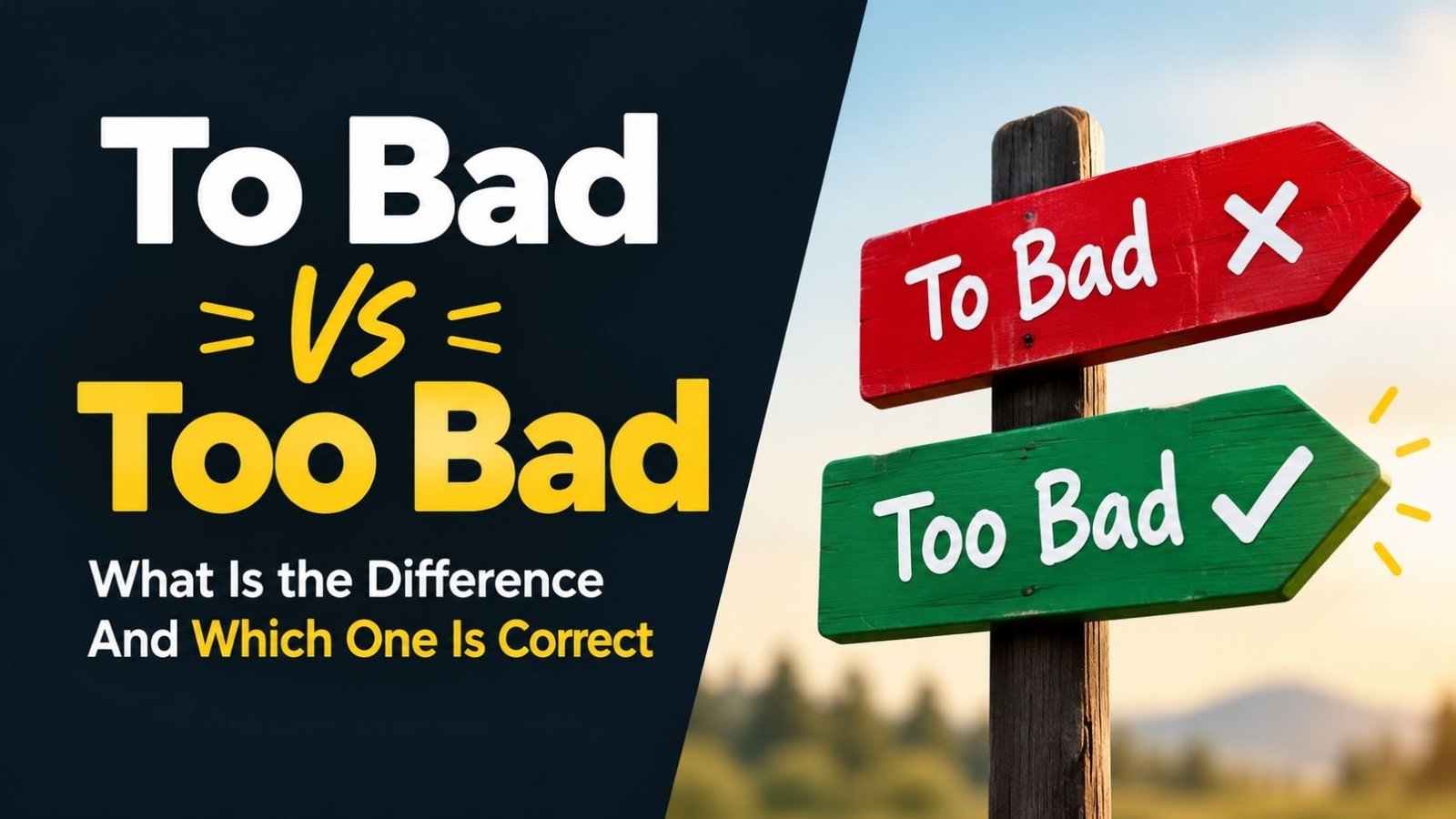
“Too bad” is the correct spelling when you want to say something is unfortunate or disappointing. “To bad” is a common misspelling that mixes up the preposition “to” with the adverb “too.” This mix-up happens because the two words sound exactly the same when spoken. Once you understand the small spelling difference, you will never confuse them again.
This confusion is one of the most common spelling mistakes in English writing. It happens in texts, emails, social media posts, and even published articles. Getting it right matters because “to” and “too” carry completely different grammatical jobs. Understanding the difference also helps you spot and avoid other similar word mix-ups.
Quick Answer: Is It To Bad or Too Bad
The correct phrase is always “too bad.” “To bad” is not a real phrase in standard English.
Here is the short version:
- Use too bad when you mean something is unfortunate, disappointing, or excessive.
- Never use to bad on its own. “To” always needs another action word or purpose after it, such as “to bake” or “too bad to fix.”
If you remember only one rule from this article, remember this one.
Read More: High School Or HighSchool
Too Bad Meaning
“Too bad” is an informal expression. It means something is unfortunate, disappointing, or regrettable. People often say it as a short, standalone reaction.
Example 1: “I can’t come to the party tonight.” “Too bad, we’ll miss you.”
Example 2: “The store closed five minutes before we arrived.” “That’s too bad.”
In both examples, “too bad” expresses mild sympathy or disappointment about a situation.
A Second Meaning: Too Bad Can Sound Dismissive
“Too bad” does not always sound sympathetic. Depending on tone, it can also sound blunt or even a little uncaring.
Example: “I don’t want to go, but I have to.” “Too bad. Let’s move.”
Here, “too bad” means the speaker is not going to change the plan, even though the other person is unhappy about it. The meaning shifts based on tone of voice, context, and the relationship between the speakers.
Why People Confuse To and Too
The confusion is not really about meaning. It is about spelling and sound.
“To” and “too” are homophones. They are pronounced the same way, but they have different jobs in a sentence.
| Word | Part of Speech | Function | Example |
| To | Preposition or infinitive marker | Shows direction, connection, or introduces a verb | She went to the store. She wants to leave. |
| Too | Adverb | Means “also” or “excessively” | I want to come too. It is too cold outside. |
Because they sound identical, writers often type the wrong one out of habit, especially when typing quickly.
To Bad or Too Bad: The Grammar Explanation
To understand why “too bad” is correct, it helps to look at what each word actually does.
“To” as a Preposition or Infinitive Marker
“To” connects a verb to its purpose, or connects a noun to a destination or relationship.
Examples
- I am going to the market.
- She wants to bake a cake.
- He listened to the music.
Notice that “to” is always followed by a place, an object, or a base verb. “To bad” does not work this way, because “bad” is an adjective, not a verb or destination.
“Too” as an Adverb
“Too” modifies an adjective, adverb, or verb. It adds emphasis, meaning “also” or “more than necessary.”
Examples
- The soup is too hot to eat.
- She is too tired to drive.
- I want to go too.
In “too bad,” the word “too” is doing exactly this job. It intensifies the adjective “bad,” turning the phrase into a fixed expression meaning “unfortunate.”
Why “To Bad” Is Grammatically Incorrect
“Bad” is an adjective. “To” cannot directly attach to an adjective on its own in this way. There is no grammatical structure in standard English where “to bad” forms a correct phrase by itself.
That is why “to bad” is always considered a spelling mistake, not an alternate form.
Read More: Sentence Or Sentance
Not Too Bad: A Related Phrase
“Not too bad” is a separate, very common expression. It means something is acceptable, fine, or better than expected.
Example: “How was the exam?” “Not too bad, actually. I think I passed.”
This phrase is more neutral or even positive, unlike “too bad” on its own, which usually leans negative or disappointing.
Not Too Bad or Not To Bad
The same rule applies here. “Not too bad” is correct. “Not to bad” is incorrect for the same reason explained above.
Too Bad So Sad: A Casual Expression
“Too bad, so sad” is an informal, often playful or sarcastic phrase. It is used when someone shows little real sympathy for a problem, sometimes teasingly and sometimes dismissively.
Example: “I lost my spot in line.” “Too bad, so sad.”
This expression rhymes on purpose, which is part of why it became popular in casual speech. It is common in spoken English and social media, but it is not typically used in formal writing.
Good Riddance to Bad Rubbish
This is a separate idiom that some readers search for alongside “too bad.” It means someone is glad that a person, thing, or situation is gone, especially if it was unpleasant or troublesome.
Example: “He finally quit the group chat.” “Good riddance to bad rubbish.”
This phrase uses “bad” as a regular adjective describing “rubbish,” and it is unrelated to the to versus too spelling issue. It is included here only because readers sometimes search for it in the same context.
Common Mistakes With To and Too
Understanding a few real examples makes the rule easier to remember for good.
❌ Incorrect: I’m sorry to hear that, to bad it didn’t work out.
✅ Correct: I’m sorry to hear that; too bad it didn’t work out.
❌ Incorrect: That’s to bad, I was hoping you could come.
✅ Correct: That’s too bad; I was hoping you could come.
❌ Incorrect: It’s not to bad for a first attempt.
✅ Correct: It’s not too bad for a first attempt.
A simple trick: if you can replace the word with “also” or “excessively” and the sentence still makes sense, use “too.” If you cannot, use “to.”
Too Bad vs To Bad: Quick Comparison Table
| Phrase | Correct or Incorrect | Meaning |
| Too bad | Correct | Unfortunate, disappointing, or a blunt dismissal |
| To bad | Incorrect | Common misspelling of “too bad” |
| Not too bad | Correct | Acceptable, fine, better than expected |
| Not to bad | Incorrect | Common misspelling of “not too bad” |
| Too bad, so sad | Correct, informal | Casual or sarcastic lack of sympathy |
Pronunciation
“To,” “too,” and “two” all sound the same in everyday American English. They are pronounced roughly like “too,” rhyming with “shoe” or “blue.” This shared pronunciation is the main reason writers mix up their spelling, since the ear cannot tell the words apart the way the eye can.
Read More: Wifes Or Wives
Origin of Too
“Too” developed from the same Old English root as “to.” Over time, English speakers began using an extra written form, “too,” to separate the meaning of “also” or “excessively” from the directional and connecting uses of “to.” This is why the words look similar today but serve different grammatical roles.
Synonyms for Too Bad
These words and phrases can replace “too bad” depending on tone and context.
| Word or Phrase | Meaning | Typical Tone |
| Unfortunate | Something regrettable happened | Neutral or formal |
| A shame | Mild disappointment | Warm, sympathetic |
| Oh well | Accepting a small disappointment | Casual |
| Tough luck | Little sympathy shown | Blunt or dismissive |
| That’s a pity | Genuine regret | Polite, slightly formal |
Frequently Asked Questions
Is it to bad or too bad?
It is always “too bad.” “To bad” is a misspelling and is not correct in standard English.
What does too bad mean?
It means something is unfortunate or disappointing. Depending on tone, it can also sound like a blunt way of saying a situation will not change.
Is not too bad or not to bad correct?
“Not too bad” is correct. It means something is acceptable or better than expected.
Why do people write to bad instead of too bad?
Because “to” and “too” sound exactly the same when spoken, writers sometimes type the wrong one, especially when writing quickly.
Is saying too bad rude?
It can sound rude or dismissive depending on tone and context, especially if it is used to shut down someone’s complaint. In a sympathetic tone, it simply expresses mild regret.
What is the difference between to and too?
“To” is a preposition or infinitive marker used for direction or connecting to a verb. “Too” is an adverb meaning “also” or “excessively.”
What does too bad so sad mean?
It is a casual, often sarcastic phrase used when someone shows little real sympathy for a problem.
Is too bad formal or informal?
“Too bad” is informal. In formal writing, phrases like “unfortunately” or “that is regrettable” are usually preferred.
What is a simple trick to remember to versus too?
If you can swap the word for “also” or “excessively” and the sentence still makes sense, use “too.” Otherwise, use “to.”
Conclusion
“Too bad” is the only correct spelling when you want to describe something as unfortunate, disappointing, or final. “To bad” is a common mix-up that happens because “to” and “too” sound identical, even though they play completely different roles in a sentence. Once you remember that “too” means “also” or “excessively,” and “to” simply connects a verb or destination, the difference becomes easy to apply every time.
Related phrases like “not too bad” and “too bad so sad” follow the same spelling rule, so the lesson carries over naturally. The next time you type this phrase, picture “too” doing extra work, just like the extra “o” it carries, and the correct choice will come automatically.

Danish Raza is the author of Grammavio, a trusted resource for simple and easy-to-understand English grammar guides. He creates helpful content covering grammar rules, word meanings, vocabulary, and common grammar mistakes to help readers improve their English skills.



2 Comments