
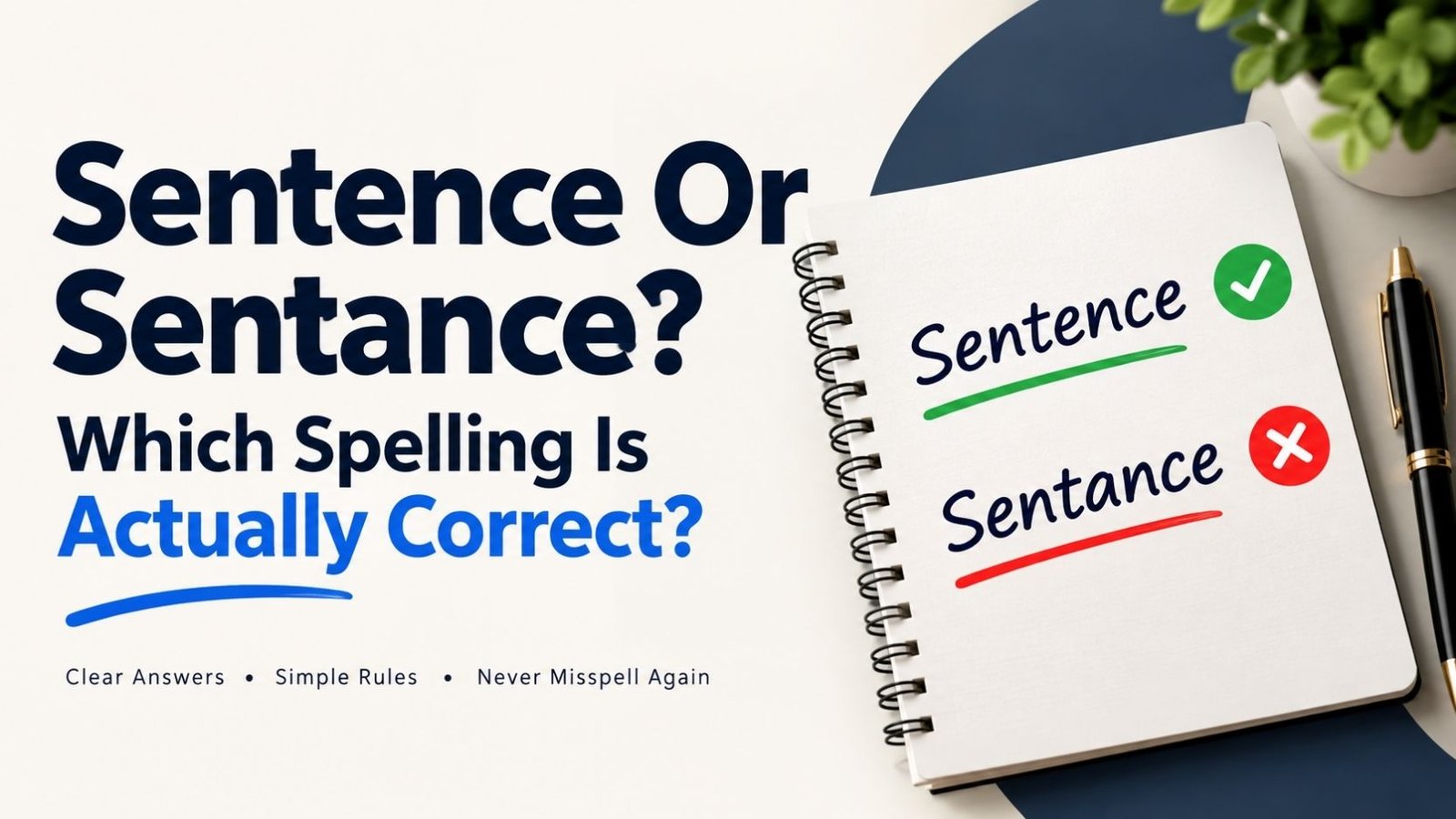
The correct spelling is sentence, not sentance. Sentence is the only form recognized in standard English dictionaries, whether you are writing for school, work, or everyday communication. Sentance is a common misspelling, and it does not appear as a valid word in any major English dictionary. If you have typed sentance and wondered whether it was right, you are not alone, and this article will clear up exactly why the confusion happens.
Getting this right matters more than it might seem. A sentence is one of the most basic building blocks of written English, so misspelling the word itself can undercut your credibility in essays, emails, and professional documents. This guide walks through the correct spelling, the grammar behind the word, common mix-ups, and clear examples so you never have to second-guess yourself again.
Sentence or Sentance: The Simple Answer
Sentence is correct. Sentance is incorrect in every context, whether you mean a grammatical sentence, a court sentencing, or any other use of the word.
The confusion usually comes from how the word sounds when spoken quickly. The middle syllable can blend together, which makes some writers guess at an “a” instead of an “e.” English spelling does not always match pronunciation exactly, and sentence is one of those words where the ear can mislead the hand.
Here is a quick reference to settle the question at a glance.
| Spelling | Status | Notes |
| Sentence | Correct | Standard spelling in all English dictionaries |
| Sentance | Incorrect | Common misspelling, not a recognized word |
Read More: Supposedly Or Supposably
Why Sentance Feels Right to Some Writers
Sentance is not a random typo. It follows a pattern that trips up many English learners and native speakers alike.
A few reasons this mistake happens so often:
- The unstressed middle vowel in sentence is pronounced closer to a soft “uh” sound, which can be misheard as “a.”
- Many English words that end in this kind of sound are spelled with “ance,” such as distance, entrance, and appearance.
- Autocorrect does not always catch the error immediately, especially in fast typing or messaging apps.
- Visual memory of the word can blur when it is typed often but rarely proofread closely.
Once you notice the pattern, though, the sentence becomes easy to remember, especially with a couple of simple tricks covered later in this article.
What Does Sentence Mean?
The word sentence has more than one meaning, depending on context. Separating these meanings clearly makes the word much easier to use correctly.
Meaning 1: A Grammatical Sentence
In grammar, a sentence is a group of words that expresses a complete thought. It typically contains a subject and a verb, and it starts with a capital letter and ends with a punctuation mark such as a period, question mark, or exclamation point.
Example: “She finished her homework before dinner.”
Meaning 2: A Legal Sentence
In a legal context, a sentence is the punishment a court gives to someone found guilty of a crime. This is where phrases like life sentence, death sentence, and prison sentence come from.
Example: “The judge handed down a five year sentence.”
Meaning 3: Sentence as a Verb
Sentence can also function as a verb, meaning to formally announce a punishment.
Example: “The judge will sentence the defendant tomorrow morning.”
Part of Speech and Pronunciation
Sentence can be used as both a noun and a verb, depending on the sentence structure around it.
- As a noun: “That was a well written sentence.”
- As a verb: “The court chose to sentence him leniently.”
Pronunciation: sentence is pronounced SEN-tuhns, with the stress on the first syllable. The middle syllable is short and unstressed, which is exactly why it gets mistaken for “ance” in casual writing.
Sentence in a Sentence: Clear Examples
Seeing the word used correctly in different contexts helps reinforce the spelling.
- “Can you rewrite that sentence so it sounds clearer?”
- “The teacher asked us to write a topic sentence for each paragraph.”
- “He received a life sentence for the crime.”
- “Please turn this fragment into a full sentence.”
Common Mistakes With Sentence and Sentance
Knowing the wrong version helps you catch it faster in your own writing.
Incorrect: Write a sentance describing your weekend.
Correct: Write a sentence describing your weekend.
Incorrect: The judge gave him a harsh sentance.
Correct: The judge gave him a harsh sentence.
Incorrect: This sentance does not make sense.
Correct: This sentence does not make sense.
💡 Tip: If you are unsure while typing, say the word slowly in your head as “SEN tence,” emphasizing the “e” in the second syllable. This small habit helps prevent the mistake from becoming automatic.
Read More: Country Vs State
Sentence Types: Simple, Compound, and Complex
Because many readers searching for sentence or sentance are also looking for grammar help, it is worth briefly covering the main sentence types.
Simple Sentence
A simple sentence has one independent clause, meaning one subject and one verb expressing a complete thought.
Example: “The dog barked.”
Compound Sentence
A compound sentence joins two independent clauses, usually with a conjunction like and, but, or or.
Example: “The dog barked, and the cat ran away.”
Complex Sentence
A complex sentence contains one independent clause and at least one dependent clause, which cannot stand alone.
Example: “Although it was raining, the dog barked at the mail carrier.”
| Sentence Type | Structure | Example |
| Simple | One independent clause | The dog barked. |
| Compound | Two independent clauses joined together | The dog barked, and the cat ran away. |
| Complex | One independent clause plus a dependent clause | Although it was raining, the dog barked. |
What Is a Topic Sentence?
A topic sentence is the sentence that introduces the main idea of a paragraph. It usually appears first and gives the reader a preview of what the paragraph will discuss. Strong topic sentences make writing easier to follow, especially in essays and reports.
What Is a Run On Sentence?
A run on sentence happens when two or more independent clauses are joined without proper punctuation or a connecting word. This creates a sentence that feels rushed or confusing to read.
Incorrect: I went to the store I bought some milk.
Correct: I went to the store, and I bought some milk.
How Long Is a Life Sentence?
A life sentence generally means imprisonment for the remainder of a person’s life, though the exact length and parole eligibility depend on the country, state, and specific laws involved. Some jurisdictions allow parole after a set number of years, while others enforce sentences without the possibility of release. Because sentencing laws vary widely, anyone researching a specific case should check the relevant legal jurisdiction directly rather than relying on a general rule.
Origin of the Word Sentence
Sentence comes from the Latin word sententia, meaning opinion, feeling, or way of thinking. It passed into English through Old French, where it originally referred to a judgment or a way of expressing an idea. Over time, the meaning expanded to include both the grammatical structure we use today and the legal punishment handed down by a court. Both modern meanings, the grammatical one and the legal one, trace back to this shared idea of expressing a judgment or complete thought.
Sentence vs Sentance: Quick Comparison
| Word | Correct or Incorrect | Meaning |
| Sentence | Correct | A grammatical unit, a legal punishment, or the verb form of sentencing someone |
| Sentance | Incorrect | Not a real word, always a misspelling of sentence |
Similar and Related Words
Understanding related words can help clarify why sentence is spelled the way it is, and how it fits alongside similar terms.
| Word | Meaning | How It Differs From Sentence |
| Sentiment | A feeling or opinion | Shares Latin roots with sentence but refers to emotion, not grammar or punishment |
| Sentencing | The act of giving a legal punishment | The noun form describing the process, rather than the punishment itself |
| Phrase | A group of words without a complete thought | Shorter than a sentence and does not need a subject and verb |
| Clause | A group of words with a subject and verb | Can be part of a sentence, but is not always a complete sentence on its own |
Sentence or Sentance in the UK and US
Sentence is spelled the same way in both British English and American English. There is no regional variation here, unlike words such as color and colour. If you have seen sentance in any British or American source, it is simply a typo, not an accepted regional spelling.
Read More: Modeling Vs Modelling
Is Sentance a Word?
No, sentance is not a recognized English word in any major dictionary, including Merriam Webster, Oxford, and Cambridge. It does not appear as an alternate spelling, a regional variant, or an archaic form. It is a straightforward misspelling of sentence.
Frequently Asked Questions
Is it sentence or sentance?
It is always sentence. Sentance is a misspelling and does not appear in any standard English dictionary.
Why do people spell it sentance?
The unstressed middle syllable in sentence can sound like “a” when spoken quickly, which leads some writers to guess the wrong spelling.
Is sentance a word in British English?
No. Sentence is spelled the same way in both British and American English, so sentance is incorrect in either variety.
What does sentence mean in a sentence?
It usually refers to a group of words that expresses a complete thought, containing a subject and a verb.
What is the difference between sentence and sentiment?
Sentence refers to a grammatical unit or a legal punishment, while sentiment refers to a feeling or opinion. They share Latin roots but have different modern meanings.
How do you pronounce sentence?
It is pronounced SEN tuhns, with stress on the first syllable and a short, soft second syllable.
Can sentence be used as a verb?
Yes. As a verb, sentence means to formally give someone a legal punishment, as in “The judge will sentence him tomorrow.”
How long is a life sentence?
It typically means imprisonment for the rest of a person’s life, though parole eligibility and exact terms vary by jurisdiction.
What is a run on sentence?
A run on sentence occurs when two or more independent clauses are joined without correct punctuation or a connecting word, making the sentence hard to follow.
Is there ever a correct use for sentance?
No. There is no context, formal or informal, where sentance is the accepted spelling.
Final Thoughts
Sentence is the only correct spelling, whether you are talking about grammar, writing, or a legal punishment. Sentance, no matter how natural it might sound when spoken aloud, is simply a misspelling that does not exist in standard English. Once you understand where the confusion comes from, the soft, unstressed middle syllable, the mistake becomes much easier to avoid.
The next time you sit down to write, remember that sentence carries a long history, from its Latin root sententia through Old French and into the English we use today. Keep the correct spelling in mind, double check it when typing quickly, and your writing will stay clear, accurate, and professional.

Danish Raza is the author of Grammavio, a trusted resource for simple and easy-to-understand English grammar guides. He creates helpful content covering grammar rules, word meanings, vocabulary, and common grammar mistakes to help readers improve their English skills.


