
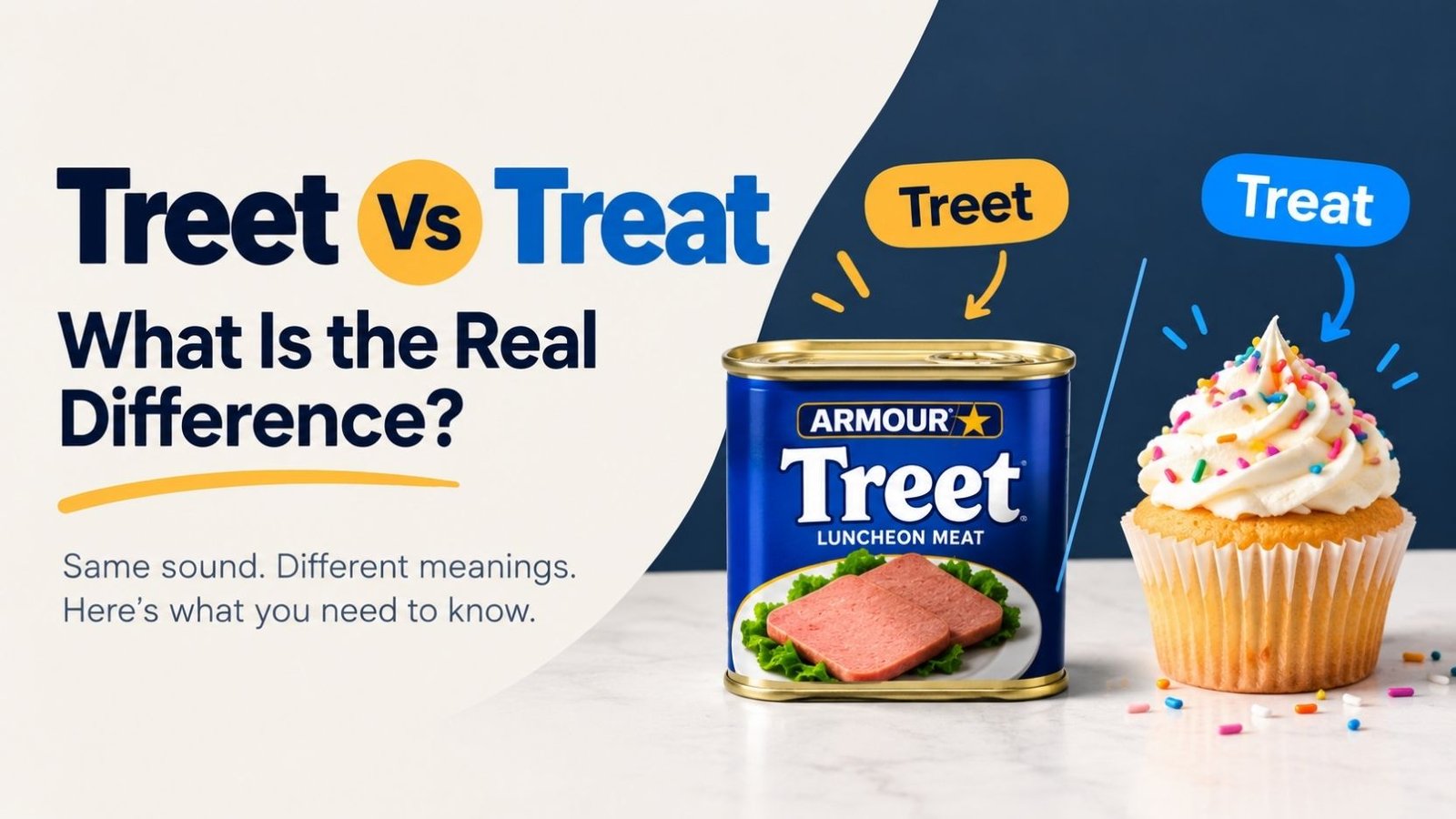
Treat is a standard English word. It works as a noun and a verb, and it shows up in everyday phrases like trick or treat, a sweet treat, or treat a burn. Treet is not a standard English word at all. It is a proper noun, used as a brand name for a canned meat product and, separately, as the name of a resale marketplace platform.
Most people who search treet vs treat are not confused about grammar. They have seen the word Treet somewhere, on a can of meat, on a resale website, or on a restaurant sign, and they want to know if it is just a misspelling or something else. Below, both words are explained clearly, along with every common context where Treet actually appears.
Quick Answer: Treet Vs Treat
| Treat | Treet | |
| Word type | Standard English word | Proper noun or brand name |
| Part of speech | Noun and verb | Not a part of speech; used as a name |
| Correct in a sentence | Yes | Only when naming a specific brand |
| Common meaning | Something enjoyable, or to handle/treat something | Canned meat brand, or a resale platform |
| Example | She gave the dog a treat. | We bought a can of Treet. |
💡 Tip: If you are writing a normal sentence about kindness, food, medicine, or Halloween, the word you want is always treat. Treet only belongs in a sentence when you are naming that specific brand.
Read More: Pheonix Vs Phoenix
What Does Treat Mean?
Treat is a common English word with several related meanings. It can describe something pleasant given to someone, or it can describe the act of handling a person, condition, or object in a certain way.
As a noun, treat means:
- A snack, gift, or small indulgence: Ice cream is a special treat.
- A pet snack: The dog waited patiently for a treat.
- An event or experience that brings pleasure: Seeing her perform live was a real treat.
As a verb, treat means:
- To provide someone with food, entertainment, or a gift: He treated his friends to dinner.
- To behave toward someone in a particular way: Please treat others with respect.
- To give medical care: The doctor will treat the infection.
- To apply a process or substance to something: They treated the wood with sealant.
- To discuss or handle a subject in writing: The essay treats the topic of memory.
All of these meanings share the same spelling, treat. Only the context changes what it means.
Is Treet A Real Word?
No. Treet is not found in standard dictionaries as an ordinary English word. When people type treet, they are almost always doing one of three things:
- Misspelling treat by mistake, often because the two words sound identical when spoken.
- Referring to a canned meat brand that is officially spelled Treet.
- Referring to Treet, a company that runs branded resale marketplaces for retail brands.
Outside of these two proper-noun uses, treet has no independent meaning. If a sentence is not naming one of these specific brands, the correct word is always treat.
Meaning 1: Treet the Canned Meat Brand
Treet, sometimes written as Armour Star Treet, is a canned luncheon meat product. It was introduced in 1939 by Armour and Company in the United States, decades before many of today’s grocery store brands existed. The product is often compared to Spam because both are canned, fully cooked meats sold in a similar shape of tin.
Treet is typically made from chicken and pork, and its texture is finer than Spam, closer to bologna or vienna sausage. It has changed ownership several times over the decades and today the Armour Star line is produced by Conagra Brands.
Treet Vs Spam
People often ask how Treet compares to Spam, since both are canned luncheon meats sold near each other on grocery shelves.
| Feature | Treet | Spam |
| Introduced | 1939 | 1937 |
| Main ingredients | Chicken and pork | Pork and ham |
| Texture | Finer, closer to bologna | Slightly coarser |
| Common nickname | “Poor man’s Spam” | Original canned meat brand |
Neither product is objectively better; the choice usually comes down to price and personal taste. Shoppers who search armour treet or treet meat are typically looking for this exact canned food product, not a spelling variation of treat.
Other Treet Food Brands
Some regional and family-run food businesses also use the spelling Treet as part of their name, separate from the Armour Star product. Restaurants such as Tastee Treet, found in towns including Council Bluffs, Iowa, and Fennville, Michigan, use the word as a stylized brand name for their ice cream and diner-style menus. Similarly, names like Sweet Treet and Carolina Treet use the spelling as a catchy, memorable version of “treat” rather than as a grammatical choice. In every one of these cases, the E-E-T spelling is intentional branding, not an accepted alternative spelling of the everyday word treat.
Read More: Pliers Or Plyers
Meaning 2: Treet the Resale Platform
The second major use of Treet has nothing to do with food. Treet, often seen online as Treet.co, is a company that builds branded resale marketplaces for retail brands. Instead of customers reselling used items on general marketplaces, brands can run their own official secondhand shop, powered by Treet’s technology.
This is where names like Portland Leather Treet and Hope and Plum Treet come from. Portland Leather Goods and Hope and Plum are examples of retail brands that use a Treet-powered resale site so customers can buy and sell pre-owned items directly through a page connected to the brand, such as a web address ending in treet.co. When someone mentions Treet Portland Leather or hopeandplum treet, they are typically referring to this official resale marketplace, not a spelling of treat.
Shoppers looking for a treet discount code are usually searching for a promo code on one of these branded resale sites, again unrelated to the everyday word treat.
Pronunciation
Treat and Treet are pronounced exactly the same way in American English.
- Treat: /triːt/
- Treet: /triːt/ (same sound, different spelling)
Both rhyme with words like meet, seat, and feet. There is no pronunciation difference between the two, which is a major reason the spelling confusion exists in the first place. English speakers hear the sound “treet” and can reasonably guess either spelling unless they already know the word.
Origin of Treat
The word treat comes from Old French traitier, meaning to handle or deal with, which itself came from Latin tractare, related to the idea of drawing something out or managing it. Early English uses of treat centered on negotiating or discussing terms, which is why older phrases like “to treat with someone” once meant to negotiate.
Over time, the meaning expanded. By the 18th century, treat had picked up its medical sense, referring to caring for a patient. The sense of giving someone a pleasurable gift, like a treat of candy or a meal out, developed alongside these other meanings and remains the most common use today.
The spelling Treet, by contrast, has no independent etymology. It was created for branding purposes, first for the 1939 canned meat product and later for the modern resale company, rather than evolving naturally as part of the English language.
Grammar: Treat as a Noun and a Verb
Treat behaves like most regular English words, with predictable forms depending on how it is used.
| Form | Word | Example |
| Base verb | treat | They treat every customer fairly. |
| Past tense | treated | She treated her team to lunch. |
| Present participle | treating | The nurse is treating the wound. |
| Plural noun | treats | The bakery sells fresh treats daily. |
| Singular noun | treat | That was a nice treat. |
There is no grammatical form of Treet. It cannot be pluralized as “treets” and cannot take verb endings like “treeted” or “treeting,” because it is not a functioning part of speech. It is only ever used as a fixed brand name.
Common Mistakes
❌ Incorrect: The teacher gave us a special treet.
✅ Correct: The teacher gave us a special treat.
❌ Incorrect: Doctors will treet the infection.
✅ Correct: Doctors will treat the infection.
❌ Incorrect: Please treet others kindly.
✅ Correct: Please treat others kindly.
⚠️ Common mistake: Writing “treets” as the plural of treat. The correct plural is always treats.
⚠️ Common mistake: Confusing Treet, the brand name, with a spelling option for the everyday word. Treet is only correct when referring specifically to the canned meat product, a restaurant using that name, or the Treet resale platform.
Treat Vs Threat: A Different Kind of Confusion
Some readers searching treet vs treat are actually thinking of a different pair of words, treat and threat. These two are unrelated in meaning, even though they share several letters.
- Treat: something pleasant, or to handle a situation or person.
- Threat: a statement or sign that something harmful may happen.
Example: “The email contained a threat” and “The email offered a free treat” mean very different things. If a search intent was really about telling these two apart, the key difference is that a threat is negative and warns of danger, while a treat is positive and pleasant.
Examples of Treat in a Sentence
- Halloween is famous for trick or treat, where children collect candy door to door.
- The vet recommended a low-sugar treat for the dog.
- Burn injuries should be treated with cool water right away, not ice.
- The article treats the subject of climate change in detail.
- She treated herself to a quiet weekend away.
Read More: Cool Off Vs Call Off
Examples of Treet Used Correctly
- We fried up some Treet for breakfast instead of bacon.
- She listed her old Portland Leather bag for sale on Treet.
- Tastee Treet has served ice cream and burgers since the 1950s.
Frequently Asked Questions
What does Treet mean?
Treet is not a standard English word. It is a brand name, used for a canned luncheon meat introduced in 1939 and, separately, for a branded resale marketplace platform used by retail brands.
Is treet a misspelling of treat?
In ordinary sentences, yes. Outside of the specific brand names, treet has no accepted meaning and should always be written as treat.
How do you spell treat correctly?
The correct spelling is treat, used for both the noun (a small pleasure or gift) and the verb (to handle, care for, or provide something enjoyable).
What is the difference between treat and treats?
Treat is singular, referring to one instance or item. Treats is the plural form, referring to more than one. “Have a treat” versus “Here are your treats” follows the normal English plural pattern.
Is Treet vs spam a real comparison?
Yes. Treet and Spam are both canned luncheon meat brands. Treet is made mainly from chicken and pork with a finer texture, while Spam uses pork and ham with a slightly coarser texture.
What is treet.co?
Treet.co is a technology platform that helps retail brands run their own official secondhand or resale shops, allowing customers to buy and sell used items directly connected to that brand.
Why do Portland Leather and Hope and Plum use the word Treet?
Both brands partner with the Treet platform to run a branded resale marketplace, which is why shoppers see links or pages referencing Treet alongside these brand names.
Is treat a noun or a verb?
Both. Treat functions as a noun (a treat) and as a verb (to treat someone or something), depending on how it is used in a sentence.
What does trick or treat mean?
Trick or treat is a Halloween tradition in which children go door to door asking for candy, with the phrase implying a mild “trick” if no treat is given.
Is there a word called treets?
No. Treets is not a standard word. The correct plural of treat is treats.
Final Thoughts
Treat is the correct, standard English word, working as both a noun and a verb across meanings that range from a small gift to medical care to simple kindness. Treet, on the other hand, only exists as a brand name. It refers to a decades-old canned meat product, a handful of restaurants that borrowed the catchy spelling, and a newer resale platform used by brands like Portland Leather Goods and Hope and Plum.
Anyone typing treet vs treat has usually run into one of these specific brands and wondered if the spelling was a mistake. Now the answer is simple: treat is what belongs in everyday writing, and Treet is a name, correct only when referring to that exact product or company.

Danish Raza is the author of Grammavio, a trusted resource for simple and easy-to-understand English grammar guides. He creates helpful content covering grammar rules, word meanings, vocabulary, and common grammar mistakes to help readers improve their English skills.



One Comment