
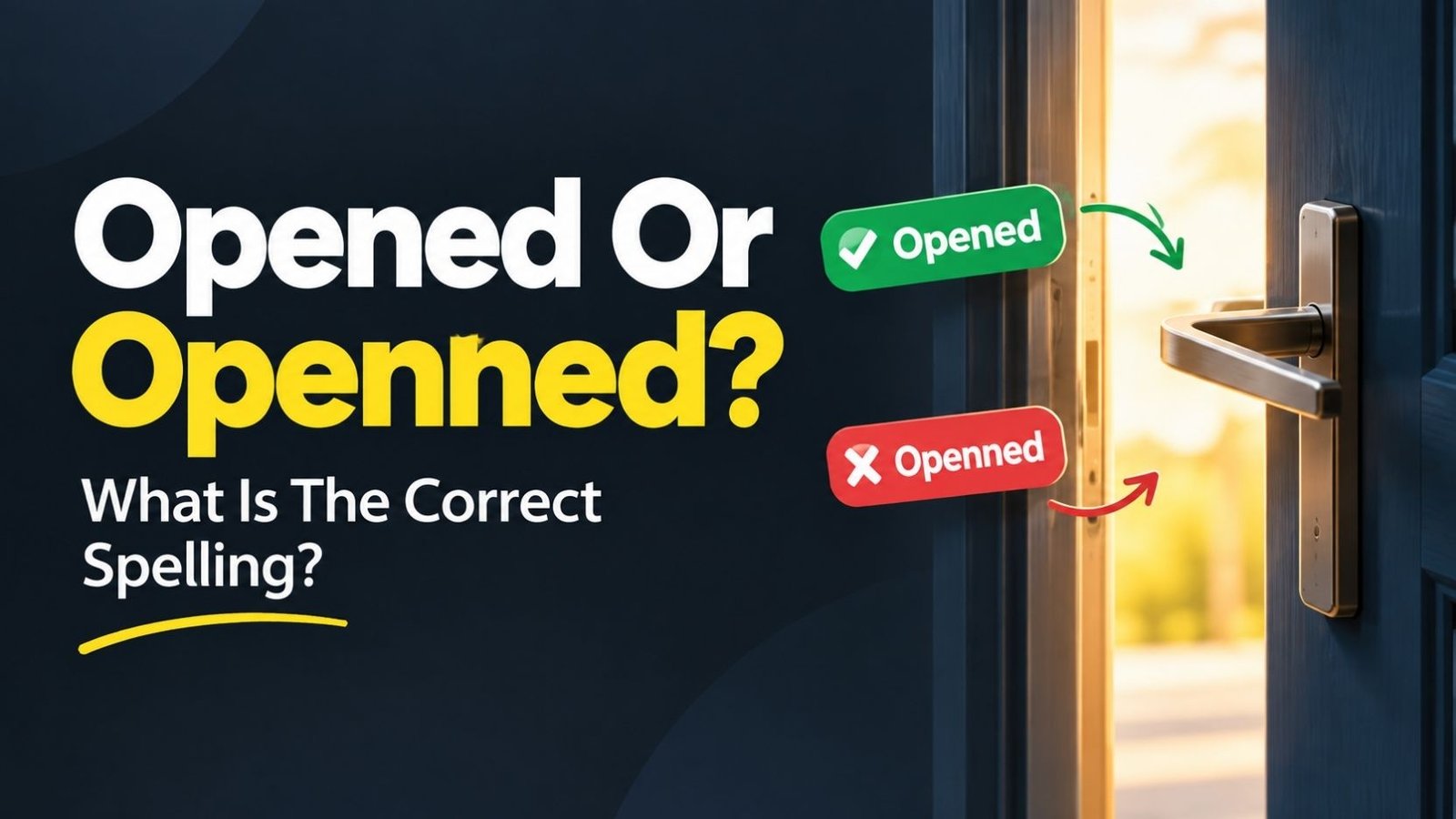
The correct spelling is “opened,” not “openned.” “Opened” is the standard past tense and past participle of the verb “open,” and it always uses a single “n.” “Openned,” with two n’s, is a common misspelling that does not appear in any recognized English dictionary. If you have typed “openned” before, you are not alone. It is one of the most frequent spelling mix-ups people search for online.
Understanding why this mistake happens can help you avoid it for good. English speakers sometimes double consonants out of habit, especially when a word feels like it should follow the pattern of words like “planned” or “stopped.” “Open,” however, follows a different rule. Once you see the pattern clearly, the correct spelling becomes easy to remember every time you write it.
Opened Or Openned: Quick Answer
| Spelling | Correct or Incorrect | Notes |
| Opened | Correct | Standard past tense and past participle of “open” |
| Openned | Incorrect | Common misspelling, not a real word |
If you remember nothing else from this article, remember this: “opened” has one “n.” There is no situation in standard English, formal or informal, where “openned” is the accepted spelling.
Why People Write Openned Instead Of Opened
The mistake usually comes from a spelling pattern reflex. Many English verbs double their final consonant before adding “ed,” especially short verbs ending in a single vowel plus a single consonant. Think of examples like:
- Stop becomes stopped
- Plan becomes planned
- Drop becomes dropped
These words double the consonant because the stress falls on the final syllable, and that syllable has a short vowel sound. The doubling keeps the vowel sound short when “ed” is added. “Open,” though, does not follow this rule, and the reason comes down to where the stress falls in the word.
Read More: Fairing Or Faring
The Grammar Rule Behind Opened
“Open” is a two-syllable word. The stress falls on the first syllable, so it sounds like OH pen, not oh PEN. English spelling rules say that when a word has more than one syllable, and the stress falls on the first syllable, the final consonant is not doubled before adding “ed.”
This is why “open” becomes “opened” with a single “n,” while a word like “permit,” which is stressed on the second syllable, becomes “permitted” with a doubled “t.” The stress pattern decides whether doubling happens, not the length of the word or personal preference.
Here is a simple way to check this rule with similar words.
| Word | Stress Pattern | Past Tense | Doubled Consonant? |
| Open | OH pen | Opened | No |
| Listen | LIS en | Listened | No |
| Happen | HAP en | Happened | No |
| Permit | per MIT | Permitted | Yes |
| Prefer | pre FER | Preferred | Yes |
Notice that “open,” “listen,” and “happen” all behave the same way. None of them double the final consonant. This pattern makes “opened” easy to predict once you know the rule, even without memorizing every word individually.
What Does Opened Mean?
“Opened” is the past tense and past participle form of the verb “open.” It describes an action that has already happened, where something moved from a closed or unavailable state into an open or accessible one.
Meaning 1: Physical Action
In its most common use, “opened” describes physically moving something so it is no longer shut. For example, a door, window, box, or bottle can be opened.
Example: She opened the window to let in fresh air.
Meaning 2: Starting or Beginning Something
“Opened” can also describe the start of an event, business, or process. A store, school, or ceremony can be opened.
Example: The new bakery opened last Saturday.
Meaning 3: Becoming Available or Accessible
“Opened” is used when something becomes available for use, viewing, or participation, such as an account, application, or opportunity.
Example: He opened a savings account at the bank.
Meaning 4: Figurative or Emotional Use
“Opened” is often used figuratively to describe a change in understanding, feeling, or awareness.
Example: The documentary opened her eyes to the problem.
Each of these meanings shares the same core idea: something moved from a closed, unavailable, or unaware state to an open one. The context of the sentence tells you which specific meaning applies.
Opened As An Adjective
“Opened” can also function as an adjective when it describes a completed state, usually right after a linking verb or before a noun in specific contexts.
Example: The opened package sat on the table.
This is different from “open” used as a plain adjective, which describes a general state rather than the result of an action.
Example: The store is open.
Here, “open” describes the current condition without pointing to a specific action that caused it. Compare that with “opened,” which usually signals that an action already took place.
Read More: Worse Case Or Worst Case
Open Or Opened: Grammar Comparison
Many readers search for “open or opened” because the two words look similar but serve different grammatical roles depending on the sentence. The table below breaks down the difference clearly.
| Form | Part of Speech | When to Use | Example |
| Open | Adjective or base verb | Describing a current state, or giving a command or present tense action | The window is open. Please open the door. |
| Opened | Past tense verb or participle | Describing a completed action in the past, or a result of an action | She opened the door an hour ago. |
A simple test helps decide which form fits. If you can add “right now” or “currently” to the sentence and it still makes sense, “open” is likely correct. If the action already finished, “opened” is the correct choice.
Is Opened Correct In Every Tense?
“Opened” is correct for two specific grammar situations: simple past tense and past participle. It is not correct for present tense or future tense, and it should never replace the base form “open” in commands or infinitives.
Here is how “open” changes across different tenses.
| Tense | Form | Example |
| Present | Open or opens | I open the shop every morning. |
| Past | Opened | I opened the shop at eight. |
| Future | Will open | I will open the shop tomorrow. |
| Present perfect | Have or has opened | She has opened the shop already. |
| Past perfect | Had opened | She had opened the shop before I arrived. |
Notice that “opened” appears correctly in the past perfect and present perfect forms because these tenses rely on the past participle. This is one reason “opened” shows up so often in writing, since it supports several different tense structures.
How To Pronounce Opened
“Opened” is pronounced OH pund, with two syllables. The stress falls on the first syllable, matching the base word “open.” The final “ed” sounds like a soft “d” sound rather than a separate syllable, since the verb ends in a voiced consonant sound before the ending is added.
This is different from verbs where “ed” is pronounced as its own syllable, such as “wanted” or “needed.” “Opened” is not pronounced oh pen ED. Getting the pronunciation right can also help reinforce the correct spelling, since the sound does not suggest a double “n.”
Origin Of The Word Open
“Open” comes from Old English “open,” which is related to older Germanic root words carrying a similar meaning of being unclosed or unobstructed. The word has kept a consistent meaning across centuries, referring to something that allows access, movement, or visibility rather than blocking it.
The “ed” ending added to form “opened” follows a regular pattern used across most English verbs to mark the past tense. Because “open” is what grammarians call a regular verb, it never developed an irregular past tense form like “went” or “ate.” It simply follows the standard rule of adding “ed” without doubling the final letter.
Examples Of Opened In A Sentence
A few clear examples can help solidify how “opened” works in real writing.
- The museum opened a new exhibit last week.
- He opened his laptop and began typing.
- The company opened three new locations this year.
- She opened up about her feelings for the first time.
- The committee opened the meeting with a brief announcement.
Each example shows “opened” describing a completed action, whether physical, figurative, or organizational.
Common Mistakes With Opened
Understanding the most frequent errors can help you avoid repeating them.
Incorrect: He openned the box carefully.
Correct: He opened the box carefully. The double “n” is never correct in any form of this word.
Incorrect: The store is opened every day at nine.
Correct: The store is open every day at nine. When describing a general, ongoing state rather than a specific past action, “open” is the correct adjective, not “opened.”
Incorrect: I have open the email already.
Correct: I have opened the email already. Perfect tenses require the past participle “opened,” not the base form “open.”
Reviewing these three patterns covers the majority of mistakes people make when choosing between “open” and “opened,” or misspelling the word as “openned.”
Openned: Why This Spelling Is Always Wrong
“Openned” does not appear in Merriam-Webster, the Oxford English Dictionary, or any other major dictionary. It is a spelling error, not a regional variation or informal alternative. Unlike some words that have accepted British and American spelling differences, such as “colour” and “color,” “open” and “opened” are spelled the same way in both British and American English.
If autocorrect or a spell checker flags “openned,” it is correctly identifying a typo. The fix is always the same: remove one “n” so the word reads “opened.”
Read More: Through vs Thru
Synonyms And Related Words
Depending on context, several words can replace “opened” while keeping a similar meaning. The right choice depends on tone and situation.
| Word | Meaning | Best Used When |
| Unlocked | Made accessible by removing a lock | Describing doors, devices, or restricted access |
| Launched | Started or introduced something new | Describing a business, product, or event |
| Revealed | Made something visible or known | Describing information or figurative discovery |
| Began | Started an action or process | Describing the start of an event or meeting |
These words are not always interchangeable with “opened,” so choose based on the specific meaning you want to express rather than substituting automatically.
Opened Versus Open: A Simple Memory Trick
If you are unsure which form to use, ask whether you are describing an action that already happened or a state that exists right now. Actions that are finished use “opened.” States that currently exist use “open.” This single question resolves most confusion between the two words in everyday writing.
Frequently Asked Questions
What does opened mean?
“Opened” means something moved from a closed or unavailable state to an open or accessible one. It is the past tense and past participle of “open.”
Is openned a real word?
No. “Openned” is a common misspelling. The correct spelling is always “opened,” with a single “n.”
Is opened a verb or an adjective?
“Opened” is primarily a verb form, but it can also function as an adjective describing a completed state, such as an opened package.
How do you pronounce opened?
“Opened” is pronounced OH pund, with stress on the first syllable and a soft “d” sound at the end.
What is the difference between open and opened?
“Open” describes a current state or gives a command, while “opened” describes a completed past action.
Why do people write openned instead of opened?
The mistake often comes from confusing “open” with verbs like “plan” or “stop,” which double their final consonant before adding “ed.” “Open” does not follow that rule because of where its stress falls.
Is it correct to say the store is opened?
Only if you mean someone performed the action of opening it at a specific time. If you mean the store is currently available to customers, “the store is open” is correct.
What is the past participle of open?
The past participle of “open” is “opened,” the same form used for the simple past tense.
Does British English spell opened differently?
No. “Opened” is spelled the same way in both British and American English.
Final Thoughts
The confusion between “opened” and “openned” almost always comes from a spelling instinct that works for other English verbs but does not apply to “open.” Because the stress in “open” falls on the first syllable, the final consonant never doubles, and the correct past tense stays simple: opened, with one “n.”
Once you understand the rule behind the stress pattern, the spelling becomes much easier to remember without needing to double check it every time. Whether you are writing a message, an email, or a formal document, using “opened” correctly is a small detail that makes your writing look more polished and accurate.

Danish Raza is the author of Grammavio, a trusted resource for simple and easy-to-understand English grammar guides. He creates helpful content covering grammar rules, word meanings, vocabulary, and common grammar mistakes to help readers improve their English skills.



2 Comments