
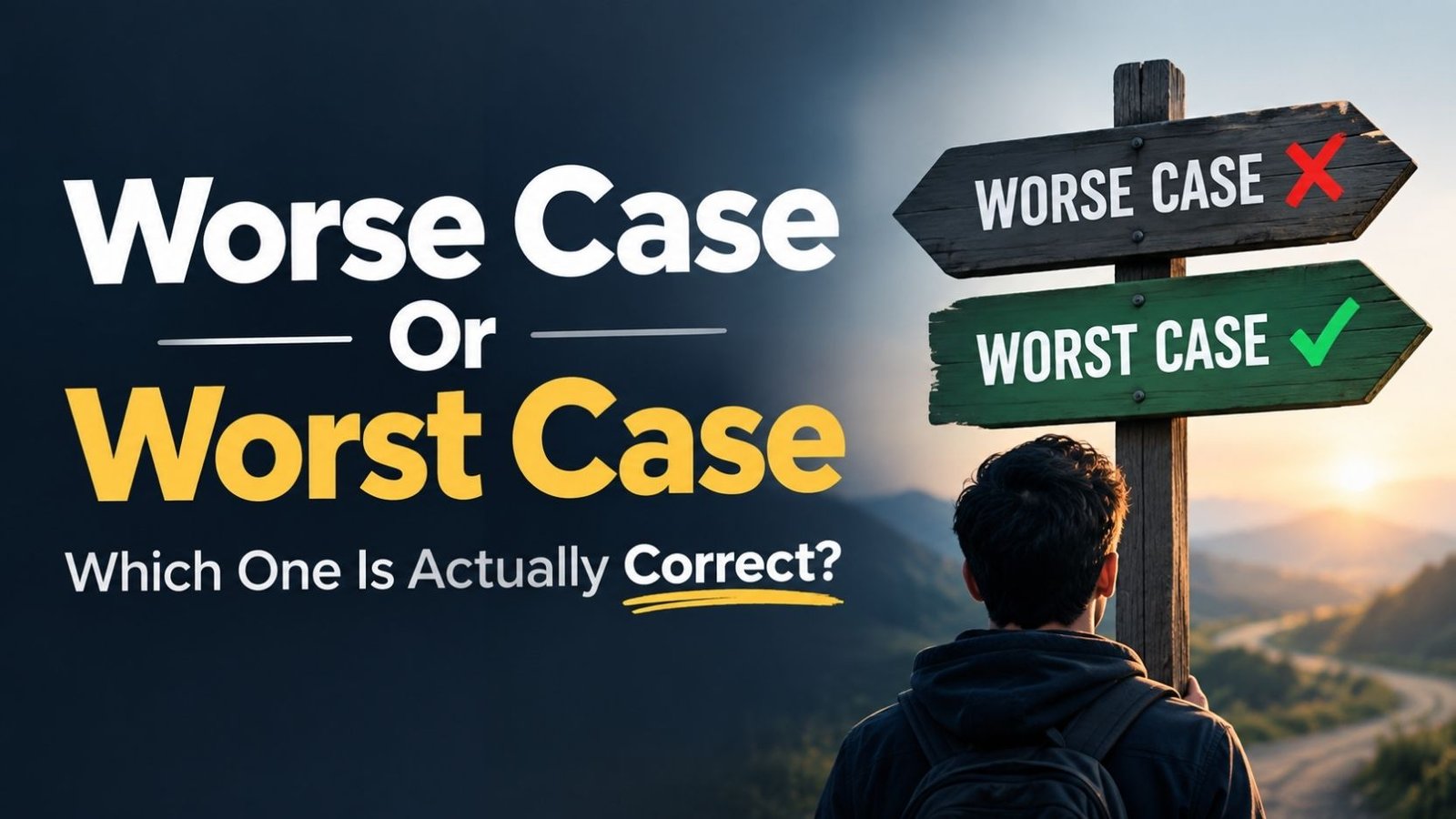
If you have ever paused mid-sentence and wondered whether to write worse case or worst case, you are not alone. The correct phrase is worst case, not worse case. This mix-up happens because worse and worst sound similar and both come from the same root word, bad.
Getting this right matters more than it seems. Worse case or worst case shows up constantly in business reports, project planning, insurance documents, and everyday conversation. Using the wrong form in a professional email or a formal document can make writing look careless, even when the rest of the message is clear and well organized.
Worse Case or Worst Case: The Quick Answer
The correct term is worst case.
Worst case refers to the most negative outcome that could possibly happen in a given situation. It describes the extreme end of a range of possibilities, not just something that is somewhat bad.
Worse case is grammatically incorrect in this context. Worse is a comparative adjective, meaning it compares two things. Worst is a superlative adjective, meaning it describes the most extreme point among three or more things. Since the phrase is talking about the single most extreme possibility, only the superlative form fits.
| Term | Correct Usage | Meaning |
| Worst case | Correct | The most negative possible outcome |
| Worse case | Incorrect in this phrase | Not a standard grammatical form |
Read More: Scarey Or Scary
Why Worst Case Is Correct: The Grammar Behind It
English adjectives that describe qualities like bad often have three forms.
- Positive form: bad
- Comparative form: worse
- Superlative form: worst
The comparative form, worse, is used when comparing exactly two things.
Example: This year’s weather was worse than last year’s.
The superlative form, worst, is used when comparing three or more things, or when describing the single most extreme example within a group.
Example: This was the worst weather in ten years.
A worst-case scenario is, by definition, the single most extreme negative outcome out of every possibility being considered. Since there is only one most extreme outcome, the superlative form worst is the only grammatically correct choice.
💡 Tip: If you can replace the word with “most bad” and it still makes sense, use worst. If you are comparing only two specific things, use worse.
What Does Worst Case Mean?
Worst case describes the most unfavorable outcome that could realistically occur in a situation. It is often used to prepare for risk, plan ahead, or set expectations before something happens.
The phrase is commonly paired with the word scenario to form worst-case scenario, which refers to a hypothetical situation representing the most damaging or difficult result possible.
People use this phrase in many everyday and professional contexts.
- Business planning, when preparing for financial losses
- Project management, when identifying risks
- Medical discussions, when explaining possible outcomes
- Insurance, when calculating maximum potential claims
- Everyday conversation, when talking about anything that could go wrong
Worse Case or Worst Case Scenario: Which Is It?
The correct phrase is worst case scenario, not worst-case scenario.
A scenario is a possible sequence of events. When you attach the word worst to it, you are describing the single most damaging version of that sequence of events among all the possibilities you are imagining.
Since worse only applies to comparisons between two items, it cannot correctly describe the most extreme option out of many. That is why worst-case scenario is the standard and accepted form in both American and British English.
How to Use Worst Case in a Sentence
Seeing the phrase used correctly in context makes the rule easier to remember.
- In the worst case, the project could be delayed by two months.
- We planned for the worst-case scenario before signing the contract.
- Even in a worst-case situation, the team had a backup plan ready.
- The doctor explained the worst-case outcome so the family could prepare.
- Our insurance covers the worst case, including total property loss.
Notice that worst always appears directly before case in each example. There is no version of these sentences where worse would be grammatically correct.
Read More: Incorporate Vs Encorporate
Common Mistakes: Worse Case vs Worst Case
This is one of the most frequent grammar mix-ups in English, largely because worse and worst differ by only one letter and are pronounced in a similar way.
❌ Incorrect: We need to prepare for the worse case.
✅ Correct: We need to prepare for the worst case.
❌ Incorrect: In a worst-case scenario, sales could drop sharply.
✅ Correct: In a worst case scenario, sales could drop sharply.
❌ Incorrect: What is the worse case outcome here?
✅ Correct: What is the worst case outcome here?
⚠️ Common mistake: Some people also misspell the phrase entirely, writing worse case senario or worse case scenerio. Both the spelling of scenario and the choice of worst instead of worse need to be correct for the phrase to be standard English.
Worse vs Worst: A Quick Comparison
| Word | Type | When to Use | Example |
| Worse | Comparative | Comparing two things | Today is worse than yesterday |
| Worst | Superlative | Comparing three or more, or naming the most extreme | Today is the worst day this year |
Understanding this distinction helps beyond just this one phrase. The same rule applies to related pairs like better and best, or more and most.
How to Pronounce Worst Case
Worst is pronounced with a short u sound, similar to the word “burst,” and ends with a hard “st” sound. In American English, it sounds like WURST, rhyming with “burst” or “first.”
Worse, by contrast, ends with a soft “z” sound, similar to the word “purse.” It sounds like WURZ.
Hearing the difference can help you remember which spelling matches which meaning, since the pronunciation itself is a useful clue that these are two separate words with two separate jobs in a sentence.
Similar Words That Cause Confusion
English has several comparative and superlative pairs that people frequently mix up. Recognizing the pattern with worse and worst can help with these as well.
| Comparative | Superlative | Example Sentence |
| Worse | Worst | This is worse than before, but that was the worst year on record |
| Better | Best | She did better this time, and it was her best performance yet |
| Farther | Farthest | He ran farther today than yesterday, reaching the farthest point yet |
The same underlying grammar rule connects all of these pairs. Comparative forms compare two things, and superlative forms identify the most extreme example among three or more.
Read More: Sensor Or Censor
Origin of Worst Case
The phrase worst case scenario became widely used in English during the twentieth century, particularly within military planning, engineering, and risk analysis fields. Professionals in these areas needed a clear way to describe the most damaging possible outcome so they could plan appropriately and reduce risk.
Over time, the phrase moved from technical and professional settings into everyday language. Today, people use worst-case scenario casually in conversation, far beyond its original planning and analysis context.
The words worse and worst themselves come from Old English, evolving from earlier Germanic root words related to the concept of bad. Their comparative and superlative forms are irregular, meaning they do not simply add “er” or “est” the way regular adjectives do, such as with tall, taller, and tallest.
Frequently Asked Questions
Is it worse case or worst case?
It is worst case. Worse case is not correct in standard English grammar.
Is it worst case scenario or worse case scenario?
The correct phrase is worst-case scenario. Worst-case scenario is a common but incorrect variation.
Why do people say worse case instead of worst case?
The mistake happens because worse and worst sound similar and are easy to confuse, especially in fast speech. Many people also simply mishear the phrase from others and repeat the error.
Is worst case a noun or an adjective phrase?
Worst case typically functions as a noun phrase, as in “the worst case,” or as a modifier before another noun, as in “worst case scenario.” It is not a single part of speech on its own.
Can worse ever be used before the word case?
Worse can appear near the word case only when making a direct comparison between two specific cases, such as “This case is worse than the last one.” However, worse case as a fixed phrase meaning the most extreme outcome is not correct.
What is a simple way to remember the correct form?
Remember that worst matches situations with only one most extreme option, while worse only works when comparing exactly two things. Since a worst-case scenario represents the single most extreme outcome, worst is always the correct choice.
Is worse case or worst case used differently in British and American English?
No. Both American and British English treat worst case scenario as the standard and correct form. The grammar rule behind comparative and superlative adjectives applies the same way in both varieties of English.
What is the difference between worst case and best case?
Worst case describes the most negative possible outcome, while best case describes the most favorable possible outcome. Both are commonly used together when discussing a range of possible results.
Final Thoughts
The debate over worse case or worst case comes down to a simple grammar rule. Worse compares two things, while worst identifies the single most extreme option among many. Since a worst case scenario refers to the one most damaging outcome out of every possibility being considered, worst is always the grammatically correct choice.
Once you understand why worst fits and worse does not, the phrase becomes easy to use with confidence. Whether you are writing a business report, discussing a medical outcome, or simply describing something that could go wrong, remembering that worst case is the standard form will help your writing stay clear, accurate, and professional.

Danish Raza is the author of Grammavio, a trusted resource for simple and easy-to-understand English grammar guides. He creates helpful content covering grammar rules, word meanings, vocabulary, and common grammar mistakes to help readers improve their English skills.



3 Comments