
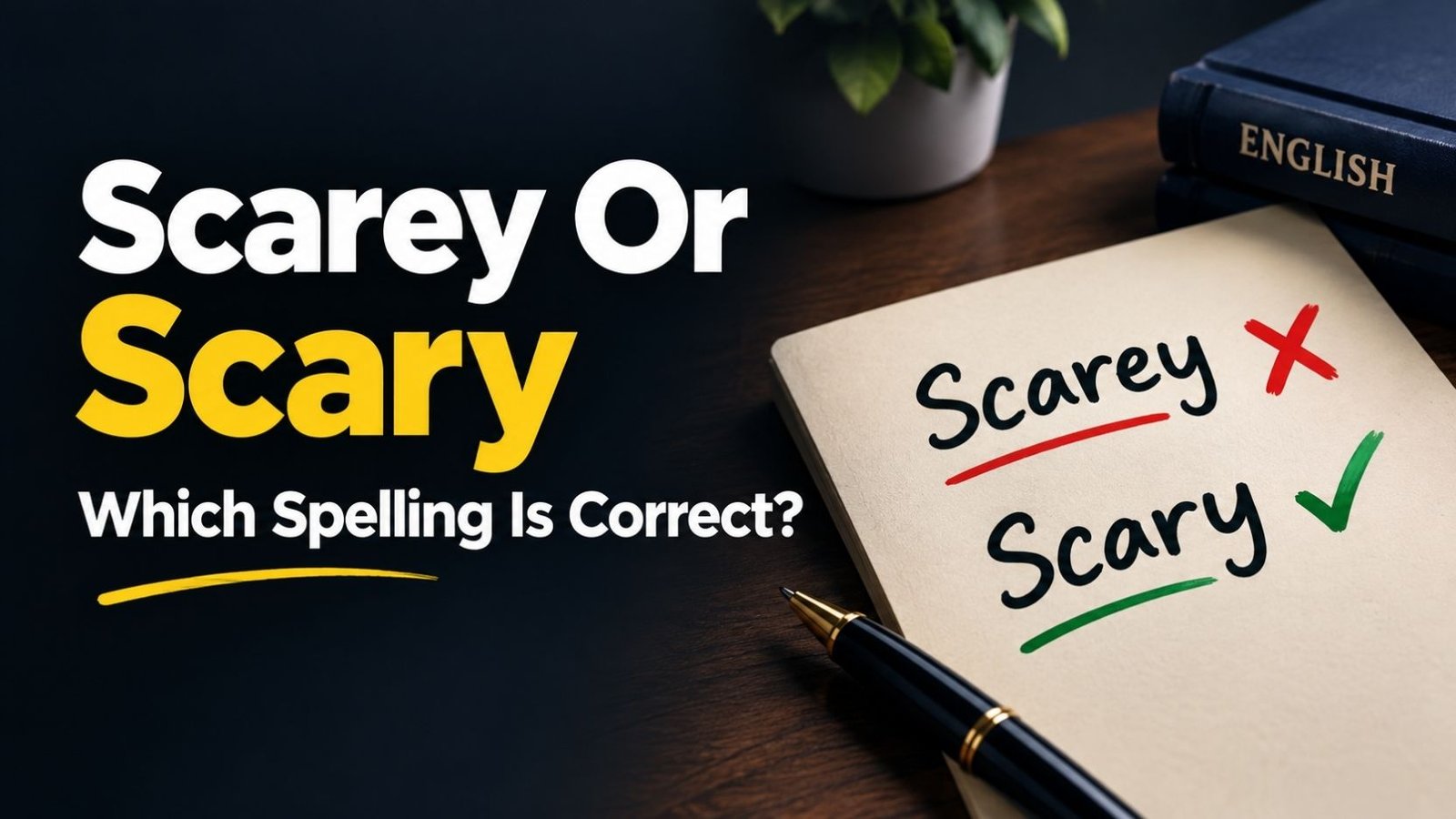
Scary is the correct spelling in modern English. Scarey is a variant spelling that shows up in casual writing, but dictionaries and style guides treat scary as the standard form. If you are describing something that causes fear, scary is the word you want.
This confusion is common because both spellings sound identical when spoken aloud. The mix-up usually happens in fast typing, text messages, or informal social posts, where spelling mistakes slip past without much notice. Understanding the correct form matters more once you move from texting a friend to writing an email, an essay, or content that other people will read and judge.
Scary Or Scarey: The Direct Answer
Scary is correct. Scarey is not accepted as standard spelling in any major English dictionary, whether American, British, Canadian, or Australian.
Scarey does still appear from time to time. Some dictionaries list it as an informal or dated variant, mostly because it turns up occasionally in older texts and casual writing. That listing does not make it correct for everyday use. It simply means lexicographers tracked a spelling that people sometimes typed.
| Spelling | Status | Where you will see it |
| Scary | Standard, correct | Dictionaries, publishing, professional writing, everyday use |
| Scarey | Nonstandard variant | Informal texts, social media, occasional older sources |
If you are ever unsure which one to type, default to scary. It is correct in every English-speaking country and in every writing context, formal or casual.
Read More: Incorporate Vs Encorporate
Why People Get Scary And Scarey Confused
The confusion comes down to one simple pattern in English spelling. The base word is scare. When English turns a noun or verb into an adjective by adding the suffix “y,” it usually drops the silent “e” at the end first.
That is exactly what happens here:
- Scare (the base word)
- Drop the silent e
- Add y
- Scary
Writers who add “y” directly onto “scare” without dropping the “e” end up with “scarey.” It looks logical at first glance, since it keeps the original word intact. But English spelling rules do not work that way once a silent “e” is involved.
This same pattern shows up in other common words:
- Ice becomes icy, not icey
- Space becomes spacy or spacey depending on the word, though spacy is the more traditional form
- Nose becomes nosy, not nosey (though nosey is a recognized variant in some dictionaries)
Scary follows the more typical rule. The “e” drops before adding “y.”
Is Scarey A Word?
Scarey is not a made-up word with no history at all, but it is not standard English either. A small number of dictionaries record it as a variant spelling of scary, mostly to reflect how the word has occasionally been used in print over the years.
For practical purposes, treat scarey as incorrect. It will not appear in:
- Major style guides
- Professional editing standards
- Academic writing
- Most spell-checkers, which will flag it as an error
If you are asking whether scarey is a real word you can use in formal writing, the answer is no. Stick with scary.
Meaning Of Scary
Scary is an adjective. It describes something that causes fear, alarm, or nervousness.
Core meaning: causing fear or fright.
The word can apply to real danger or to something that simply feels unsettling, even without actual physical risk. A scary movie is not truly dangerous, but it triggers the same emotional reaction as something genuinely threatening.
Examples in context:
- The abandoned house looked scary in the dark.
- Public speaking is scary for a lot of people.
- That was a scary moment when the car skidded on the ice.
Scary can describe objects, situations, people, sounds, or feelings. It is flexible, which is part of why it shows up so often in everyday conversation.
Scary In A Sentence
Seeing the word used naturally helps make the meaning click faster than a definition alone.
- The clown’s laugh was genuinely scary, not funny at all.
- Losing my job felt scary, even though I knew I would find another one.
- Some people find spiders scary, while others barely notice them.
Notice that scary can describe something external (a clown, a spider) or an internal feeling tied to a situation (losing a job). Both uses are correct.
Read More: Tapping Or Taping
Grammar: Part Of Speech And Word Forms
Scary is an adjective. Like most short adjectives, it changes form when used in the comparative or superlative.
| Form | Word | Example |
| Base | Scary | This story is scary. |
| Comparative | Scarier | This story is scarier than the last one. |
| Superlative | Scariest | This is the scariest story I have ever read. |
Notice the same spelling rule applies here too. The final “y” changes to “i” before adding “er” or “est,” which is standard for adjectives ending in a consonant plus “y.”
Scarey does not follow any of these accepted comparative or superlative patterns in standard dictionaries, which is one more reason it is not treated as a real alternative spelling.
How To Pronounce Scary
Scary is pronounced SKAIR-ee, with the stress on the first syllable. In the International Phonetic Alphabet, it is written as /ˈskɛəri/ in British English and /ˈskɛri/ in American English.
Both scary and scarey are pronounced exactly the same way. Pronunciation gives no clue about which spelling is correct, since the sound is identical either way. This is exactly why the misspelling happens so often. People type the word the way it sounds rather than the way it is actually spelled.
Origin Of The Word Scary
Scary comes from the verb scare, which entered English in the Middle Ages from Old Norse. The Old Norse word skirra meant to frighten or to avoid out of fear, and it is related to an older root meaning shy or timid.
Scare became established in English by around the 1200s as a verb meaning to frighten. The adjective scary developed later, adding the “y” suffix to describe something that produces that frightened feeling. This kind of formation, turning a verb into a descriptive adjective with “y,” is a common pattern in English and follows the same logic as words like sleepy, from sleep, or itchy, from itch.
Scarey Or Scary In The UK, Canada And Australia
There is no regional exception for this word. Scary is correct in American English, British English, Canadian English, and Australian English. Unlike words such as color and colour, or realize and realise, scary does not have a separate British or American spelling.
Some readers search for “scarey or scary UK” or “scarey or scary Canada” assuming there might be a regional variation, similar to other spelling differences between American and British English. That is not the case here. Every major English-speaking region treats scary as the standard spelling, and scarey as nonstandard.
Scary Vs Scarey: Quick Comparison
| Feature | Scary | Scarey |
| Correct spelling | Yes | No |
| Found in major dictionaries as standard | Yes | No, occasionally listed as a variant |
| Accepted in Scrabble | Yes | No |
| Used in formal writing | Yes | No |
| Common in casual texting | Yes | Occasionally |
Common Mistakes With Scary And Scarey
❌ Incorrect: That was a really scarey movie.
✅ Correct: That was a really scary movie.
❌ Incorrect: The clowns look scarey at night.
✅ Correct: The clowns look scary at night.
❌ Incorrect: This is the scareyest story I’ve heard.
✅ Correct: This is the scariest story I’ve heard.
A related mistake worth noting: some writers confuse “scary” (frightening) with “scared” (feeling frightened). These words are not interchangeable.
- Scary describes the source of fear. The movie is scary.
- Scared describes the person feeling fear. I am scared of the movie.
Mixing these up (“I am scary of spiders”) is a separate, unrelated error, but it comes up often enough to mention here.
Synonyms For Scary
Several words overlap with scary but carry slightly different shades of meaning.
| Word | Meaning | Typical use |
| Frightening | Causing fear, slightly more formal tone | Written and spoken English |
| Terrifying | Causing intense, overwhelming fear | Stronger than scary |
| Spooky | Eerie or unsettling, often tied to ghosts or the supernatural | Halloween, ghost stories |
| Creepy | Causing unease or a crawling, uncomfortable feeling | Often about something strange rather than dangerous |
| Alarming | Causing concern or worry, not necessarily fear | News, warnings, sudden events |
| Eerie | Strange and unsettling, often quiet or mysterious | Atmosphere, empty places |
Scary and spooky often get grouped together, especially around Halloween, but they are not identical. Spooky leans toward eerie or ghostly, while scary is broader and covers anything that produces fear, supernatural or not. Creepy tends to describe something unsettling rather than something that produces sharp, immediate fear. Something can be creepy without being truly scary, and something can be scary without feeling creepy at all.
Read More: Women Or Woman
Scary In Popular Culture
The word scary shows up constantly in entertainment, most notably through the Scary Movie film franchise, a series of horror comedy parodies that spoofs popular horror movies. The franchise has released multiple installments over the years, and continued audience interest around Halloween keeps searches for scary movies, scary stories, and related horror content consistently high.
This is separate from the spelling question, but it explains why searches for “scary” spike heavily during October, alongside seasonal topics like haunted attractions, costumes, and horror franchises.
Frequently Asked Questions
Is it scarey or scary?
Scary is the correct spelling. Scarey is a nonstandard variant that some dictionaries note but do not treat as standard English.
Is scarey a word?
Scarey is recorded in a few dictionaries as a variant spelling, but it is not considered correct in formal or standard English. Use scary instead.
What is the difference between scary and scared?
Scary describes something that causes fear, like a scary movie. Scared describes a person’s feeling of fear, as in “I am scared of the dark.”
How do you spell scary correctly?
S, c, a, r, y. The base word scare drops its final “e” before adding “y.”
Is scarey or scary correct in British English?
Scary is correct in British English, same as in American, Canadian, and Australian English. There is no regional spelling difference for this word.
Is scarey a Scrabble word?
No. Standard Scrabble dictionaries accept scary but not scarey.
What is the difference between scary and creepy?
Scary describes something that produces fear directly. Creepy describes something that feels unsettling or strange, often without a clear, immediate threat.
Is eerie the same as scary?
Not exactly. Eerie describes something strange or unsettling, often quiet or mysterious, while scary is a broader term for anything that causes fear.
How do you pronounce scary?
Scary is pronounced SKAIR-ee, with the stress on the first syllable.
What part of speech is scary?
Scary is an adjective. Its comparative and superlative forms are scarier and scariest.
Final Thoughts
Scary is the spelling to use every time, whether you are texting a friend, writing a blog post, or filling out something formal. Scarey might occasionally surface in casual writing or older texts, but it has never been the accepted standard, and dictionaries consistently point back to scary as the correct form.
If you remember one rule, remember this: scare loses its silent “e” before “y” joins in. That small spelling shift is the entire difference between getting it right and getting it wrong. Once that rule sticks, you will never have to second guess whether it is scarey or scary again.

Danish Raza is the author of Grammavio, a trusted resource for simple and easy-to-understand English grammar guides. He creates helpful content covering grammar rules, word meanings, vocabulary, and common grammar mistakes to help readers improve their English skills.



4 Comments