
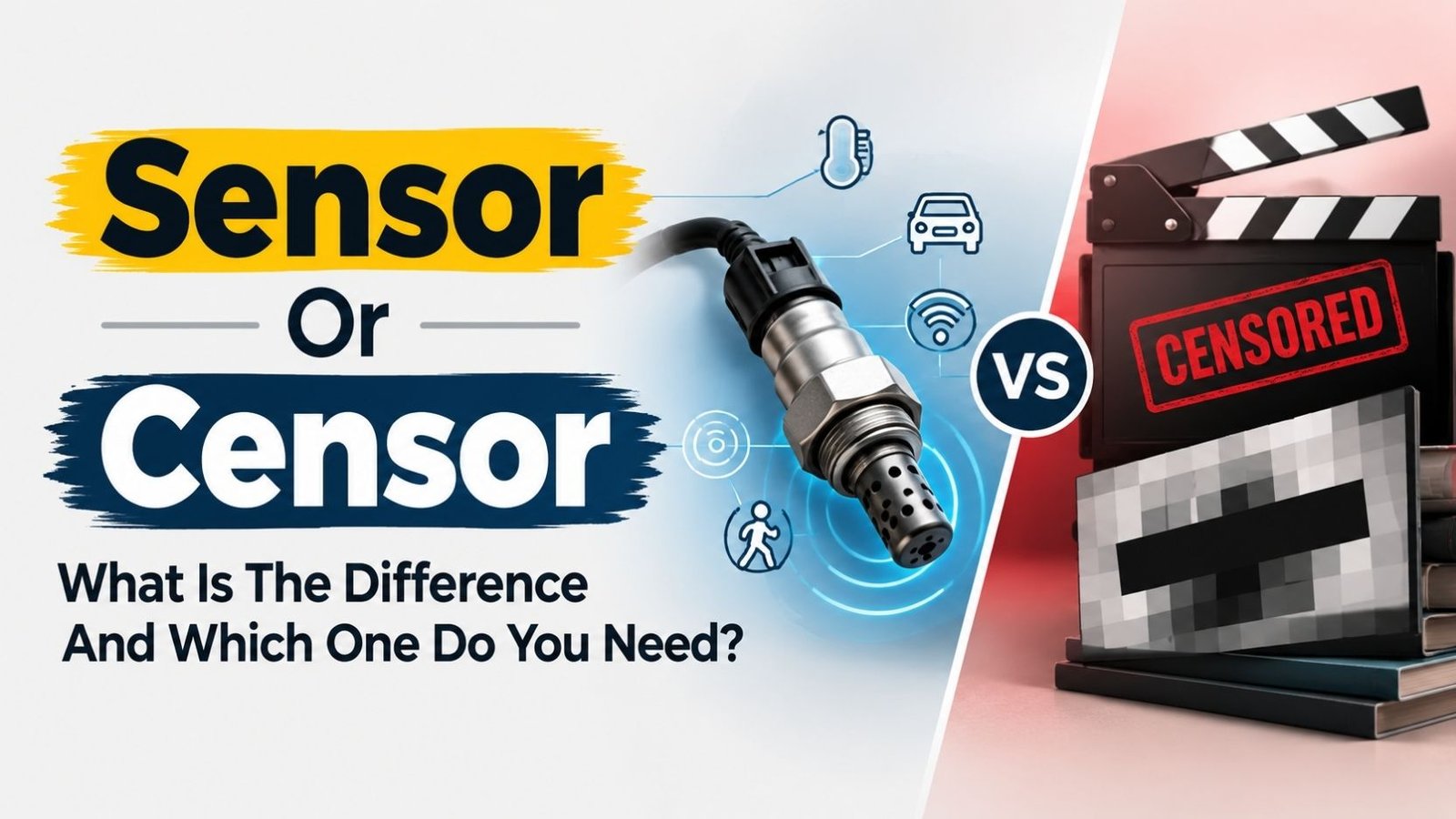
If you have ever paused mid-sentence wondering whether to write sensor or censor, you are not alone. These two words look almost identical, sound similar when spoken quickly, and both slip easily into everyday conversation. But they mean completely different things.
A sensor is a device that detects something, like light, motion, or pressure. A censor is a person or authority that reviews and removes content considered inappropriate. One belongs to engineering and technology. The other belongs to media, publishing, and communication.
This mix-up happens more often than people expect, especially in writing, texting, and even professional documents. Getting it wrong can confuse your reader or make a technical explanation sound incorrect. Understanding the difference takes only a few minutes, and once it clicks, you will never confuse them again.
Knowing which word to use matters whether you are describing a car part, explaining a movie rating, writing a school essay, or setting up a smart home device. This guide breaks down both words clearly, with simple definitions, real examples, and the exact situations where each one applies.
Sensor Or Censor: The Simple Difference
The easiest way to remember the difference is to think about what each word does.
A sensor senses. It detects something physical, like temperature, movement, sound, or pressure, and sends that information somewhere else, usually to a device or system that reacts to it.
A censor censors. It reviews content, such as films, books, or speech, and removes or blocks parts that are considered offensive, harmful, or against certain rules.
| Word | Part of Speech | Simple Meaning | Common Field |
| Sensor | Noun | A device that detects a physical signal | Technology, engineering, automobiles |
| Censor | Noun or verb | A person or act of reviewing and removing content | Media, publishing, communication |
Notice the spelling difference is small. Sensor has an “s” in the middle. Censor has a “c.” That single letter changes the entire meaning of the word.
Read More: Scarey Or Scary
What Does Sensor Mean?
A sensor is a device that detects a change in its environment and responds to it, usually by sending a signal to another part of a system.
Sensors are everywhere in daily life. Your phone uses a sensor to know when to rotate the screen. Your car uses several sensors to monitor engine performance, tire pressure, and even how close you are to another vehicle while parking.
Sensor In A Sentence
- The motion sensor turned on the porch light as soon as I walked outside.
- A faulty oxygen sensor can cause your car to burn more fuel than usual.
- The smoke sensor in the kitchen went off while dinner was cooking.
Common Types Of Sensors
Because “sensor” appears in so many technical contexts, it helps to see a few common examples side by side.
| Type of Sensor | What It Detects | Where It Is Used |
| TPMS sensor (tire pressure sensor) | Air pressure inside a tire | Vehicles |
| Oxygen sensor (O2 sensor) | Oxygen levels in exhaust gas | Car engines |
| Mass air flow sensor | Amount of air entering the engine | Fuel injection systems |
| Crankshaft position sensor | Position and speed of the crankshaft | Engine timing systems |
| Camshaft position sensor | Position of the camshaft | Engine control systems |
| Throttle position sensor | Angle of the throttle valve | Engine performance monitoring |
| Knock sensor | Engine vibration or knocking | Engine protection systems |
| MAP sensor | Manifold air pressure | Fuel and ignition timing |
| Motion sensor | Movement in a space | Security lights, alarms |
| Dexcom G7 sensor or Libre 3 sensor | Glucose levels under the skin | Continuous glucose monitoring for diabetes management |
Automotive sensors come up constantly in searches because modern vehicles rely on dozens of them to run efficiently. If a dashboard warning light appears, it often traces back to one specific sensor sending an unusual reading.
Medical sensors, like the ones used in the Dexcom G7 or Freestyle Libre 3, work differently. Instead of monitoring a machine, they monitor the human body, tracking glucose levels continuously and sending that data to a phone or receiver.
💡 Tip: If the topic involves a machine, a car part, or a device detecting something physical, the correct word is almost always sensor.
What Does Censor Mean?
A censor is a person, group, or authority that examines books, films, speech, or other content and removes or restricts parts considered unsuitable, harmful, or against a set of rules.
Censor can also be used as a verb, meaning to actively remove or block that content.
Censor In A Sentence
- The movie was edited after the national censor board requested several changes.
- She decided to censor a few words in the email before sending it to her manager.
- Streaming platforms often censor certain scenes depending on the country.
Read More: Atleast Or At Least
Censor As A Noun Vs Censor As A Verb
This is where a lot of confusion starts, because censor works as both a noun and a verb, and the meaning shifts slightly depending on the sentence.
| Form | Function | Example |
| Censor (noun) | A person or authority | The censor removed the violent scene from the film. |
| Censor (verb) | The act of removing or blocking content | Producers had to censor the dialogue before release. |
| Censored (past tense) | Something that was already removed or blocked | The interview was censored before it aired. |
Common Uses Of Censor Online And In Media
Censorship shows up in many everyday digital situations, not just movies and books.
- Censor bar: A black bar placed over an image to hide something, often used humorously or to blur sensitive content.
- Censor beep or censor sound effect: The audio tone used to cover a curse word on television or in videos.
- How to censor text on Discord: Blocking or hiding specific words in chat, often using built in moderation tools.
- Censor image: Blurring or covering part of a picture, usually for privacy or content guidelines.
⚠️ Common mistake: People sometimes search “censor board or censor board,” accidentally repeating the same word when they meant to compare it with something else, like a ratings board or review board. In official terms, most countries use a Central Board of Film Certification or a similar review authority, which functions as a censor board.
Sensor Or Censor: Quick Comparison Table
Here is a side-by-side comparison to settle any remaining confusion at a glance.
| Feature | Sensor | Censor |
| Meaning | Detects a physical signal | Reviews and restricts content |
| Type of word | Noun only | Noun and verb |
| Used in | Technology, automobiles, medical devices | Media, film, publishing, online platforms |
| Example | Tire pressure sensor | Movie censor |
| Related action | Detecting, sensing | Blocking, reviewing, restricting |
Sensor Or Censor: Pronunciation
This is one major reason the two words get mixed up. They sound almost the same when spoken at normal conversational speed.
- Sensor is pronounced SEN sur.
- Censor is pronounced SEN sur as well, with nearly identical stress and rhythm.
The difference lies almost entirely in spelling and context, not in how the words sound. Because of this, many people type the wrong word purely out of habit, especially when typing quickly or using voice to text tools.
✅ Correct approach: Focus on the meaning of the sentence, not the sound of the word, when deciding which spelling to use.
Origin Of Sensor And Censor
Understanding where each word comes from helps explain why they look so similar despite having unrelated meanings.
Sensor comes from the Latin word “sentire,” meaning to feel or to perceive. This root also gives us words like “sense” and “sensation.” A sensor, true to its origin, is something that perceives or feels a physical change.
Censor comes from the Latin word “censere,” meaning to assess or to judge. In ancient Rome, a censor was actually a government official responsible for conducting the census and supervising public morals. Over time, this evolved into the modern meaning of someone who judges and restricts content.
So while the words look alike today, their Latin roots were never related. One is about perceiving. The other is about judging.
Sensor Or Censor: Similar And Confusing Words
A few other words sometimes get pulled into this confusion because they share sounds or spelling patterns.
| Word | Meaning | Difference from Sensor or Censor |
| Censure | To criticize strongly or formally | Refers to criticism, not detection or content removal |
| Censer | A container used to burn incense | A religious object, unrelated to technology or media |
| Census | An official count of a population | Related historically to “censor,” but means counting people |
Censer is especially easy to confuse with censor because the two are pronounced almost identically. A censer is a decorative container, often used in religious ceremonies, used to burn incense. It has nothing to do with reviewing content.
Read More: Suing Or Sueing
How To Remember Sensor Vs Censor Permanently
A simple memory trick makes this distinction stick.
- Sensor has an “s” like “sense.” Sensors sense things.
- Censor has a “c” like “cut.” Censors cut or remove things.
Another helpful method is picturing the context first. If you are talking about a machine, a car, or a health device, the word is sensor. If you are talking about a movie, a book, or blocking words, the word is censor.
Frequently Asked Questions
Is it sensor or censor for a car part?
It is sensor. Car components like the oxygen sensor, mass air flow sensor, and crankshaft position sensor all detect physical conditions inside the engine.
Is it sensor or censor for a movie rating board?
It is censor. A censor board reviews films and can require edits or restrict certain content before release.
What is the difference between sensor and censor?
A sensor detects something physical, like motion or pressure. A censor reviews and removes content considered inappropriate or restricted.
Is censor a noun or a verb?
Censor can be both. As a noun, it refers to a person or authority. As a verb, it means to remove or block content.
How do you spell the device that detects motion, sensor or censor?
It is spelled sensor. A motion sensor detects movement and triggers lights, alarms, or other automated responses.
What does it mean to censor something?
To censor something means to remove, block, or restrict part of it, usually because it is considered offensive, sensitive, or against certain guidelines.
Are sensor and censor pronounced the same way?
Yes, they sound very similar when spoken, which is why the spelling mix-up happens so often. The meaning always depends on context, not sound.
Is a glucose monitor called a sensor or a censor?
It is called a sensor. Devices like the Dexcom G7 and Freestyle Libre 3 use a small sensor placed under the skin to track glucose levels continuously.
What is a censor bar?
A censor bar is a black bar placed over part of an image or video to hide something, often used for privacy or to follow content guidelines.
Why do people confuse sensor and censor so often?
The two words are nearly identical in pronunciation and spelling, differing by only one letter, which makes it easy to type or say the wrong one without noticing.
Final Thoughts
Choosing between sensor or censor comes down to one simple question: are you talking about detecting something physical, or about reviewing and restricting content? A sensor belongs in the world of technology, cars, and medical devices, quietly measuring things like motion, pressure, or glucose levels. A censor belongs in the world of media and communication, reviewing films, text, or speech and deciding what stays and what gets removed.
Once you connect sensor with “sense” and censor with “cut” or “control,” the confusion tends to disappear for good. Whether you are writing about a tire pressure warning light or explaining how a movie got its rating, using the correct word makes your writing clearer, more accurate, and more professional.

Danish Raza is the author of Grammavio, a trusted resource for simple and easy-to-understand English grammar guides. He creates helpful content covering grammar rules, word meanings, vocabulary, and common grammar mistakes to help readers improve their English skills.



One Comment