
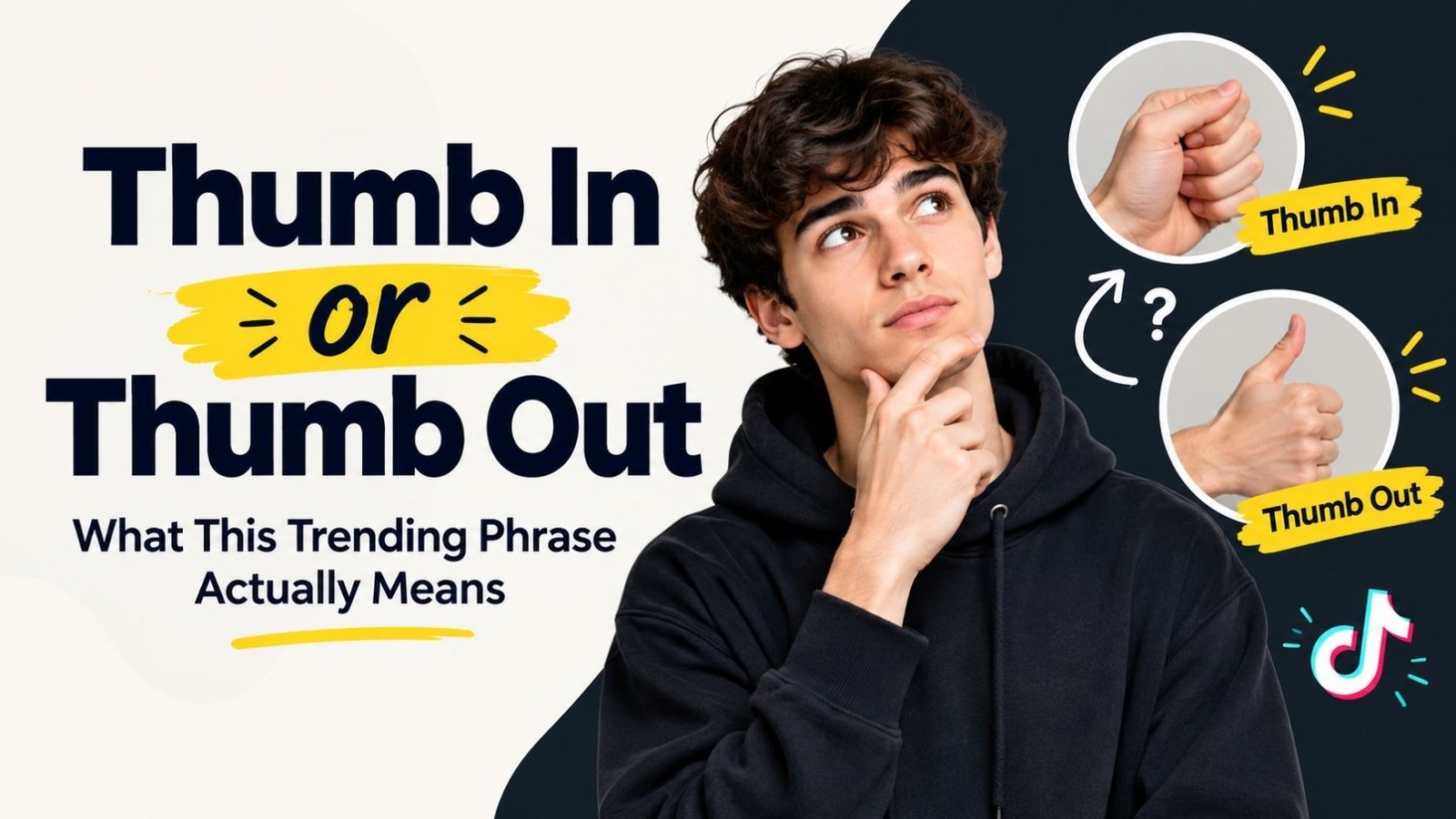
If you have scrolled through TikTok lately, you have probably seen someone ask a stranger, “thumb in or thumb out?” The question sounds simple, but the answers people give rarely match. That is because thumb in or thumb out is not a fixed slang term with one dictionary definition. It is a viral prompt that different creators use in different ways.
This guide breaks down where the phrase comes from, the main ways people use it, and why you will not find one single “correct” meaning. Understanding the context behind each video is the fastest way to understand what any one person means when they say it.
What Does Thumb In or Thumb Out Mean?
There is no single, agreed-upon meaning for thumb in or thumb out. It is best understood as a flexible TikTok phrase, most often used as a street interview question or a playful icebreaker. The exact meaning shifts depending on who is asking and why.
Across the videos and pages that use this phrase, three patterns show up again and again:
- A street interview or “this or that” question, asked mostly for reaction and laughs
- A description of hand or thumb position in a specific activity, such as bowling or dance
- A body language talking point, where thumb position is linked to confidence or shyness
None of these interpretations is officially “the” meaning. The phrase works more like an inkblot test. It gives people a fun prompt, and they fill in their own answer.
Read More: Sensor Or Censor
Why the Phrase Does Not Have One Fixed Definition
Most viral slang starts with a clear origin: a song lyric, a meme format, or a specific video that everyone points back to. Thumb in or thumb out does not have that kind of traceable origin. It shows up across unrelated corners of TikTok, used by different creators for different purposes.
This matters for anyone searching for a straightforward answer. Sites that claim to give you “the real meaning,” including a sexual or romantic one, are often guessing or repeating each other rather than pointing to a verified source. When a phrase spreads this loosely, it is more honest to explain the range of uses than to force one definition onto it.
The Main Ways People Use Thumb In or Thumb Out
1. As a Street Interview Icebreaker
The most common version of this phrase appears in short “man on the street” style videos. A creator stops people in public and asks them to pick a side: thumb in or thumb out. The question itself is intentionally vague. That vagueness is the point. It works as a conversation starter, similar to “cake or pie” or “window or aisle seat,” where the fun comes from watching people react to an odd choice rather than from the choice having deep meaning.
In these clips, people often laugh, ask for clarification, or make up their own reasoning on the spot. The humor comes from the confusion, not from a shared understanding of what is being asked.
2. As a Description in Specific Activities
Away from street interviews, “thumb in” and “thumb out” also describe real hand positions in a few everyday contexts.
- In bowling, some players tuck the thumb into the ball’s thumb hole for control, while others release it earlier for a different spin. Videos joking about “thumb in or thumb out” for bowling strikes are referring to this grip debate.
- In dance, a partner may keep their thumb tucked against the palm or extended outward during certain holds, which some creators describe using this same phrase.
- In everyday hand position, thumb in usually means the thumb is tucked toward the palm or pocket, while thumb out means it is extended or resting outside.
These uses are literal. They describe an actual physical position rather than carrying hidden slang meaning.
3. As a Body Language Talking Point
Some TikTok content connects thumb position to personality or confidence, in the same spirit as general body language advice. In this framing, keeping your thumbs out of your pockets is sometimes described as an open, confident stance, while tucking your thumbs in is linked to nervousness or shyness.
This is worth a caution: body language interpretations like this are popular opinion, not established psychological fact. A single hand position does not reliably reveal someone’s personality, and this idea should be treated as casual commentary rather than science.
Is Thumb In or Thumb Out Sexual Slang?
Some search results and low-quality content pages claim the phrase has a specific sexual meaning. Based on what is actually verifiable, this claim does not hold up well. The phrase is used far more often as a lighthearted street interview question or a literal description of hand position than as established sexual slang.
It is true that on social media, any suggestive-sounding phrase can get used as innuendo in some individual videos or comment sections, and creators sometimes lean into double meanings for humor. But that is different from the phrase having a fixed, widely recognized sexual definition the way some genuine slang terms do.
If you saw the phrase used with an implied meaning in one specific video or conversation, the safest approach is to judge it from that context rather than assume it applies everywhere the phrase appears.
Read More: Atleast Or At Least
Grammar And Part Of Speech
“Thumb in or thumb out” functions as a phrase rather than a single part of speech. Depending on how it is used in a sentence, it can work as:
- A noun phrase: “Thumb in or thumb out is the question of the day.”
- A short interrogative expression: “Thumb in or thumb out?”
- A descriptive phrase: “She prefers the thumb out grip.”
“Thumb” itself is a noun, and “in” and “out” are prepositions describing position. There is no verb form of this phrase in standard use.
How to Pronounce Thumb In or Thumb Out
The pronunciation is straightforward and follows normal English rules.
- Thumb: rhymes with “some”; the “b” is silent
- In: pronounced as it looks, “ihn”
- Out: rhymes with “shout”
Said together, it flows naturally: “thum-in-or-thum-out.”
Examples of Thumb In or Thumb Out in a Sentence
- “The interviewer asked everyone on the street, thumb in or thumb out, and got a different answer every time.”
- “For a better grip, some bowlers go thumb out on their release.”
- “He kept his thumbs out of his pockets the whole meeting, which some people read as confidence.”
Common Mistakes to Avoid
❌ Incorrect: Treating thumb in or thumb out as an official term with one settled dictionary meaning.
✅ Correct: Recognizing it as a flexible, context-dependent phrase used across different types of TikTok content.
❌ Incorrect: Assuming every use of the phrase carries a hidden or sexual meaning.
✅ Correct: Reading the specific video or conversation to understand what the speaker actually intends.
❌ Incorrect: Citing thumb position as scientific proof of someone’s personality.
✅ Correct: Treating body language claims about thumbs as casual opinion, not verified psychology.
Read More: Suing Or Sueing
Similar Phrases and Related Terms
| Phrase | Meaning | Context |
| This or that | A simple forced-choice question format | Used broadly across social media for quick opinions |
| Window or aisle | A lighthearted preference question | Common in street interviews and icebreaker content |
| Thumbs up or thumbs down | A clear approval or disapproval gesture | Has a fixed, widely understood meaning, unlike thumb in or thumb out |
The key difference is that thumbs up and thumbs down have a long-established, universally understood meaning. Thumb in or thumb out does not share that same level of fixed meaning, which is exactly why it causes confusion.
Frequently Asked Questions
What does thumb in or thumb out mean?
It is a flexible TikTok phrase most often used as a street interview icebreaker question, though it can also describe a literal hand position in activities like bowling or dance. It does not have one single official meaning.
What does thumb in or thumb out mean on TikTok specifically?
On TikTok, it usually appears in “man on the street” style videos where creators ask strangers to pick a side for fun, without a serious or fixed meaning behind the question.
Is thumb in or thumb out a real slang term?
Not in the traditional sense. Unlike established slang with one clear meaning, this phrase changes depending on who uses it and in what video or conversation.
Do women like thumb in or thumb out?
There is no reliable, verified answer to this, since the phrase itself does not have one fixed meaning to react to. Any video claiming to represent “what women prefer” is showing individual opinions, not an established fact.
Is thumb in or thumb out sexual?
Not by default. It is used far more commonly as a playful icebreaker or literal description of hand position. It is possible for individual creators to use it as innuendo, but that is not the same as the phrase having an official sexual meaning.
What does thumb in or thumb out mean in bowling?
It refers to whether a bowler keeps their thumb tucked into the ball’s thumb hole through the release, or pulls it out earlier for a different type of spin and control.
What part of speech is thumb in or thumb out?
It functions as a phrase rather than a single part of speech. It can act as a short question, a noun phrase, or a descriptive phrase depending on the sentence.
Where did thumb in or thumb out come from?
There is no single confirmed origin. It appears across different, unrelated TikTok content, including interviews, dance clips, and grip discussions, without one traceable starting point.
Final Thoughts
Thumb in or thumb out is a good example of how quickly language can spread online without settling into one fixed meaning. It works as a street interview icebreaker, a description of grip or hand position, and sometimes a lighthearted comment on body language, all under the same three words.
If you come across the phrase and want to know what someone means by it, the best approach is to look at the specific video or conversation rather than searching for one universal answer. The phrase is intentionally open-ended, and that openness is exactly what has kept it circulating.

Danish Raza is the author of Grammavio, a trusted resource for simple and easy-to-understand English grammar guides. He creates helpful content covering grammar rules, word meanings, vocabulary, and common grammar mistakes to help readers improve their English skills.


