
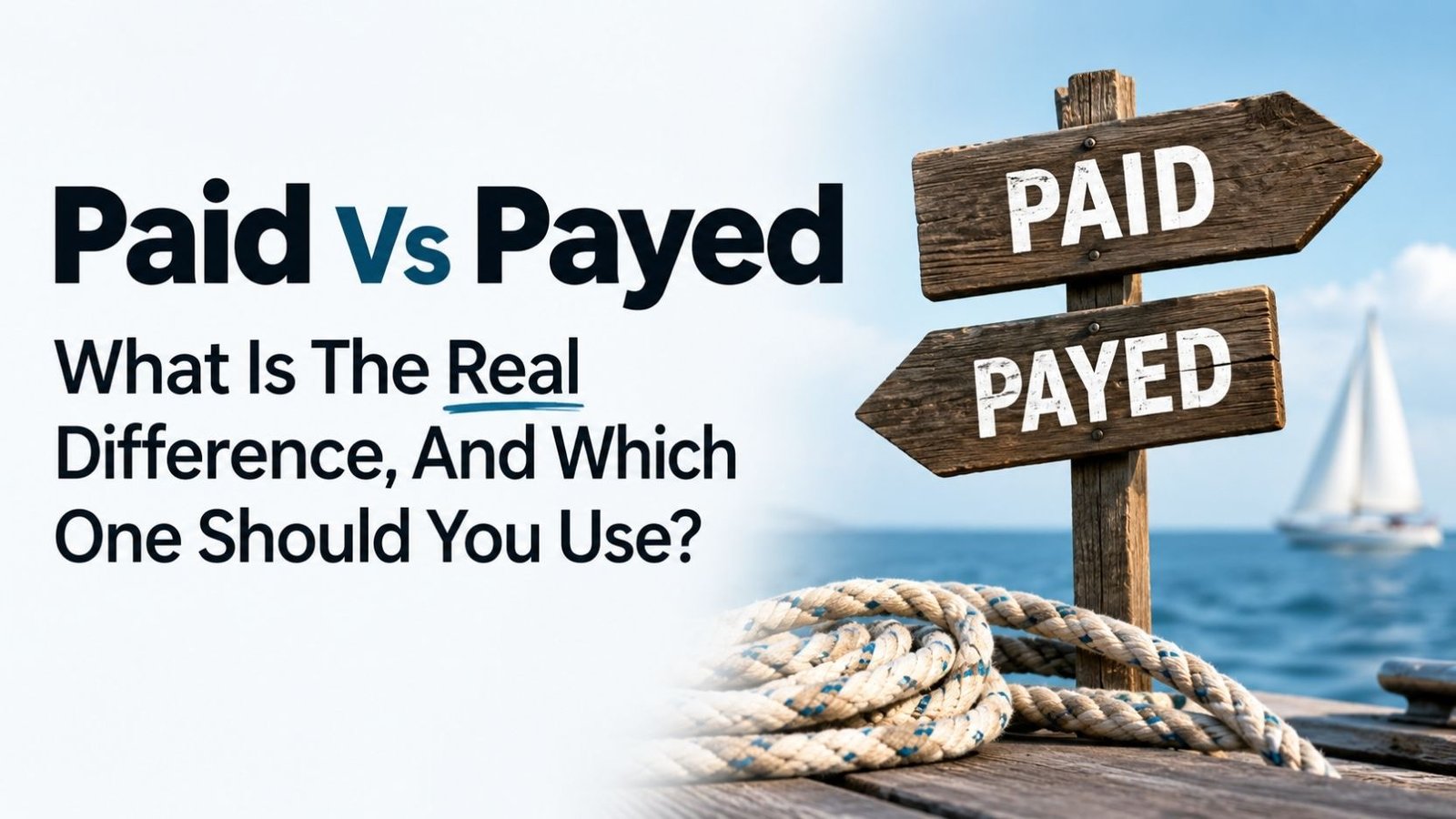
If you have ever paused mid-sentence wondering whether to write “paid” or “payed,” you are not alone. Both words look almost identical, and both come from the verb “to pay.” That similarity is exactly why so many people mix them up.
Here is the short answer. In almost every situation, the correct word is paid. You get paid for work. You paid your bills. Someone paid attention. Payed is a real word too, but it is extremely rare, and it only applies to one narrow nautical meaning involving ropes and ships.
Understanding this difference matters more than it might seem. Using the wrong form in an email, a resume, an essay, or a business document can make writing look careless. Once you understand the simple rule behind paid and payed, you will never second-guess yourself again.
What Does Paid Mean?
Paid is the past tense and past participle of the verb pay. It describes the act of giving money, effort, or attention to something or someone. This is the form you will use in nearly every everyday sentence.
Paid works in financial contexts, emotional contexts, and expressions.
- She paid the electricity bill on time.
- He paid attention during the meeting.
- They paid a visit to their grandparents.
- The company paid its employees on Friday.
Paid also appears in common idioms and phrases, such as paid in full, paid off, and paid vacation. In every one of these cases, paid is the correct spelling.
Read More: Worse Case Or Worst Case
What Does Payed Mean?
Payed is a real word, but its meaning has nothing to do with money. It comes from a specialized nautical term. Sailors use payed to describe the act of letting out a rope or cable, usually by feeding it out steadily, such as when loosening an anchor line.
Merriam-Webster confirms this specialized usage. According to Merriam-Webster, payed is listed as an alternate past tense of pay, but only within this nautical sense of releasing a rope or cable, not in the everyday sense of giving money or attention.
- The sailors payed out the anchor chain slowly.
- The crew payed the rope out as the boat drifted from the dock.
Outside of sailing and rope handling, payed is not considered standard English.
Paid Vs Payed: Quick Comparison Table
| Word | Correct Usage | Example |
| Paid | Everyday meaning: money, effort, attention | She paid for the groceries. |
| Payed | Nautical meaning: releasing a rope or cable | The crew payed out the rope slowly. |
This table sums up the entire debate. If you are talking about money, time, attention, or almost anything outside of sailing, paid is correct.
When Do You Use Paid Vs Payed?
This is the exact question most readers are trying to answer, so let’s make it simple.
Use paid when you are talking about:
- Money or payment
- Attention or focus
- Visits or favors
- Consequences, as in paid the price
- Any general past tense use of pay
Use payed only when you are describing the specific nautical action of releasing a rope, cable, or line. If your sentence has nothing to do with boats, ropes, or sailing, payed is not the word you want.
💡 Tip: If you are unsure, default to paid. It covers well over 99 percent of real world situations.
Paid Vs Payed Attention
This is one of the most searched comparisons, and the answer is straightforward. The correct phrase is always paid attention, never payed attention.
- Correct: He paid attention to the instructions.
- Incorrect: He payed attention to the instructions.
Attention is not a rope or a cable, so the nautical spelling never applies here. Many people type payed attention simply because paid and payed look similar, but grammatically, only paid attention is correct.
Paid Vs Payed Money
The same rule applies to money. Whenever you are describing a financial transaction, paid is the only correct choice.
- Correct: I paid the rent yesterday.
- Incorrect: I payed the rent yesterday.
Since payed only relates to ropes on a ship, it never appears in financial writing, invoices, contracts, or everyday conversations about money.
Paid Off Vs Payed Off
Paid off is the correct form when talking about finishing a debt or seeing a positive result from effort.
- Correct: She finally paid off her student loans.
- Correct: Their hard work paid off in the end.
- Incorrect: Their hard work payed off in the end.
Payed off is not standard usage in any context, including the nautical one, so paid off should always be your choice here.
Read More: Fairing Or Faring
Merriam-Webster Payed Definition: Paid Vs Payed
Since many readers specifically search for the Merriam-Webster explanation, here is a clear summary. Merriam-Webster lists payed as a valid past tense form of pay, but strictly limited to the meaning of letting out a rope, line, or cable in nautical use. For every other meaning of pay, including money, time, and attention, Merriam-Webster lists paid as the standard past tense and past participle.
This distinction is why dictionaries do not treat payed as a misspelling. It is a legitimate word, just one with an extremely limited and specialized use.
Is Payed A Word?
Yes, payed is a real word. It is not a typo or a made up spelling. However, its use is restricted almost entirely to sailing and rope handling. Outside of that context, payed is considered nonstandard or incorrect, even though it appears in dictionaries.
This is why so many people are confused. Payed exists, but it is not interchangeable with paid in daily writing, business communication, or general grammar.
Paid Vs Payed Grammar
From a grammar standpoint, both words function as the past tense and past participle of pay. The difference is not about grammar rules but about meaning and context.
- Paid is used for general, financial, and figurative meanings of pay.
- Payed is used only for the specific nautical meaning of releasing a rope.
Because the general meaning of pay applies to almost every situation people write about, paid ends up being correct in nearly all everyday sentences, essays, emails, and conversations.
Common Mistakes With Paid And Payed
Many writers substitute payed for paid simply out of habit or uncertainty. Here are the most common mistakes, corrected.
❌ Incorrect: He payed for dinner last night.
✅ Correct: He paid for dinner last night.
❌ Incorrect: I payed close attention to the details.
✅ Correct: I paid close attention to the details.
❌ Incorrect: The loan was payed off early.
✅ Correct: The loan was paid off early.
❌ Incorrect: She payed a visit to her old teacher.
✅ Correct: She paid a visit to her old teacher.
A simple way to avoid this mistake: unless you are writing about a ship releasing a rope, always choose paid.
Similar Words And Related Confusions
| Word | Meaning | Difference From Paid |
| Payable | Something that is due to be paid | Describes an obligation, not a completed action |
| Payment | The act or amount of paying | A noun, not a verb form |
| Repaid | Paid back | Used for returning money already received |
These related words share the same root as pay, but each carries a distinct grammatical role, so they are not directly interchangeable with paid or payed.
Origin Of Paid And Payed
Both words trace back to the verb pay, which comes from the Old French word “paiier,” meaning to satisfy or pacify, often through payment. Over time, English speakers developed slightly different past tense spellings depending on context. The general form became paid, while the nautical form payed developed separately within sailing communities, where oral tradition and specialized vocabulary often preserved older or alternate spellings.
This is a common pattern in English. Specialized professions, including sailing, law, and medicine, sometimes keep older or unusual word forms long after everyday language has moved on.
Examples Of Paid In Everyday Sentences
- The company paid its taxes before the deadline.
- I paid extra for faster shipping.
- He paid the babysitter after the movie.
- We paid close attention to the safety instructions.
- They paid the difference in cash.
These examples show how paid fits naturally into financial, social, and general contexts, which is why it is the form most readers actually need.
Read More: Opened Or Openned
Examples Of Payed In Nautical Sentences
- The sailors payed the rope out slowly as the tide pulled the boat.
- The captain ordered the crew to pay out more line, and they payed it carefully into the water.
Notice how these examples are limited to ropes, lines, and sailing actions, unlike the wide range of situations where paid applies.
Frequently Asked Questions
What does paid vs payed mean?
Paid is the standard past tense of pay, used for money, time, and attention. Payed is a rare form used only for releasing a rope or cable in sailing.
Is payed a word?
Yes, but only in the nautical sense of letting out a rope. In every other context, paid is correct.
When do you use paid vs payed?
Use paid for nearly everything, including money, attention, and general actions. Use payed only when describing a rope or line being let out on a ship.
Is it paid attention or payed attention?
It is always paid attention. Payed attention is incorrect.
Is it paid off or payed off?
Paid off is correct. Payed off is not standard usage.
What is the Merriam-Webster definition of payed?
Merriam-Webster defines payed as an alternate past tense of pay, limited strictly to the nautical meaning of releasing a rope or cable.
Is payed used in British English?
No. British English follows the same rule as American English. Paid is standard, and payed is limited to nautical contexts.
What is the difference between paid and payed grammar wise?
Both are past tense forms of pay, but they differ by meaning rather than by grammar rule. Paid covers general and financial meanings, while payed covers only the nautical meaning.
Can payed ever replace paid in writing?
No. Payed should never replace paid in financial, everyday, or general writing. It only applies to ropes and sailing.
Why do people confuse paid and payed?
The two words look nearly identical and both come from the same root verb, which makes it easy to type payed by mistake when paid is the correct choice.
Final Thoughts
The difference between paid and payed comes down to context, not personal preference. Paid is the word almost everyone needs, whether you are talking about money, attention, favors, or results. Payed exists, but it lives in a very small corner of English, reserved for sailors releasing ropes and cables.
If you remember one simple rule, you will never make this mistake again: default to paid, and only reach for payed if you are literally describing a rope being let out on a boat. That one distinction settles the paid vs. payed debate for good.

Danish Raza is the author of Grammavio, a trusted resource for simple and easy-to-understand English grammar guides. He creates helpful content covering grammar rules, word meanings, vocabulary, and common grammar mistakes to help readers improve their English skills.



One Comment