
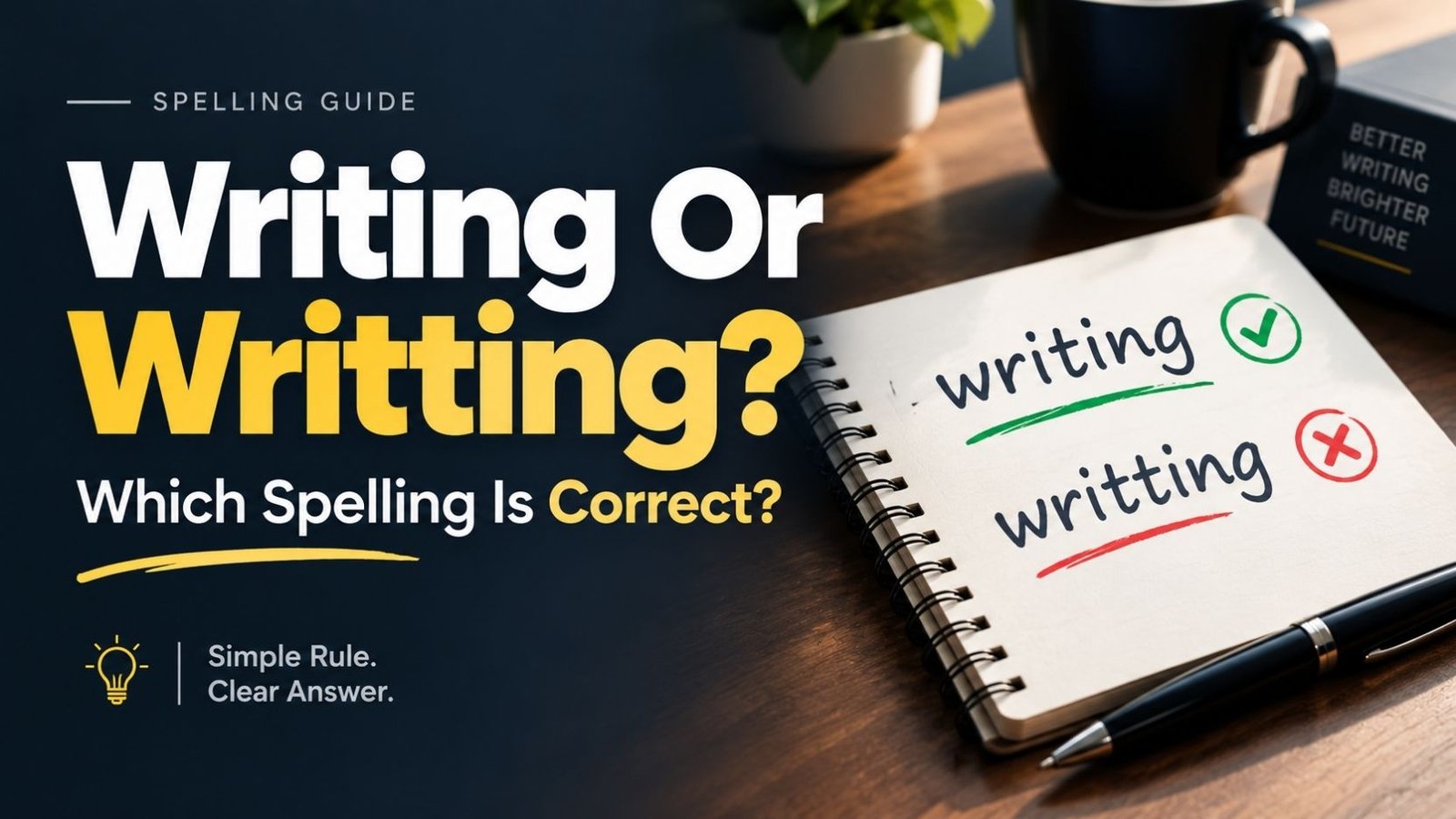
The correct spelling is writing, not writting. Writing is the standard English spelling used in every major dictionary, in schools, and in professional writing. Writting is a common misspelling that happens because people double the “t” by mistake.
This mix-up is easy to understand once you know the simple spelling rule behind it. Many English learners assume that adding “ing” always means doubling the last consonant. That rule does apply in some words, but not in this one. Understanding why will help you avoid the mistake for good.
Meaning matters here too, since writing is not just about spelling. It is a word people use every day, in emails, in schoolwork, in books, and in casual conversation. Getting the spelling right helps your writing look polished and professional.
Once you understand the small grammar detail behind this word, you will never second-guess it again. This guide explains the meaning, the grammar rule, common mistakes, and clear examples so you can use the word correctly every time.
What Does Writing Mean?
Writing is the present participle and gerund form of the verb “write.” It refers to the act of forming letters, words, or symbols to communicate meaning, usually by hand or with a device such as a keyboard.
The word carries two main uses:
- As a verb form, writing describes an ongoing action, such as “She is writing a letter.”
- As a noun, writing refers to the finished product or the activity itself, such as “His writing is very clear.”
Both uses come from the base verb “write,” which has existed in English for centuries with a stable, consistent meaning: to produce text using a pen, pencil, keyboard, or similar tool.
Read More: Sweeped Or Swept
Is It Writing or Writting? The Simple Answer
Writing is always correct. Writting is not a recognized English word in any standard dictionary.
The confusion usually comes from the spelling pattern of other English verbs. Words like “sit” become “sitting,” and “run” becomes “running,” doubling the final consonant. Because of this pattern, some writers assume “write” should follow the same rule and become “writting.” It does not.
The reason lies in a specific spelling rule explained in the next section.
Why Writing Has One “T,” Not Two
English has a rule for doubling consonants before adding “ing,” but it only applies under specific conditions. To decide whether a consonant doubles, look at how the word ends and how it sounds.
The rule works like this:
- If a short verb ends in a single vowel followed by a single consonant, and the stress falls on that final syllable, the consonant usually doubles. Example: sit becomes sitting.
- If the verb ends in a silent e, you drop the e and add “ing” without doubling anything. Example: write becomes writing.
“Write” ends in a silent e. That silent e is dropped when you add “ing,” but no letter gets doubled. This is why the correct form is writing, with a single “t.”
Writting would only make sense if “write” ended in a short vowel and a single consonant with no silent e, similar to words like “hit” or “run.” Since that is not the case, doubling the “t” is incorrect.
Quick Comparison Table
| Word | Correct Spelling | Rule Applied |
| Write | Writing | Drop the silent e, do not double the consonant |
| Sit | Sitting | Short vowel plus single consonant, so double the consonant |
| Hope | Hoping | Drop the silent e, do not double the consonant |
| Run | Running | Short vowel plus single consonant, so double the consonant |
| Bite | Biting | Drop the silent e, do not double the consonant |
Notice the pattern. Verbs ending in a silent e, like write, hope, and bite, simply drop the e before adding “ing.” Verbs with a short vowel and a single ending consonant, like sit and run, double that consonant instead. Write belongs to the first group, which is exactly why writing has only one “t.”
Writing or Writting: Grammar Breakdown
Understanding the grammar helps explain why writting never appears in correct English.
Part of speech: Writing can function as a gerund (a verb form acting as a noun), a present participle (used in continuous tenses), or a standalone noun.
Base verb: Write
Verb forms:
| Form | Example |
| Base form | I write every day. |
| Present participle | I am writing a report. |
| Past tense | I wrote a report. |
| Past participle | I have written a report. |
| Gerund | Writing is my favorite hobby. |
This table shows that “writing” fits naturally into several grammar roles, while “writting” has no place in any of them. It simply is not a recognized form of the verb.
How to Use Writing in a Sentence
Writing appears in many everyday sentence patterns. Below are natural examples that show its different uses.
As a present participle (continuous tense):
- I am writing a letter to my grandmother.
- She was writing when the phone rang.
As a gerund (acting like a noun):
- Writing helps me organize my thoughts.
- Her writing has improved a lot this year.
As a descriptive noun:
- The writing on the wall was hard to read.
- His writing style is simple and clear.
These examples show that writing works smoothly in different grammatical roles, something writting cannot do because it is not a real word.
Read More: Homophone Vs Homograph
Am I Writing or Writting? Choosing the Right Word
If you are asking yourself “am I writing or writting this correctly,” the answer is simple: always choose writing. There is no context, formal or informal, where writting is the accepted spelling.
This applies whether you are:
- Writing a school essay
- Writing a work email
- Writing a text message
- Writing a novel or story
- Writing a resume or cover letter
No professional, academic, or casual setting accepts writting as a correct alternative.
Common Mistakes With Writing or Writting
Here are the most frequent errors people make, along with the corrected versions.
❌ Incorrect: I am writting a report for my manager.
✅ Correct: I am writing a report for my manager.
❌ Incorrect: Her writting is beautiful.
✅ Correct: Her writing is beautiful.
❌ Incorrect: He enjoys writting short stories.
✅ Correct: He enjoys writing short stories.
❌ Incorrect: This writting needs some edits.
✅ Correct: This writing needs some edits.
💡 Tip: If you are unsure while typing, remember the silent e rule. Since “write” ends in silent e, you drop the e and add “ing,” resulting in one “t,” not two.
Why This Mistake Happens So Often
This spelling error is extremely common, especially among English learners and fast typists. There are a few clear reasons:
- Pattern confusion: Many verbs double their final consonant before “ing,” so learners overapply that rule to every word.
- Typing speed: Writers sometimes double letters by accident while typing quickly.
- Autocorrect gaps: Some autocorrect tools do not always catch this specific error, especially in casual writing like texting or social media.
- Visual similarity: “Writting” looks close enough to “writing” that it can slip past a quick read.
Recognizing why the mistake happens makes it easier to catch and correct before you hit send or submit your work.
Writing or Writting: Related Confusing Words
A few other word pairs cause similar confusion because of the same doubling pattern. Understanding these can help reinforce the rule.
| Word | Common Misspelling | Correct Form | Reason |
| Write | Writting | Writing | Silent e is dropped, no doubling |
| Written | Writen | Written | This is the correct past participle, already doubled |
| Writer | Writter | Writer | No doubling needed when adding “er” |
Notice that “written” already has a double “t,” and that form is correct. The confusion usually comes from applying that same doubling pattern to “writing,” where it does not belong.
Writing in Different Contexts
The word writing appears in many everyday situations, and its core meaning stays consistent across all of them.
In education: Writing refers to a specific skill taught in schools, alongside reading, speaking, and listening.
In careers: Writing describes a professional field, including freelance writing, content writing, technical writing, and creative writing.
In daily life: Writing includes simple tasks like writing a shopping list, writing a text message, or writing a birthday card.
In technology: Writing can also describe typed content, such as writing an email or writing a social media post.
In every one of these contexts, the spelling stays the same: writing, with a single “t.”
Pronunciation of Writing
Writing is pronounced as RY-ting, with the stress on the first syllable. The “t” sound in casual American English often softens into something closer to a “d” sound, so it can sound like “RY-ding” in fast speech. This is a normal feature of American pronunciation and does not affect the spelling.
Read More: Infront Or In Front
Synonyms and Related Words
While writing does not have an exact one-word replacement in every context, several related words share similar meaning depending on how the word is used.
| Word | Meaning | Difference From Writing |
| Composing | Creating written or musical work | Often used for formal or creative work, like composing a letter or a song |
| Drafting | Creating an early version of a written piece | Suggests the work is not yet final |
| Penning | Writing something, often creatively | Slightly more literary or old-fashioned in tone |
| Typing | Entering text using a keyboard | Focuses on the physical method, not the creative process |
These words can sometimes replace writing depending on context, but none of them share the exact same grammar role in every sentence.
Frequently Asked Questions
Is it writing or writting?
It is always writing. Writting is a common misspelling and is not recognized in standard English.
Why do people spell it writting?
People often mistakenly apply the consonant doubling rule from words like “sit” and “run” to the word “write,” even though write ends in a silent e and follows a different rule.
Is writing a noun or a verb?
Writing can function as both. It works as a present participle verb form, such as “I am writing,” and as a noun or gerund, such as “Writing is a valuable skill.”
How do you spell writing correctly?
Writing is spelled w r i t i n g, with a single “t.” Drop the silent e from “write” and add “ing.”
What is the difference between writing and written?
Writing is the present participle and gerund form of write, used for ongoing action or as a noun. Written is the past participle, used with helping verbs like “has” or “have,” as in “I have written the report.”
Is writting ever correct in any dialect of English?
No. Writting is not accepted in American English, British English, or any other standard dialect. It is considered a spelling error everywhere.
What is the correct spelling of writing a check?
The correct spelling is “writing a check,” using a single “t,” the same as in every other use of the word.
Does autocorrect always fix writting?
Not always. Some autocorrect tools catch the mistake, but others may miss it, especially in messaging apps or informal typing. It is best to know the correct spelling rather than rely only on autocorrect.
Conclusion
The correct spelling is writing, never writting. This comes down to a simple grammar rule: since “write” ends in a silent e, that e is dropped before adding “ing,” and no letter gets doubled. Writting looks like it might follow the same doubling pattern as words like “sitting” or “running,” but write simply does not belong to that group.
Once you remember this small but important rule, you will be able to use writing correctly every time, whether you are writing an email, a story, a school assignment, or a quick text message. A single “t” is all it takes to keep your writing accurate and professional.

Danish Raza is the author of Grammavio, a trusted resource for simple and easy-to-understand English grammar guides. He creates helpful content covering grammar rules, word meanings, vocabulary, and common grammar mistakes to help readers improve their English skills.



2 Comments