
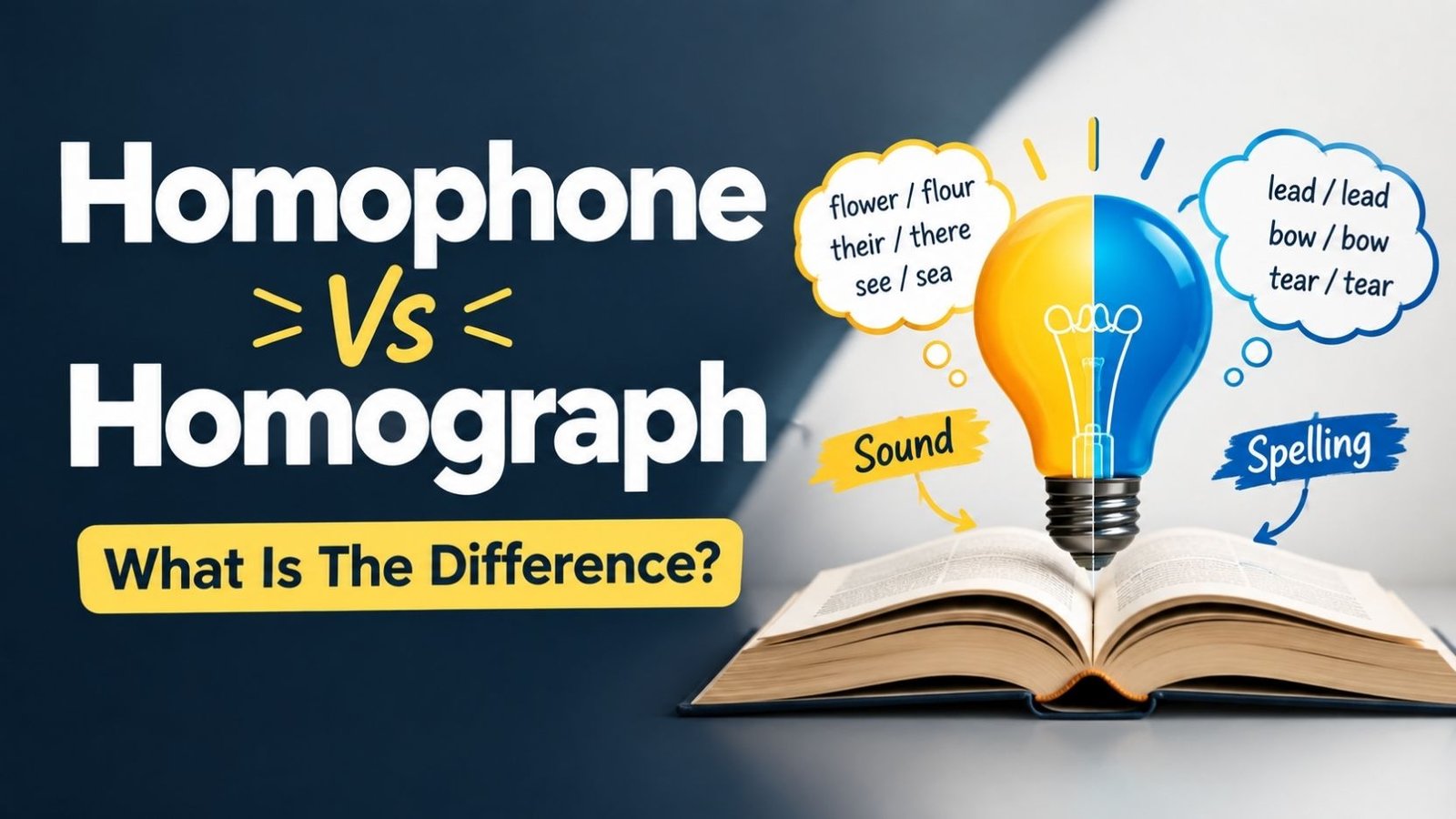
A homophone is a word that sounds exactly like another word but has a different meaning and often a different spelling, such as flower and flour. A homograph is a word that is spelled exactly like another word but has a different meaning and sometimes a different pronunciation, such as lead the metal and lead meaning to guide. The two terms describe two different kinds of confusion in English, one built on sound and one built on spelling.
Understanding the difference between a homophone and a homograph matters because English is full of words that look or sound alike but mean completely different things. Writers mix them up in emails, students lose points on spelling tests, and even fluent speakers pause mid-sentence trying to pick the right word. Once you see the pattern, the confusion disappears for good.
What Is A Homophone?
A homophone is a word that sounds the same as another word when spoken aloud, but the two words differ in meaning. Most of the time, they are spelled differently too. The word itself comes from Greek roots: “homo” meaning same, and “phone” meaning sound.
This is why the definition of homophone always centers on sound, not spelling. Two words can look nothing alike on the page and still be homophones, as long as your ears cannot tell them apart.
Simple definition: Homophone means a word that sounds like another word but has a different meaning.
Read More: Infront Or In Front
Common Homophone Examples
| Word | Meaning | Example Sentence |
| Flower | A blooming plant part | The flower opened in the morning sun. |
| Flour | Ground wheat used in baking | She added flour to the bread dough. |
| Their | Belonging to them | Their car is parked outside. |
| There | A location | Put the box over there. |
| They’re | Contraction of they are | They’re coming to dinner tonight. |
| Right | Correct, or a direction | Turn right at the next light. |
| Write | To put words on paper | Please write your name here. |
| Sea | A large body of salt water | We swam in the sea. |
| See | To use your eyes | I can see the mountains from here. |
Notice that in every pair, the words sound identical when spoken, yet each one plays a completely different role in a sentence. This is the core idea behind what a homophone is.
Which Sentence Shows the Correct Use of a Common Homophone?
This is a common question in grammar exercises. The correct sentence is the one that matches the intended meaning with the correct spelling. For example:
- ❌ Incorrect: I need to by some flour for the cake.
- ✅ Correct: I need to buy some flour for the cake.
Here, “buy” (to purchase) is the correct word, not “by” (a preposition showing location or method). Choosing correctly always comes down to meaning, not sound, since the sound gives no clue at all.
What Is A Homograph?
A homograph is a word that is spelled exactly the same as another word but carries a different meaning. Some homographs are pronounced the same way, and others are pronounced differently depending on the meaning. The word comes from Greek roots as well: “homo” meaning same, and “graph” meaning written.
This is the opposite pattern from a homophone. With homographs, the spelling stays identical, but the meaning, and sometimes the pronunciation, shifts.
Simple definition: Homograph means a word that is spelled like another word but has a different meaning.
Common Homograph Examples
| Word | Meaning 1 | Meaning 2 |
| Lead | To guide someone (verb, rhymes with “seed”) | A heavy metal (noun, rhymes with “bed”) |
| Bow | To bend forward as a greeting (rhymes with “cow”) | A knot with loops, or a weapon (rhymes with “go”) |
| Tear | A drop of liquid from crying (rhymes with “pier”) | To rip something (rhymes with “pair”) |
| Wind | Moving air (rhymes with “pinned”) | To turn or coil something (rhymes with “find”) |
| Bass | A type of fish | A low, deep sound in music |
| Close | Nearby | To shut something |
Some homograph pairs, like bass and close, change pronunciation depending on meaning. Others, like the two meanings of the word “bat” (a flying mammal, or a piece of sports equipment), are spelled and pronounced the same way, with only the meaning changing based on context.
Homophone Vs Homograph: Quick Comparison Table
The fastest way to understand homophone vs homograph is to see them side by side.
| Feature | Homophone | Homograph |
| Sound | Same | May be same or different |
| Spelling | Usually different | Always the same |
| Meaning | Different | Different |
| Example | Flower and flour | Lead (metal) and lead (to guide) |
| Confusion point | Choosing the correct spelling | Choosing the correct meaning or pronunciation |
A simple way to remember it: homophones trick your ears, while homographs trick your eyes.
Homonym Vs Homophone vs Homograph
Many readers search for homonym vs homophone vs homograph because the three words are related but not identical. Homonym is the broader, umbrella term.
- Homonym: A word that either sounds the same, is spelled the same, or both, as another word, with a different meaning. Homonym is the general category.
- Homophone: A specific type of homonym where the words sound the same.
- Homograph: A specific type of homonym where the words are spelled the same.
Some words fit into both categories at once. For example, “bat” (the animal) and “bat” (the sports equipment) are spelled the same, sound the same, and mean different things. This makes “bat” a homonym, a homograph, and, because it also sounds identical, technically a homophone of itself in the loosest sense, though in practice it is usually just labeled a homograph or homonym.
Simple Way to Remember the Difference
| Term | Sound | Spelling | Meaning |
| Homonym | Same or different | Same or different | Different |
| Homophone | Same | Different (usually) | Different |
| Homograph | Same or different | Same | Different |
If you remember only one thing, remember this: homophone focuses on the ear, homograph focuses on the eye, and homonym covers both situations.
Read More: Greatful Or Grateful
Homophone Vs Homograph Anchor Chart
Teachers and students often look for a homophone vs. homograph anchor chart to use as a quick classroom reference. Here is a simple version you can copy onto a poster or worksheet.
Homophones (sound the same):
- Flower / Flour
- Sea / See
- Right / Write
- Their / There / They’re
Homographs (spelled the same):
- Lead (metal) / Lead (to guide)
- Bow (bend) / Bow (ribbon or weapon)
- Tear (cry) / Tear (rip)
- Bat (animal) / Bat (sports equipment)
Key question to ask:
- Do the words sound the same? If yes, they may be homophones.
- Do the words look the same on paper? If yes, they may be homographs.
- Do they do both? Then the word is also a homonym.
This kind of chart works well because it gives students an instant test they can apply to any confusing word pair.
Why This Confusion Happens In English
English inherited words from many different languages, including Old English, Latin, French, and Greek. As the language grew, different words sometimes ended up sounding alike or looking alike purely by coincidence.
Spelling reforms over the centuries were never fully consistent, which is part of why homophones like “their,” “there,” and “they’re” exist as three separate spellings for sounds that merged over time.
Homographs often happen for a different reason. A single spelling was sometimes used for two words that came from entirely separate word histories, and those histories only crossed paths because the spelling system settled on the same letters for both.
Common Mistakes With Homophones And Homographs
❌ Incorrect: Their going to the store later.
✅ Correct: They’re going to the store later.
Here, “they’re” (a contraction of “they are”) is needed, not “their” (which shows possession).
❌ Incorrect: She read the whole book yesterday and will read another one tomorrow.
✅ Correct (as a homograph note): “Read” is spelled the same in past tense and present tense, but pronounced differently: “red” for the past and “reed” for the present.
This is a good example of a homograph mistake that has nothing to do with spelling errors. The spelling is already correct, but readers sometimes say the word with the wrong pronunciation because they miss the tense clue in the sentence.
❌ Incorrect: I need to were my seatbelt.
✅ Correct: I need to wear my seatbelt.
“Were” (a past tense form of “to be”) and “wear” (to have clothing on your body) are homophones that are frequently confused in casual writing.
Homophone Examples In Full Sentences
- The bride carried a bouquet of white flowers. (flower)
- Add two cups of flour to the mixing bowl. (flour)
- I can see the ocean from this window. (see)
- The sea was calm all afternoon. (sea)
- You were right about the weather. (right)
- I will write you a letter next week. (write)
Homograph Examples In Full Sentences
- The mayor will lead the parade this year. (lead, to guide)
- The old pipes were made of lead. (lead, the metal)
- He gave a polite bow before leaving the stage. (bow, to bend)
- She tied a red bow around the gift. (bow, a ribbon)
- A single tear rolled down her cheek. (tear, a drop from crying)
- Be careful not to tear the paper. (tear, to rip)
Complete The Sentence With The Correct Homophone
This type of exercise is common in schools. The goal is to pick the spelling that matches the meaning of the sentence, since the sound alone will not help you choose.
Example exercise:
“I ___ to the store yesterday.” (Choose: bye, by, buy)
The correct answer is neither “bye” nor “by.” Since none of these mean “traveled,” you would actually need a different word such as “went.” This shows why context, not sound, always decides the right homophone.
Another example:
“Please ___ down the correct answer.” (Choose: right, write)
The correct answer is “write,” since the sentence asks the reader to record something on paper.
Homophone Vs Homonym
Homophone and homonym are related but not interchangeable. A homophone always involves words that sound the same. A homonym is the broader term and can include words that sound the same, look the same, or both. Every homophone is technically a type of homonym, but not every homonym is a homophone.
Homograph Vs Homonym
The same logic applies here. A homograph always involves words that are spelled the same. A homonym is the umbrella term. Every homograph is a type of homonym, but not every homonym is a homograph.
Read More: Paid Vs Payed
Word Origins: Homophone And Homograph
Both words share the Greek prefix “homo,” meaning same. The second half of each word points to what stays the same.
- Homophone: From “phone,” meaning sound or voice, as in telephone or microphone.
- Homograph: From “graph,” meaning something written, as in paragraph or autograph.
This origin makes both terms easy to remember once you connect them to more familiar English words that share the same roots.
Homophones, Homonyms And Homographs Worksheets
Teachers often search for homophones, homonyms, and homographs worksheets to help students practice telling the three terms apart. A useful worksheet usually includes three sections:
- A list of word pairs where students identify whether each pair is a homophone, a homograph, or both.
- Fill-in-the-blank sentences where students choose the correct spelling based on meaning.
- A short writing exercise where students use each word correctly in an original sentence.
This kind of practice reinforces the difference far better than memorizing definitions alone, because it forces the reader to apply the rule in context.
Quick Reference: Homophone Vs Homograph Vs Homonym
| Term | Definition | Example |
| Homophone | Same sound, different meaning | Flower and flour |
| Homograph | Same spelling, different meaning | Lead (metal) and lead (to guide) |
| Homonym | Same sound or spelling, different meaning | Bat (animal) and bat (equipment) |
Frequently Asked Questions
What is the main difference between a homophone and a homograph?
A homophone sounds the same as another word but is usually spelled differently. A homograph is spelled the same as another word, and may or may not sound the same.
What is a homophone in simple words?
Homophone is a word that sounds exactly like another word but has a different meaning, such as sea and see.
What is a homograph in simple words?
A homograph is a word that is spelled exactly like another word but has a different meaning, such as bow (to bend) and bow (a ribbon).
Is homonym the same as homophone?
No. Homonym is the general term for words that sound alike, look alike, or both. Homophone specifically means words that sound alike.
Can a word be both a homophone and a homograph?
Yes. A word like “bat” can be spelled the same, sound the same, and still mean two different things, which makes it both a homograph and, by some definitions, a homonym.
What is an example of a homophone vs homograph pair?
Flower and flour are homophones because they sound alike but are spelled differently. Lead and lead (the metal versus the verb) are homographs because they are spelled alike but pronounced differently.
Why does English have so many homophones and homographs?
English borrowed words from many languages over centuries, and spelling was never perfectly standardized, which led to many words that sound alike or look alike by coincidence.
How can I remember the difference between homophone and homograph?
Think of “phone” for sound, since a telephone carries sound. Think of “graph” for writing, since a paragraph is written text. Homophones match in sound; homographs match in spelling.
Is “read” a homophone or a homograph?
“Read” is a homograph. The word is spelled the same in the present tense and the past tense, but pronounced differently depending on the tense.
Are there worksheets available to practice homophones and homographs?
Yes, many teachers create simple worksheets with word lists, fill-in-the-blank sentences, and short writing tasks to help students practice identifying and using homophones and homographs correctly.
Final Thoughts
The difference between homophone and homograph comes down to one simple test: does the confusion happen in your ears or in your eyes? Homophones sound alike but usually look different on the page, while homographs look identical but can carry completely different meanings and sometimes different pronunciations. Homonym sits above both terms as the general category that covers either kind of overlap.
Once you keep this distinction in mind, choosing the right word becomes much easier, whether you are writing an email, grading a worksheet, or simply trying to explain why English can be so tricky. A little attention to sound versus spelling is usually all it takes to avoid the mix up for good.

Danish Raza is the author of Grammavio, a trusted resource for simple and easy-to-understand English grammar guides. He creates helpful content covering grammar rules, word meanings, vocabulary, and common grammar mistakes to help readers improve their English skills.



2 Comments