
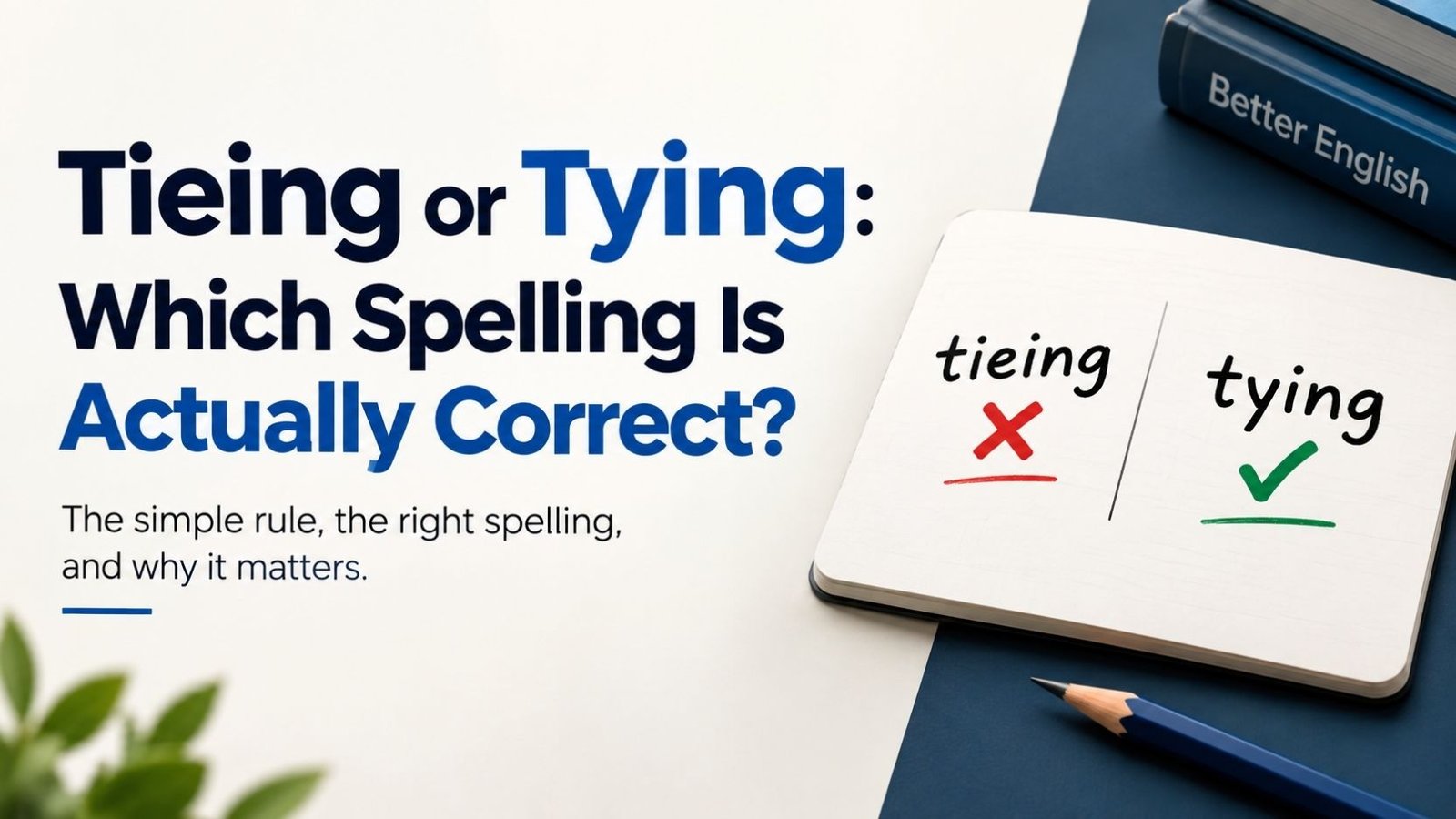
The correct spelling is tying, not tieing. Tying is the present participle and gerund form of the verb “tie,” and it follows a standard English spelling rule. Tieing is a common misspelling that many people type by mistake because it feels more natural to just add “-ing” to the word “tie.”
This confusion happens because English usually adds “-ing” straight onto a verb, like “walk” becoming “walking.” But a small group of verbs that end in “ie,” such as tie, die, and lie, follow a different pattern. Understanding this one rule clears up the tieing or tying question completely, and it also helps with several similar words you probably use every day.
Tieing Or Tying: The Simple Answer
There is only one correct spelling here.
- Correct: tying
- Incorrect: tieing
Every major dictionary, including Merriam-Webster and the Oxford English Dictionary, lists “tying” as the only accepted spelling of the “-ing” form of “tie.” “Tieing” does not appear as a standard or accepted variant in either American or British English.
So whether you are asking about tieing or tying a game, tieing or tying the knot, or tieing or tying shoes, the spelling itself never changes. Only the context changes.
Read More: Staring Vs Starring
Why People Write Tieing Instead Of Tying
Most English verbs simply add “-ing” to the base word: play becomes playing, walk becomes walking, read becomes reading. It seems logical to do the same thing with tie and get “tieing.”
But English has a specific spelling rule for short verbs that end in the letters “ie.”
💡 Tip: When a verb ends in “ie,” change the “ie” to a “y” before adding “-ing.”
This is why:
- tie becomes tying
- die becomes dying
- lie becomes lying
If you kept the “ie” and just added “-ing,” you would get an awkward double vowel pattern that English spelling avoids. “Tying” looks and sounds smoother, and it keeps the word easy to read.
The Grammar Rule Explained Simply
Here is the rule in plain English, without technical jargon.
Rule: For one-syllable verbs ending in “ie,” drop the “e,” change the “i” to “y,” and add “-ing.”
Step by step, using “tie” as the example:
- Start with the base verb: tie
- Remove the final “e”: ti
- Change the “i” to “y”: ty
- Add “-ing”: tying
This same three-step pattern applies to every common English verb that ends in “ie.” It is one of the more consistent spelling rules in English, which is part of why “tieing” is considered a clear error rather than an acceptable alternative spelling.
Why English Avoids “Ieing”
If English allowed “ieing,” you would end up with three vowels in a row inside one syllable: i, e, i. That combination is unusual and hard to read at a glance. Changing “ie” to “y” keeps the spelling clean and keeps the word looking like a normal English verb form. This is also why the rule has stayed stable for so long. It solves a real readability problem rather than existing as an arbitrary tradition.
Tying: Part Of Speech And Basic Grammar
“Tying” is the present participle of the verb “tie.” It can function in two main ways.
- As part of a continuous verb tense: “She is tying her shoes.”
- As a gerund, acting like a noun: “Tying shoes takes practice for young children.”
Because “tying” is a verb form rather than a separate word, its meaning always connects back to “tie”: to fasten, secure, or connect something using a knot, string, cord, or similar material. It can also mean to reach an equal score or result, which is covered in more detail below.
Verb Forms Of Tie
Seeing the full set of verb forms helps explain why “tying” is the only correct “-ing” spelling.
| Form | Example | Usage |
| Base form | tie | I tie my shoes every morning. |
| Present participle or gerund | tying | She is tying a ribbon on the gift. |
| Simple past | tied | He tied the boat to the dock. |
| Past participle | tied | The scores were tied at the final whistle. |
| Third person singular | ties | He always ties his tie the same way. |
Notice that only the “-ing” form changes the spelling pattern of the root word. The other forms simply add a letter or two onto “tie” without needing to remove the “e” or shift the “i” to “y.”
Tieing Or Tying A Game: What It Means In Sports
When two teams or players finish with the same score, English speakers describe this using the verb “tie.”
- “The two teams are tying the score in the second half.”
- “Tying a game usually happens when both sides play defensively near the end.”
In this sports context, tying refers to reaching an equal score, not winning or losing. A “tying goal” or “tying run” is the specific point or score that brings both sides level. This use appears constantly in sports writing, especially in soccer, baseball, and hockey coverage, where announcers often say a player is “tying it up” late in a game.
Grammatically, this is the exact same “tying” as in any other sentence. Sports context does not change the spelling or the grammar rule. It only changes the meaning slightly, from physically fastening something to reaching an equal result.
Tieing Or Tying The Knot: The Idiom
“Tying the knot” is a well-known idiom that means getting married. It comes from the literal act of tying a knot, since wedding ceremonies in many cultures have historically involved some form of binding, knotting, or joining symbol to represent two people joining together.
- “They are tying the knot next summer in a small garden ceremony.”
- “After years of dating, the couple finally tied the knot.”
This phrase works the same grammatical way as the literal meaning of “tie.” The spelling is still “tying,” never “tieing,” even though the meaning here is figurative rather than physical.
Tieing Or Tying Shoes: Everyday Usage
This is one of the most common everyday uses of the word, especially in conversations about children learning basic skills.
- “My son is finally tying his shoes by himself.”
- “Tying shoes correctly can prevent tripping.”
Because this phrase is used so often in casual speech, and because “tie” already ends in “ie,” it is one of the most frequent places people accidentally type “tieing” instead of “tying.” Knowing the spelling rule helps avoid this mistake specifically in everyday writing like text messages, parenting blogs, and school newsletters.
Read More: For Ever or Forever
Tieing Or Tying Up Loose Ends: The Idiom
“Tying up loose ends” is another common idiom. It means finishing the small remaining tasks in a project, plan, or situation.
- “Before the trip, I need to tie up a few loose ends at work.”
- “She spent the afternoon tying up loose ends before the deadline.”
Again, only “tying” is correct here. The idiom borrows the physical image of tying loose pieces of string or rope together so nothing is left hanging.
Tieing Or Tying Out: What This Phrase Means
“Tying out” usually appears in two main contexts.
- Securing an animal, such as tying out a dog on a leash or stake outside.
- A phrase used in some regional or informal speech to describe finishing or wrapping something up, similar to “tying things up.”
- “We are tying out the dog in the backyard while we eat outside.”
- “Let’s finish tying out the last few details before we submit the report.”
The spelling rule stays exactly the same regardless of which meaning applies.
Knot Tying And Fly Tying: Specialized Uses
Two specific hobby and outdoor terms use this same word correctly spelled as “tying.”
- Knot tying: refers to the skill of creating knots for climbing, sailing, camping, fishing, or everyday use. Knot tying guides usually teach several standard knots step by step.
- Fly tying: is the craft of creating artificial fishing flies used in fly fishing. People who do this often use a fly tying vise to hold materials steady, along with specialized fly tying tools and fly tying materials like feathers, thread, and small hooks.
Both terms are widely used in outdoor and hobby communities, and both always use the standard spelling “tying,” never “tieing.”
| Term | Meaning | Common Context |
| Knot tying | Creating knots by hand for practical use | Camping, sailing, climbing |
| Fly tying | Making artificial fishing flies | Fly fishing hobby and equipment |
American English Vs British English
There is no difference between American and British English on this particular spelling. Both regions treat “tying” as the only correct form and “tieing” as an error. If you have seen “tieing or tying UK” searched online, the honest answer is that UK dictionaries, including Oxford and Cambridge, follow the exact same rule as American dictionaries here. This is one of the rare spelling cases where American and British English fully agree.
Common Mistakes With Tieing Or Tying
Here are the most frequent mistakes people make with this word, along with the correct version.
❌ Incorrect: I am tieing my shoes.
✅ Correct: I am tying my shoes.
❌ Incorrect: They are tieing the game in the last minute.
✅ Correct: They are tying the game in the last minute.
❌ Incorrect: We are tieing the knot this fall.
✅ Correct: We are tying the knot this fall.
⚠️ Common mistake: Writers sometimes assume every verb simply adds “-ing” to its base form without changing spelling. This works for most English verbs, but not for short verbs ending in “ie.”
Similar Words That Follow The Same Rule
Several other everyday verbs follow the identical spelling pattern as tie to tying. Seeing them together makes the rule easier to remember.
| Base Verb | Correct “Ing” Form | Incorrect Form |
| tie | tying | tieing |
| die | dying | dieing |
| lie | lying | lieing |
| vie | vying | vieing |
If you remember just one example, such as “lying” instead of “lieing,” you can apply the same logic to “tying” instead of “tieing.” All four follow the exact same three-step spelling change: drop the e, change i to y, add ing.
Pronunciation Of Tying
“Tying” is pronounced with two syllables: TY ing, similar to “TIE ing” without a break between the two vowel sounds. In IPA, it is written as /ˈtaɪ.ɪŋ/. The stress falls on the first syllable, just like in the base word “tie.” Pronunciation does not change based on context, whether you are talking about tying shoes, tying a game, or tying a knot.
Origin Of The Word Tie
“Tie” comes from Old English “tēag” or “tēah,” meaning a rope, cord, or bond used to fasten things together. Over time, the word evolved through Middle English into the modern spelling “tie.” The “-ing” form followed the general Middle English spelling pattern that developed for verbs ending in “ie,” which is why “tying” has been the standard form for centuries rather than a modern invention.
Read More: Pastor Or Paster
Is It Tieing Or Tying In A Tie: Clothing Meaning
“Tying a tie” refers to the act of fastening a necktie around the collar using one of several standard knots, such as the four-in-hand or the Windsor knot.
- “He is tying his tie before the interview.”
- “Tying a tie takes practice, but it becomes automatic after a while.”
This is simply another everyday example of the standard verb form, applied to the clothing accessory called a “tie.” The word “tie” here is a noun, but the action of putting it on still uses the verb “tying.”
Frequently Asked Questions
Is it tieing or tying?
It is always “tying.” “Tieing” is a misspelling and is not accepted in standard English dictionaries.
What is the meaning of tying?
Tying means fastening, securing, or connecting something using string, rope, ribbon, or a similar material. It can also mean reaching an equal score in a competition.
Why is tying spelled without the “e”?
Verbs ending in “ie” drop the “e,” change “i” to “y,” and add “-ing.” This keeps the spelling smooth and avoids an awkward vowel combination.
Is tying a noun or a verb?
Tying is a verb form. It can act as part of a continuous tense, such as “is tying,” or as a gerund functioning like a noun, such as “tying shoes is a useful skill.”
What is the difference between tying and tied?
“Tying” describes an action in progress, such as “She is tying her shoelaces.” “Tied” describes a completed action, such as “She tied her shoelaces this morning.”
Is tieing ever correct in any dialect?
No. Tieing is not recognized as a standard spelling in American English or British English. It is considered a spelling mistake rather than a regional variation.
How do you spell tying correctly every time?
Remember the pattern from tie to tying: drop the e, change i to y, add ing. Practicing this with similar words like lie to lying and die to dying can help the rule stick.
What does tying the knot mean?
It is an idiom meaning to get married. It comes from the traditional symbolism of knots representing a joined bond between two people.
What does tying up loose ends mean?
It means completing the last remaining small tasks of a project or plan before considering it finished.
Is tying used the same way in sports and everyday speech?
Yes. The spelling and grammar rule never change. Only the meaning shifts slightly depending on context, such as physically fastening something versus reaching an equal score in a game.
Conclusion
The tieing or tying question has a clear and consistent answer: tying is correct, and tieing is a spelling mistake. This comes from a simple English rule that applies to short verbs ending in “ie,” where the “e” is dropped, the “i” becomes a “y,” and “-ing” is added. This same pattern shows up in related words like lying, dying, and vying, which makes the rule easier to remember once you see the pattern across multiple examples.
Whether you are talking about tying shoes, tying a game, tying the knot, tying up loose ends, or specialized hobbies like knot tying and fly tying, the spelling never changes based on meaning or context. Keeping this one grammar rule in mind will help you spell “tying” correctly every time, in both American and British English.

Danish Raza is the author of Grammavio, a trusted resource for simple and easy-to-understand English grammar guides. He creates helpful content covering grammar rules, word meanings, vocabulary, and common grammar mistakes to help readers improve their English skills.


