
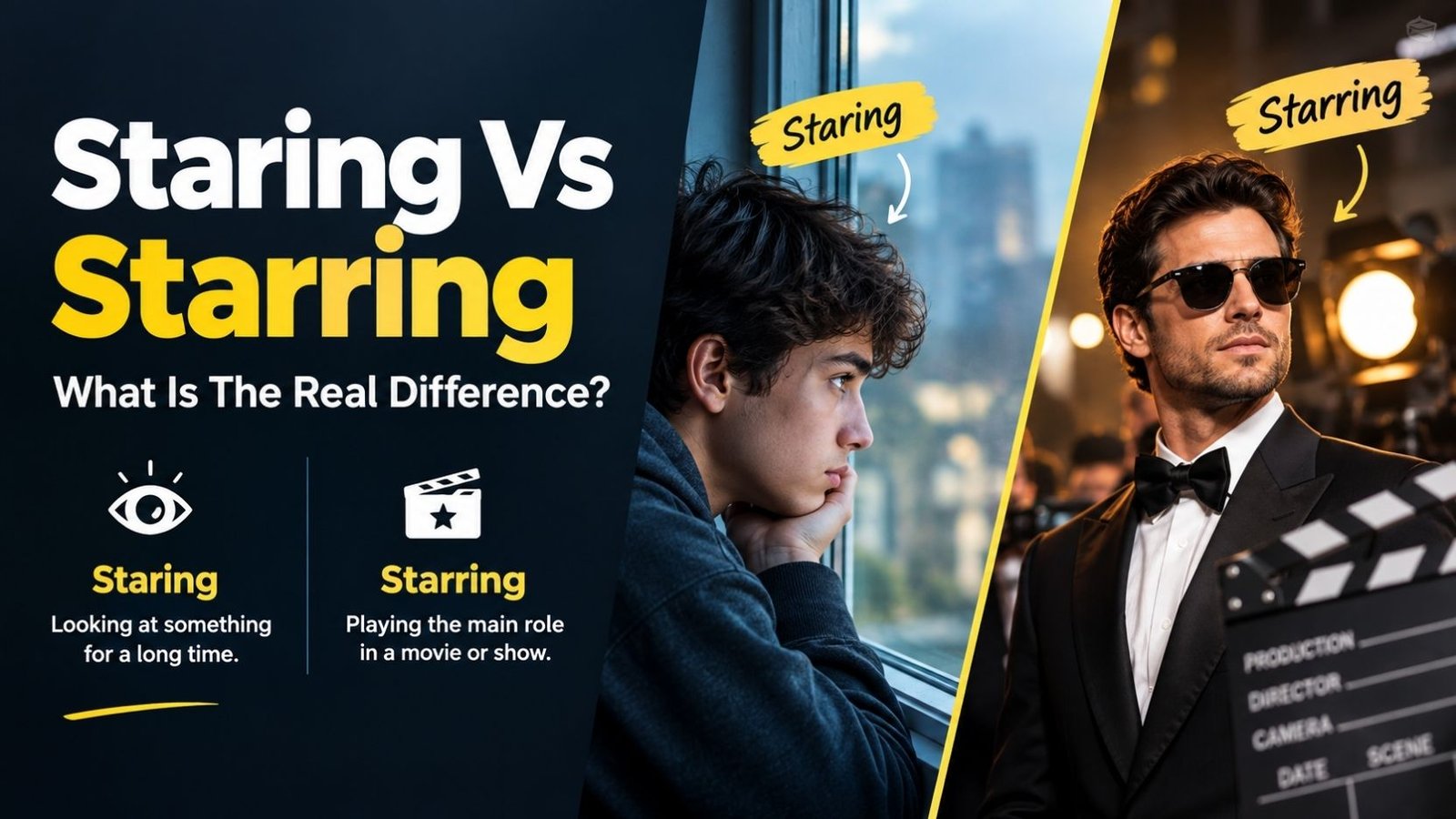
Staring and starring look almost the same, but they mean completely different things. Staring means looking at something for a long time without looking away. Starring means playing the main role in a movie, show, or performance. The two words sound similar and are often typed by mistake for one another, which is exactly why so many people search for staring vs starring before writing a sentence.
The confusion is understandable. Both words come from a base word that changes only slightly in spelling, and English spelling rules around doubled consonants trip up even confident writers. Once you understand the small grammar rule that separates them, the difference becomes easy to remember for good. This guide breaks down the meaning, grammar, pronunciation, and everyday usage of both words in plain English.
Staring Vs Starring: Quick Answer
If you only need the short version, here it is.
| Word | Base Word | Meaning | Example |
| Staring | Stare | Looking fixedly at someone or something | She was staring out the window. |
| Starring | Star | Playing the lead role in a film or show | Tom Hanks is starring in the new movie. |
Staring comes from the verb “to stare,” which means to look at something steadily. Starring comes from the verb “to star,” which means to appear as the main performer in a production. They are built from two entirely different root words that simply happen to look alike once “-ing” is added.
Read More: Conducive To Or For
What Does Staring Mean?
Staring means looking at someone or something for a long time, usually without blinking much or glancing away. It often suggests focused attention, curiosity, confusion, or sometimes rudeness, depending on the situation.
Meaning 1: Looking fixedly
This is the most common meaning. It describes the physical act of keeping your eyes fixed on one thing.
- The child was staring at the fireworks.
- He kept staring at his phone screen.
Meaning 2: Looking in a way that feels intense or awkward
Staring can also describe a look that makes someone uncomfortable, especially when it lasts longer than normal eye contact.
- Stop staring at me; it’s making me nervous.
- Everyone was staring after the loud crash.
Meaning 3: Something being obvious (“staring you in the face”)
This is an idiomatic use. It means something is extremely obvious, even if it was missed at first.
- The answer was staring me in the face the whole time.
What Does Starring Mean?
Starring means having the main role in a film, TV show, play, or other performance. It comes from the noun “star,” meaning a famous or leading performer.
Meaning 1: Playing the lead role
This is the primary meaning used in entertainment and media.
- The film stars two award-winning actors.
- She is starring in her first Broadway production.
Meaning 2: Featuring someone as a key performer
Starring can also describe a production that includes a well-known performer, even if the sentence structure shifts slightly.
- A new series starring a popular comedian premieres next month.
Starring is almost always connected to acting, performing, or appearing in a creative production. It is rarely used outside that context.
Staring Vs Starring: Grammar Difference
The grammar difference comes down to one letter and one spelling rule.
Where the Words Come From
- Staring is the present participle of the verb stare.
- Starring is the present participle of the verb star.
Both words are formed by adding “-ing” to a base verb, but English spelling rules treat them differently because of how each base word is built.
Why the Spelling Changes
Stare ends in a silent “e.” When “-ing” is added to a verb ending in a silent “e,” that “e” is dropped.
- Stare + ing → Staring (not staree-ing)
Star ends in a single vowel followed by a single consonant, and it is a one syllable word with the stress on that final consonant. Under standard English spelling rules, this means the final consonant is doubled before adding “-ing.”
- Star + ing → Starring (the “r” doubles)
This same doubling rule explains other familiar pairs, such as run becoming running and swim becoming swimming. Staring only has one “r” because the silent “e” is simply removed, not because a consonant was doubled.
💡 Tip: If the base word ends in a silent “e,” drop the “e” before adding “-ing.” If the base word ends in one vowel and one consonant, double that consonant instead.
Part of Speech
Both staring and starring are present participles. A present participle can function as:
- A verb form in continuous tenses (She is staring. He is starring.)
- An adjective (a staring contest, a starring role)
- A gerund in some sentence structures (Staring for too long can feel rude.)
Staring Vs Starring: Side By Side Comparison
| Feature | Staring | Starring |
| Base verb | Stare | Star |
| Meaning | Looking fixedly | Playing the lead role |
| Spelling rule | Drop the silent “e” | Double the final consonant |
| Common context | Eye contact, attention, behavior | Movies, shows, performances |
| Typical sentence | She was staring at the ocean. | He is starring in the new film. |
Read More: Pastor Or Paster
How To Pronounce Staring And Starring
The pronunciation difference is small but noticeable once you know what to listen for.
- Staring: is pronounced STAIR-ing. The first syllable rhymes with “hair.”
- Starring: is pronounced STAR-ing. The first syllable rhymes with “car” or “far.”
The vowel sound is the main clue. Staring has the same vowel sound as “stare,” “hair,” and “chair.” Starring has the same vowel sound as “star,” “car,” and “far.” If you say the base word first, the correct pronunciation of the “-ing” form usually follows naturally.
Examples Of Staring In A Sentence
- The dog was staring at the front door, waiting for its owner.
- I caught him staring at the clock during the meeting.
- She sat quietly, staring at the rain.
Examples Of Starring In A Sentence
- The new thriller is starring a well-known actress.
- He landed his first starring role after years of small parts.
- The show is starring three actors who have never worked together before.
Common Mistakes With Staring And Starring
These two words are commonly swapped in writing, especially in casual messages, social media captions, and quick emails.
❌ Incorrect: The movie is staring a famous actor.
✅ Correct: The movie is starring a famous actor.
❌ Incorrect: She kept starring at the painting for ten minutes.
✅ Correct: She kept staring at the painting for ten minutes.
A simple way to check which word you need: if you mean “looking,” use staring. If you mean “acting in a movie or show,” use starring.
Staring Vs Starring In A Movie
This is one of the most searched versions of this comparison, because people often type “staring” when they actually mean the cast of a film. If a sentence is about who appears in a movie, starring is always the correct word.
- Correct: The movie is starring two Oscar-winning actors.
- Incorrect: The movie is staring two Oscar-winning actors.
Staring would only be correct in a film context if you were describing a character’s action, such as “The actor spent the scene staring out the window.”
Why Do People Stare? Common Contexts
Staring shows up in many everyday situations beyond simple definitions. Understanding these contexts helps explain why the word appears so often in real conversations and searches.
Why Is My Dog Staring At Me?
Dogs often stare at their owners to communicate a need, show affection, or seek attention. Long, relaxed staring paired with soft eyes usually signals bonding. Staring paired with a stiff body or fixed focus on an object, like food, usually signals want or anticipation.
Why Is My Cat Staring At Me?
Cats may stare out of curiosity, alertness, or simple observation. A slow blink during staring is often seen as a sign of trust. Prolonged, unblinking staring without any body movement can sometimes indicate discomfort or focus on something specific, like a sound or movement nearby.
What Is Considered Staring In Human Behavior?
In everyday social behavior, staring is usually considered eye contact that lasts noticeably longer than what feels natural in conversation. Brief eye contact is normal and expected. Extended, fixed staring can come across as rude, intense, or intrusive, depending on cultural norms and context.
Staring Contests
A staring contest is a simple game where two people look directly into each other’s eyes without blinking or looking away. The first person to blink or turn away loses. It is a common example of staring used in a lighthearted, everyday context rather than a formal one.
Read More: Chiefs Or Chieves
Similar Or Confusing Words
| Word | Meaning | Difference From Staring/Starring |
| Glaring | Staring in an angry or hostile way | Adds a negative emotional tone that plain staring does not require |
| Gazing | Looking softly or admiringly | Usually gentler and more affectionate than staring |
| Featuring | Including someone or something prominently | Broader than starring; not limited to acting roles |
| Casting | Choosing actors for roles | Refers to the selection process, not the act of performing |
Frequently Asked Questions
What does staring vs starring mean?
Staring means looking at something for a long time without looking away. Starring means playing the lead role in a movie, show, or performance.
Is it staring or starring in a movie?
It is starring in a movie. Starring refers to the actors who play lead roles in a film.
How do you pronounce staring and starring?
Staring rhymes with “hair” and is pronounced STAIR-ing. Starring rhymes with “car” and is pronounced STAR-ing.
Why does starring have two Rs but staring only has one?
Starring doubles the “r” because the base word “star” ends in one vowel and one consonant, following a standard English spelling rule. Staring only has one “r” because the base word “stare” simply drops its silent “e” before adding “-ing.”
Is staring a noun or a verb?
Staring is most often used as a verb form, specifically the present participle of “stare.” It can also function as an adjective, as in “a staring contest.”
Is starring a noun or a verb?
Starring is the present participle of the verb “star.” It is most often used as a verb form describing someone’s role in a production, as in “starring in a film.”
What is the difference between staring and glaring?
Staring is neutral and simply means looking fixedly. Glaring adds anger or hostility to that same fixed look.
Can staring be rude?
Yes, staring can be considered rude in many social situations, especially when it lasts longer than typical eye contact or makes someone feel uncomfortable.
Why is my dog or cat staring at me?
Pets often stare to communicate needs, show attention, express curiosity, or build trust with their owner, depending on their body language and the situation.
What is a staring contest?
A staring contest is a simple game where two people try to hold eye contact without blinking, and the first person to blink loses.
Final Thoughts
Staring and starring may look nearly identical on the page, but they come from two completely different words with two completely different meanings. Staring describes the act of looking fixedly at someone or something, while starring describes playing the lead role in a movie, show, or performance. The spelling difference comes down to a simple rule: stare drops its silent “e,” while star doubles its final consonant.
Once you connect each word back to its root, stare for staring and star for starring, the mix-up becomes much harder to make. Whether you are describing a long look from a pet, an awkward moment of eye contact, or the lead actor in a new film, choosing the right word comes down to asking one simple question: are you talking about looking, or are you talking about acting?

Danish Raza is the author of Grammavio, a trusted resource for simple and easy-to-understand English grammar guides. He creates helpful content covering grammar rules, word meanings, vocabulary, and common grammar mistakes to help readers improve their English skills.



2 Comments