
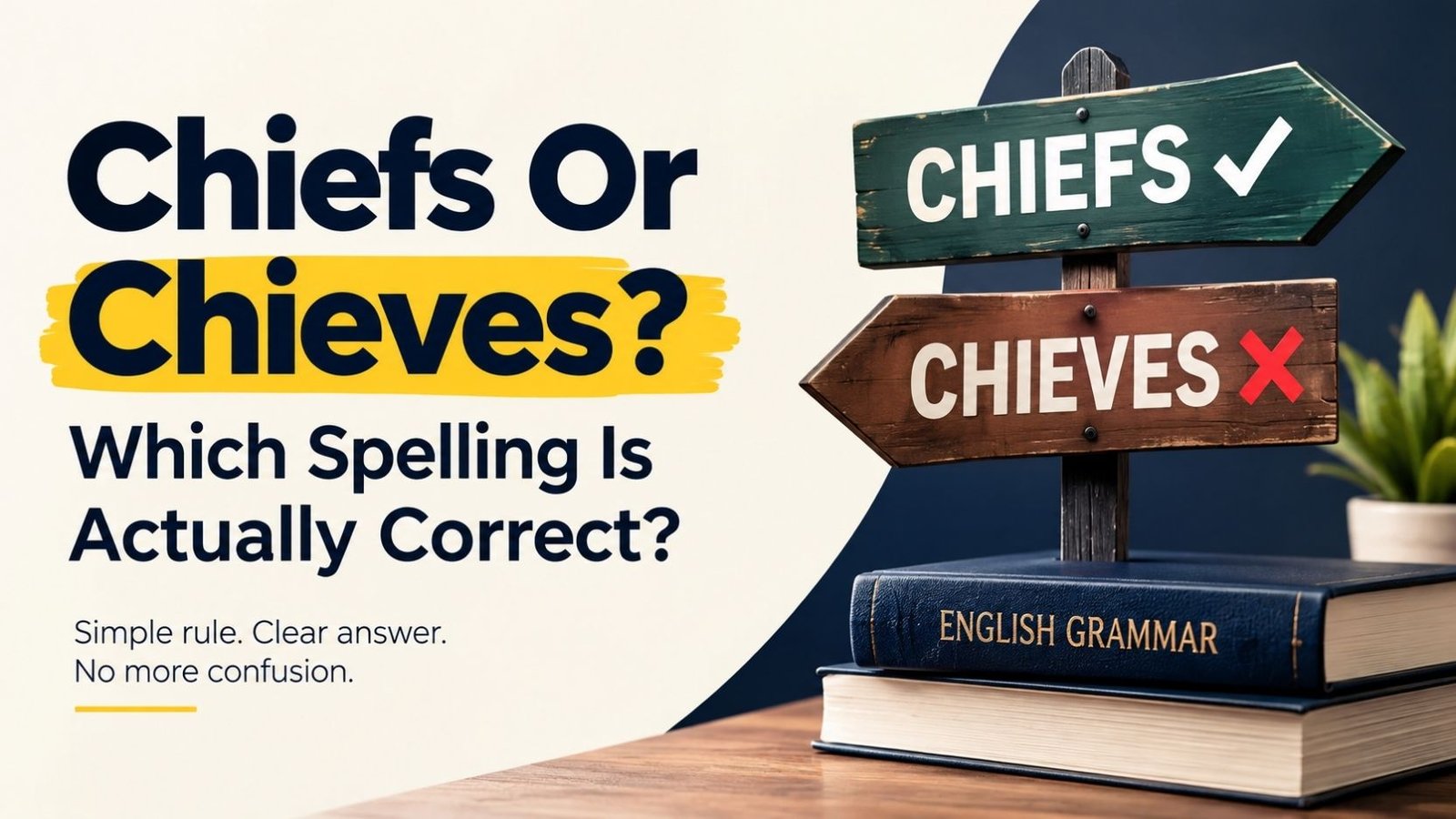
If you have ever paused mid-sentence and wondered whether the plural of chief is chiefs or chieves, you are not alone. The correct spelling is chiefs. Chieves is not a recognized English word, even though it looks like it should follow the same pattern as words like leaf and leaves.
This mix-up happens because English has a small group of words ending in f that do change to- ves in the plural, such as knife to knives and wolf to wolves. Chief does not belong to that group. It follows the regular rule instead, so you simply add an s at the end.
Understanding why chief breaks the pattern helps you avoid the mistake for good. It also clears up confusion with other similar-looking terms, including Chinese chives, the name Chieves, and the Kansas City Chiefs football team, all of which show up in searches for this exact phrase. This article walks through the grammar, the reasoning behind it, and every related meaning you might be looking for.
Read More: Treck Or Trek
Chiefs Or Chieves: The Short Answer
The plural of chief is chiefs, not chieves. There is no standard English word spelled chieves used as the plural of chief. If you see it written that way, it is a spelling mistake, not an accepted variant.
Here is the core rule in one place.
| Word | Correct Plural | Incorrect Form |
| Chief | Chiefs | Chieves |
| Belief | Beliefs | Believes (as a plural noun) |
| Roof | Roofs | Rooves is a rare, older variant |
| Leaf | Leaves | Leafs (only correct for hockey team name) |
| Knife | Knives | Knifes (verb form only) |
Notice how chief sits with belief and roof, the words that keep the regular s ending, rather than with leaf and knife, the words that switch to ves.
Why Is The Plural Of Chief Chiefs And Not Chieves?
This is the real grammar question behind almost every version of this search. The answer comes down to how English pluralizes words that end in the letter f or fe.
The General Rule for Words Ending in F
Most English nouns that end in f simply add an s to form the plural. This is the default, most common pattern.
Examples include:
- Chief becomes chiefs
- Belief becomes beliefs
- Cliff becomes cliffs
- Proof becomes proofs
- Roof becomes roofs
The Exception Group: F to Ves
A smaller set of nouns changes the f or fe ending to ves. This exception exists mainly for older, native English words that have kept an older sound pattern from Old English, where the f sound softened to a v sound between vowels.
Examples include:
- Leaf becomes leaves
- Knife becomes knives
- Wolf becomes wolves
- Life becomes lives
- Half becomes halves
Why Chief Does Not Follow the Ves Pattern
Chief did not enter English from Old English roots. It came into the language later, through Old French, from the Latin word caput, meaning head. Words borrowed later, especially from French and Latin, tend to keep the simple s plural rather than adopting the older ves shift.
That is the real reason chiefs is correct. The word simply never belonged to the small, older group of nouns that follow the f to ves pattern. There is no shortcut rule that predicts this from spelling alone. It comes down to word history, and chief’s history places it firmly in the regular s group.
💡 Tip: If a word entered English through French or Latin, it usually takes the regular s plural, even if it ends in f.
Chief: Meaning, Part Of Speech, And Pronunciation
Before going further into usage, it helps to look at chief on its own.
Simple Definition
Chief is most commonly used as a noun meaning the leader or head of a group, organization, or tribe. It can also work as an adjective meaning the most important or primary one.
Part of Speech
Chief can function as:
- A noun, as in the fire chief made the final call
- An adjective, as in her chief concern was safety
Pronunciation
Chief is pronounced cheef, rhyming with leaf and beef. It has one syllable. In IPA, it is written as tʃiːf. There is no difference between American and British pronunciation for this word.
Read More: Targeted Or Targetted
Chief In A Sentence: Clear Examples
Seeing the word in context makes the correct plural easier to remember.
- The tribal chiefs met to discuss the new water rights agreement.
- Several police chiefs attended the community safety meeting.
- Her chief goal this year is finishing the certification program.
- The kitchen has three chiefs, each responsible for a different station.
Every plural use above takes the regular s ending. None of them use chieves.
Common Mistakes With Chiefs And Chieves
Here are the most frequent errors people make with this word, along with the correct version.
❌ Incorrect: The village chieves gathered for the ceremony.
✅ Correct: The village chiefs gathered for the ceremony.
❌ Incorrect: There are five fire chieves in the district.
✅ Correct: There are five fire chiefs in the district.
❌ Incorrect: Chieves is the plural of chief.
✅ Correct: Chiefs is the plural of chief.
The error usually comes from mentally grouping chief with leaf, thief, or knife, since they share the same ending sound. Thief is actually part of the exception, since thief becomes thieves, which likely adds to the confusion around chief.
⚠️ Common mixup: Thief follows the ves rule and becomes thieves. Chief does not follow that rule and stays chiefs. These two words look similar but behave differently in the plural.
Chieves As A Misspelling: Where Else It Shows Up
Since chieves is not a standard word, most searches for it fall into one of a few categories that have nothing to do with grammar rules. It is worth covering these clearly, since many people searching this phrase are actually looking for something else entirely.
Chinese Chives
One common source of confusion is Chinese chives, sometimes searched informally as chieves food or chinese chieves. Chinese chives are a leafy vegetable used in Asian cooking, related to garlic and onions, and often used in dumplings and stir fries. The correct spelling is chives, not chieves, and the singular form is chive. This word has nothing to do with the plural of chief. It is simply a different word that happens to sound similar when spoken quickly.
Garlic Chives
Garlic chives, sometimes misspelled as garlic chieves, are a specific variety of Chinese chives with a mild garlic flavor, flat leaves, and small white flowers. Again, the correct spelling is chives.
Chieves as a Surname
Chieves also appears as a real surname in the United States. Names like Marcus Chieves, Barbara Chieves, and Alisa Chieves refer to specific individuals and are unrelated to the grammar question. A surname is simply a family name, and its spelling does not follow standard vocabulary rules, since names are not required to match dictionary spelling patterns.
Kansas City Chiefs: The Football Connection
A large share of searches combining chiefs and chieves actually relate to the Kansas City Chiefs, the NFL football team based in Kansas City, Missouri. Searches like kansas city chieves, chieves vs bills, chieves football, and chieves vs eagles are almost always misspellings of Kansas City Chiefs.
The team name is Chiefs, spelled with the regular plural form covered earlier in this article. There is no alternate spelling for the team name. If you are looking for information such as the Chiefs schedule, recent scores, or matchup details against teams like the Bills, Broncos, Chargers, Ravens, or Eagles, the correct search term is Chiefs, not Chieves.
📌 Quick reference: Whether you mean the leadership term or the football team, the spelling is always Chiefs.
Chiefs Or Chieves: Word Comparison Table
| Term | Correct Spelling | Meaning |
| Plural of chief | Chiefs | Leaders, heads of a group |
| Vegetable | Chives | A leafy allium used in cooking |
| Surname | Chieves | A family name, unrelated to grammar |
| NFL team | Chiefs | Kansas City’s professional football team |
Read More: Run Or Ran
Similar Words That Follow The Same Pattern As Chief
If chief still feels confusing, it helps to see it alongside other words that behave the same way.
| Word | Plural | Pattern |
| Chief | Chiefs | Regular s |
| Belief | Beliefs | Regular s |
| Relief | Reliefs | Regular s |
| Grief | Griefs | Regular s, though rarely pluralized |
| Reef | Reefs | Regular s |
These words all end in f but keep the plain s ending, just like chief. Once you notice the pattern, chiefs starts to feel like the obvious choice rather than an exception to memorize.
British English And American English
There is no difference between British and American English when it comes to this plural. Chiefs is correct in both. Some f-to-ves words, like roof, have historical variants such as rooves in older British usage, but chief has never had a widely accepted ves form in either dialect.
Frequently Asked Questions
Is it chiefs or chieves?
It is chiefs. Chieves is not a standard English word.
Why is the plural of chief chiefs and not chieves?
Chief comes from Old French and Latin roots, so it follows the regular s plural rule instead of the older f to- ves pattern used by native Old English words like leaf and knife.
Is chieves a real word at all?
Chieves is not a recognized dictionary word for the plural of chief. It does exist as a surname for some individuals in the United States.
What is the plural of chieves?
Since chieves itself is not a standard word, it does not have an established plural in dictionary English.
Is chiefs or chief’s correct when showing possession?
Chief’s, with an apostrophe before the s, shows possession for one chief, as in the chief’s decision. Chiefs, without an apostrophe, is simply the plural, as in three chiefs attended.
Does chieves mean the same thing as chives?
No. Chives is a leafy herb used in cooking. Chieves is either a misspelling of chives or a surname, and it is unrelated to chief in meaning.
Is Kansas City Chieves a correct spelling of the football team?
No. The correct name is the Kansas City Chiefs. Chieves is a common misspelling.
What type of word is chief?
Chief works as both a noun, meaning a leader, and an adjective, meaning the most important one.
How do you pronounce chief?
Chief is pronounced cheef, with one syllable, and it rhymes with leaf and beef.
Final Thoughts
The answer to chiefs or chieves comes down to word history rather than a simple spelling trick. Chief entered English through French and Latin, so it takes the regular plural ending, giving you chiefs. Words like leaf, knife, and wolf follow an older pattern from Old English, which is why they shift to ves, and that pattern simply does not apply to chief.
Whenever you are unsure, remember that chieves is not a standard English word outside of its use as a surname. Whether you are writing about tribal chiefs, workplace chiefs, or cheering for the Kansas City Chiefs, the correct spelling is always chiefs.

Danish Raza is the author of Grammavio, a trusted resource for simple and easy-to-understand English grammar guides. He creates helpful content covering grammar rules, word meanings, vocabulary, and common grammar mistakes to help readers improve their English skills.


