
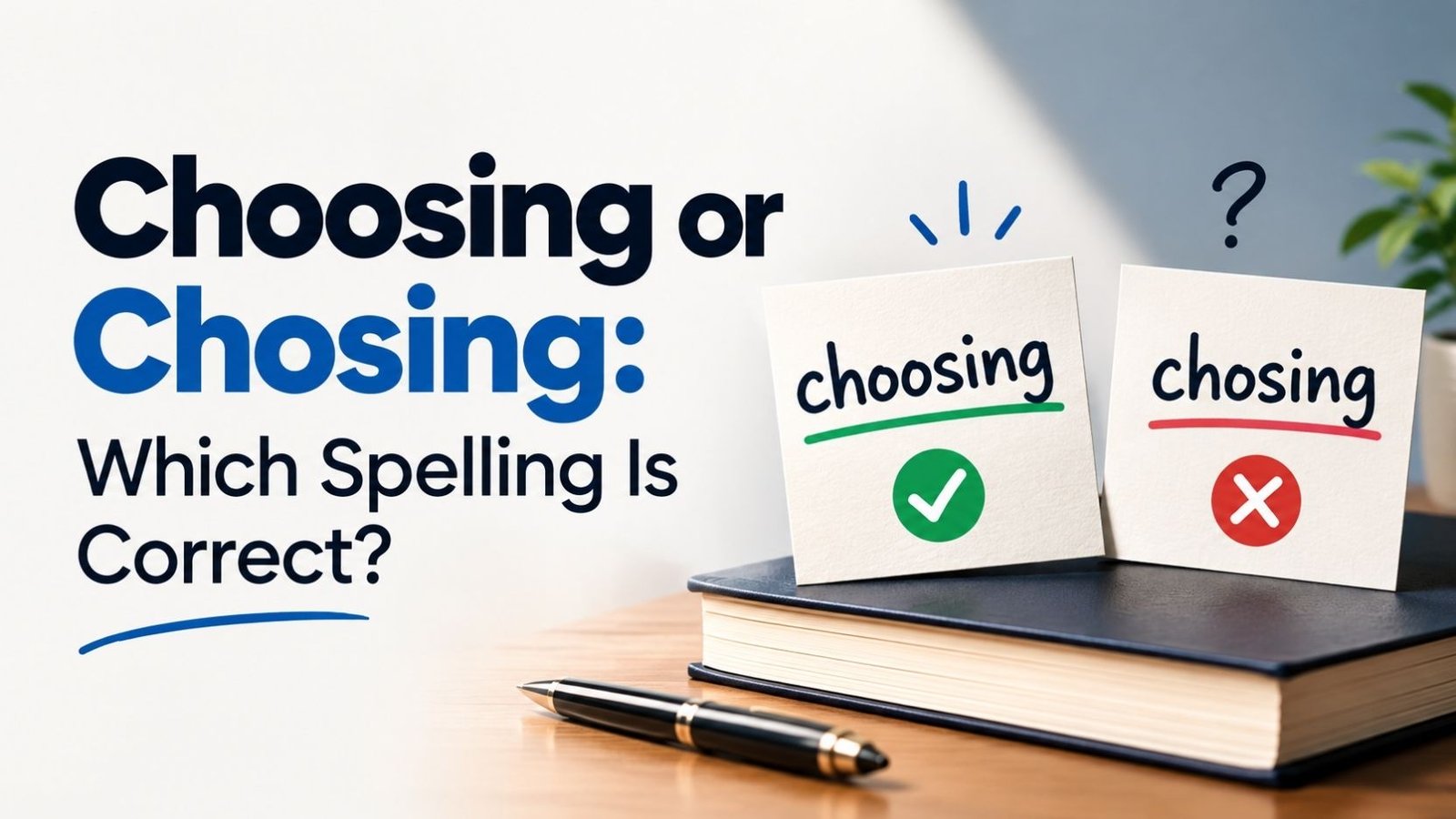
Choosing is the correct spelling. Chosing is a misspelling, and major dictionaries do not list it as a word. If you are torn between choosing or chosing, use the version with two o’s. The word comes from the verb “choose,” and the -ing form keeps both o’s.
Many writers mix this up because the past tense, “chose,” has only one o. It feels natural to add -ing to a word you already use often. But that is not how this verb works. This guide explains the rule, shows clear examples, and helps you stop second-guessing the spelling.
Quick Answer: Is It Choosing or Chosing?
✅ Correct: choosing
❌ Incorrect: chosing
Choosing is the present participle of the verb “choose.” It means selecting one option from two or more. The spelling is the same in American and British English.
You can use this answer for any sentence. Whether you write “I am choosing a gift” or “Thank you for choosing us,” the double o stays.
Read More: Couch or Coach
What Does Choosing Mean?
Choosing means the act of selecting something from a set of options. It describes a decision that is happening now, or a decision as a general idea.
Meaning 1: An action in progress. Someone is picking between options right now.
She is choosing a paint color for the kitchen.
Meaning 2: The act of selecting, as an idea. Here the word works like a noun.
Choosing a college can feel stressful.
Both meanings come from the same verb. The only difference is how the word works inside the sentence.
Why Choosing Is Spelled With Two O’s
The spelling follows a simple pattern. Start with the base verb, “choose.” When you add ing to a verb that ends in a silent e, you drop the e and add the ending.
So the steps look like this:
- Start with choose.
- Drop the silent e: choos.
- Add ing: choosing.
The double o stays because it belongs to the base verb. It is not part of the ending.
Now look at where “chosing” goes wrong. It would come from “chose” plus ing. But “chose” is not the base verb. It is the past tense. The ing form is always built from the base form.
Other verbs follow the same pattern:
| Base verb | Drop the silent e | Add ing |
| choose | choos | choosing |
| lose | los | losing |
| use | us | using |
| move | mov | moving |
| hope | hop | hoping |
💡 Tip: Never build an ing word from a past tense form. Always start with the base verb.
The Full Verb Forms of Choose
“Choose” is an irregular verb. That means the past forms do not end in ed. Seeing all the forms together makes the pattern clear.
| Form | Word | Example |
| Base form | choose | Please choose one option. |
| Third person singular | chooses | He chooses tea every morning. |
| Present participle | choosing | They are choosing a name. |
| Past tense | chose | I chose the blue one. |
| Past participle | chosen | The winner was chosen by vote. |
Only one of these forms has an ing ending, and it has two o’s. Chose and chosen have a single o, and that is where the confusion starts.
How to Use Choosing in a Sentence
The word “choosing” does three different jobs. Knowing them helps you use it with confidence.
1. In continuous tenses: It follows a form of “be,” such as am, is, are, was, or were.
I am choosing between two apartments.
They were choosing a restaurant when I called.
2. As a gerund: A gerund is an ing word that works as a noun. It can be the subject of a sentence.
Choosing the right roofing material takes planning.
3. After a preposition: A gerund also follows words like for, of, about, and when.
Here is what buyers consider when choosing jeans.
She is worried about choosing the wrong course.
Read More: Free Rein or Free Reign
Thank You for Choosing Us: The Correct Wording
This is one of the most common places people search for the spelling. Businesses, clinics, and online stores use the phrase all the time.
The word “for” is a preposition, so it needs a gerund after it. That gerund is “choosing.”
- ✅ Thank you for choosing our clinic.
- ✅ Thank you for choosing me.
- ❌ Thank you for chosing us.
⚠️ Common mistake: Some writers use “choosing” without saying what was chosen. In most cases, add an object such as “us,” “our team,” or “this service.”
Choosing vs. Chose vs. Chosen
These three words come from the same verb, but they are not interchangeable. This table shows when to use each one.
| Word | Type | When to use it | Example |
| choosing | Present participle or gerund | Ongoing action or the act itself | I am choosing a book. |
| chose | Past tense | A finished action in the past | I chose a book yesterday. |
| chosen | Past participle | After “have,” “has,” “had,” or “be” | I have chosen a book. |
Here is one sentence that uses all three:
Yesterday I was choosing a gift, and I chose a book that my sister had chosen for me last year.
Common Mistakes With Choosing
The mistakes fall into a few clear groups.
Mistake 1: Adding ing to the past tense
Incorrect: I am chosing a new phone.
Correct: I am choosing a new phone.
The -ing form comes from “choose,” not “chose.”
Mistake 2: Using the past tense where the ing form belongs
Incorrect: Chose a career is a big decision.
Correct: Choosing a career is a big decision.
A sentence subject needs the gerund.
Mistake 3: Mixing up the vowel spelling
Incorrect: choosseing, choosign, choozing
Correct: choosing
The “z” sound in this word is spelled with an s, and the vowel sound is spelled oo.
You may also see typos like “chosing seats” or “chosing fonts” online. These are the same error. They are not a special or alternate usage.
Choosing or Chosing in UK and US English
Some people search “choosing or chosing UK” and wonder if British English uses a different spelling. It does not. Both American and British English spell the word choosing.
Many words do differ between the two, such as “color” and “colour.” This is not one of them. Since your target reader is in the United States, the spelling is simply choosing, with no regional exceptions to worry about.
How to Pronounce Choosing
The word has two syllables, and the stress falls on the first one.
- Simple pronunciation: CHOO zing
- IPA (American): /ˈtʃuːzɪŋ/
The first sound is “ch,” as in “chair.” The vowel is a long “oo,” as in “food.” The middle sound is a “z,” not an “s.”
Compare it with the past tense. “Chose” rhymes with “nose” and is pronounced /tʃoʊz/. The vowel is different. The vowel sound in choosing is oo, not oh. That difference is a good reason the spelling keeps the double o.
Where Does the Word Choose Come From?
“Choose” is an old English word. It traces back to the Old English verb cēosan, which meant to select or to pick. It belongs to the Germanic language family, and related words still exist today, such as Dutch kiezen.
Word historians connect it to a very old root linked to tasting and trying. That makes sense, since choosing often starts with testing what you like. The spelling of the past forms changed over the centuries, which is why “chose” and “chosen” look so different from the base verb.
Synonyms and Related Words
Choosing has many close relatives. They are not all identical, so the differences matter.
| Word | Meaning | How it differs |
| picking | Selecting something | More casual and everyday |
| selecting | Choosing carefully from a group | More formal, often used in business |
| opting for | Deciding on one option | Suggests a decision between clear alternatives |
| electing | Choosing by vote | Used for leaders and officials |
| choosy | Picky, hard to please | An adjective, not a verb |
The opposite idea includes words like rejecting, refusing, and turning down.
The related word “chooser” means a person who chooses, as in the saying “beggars can’t be choosers.”
Choosing in Names and Titles: “Choosin’ Texas”
Some of the searches around this word come from a song. Ella Langley released “Choosin’ Texas” on October 17, 2025. It was the lead single from her second studio album, Dandelion, and she wrote it with Luke Dick, Miranda Lambert, and Joybeth Taylor.
Notice the title spelling. It reads “Choosin’,” with an apostrophe where the g would be. This is a deliberate, informal style that mirrors how people speak. In standard writing, the full word is choosing.
That gives you three forms to recognize:
- Choosing Texas: correct standard spelling
- Choosin’ Texas: the official stylized song title
- Chosing Texas: a misspelling
If you are searching for the song, “Choosin’ Texas” gets you the right result. For lyrics, use a licensed lyrics site rather than copying text from random pages.
Read More: Staring Vs Starring
Easy Ways to Remember the Spelling
A few small habits make the spelling stick.
- Say the vowel out loud: If you hear a long “oo,” write two o’s.
- Think of “choose” first: Then add ing.
- Use a rhyme: Choosing has the same oo as “zoo” and “too.”
- Pair it with “losing”: You would never write “losing” as “lossing,” and you would not shorten “choosing” either.
- Check your spell checker: It will underline “chosing” almost every time.
💡 Tip: If you are unsure, try the base verb first. If “choose” fits the sentence, add ing.
Frequently Asked Questions
Is it choosing or chosing?
It is choosing. Chosing is a common misspelling and is not a standard English word.
Why is choosing spelled with two o’s?
Because the base verb, “choose,” has two o’s. You drop the silent e and add ing, which leaves the double o in place.
Is choosing a noun or a verb?
It is the present participle of the verb “choose.” It can also work as a noun, in which case it is called a gerund, as in “Choosing takes time.”
What is the past tense of choose?
The past tense is “chose,” and the past participle is “chosen.” Neither one ends in ing.
Is “thank you for chosing us” correct?
No. The correct sentence is “Thank you for choosing us.”
Is choosing spelled differently in British English?
No. Both British and American English use the spelling choosing.
How do you pronounce choosing?
Say CHOO zing. The first syllable is stressed, and the vowel is a long “oo.”
What is the difference between choosing and chosen?
“Choosing” describes an action in progress or the act itself. “Chosen” describes something that has already been picked, as in “She has chosen a name.”
Conclusion
The right spelling is choosing, with two o’s. The word is the -ing form of the verb “choose,” and you build it by dropping the silent e and adding -ing. “Chosing” fails because it starts from “chose,” which is the past tense, not the base verb.
For a quick final check, ask yourself one question: does “choose” fit here? If it does, write “choosing.” That one habit will keep your spelling correct in emails, essays, business messages, and everyday writing.

Danish Raza is the author of Grammavio, a trusted resource for simple and easy-to-understand English grammar guides. He creates helpful content covering grammar rules, word meanings, vocabulary, and common grammar mistakes to help readers improve their English skills.



One Comment