
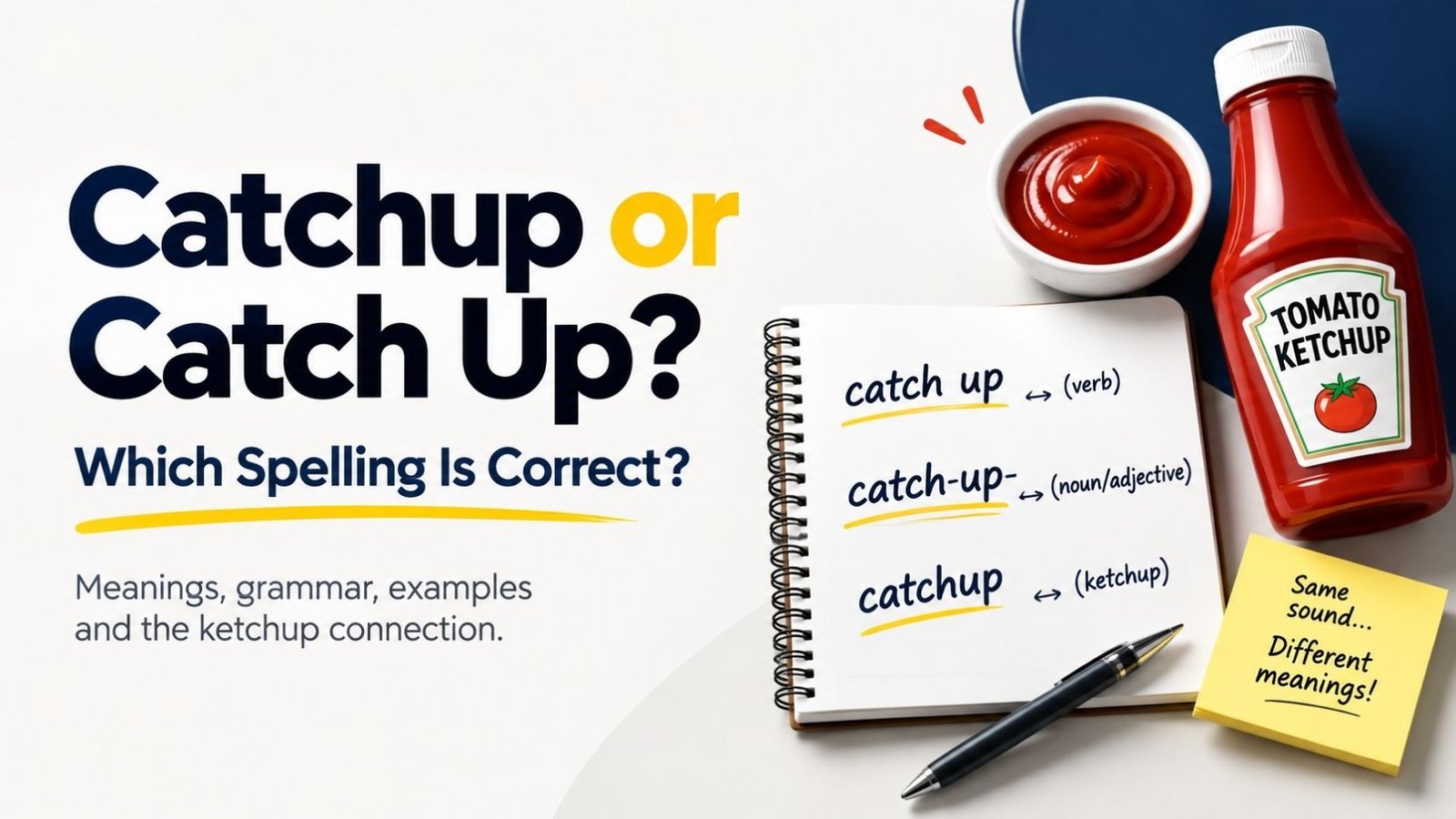
Use “catch up” as two words when it is a verb, as in “I need to catch up on email.” Use the hyphenated form, with a hyphen between catch and up, when it works as a noun or adjective. That covers phrases like “a quick catch-up with a friend” or “a catch-up meeting.” Written as one word, “catchup” is normally a spelling of the condiment ketchup.
The confusion is understandable, because all three versions sound almost the same. Spell checkers and casual writers often blur them, especially in work chats and calendar invites. Once you know which part of speech you need, the choice becomes easy. This guide covers meanings, grammar, pronunciation, common mistakes, and the money term “catch up contribution” that people often search for.
A note on spelling in this article: the hyphen is described in words and not printed. Where the noun or adjective appears in an example, it is shown with a space. In dictionaries and official documents, a hyphen sits between catch and up.
Quick Answer: Catchup or Catch Up
💡 The short rule
| Form | Part of speech | Example |
| catch up (two words) | Verb | We should catch up this weekend. |
| catch up with a hyphen | Noun or adjective | Let’s schedule a catch-up meeting. |
| catchup (one word) | Noun, meaning ketchup | She asked for catchup on her fries. |
This matches Merriam-Webster. It lists “catchup” as a less common spelling of ketchup, and gives the hyphenated form as the adjective and noun meaning the act of catching up. The two-word version is the verb.
Read More: Yea or Yeah
What Does Catch Up Mean?
The phrase has several meanings. Each one comes from the same idea: closing a gap, whether in distance, time, news, or progress.
Meaning 1: To bring someone up to date”: You share news that someone missed. Example: “Can you catch me up on yesterday’s meeting?”
Meaning 2: To reach someone ahead of you: You move faster until you are level. Example: “She ran to catch up with the group.”
Meaning 3: To reconnect and talk: You spend time with someone and share what has happened lately. Example: “We’re meeting for coffee to catch up.”
Meaning 4: To make up for something you fell behind on: This is common with sleep, homework, and email. Example: “I stayed late to catch up on work.”
Meaning 5: As a noun, an informal talk or meeting: Example: “We have a weekly team catch up on Monday.”
Merriam-Webster also lists a related idiom. To “play catch up” means to try to reach a norm or a competitor’s level. A sports team that is losing is “playing catch up.”
Is It Catchup or Catch Up as a Noun?
This is where most people get stuck. Standard dictionaries give the noun with a hyphen: the hyphenated form. The one-word spelling “catchup” is not the standard choice for this meaning.
In real life, you will see all three. Brand names, social media posts, and text messages often use “catchup.” Formal writing, news articles, and official documents lean toward the hyphenated form.
⚠️ Common mistake: Writing “catchup” for a meeting or chat in formal writing. Readers may think of the condiment first.
Catch Up Meeting and Catch Up Call
“Catch up meeting” and “catch up call” use the phrase as an adjective that describes the meeting. That is why the hyphenated form is the standard spelling here. The two-word version looks like a verb followed by a noun, which can read oddly.
Both of these work in a sentence:
- “Our catch-up meeting is at 10 a.m.”
- “Let’s have a quick catch-up call after lunch.”
For a one-on-one chat, “catch up” is also friendly and informal. For a formal business meeting, many people prefer “status update” or “check-in.”
Catch Up With Someone
“Catch up with someone” is the verb phrase. It means to meet and exchange news, or to reach someone who is ahead of you.
- “I’m catching up with an old friend tonight.”
- “I’ll catch up with you at the station.”
You will also see “catch up to” when the meaning is physically reaching someone. For conversation and news, “catch up with” is the usual choice.
Catchup Also Means Ketchup
Many readers do not realize that “catchup” is a real word with a completely different meaning. It is an accepted spelling of ketchup, the tomato sauce. Merriam-Webster labels it a less common spelling. “Catsup” is another variant.
The condiment’s name is often traced to a Chinese word for a fish sauce. The word traveled through Southeast Asia into English. Sources differ on the finer details of that path, so treat the exact route with some care.
This means “catchup” can cause a real mix-up in a sentence. Compare these two:
- “Let’s grab lunch and catch up.” (talk)
- “Pass the catchup, please.” (sauce)
Catch Up Grammar: Part of Speech and Verb Forms
“Catch up” is a phrasal verb. That means a verb and a small word, here “up,” work together to create a meaning. The meaning is not always clear from the two words alone.
| Form | Example |
| Base form | catch up |
| Third person singular | She catches up on email every morning. |
| Simple past | We caught up last week. |
| Past participle | I have caught up on my reading. |
| Present participle | He is catching up with his class. |
⚠️ Watch the past tense. The correct form is “caught up.” “Catched up” is not standard English.
Which Word Follows Catch Up?
Different small words after “catch up” change the meaning.
- Catch up on: the thing you missed. “Catch up on sleep.”
- Catch up with: a person or group. “Catch up with a friend.”
- Catch up to: often a moving target. “The car caught up to the truck.”
You can split the phrase with a pronoun. “Catch me up on the news” is correct and natural. You do not say “catch up me on the news.”
Catch Up vs Caught Up
“Caught up” can also mean busy or involved. “I got caught up in a long meeting.” This is a related but different meaning from simply updating someone.
Plural of Catch Up
As a noun, add an s: “catch ups” with a space, or the hyphenated form with an s. “We hold two catch ups a week.” The plural follows the same spelling choice as the singular.
Read More: Requester or Requestor
How to Pronounce Catch Up
The pronunciation changes slightly depending on how you use the phrase.
- As a verb: catch UP. The stress falls on “up.” It is roughly /kætʃ ʌp/.
- As a noun or adjective: CATCH up. The stress moves to the first part. Merriam-Webster shows this as ˈkach-ˌəp.
- Ketchup (the sauce): KETCH uhp or KATCH uhp. Merriam-Webster lists both for “catchup” in the sauce sense.
American and British speakers pronounce these in much the same way. The “t” in “catch” is not pronounced separately. The “tch” is one sound, like the “ch” in “church.”
Origin of Catch Up
“Catch” comes from older French forms that meant to chase or capture. English speakers began joining it with “up” to describe reaching someone or something ahead. Over time, the phrase also took on its meaning of bringing someone up to date.
The noun use is more recent and grew from the verb. Businesses and schools use it widely now, as in “catch up day” or “catch up lessons.” The core idea is still the same: close the gap.
Synonyms for Catch Up
The best synonym depends on the meaning. These are not all interchangeable.
| Word or phrase | Meaning | Best used for |
| Update | Give the latest information | Work or news |
| Reconnect | Restore contact | Friends and family |
| Get up to speed | Learn what you missed | Projects and teams |
| Make up for lost time | Do more to cover a delay | Sleep, study, work |
| Draw level | Reach the same point | Races and competitions |
| Chat | Talk casually | Informal conversation |
“Catch up” is warmer and more casual than “update.” Choose “status update” when you want a more professional tone.
Catch Up in Everyday Phrases
A few common uses deserve a short explanation.
Can you catch up on sleep?: In everyday English, “catch up on sleep” means sleeping longer to make up for lost rest. Sleep researchers generally say extra rest after a short sleep shortfall can help. Many also say it may not fully undo the effects of long-term sleep loss. If you are often short on sleep, a doctor is the right person to ask.
Catch up day: This usually means a set day to finish tasks that fell behind. Schools and workplaces use it. The phrase is easy to understand without extra explanation.
Catch up TV: In British usage, this refers to watching programs after they first air, through on-demand services. Americans more often say “on demand” or “streaming.”
Catch up in markets: Financial writers use the phrase when one asset is expected to close a performance gap with another. For example, a headline might say one group of stocks could “catch up” to a related price move. That is a market forecast, not a grammar rule, and it may or may not happen.
Catch Up Contributions: 401k, IRA, and More
Many people searching for “catchup” are actually looking for retirement savings rules. Here the term “catch up contribution” means extra money that older savers are allowed to put into retirement accounts. Official IRS materials and most dictionaries print this term with a hyphen. Many finance blogs write it as “catchup,” and you will see both.
What Is a 401k Catch Up Contribution?
It is an extra amount, above the normal yearly limit, that savers age 50 and older can add to certain retirement accounts. The idea is to help people closer to retirement save more. It applies to 401k, 403b, most 457 plans, and the federal Thrift Savings Plan.
2026 Catch Up Limits
For 2026, the 401k deferral limit rises to $24,500, and the IRA limit rises to $7,500. The 401k catch up limit for workers age 50 and older rises to $8,000 in 2026, up from $7,500 in 2025. That brings the total 401k limit for most older workers to $32,500.
| Account | Standard limit | Catch up | Total |
| 401k, 403b, most 457, TSP | $24,500 | $8,000 | $32,500 |
| 401k, ages 60 to 63 | $24,500 | $11,250 | $35,750 |
| IRA and Roth IRA | $7,500 | $1,100 | $8,600 |
| SIMPLE plan | $17,000 | $4,000 | $21,000 |
| HSA, ages 55 and older | $4,400 individual, $8,750 family | $1,000 | $5,400 or $9,750 |
The same figures appear for IRAs (8,600total),401ks(32,500), SIMPLE plans ($21,000), and HSAs, where those 55 and older can add an extra $1,000. The IRA catch-up amount is now adjusted for inflation under SECURE 2.0, and it rises to $1,100 for 2026.
What Is the Super Catch Up?
SECURE 2.0 created a higher catch-up limit for employees aged 60, 61, 62, and 63. For 2026, it stays at $11,250 instead of the regular $8,000. This is often called the “super catch-up.” It replaces the regular catch-up for that age group. It does not add to it. For SIMPLE plans, the super catch-up for ages 60 to 63 is $5,250 in 2026.
Roth Catch Up Rules for Higher Earners
SECURE 2.0 also changed how some people must make catch up contributions. The Roth catch up rule applies if your prior year wages from the plan sponsor exceeded the threshold, which is $150,000 in 2026, up from the original $145,000. If the rule applies to you, your catch up goes in as after tax Roth money. Your plan must offer a Roth option for this to work.
Past Years in Brief
The regular 401k catch up amount was $7,500 for 2023, 2024, and 2025. It rose to $8,000 for 2026. Limits change each year, so check the IRS for the current figures before you contribute.
💡 Tip: This section is general information, not financial or tax advice. Your plan may have its own rules. A tax professional or your plan administrator can confirm what applies to you.
Read More: Burnt or Burned
Common Mistakes With Catch Up
❌ Incorrect: Let’s catchup tomorrow.
✅ Correct: Let’s catch up tomorrow.
Here “catch up” is a verb, so it takes two words.
❌ Incorrect: We scheduled a catchup for Friday.
✅ Correct: We scheduled a catch-up for Friday (hyphenated in standard print).
Used as a noun, the hyphenated form is the standard spelling.
❌ Incorrect: I catched up on my sleep.
✅ Correct: I caught up on my sleep.
“Caught” is the past tense of “catch.”
❌ Incorrect: Please catch up me on the news.
✅ Correct: Please catch me up on the news.
Pronouns go between “catch” and “up.”
❌ Incorrect: I need to catch up in my emails.
✅ Correct: I need to catch up on my emails.
Use “on” for the thing you fell behind on.
Catch Up vs Similar Words
| Word | Meaning | How it differs |
| Catch up | Close a gap or share news | Flexible, casual, and widely used |
| Keep up | Stay level with something | You are not behind yet |
| Follow up | Take a further action | Comes after a first contact |
| Check in | Briefly confirm status | Shorter and more formal |
| Catch on | Understand something | About learning, not time |
Frequently Asked Questions
Is it catchup or catch up?
Use “catch up” (two words) for the verb. Use the hyphenated form for the noun and adjective. “Catchup” as one word usually means ketchup.
Is catch up a noun or a verb?
It is both, with different spellings. The two word form is a verb. The hyphenated form is a noun or adjective.
Is it catch up or catch up with a hyphen in a meeting invite?
For a title like “Team Catch Up,” the hyphenated form is the standard choice because it is a noun. Many people skip the hyphen in informal chats, but formal writing should include it.
What does catch up with someone mean?
It means to meet or talk to share recent news. It can also mean to reach someone who is ahead of you.
How do you pronounce catch up?
As a verb, stress “up”: catch UP. As a noun, stress “catch”: CATCH up. The “t” is silent in “catch.”
What does it mean to play catch up?
It means to be behind and try to reach the same level. Sports teams and businesses use the phrase.
What is a 401k catch up contribution?
It is an extra amount savers age 50 and older can add to a 401k beyond the regular limit. For 2026, the standard catch-up is $8,000. Ages 60 to 63 can add up to $11,250 instead.
Does the IRA have a catch up contribution?
Yes. For 2026, savers age 50 and older can add $1,100 to an IRA or Roth IRA, for a total of $8,600.
Conclusion
“Catch up” is two words when it is a verb and takes a hyphen when it is a noun or adjective. “Catchup” as one word is mainly a spelling of ketchup. The verb forms are catch up, catches up, caught up, and catching up. The phrase can mean to update someone, reach someone, reconnect, or make up for lost time.
Before you type, ask one question: am I describing an action, or naming a thing? If it is an action, write two words. If it is a thing, such as a meeting or contribution, use the hyphenated noun. That one habit will keep your writing clear in emails, calendar invites, and retirement paperwork alike.

Danish Raza is the author of Grammavio, a trusted resource for simple and easy-to-understand English grammar guides. He creates helpful content covering grammar rules, word meanings, vocabulary, and common grammar mistakes to help readers improve their English skills.


One Comment