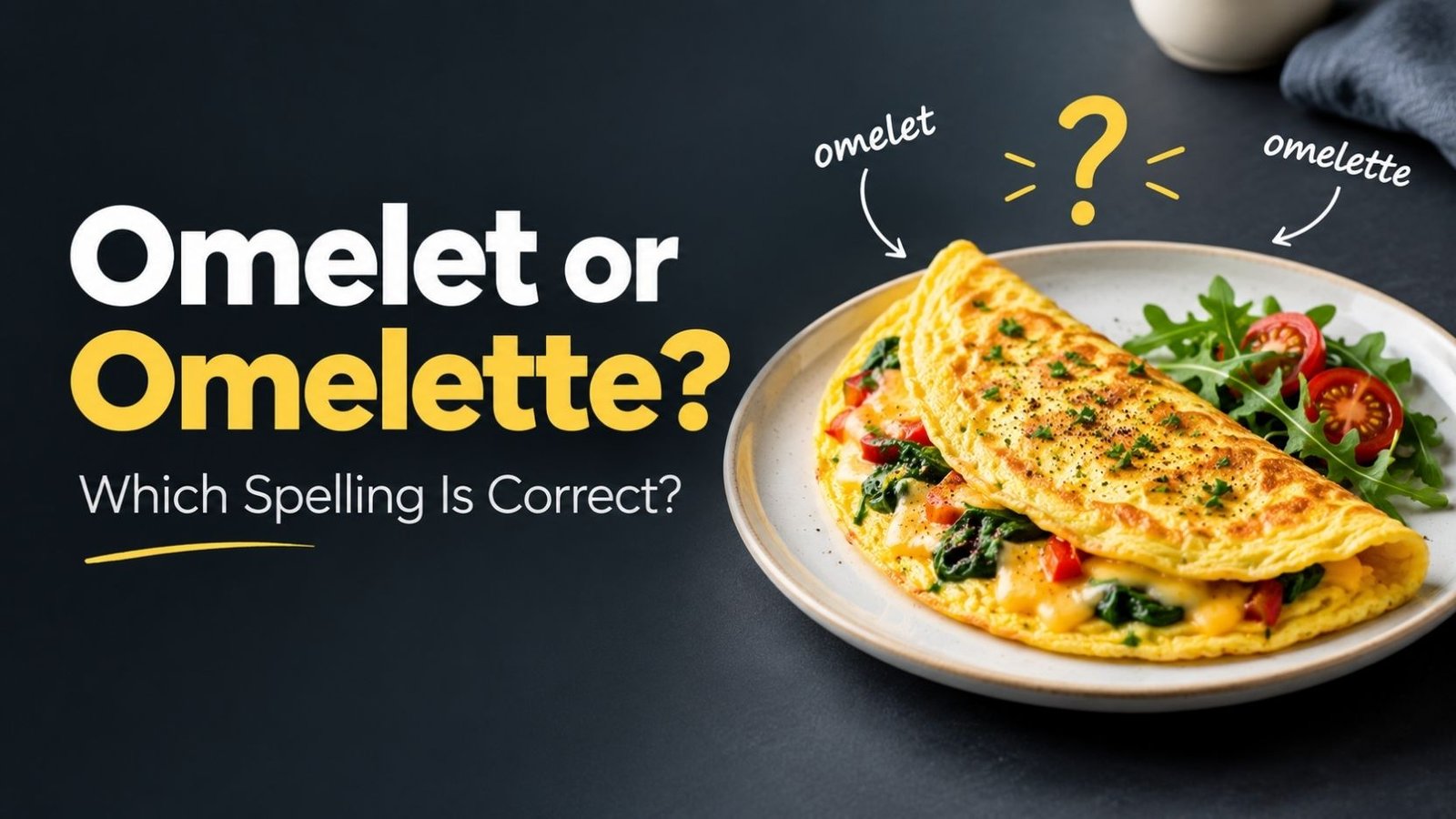
Both spellings are correct. “Omelet” is the most common spelling in American English, and “omelette” is the standard spelling in British English and in French. They mean the same thing: a dish of beaten eggs cooked in a pan, usually folded around a filling.
If you are writing for a US audience, use “omelet.” If you are writing for a UK, Irish, or Australian audience, use “omelette.” The most important rule is to pick one spelling and keep it the same throughout your writing.
Many people stop mid-sentence and wonder which version they should type. The confusion is understandable, because American dictionaries list both forms. This guide explains the difference, how to pronounce the word, where it came from, and how the spelling connects to popular dishes like the Denver omelet and the French omelette.
Quick Answer: Which One Should You Use?
💡 Short answer: Use “omelet” for American readers. Use “omelette” for British readers or when you are writing about French cooking.
| Region or Style Guide | Preferred Spelling | Notes |
| United States | omelet | Most common in American writing |
| AP Style | omelet | News and media style in the US |
| United Kingdom | omelette | Standard British spelling |
| Australia and Ireland | omelette | Follows British usage |
| Canada | omelette is common | Canadian writing often follows British spelling, but both appear |
| French cooking | omelette | The original French spelling |
Major American dictionaries, such as Merriam-Webster, list “omelet” first and “omelette” as an accepted variant. British dictionaries, such as Oxford, treat “omelette” as the main form. Neither spelling is a mistake.
Read More: Bareable or Bearable
What Does Omelet Mean?
An omelet is a dish made from beaten eggs cooked in a hot pan. The eggs set into a thin, soft sheet. The cook then folds or rolls the sheet, often around a filling.
Simple definition: An omelet is a folded or rolled egg dish, often filled with cheese, vegetables, or meat.
Common fillings include:
- Cheese
- Ham
- Mushrooms
- Spinach
- Onions and peppers
- Herbs such as chives or parsley
The word is also used loosely in English. People may say “a cheese omelet” or “an egg omelet,” even though the word already means a dish made of eggs. The second phrase is common in searches, but “omelet” alone is enough.
How Do You Pronounce Omelet and Omelette?
Both spellings are pronounced the same way in English. The spelling does not change the sound.
- American pronunciation: AHM lit, or AHM uh lit
- British pronunciation: OM lit, or OM uh lit
- IPA (American): /ˈɑːmlɪt/ or /ˈɑːməlɪt/
Many speakers say it with two syllables, and many say it with three. Both are normal. The stress falls on the first syllable.
The French word is pronounced a little differently, with a softer ending sound. English speakers usually do not copy the French sound.
Where Did the Word Come From?
The word came into English from French. The French form is “omelette.” Dictionaries trace it to the older French word “amelette,” which in turn comes from “alemelle.”
Linguists point to an interesting detail here. “Alemelle” is linked to “lemelle,” meaning a thin blade. The idea seems to be that an omelette is flat and thin, like a blade. Some of the earlier changes in the word are thought to have come from the way the French article “la” attached itself to the noun. These steps are described by major dictionaries, though the exact path of every sound change is not fully settled.
English borrowed the word in the 1600s. Over time, American writers shortened the ending and began spelling it “omelet.” The older, French-looking “omelette” stayed common in British writing.
Omelet or Omelette: Grammar Basics
The word is a countable noun. That means you can count omelets and make the word plural.
| Form | American Spelling | British Spelling |
| Singular | omelet | omelette |
| Plural | omelets | omelettes |
Examples:
- “I ordered a cheese omelet for breakfast.”
- “She made three omelettes for the guests.”
A few small grammar points are worth knowing:
- Use “an” before the word, not “a,” because it starts with a vowel sound. Write “an omelet,” not “a omelet.”
- You can use it as a modifier. Examples include “omelet pan,” “omelet station,” and “omelette maker.”
- It is not a verb. People say “make an omelet” or “cook an omelet,” but not “to omelet.”
⚠️ Common mistake: Using “a omelet” instead of “an omelet.”
Read More: Zeppoli or Zeppole
Common Spelling Mistakes
Many readers search for this word because they have seen unusual spellings. Here are the most common errors.
| Incorrect | Correct | Why |
| omlet | omelet or omelette | The word has an extra “e” before the “l” |
| omelete | omelet or omelette | The ending is “et” or “ette,” not “ete” |
| omlette | omelette | The “e” after “om” is required |
| a omelet | an omelet | Use “an” before a vowel sound |
❌ Incorrect: I had a omlet for lunch.
✅ Correct: I had an omelet for lunch.
Types of Omelets and Omelettes
Many search results mix spelling questions with recipe questions. That makes sense, because the dish has many versions. Here are the most popular ones.
| Type | What It Is | Key Features |
| Denver omelet | An American diner classic, also called a Western omelet | Ham, onion, bell pepper, and cheese |
| French omelette | A classic French style | Smooth, pale, soft, and rolled, with little or no browning |
| Spanish omelet | Often a potato and egg dish called tortilla española | Thick, round, and made with potatoes and sometimes onions |
| Japanese omelet | Often tamagoyaki, a rolled egg dish | Layered, slightly sweet, and cooked in a rectangular pan |
| Cheese omelet | A simple filled omelet | Melted cheese inside folded eggs |
| Spinach omelet | A vegetable omelet | Cooked spinach, often with cheese |
| Egg white omelette | A lighter version | Made only with egg whites |
What Is the Difference Between a Denver Omelet and a Western Omelet?
In most American kitchens, the two names describe the same dish. Both usually include ham, onions, bell peppers, and cheese. The name “Denver” is more common in some regions, while “Western” is more common in others.
What Is the Difference Between a French Omelette and an American Omelet?
The main difference is texture and shape. A French omelette is cooked gently and quickly. It stays pale and creamy inside, and the cook rolls it into a smooth shape. An American diner omelet is usually cooked a little longer, may brown lightly, and is folded in half around a thick filling.
What Is the Difference Between a Spanish Omelet and a Regular Omelet?
A Spanish omelet, often called a tortilla española, is built around cooked potatoes. It is thick, round, and cut into wedges, and it is served warm or at room temperature. A regular omelet is thin and folded around a filling. Note that in the US, “Spanish omelet” can also refer to an omelet topped with a tomato and pepper sauce, so the meaning depends on the menu.
How to Make an Omelet: Step by Step
This simple method works for a basic American-style omelet. It takes about five minutes.
What you need:
- 2 or 3 eggs
- 1 tablespoon butter
- A pinch of salt
- A small handful of cheese or other fillings
- An 8 to 10-inch nonstick pan
Steps:
- Crack the eggs into a bowl. Add a pinch of salt.
- Whisk until the yolks and whites are fully mixed.
- Heat the pan over medium-low heat. Add the butter and let it melt.
- Pour in the eggs. Let them sit for a few seconds.
- Gently push the cooked edges toward the center. Tilt the pan so the raw egg flows to the edges.
- When the eggs are almost set but still slightly shiny, add your filling to one half.
- Fold the other half over the filling.
- Slide the omelet onto a plate and serve right away.
💡 Tip: Low and steady heat gives a softer omelet. High heat makes it dry and rubbery.
How to Make a French Omelette
The French method is a little different. You stir the eggs gently as they cook, almost like soft scrambled eggs, and then stop and roll them. The goal is a smooth outside with no brown spots and a creamy inside. Use butter and keep the heat moderate.
How to Make a Microwave Omelette
A microwave omelette is a fast option for busy mornings. Whisk two eggs with a splash of milk and a pinch of salt in a microwave-safe bowl. Add fillings and cook in short bursts, stirring in between, until just set. The texture is closer to a soft scramble than a pan omelet, but it works well for a quick meal.
What Is the Proper Way to Make an Omelet?
There is no single proper way. French cooks prefer a pale and creamy omelette. American diners prefer a thicker, folded omelet with fillings. The best method is the one that gives you the texture you like.
Best Pan for Making an Omelet
An omelet pan is usually a shallow, nonstick skillet with gently sloped sides. The slope helps you slide the omelet out and fold it. An 8 inch pan suits two eggs, and a 10 inch pan suits three or four.
A few things matter more than the brand:
- A nonstick surface, so the eggs release easily
- Even heat across the bottom
- A comfortable handle
- A size that matches the number of eggs
An omelette maker, such as a small electric or microwave tool, can also help if you cook omelets often. It is a convenience, not a requirement.
Read More: Publically or Publicly
Words Related to Omelet
These words are close in meaning, but they are not identical.
| Word | Meaning | How It Differs |
| Frittata | An Italian egg dish | Usually cooked in a pan and finished in the oven. Fillings are mixed into the eggs rather than folded inside |
| Scrambled eggs | Eggs stirred while cooking | No fold and no distinct sheet |
| Tortilla española | A Spanish potato and egg dish | Thick and round, built around potatoes |
| Tamagoyaki | A Japanese rolled egg dish | Made in layers and often slightly sweet |
| Quiche | A baked egg pie | Has a crust and a custard filling |
Omelet Near Me: A Quick Note on Searching
When you search for “omelet near me” or “omelette near me,” search engines usually treat both spellings as the same word. You will see similar results either way. Restaurant menus may use either spelling, so it helps to check both if you are looking for a specific place.
A Note for Readers Who Search in Hindi or Urdu
Some readers search for phrases like “omelette banane ka tarika.” This phrase means “how to make an omelette” or “the way of making an omelette.” The cooking method is the same as in the steps above. Many home cooks in South Asia add chopped onions, green chilies, tomatoes, and fresh coriander to the eggs before cooking.
Frequently Asked Questions
Is it spelled omelet or omelette?
Both are correct. “Omelet” is the common American spelling, and “omelette” is the common British and French spelling.
Which spelling is more common in the United States?
“Omelet” is more common in the United States, and AP Style uses it. You will still see “omelette” on many menus, especially for French style dishes.
What is the difference between omelet and omelette?
There is no difference in meaning. The only difference is the spelling, which varies by region.
Is “omelet” a noun or a verb?
It is a noun. You can make, cook, or order an omelet, but you cannot “omelet” something.
What is the plural of omelet?
The plural is “omelets.” In British spelling, the plural is “omelettes.”
How do you pronounce omelet?
Most Americans say AHM lit or AHM uh lit. The British often say OM lit. The two spellings sound the same.
What is a Denver omelet?
A Denver omelet is an American-style omelet filled with ham, onions, bell peppers, and cheese. It is also called a Western omelet.
Is “egg omelet” correct?
It is understandable, but it repeats the idea. An omelet is already made of eggs, so “omelet” alone is enough.
Conclusion
“Omelet” and “omelette” are two accepted spellings of the same word. American writers usually choose “omelet,” and British writers usually choose “omelette.” The word comes from French, and the longer form is closer to the original.
The best choice depends on your audience. Use “omelet” for readers in the United States, use “omelette” for UK readers or French cooking, and stay consistent within the same piece. Whichever spelling you pick, the dish is the same: soft, folded eggs with a filling you enjoy.

Danish Raza is the author of Grammavio, a trusted resource for simple and easy-to-understand English grammar guides. He creates helpful content covering grammar rules, word meanings, vocabulary, and common grammar mistakes to help readers improve their English skills.