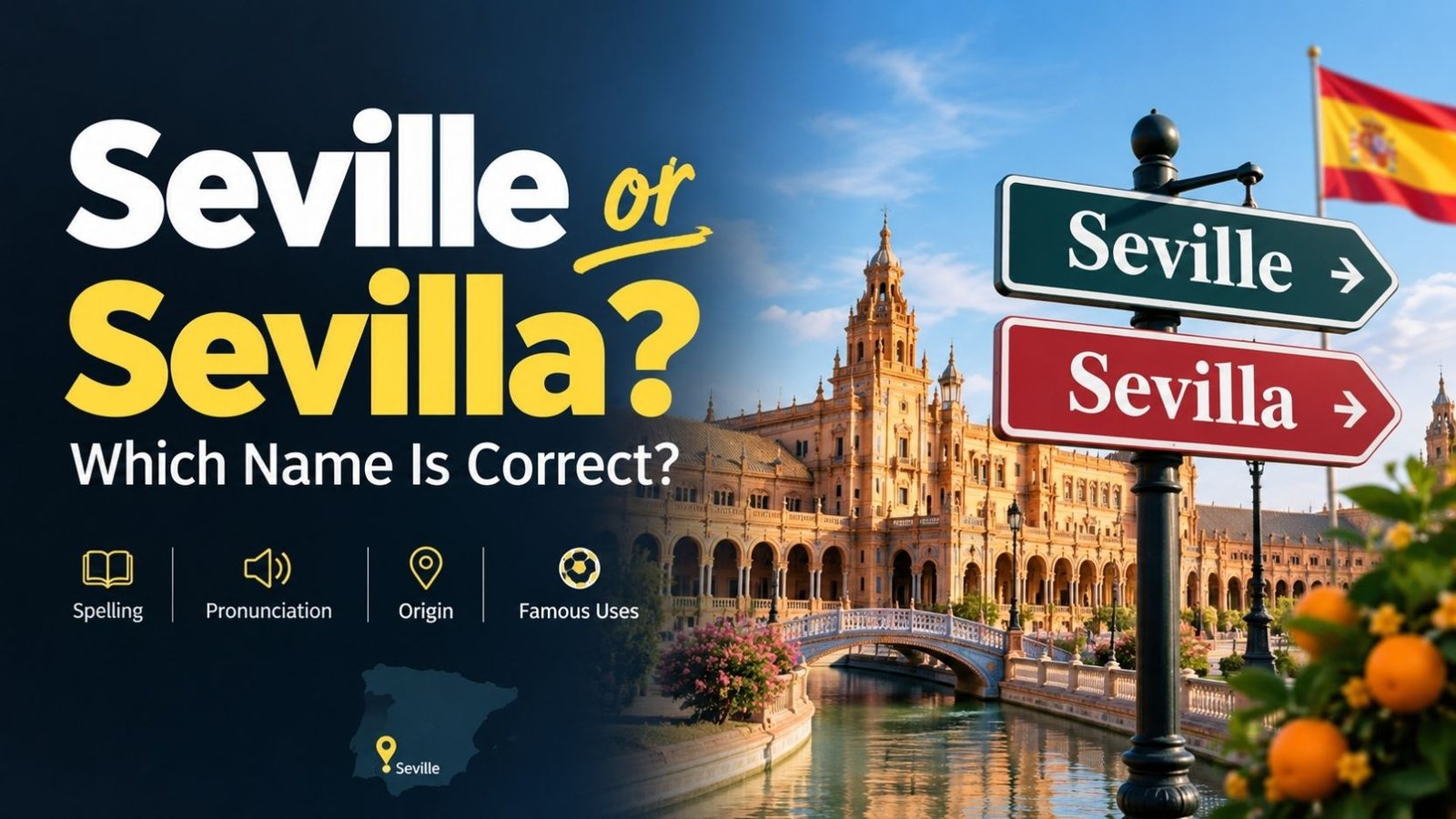
Both are correct. Sevilla is the Spanish name of the city, and Seville is the traditional English name. In American English, Seville is the usual choice in everyday writing, travel guides, and news stories about the city.
Which one you use depends on context. Use Seville in English sentences and Sevilla when you write in Spanish or refer to the football club, Sevilla FC. The rest of this guide covers pronunciation, origin, famous uses of the name, and common mistakes.
Quick Answer: Seville vs Sevilla
| Name | Language | Best used for |
| Seville | English | The city, general writing, travel, history |
| Sevilla | Spanish | Spanish text, local signs, the football club |
💡 Tip: If your reader is in the USA, Seville is the safer choice. Sevilla is also fine when you use it on purpose, for example when you want a local feel.
Read More: Handsome or Hansom
Is It Seville or Sevilla in English?
Seville is the standard English spelling. Major English dictionaries and style guides list it as the English form of the city’s name. Sevilla is the native spelling, and English speakers recognize it, but it is not the default.
English often has its own names for foreign places. Cologne is Köln in German, and Vienna is Wien. Seville and Sevilla follow the same pattern.
- ✅ “We spent three days in Seville.”
- ✅ “Sevilla is the capital of Andalusia.” (Spanish style, understood but less common in English)
- ❌ “We flew to Seville, Sevilla.” (Both names together make the sentence awkward.)
Is It Seville or Sevilla in Spain?
In Spain, the name is always Sevilla. Road signs, train stations, maps, and official websites all use it. You will not see Seville on local signs, though you may see it in tourist materials written in English.
Seville is the capital of the Andalusia region in southern Spain. It sits on the Guadalquivir River. It is one of the largest cities in the country.
How to Pronounce Seville or Sevilla
The two names sound different, so it helps to learn both.
| Name | Simple guide | Note |
| Seville (American English) | suh VIL | Stress falls on the second syllable |
| Sevilla (Spanish) | seh VEE yah | The Spanish v sounds close to a soft b |
Many English speakers say “suh VIL” with a short i. Some say “seh VIL.” Both are heard, but “suh VIL” is the most common.
In Spanish, the double l is usually pronounced like a y. In many parts of Spain, the name sounds like “seh BEE yah.” Spanish speakers often soften the v so it sounds close to b.
How to Pronounce Sevilla FC
Say the club name the Spanish way: “seh VEE yah” followed by “F C.” English commentators sometimes say “suh VIL ah,” and that is understood too. If you want to sound natural to Spanish fans, use the Spanish version.
Where Does the Name Come From?
The city is very old, and its name has changed across several languages. The Romans called it Hispalis. After the Moors took control, the name became Ishbiliya in Arabic. That Arabic form later developed into the Spanish Sevilla.
English likely borrowed the name through French, where the city was written Séville. That helps explain the English spelling with the final e. The details of this path can vary by source, so it is best to describe it as likely rather than certain.
What Does Seville Mean in Different Contexts?
Seville is mostly a place name, but it appears in many other ways. The word usually points to the city or to something named after it.
- Seville the city: The Andalusian capital known for flamenco, orange trees, and historic buildings.
- Seville orange: A bitter orange often used to make marmalade.
- The Barber of Seville: A famous opera by Rossini, based on a play by Beaumarchais.
- Cadillac Seville: A luxury car sold by Cadillac from 1975 to 2004.
- Bulova Super Seville: A watch model name from the Bulova brand.
The Barber of Seville is the title most English speakers know. The opera itself is in Italian, and its Italian title uses Siviglia, which is yet another form of the name. That is a good reminder that many languages have their own version of this city’s name.
Read More: Says or Sais
Famous Places in Seville
Many searches for Seville are about its landmarks. Here are the best-known ones.
| Landmark | What it is |
| Seville Cathedral | A huge Gothic cathedral, home to the Giralda tower |
| Alcázar of Seville | A royal palace with Moorish-style design and gardens |
| Plaza de España | A grand semicircular plaza built for the 1929 Ibero-American Exposition |
The cathedral, the Alcázar, and the General Archive of the Indies are listed together as a UNESCO World Heritage Site. The Giralda was once a minaret before it became part of the cathedral. Together, these places explain much of the city’s fame.
Madrid to Seville: Travel Basics
Many visitors from the USA reach Seville through Madrid. The high-speed AVE train connects the two cities. The fastest services take around two and a half hours, though times and schedules change. Check the official rail operator for current timetables and prices before you travel.
Sevilla FC and Football Searches
When people write Sevilla in a football search, they usually mean Sevilla FC. The club was founded in 1890 and plays in Seville. It is known for its success in European competition, including a record number of Europa League titles.
Seville has two main football clubs. The other is Real Betis. So when someone searches “Real Betis Seville or Sevilla FC,” they are asking about the city’s two teams.
Match searches such as Sevilla vs Barcelona or Real Madrid vs Sevilla refer to Sevilla FC, not the city. In those cases, Sevilla is the correct and expected spelling, even in English.
Is Seville Safe?
Seville is generally considered a safe city for visitors. The most common problem is petty theft, such as pickpocketing in crowded places. Standard travel care works well: keep valuables close, stay alert in busy areas, and check your government’s current travel advice before a trip.
Common Mistakes
Mistake 1: Treating one name as wrong
- ❌ Incorrect: “Seville is a mistake, it should always be Sevilla.”
- ✅ Correct: “Seville is the English name, and Sevilla is the Spanish name.”
Mistake 2: Using Seville for the football club
- ❌ Incorrect: “Seville FC won last night.”
- ✅ Correct: “Sevilla FC won last night.”
Mistake 3: Mixing spellings in one document
Pick one spelling for the city and use it throughout. A single article should not switch between Seville and Sevilla for the same place.
Mistake 4: Mispronouncing the English name
Avoid saying “SEV ill.” The stress belongs on the second syllable: “suh VIL.”
Read More: Ate or Eaten
Which One Should You Use?
Use this simple rule:
- Writing in English about the city: use Seville.
- Writing in Spanish: use Sevilla.
- Writing about the football club: use Sevilla FC.
- Writing about the opera, orange, or Cadillac: use Seville, because those names are set.
Frequently Asked Questions
Is it Seville or Sevilla?
Both are correct. Seville is the English name, and Sevilla is the Spanish name.
Is it spelled Seville or Sevilla in English?
The standard English spelling is Seville. Sevilla is also understood, but it is the Spanish form.
How do you pronounce Seville?
In American English, it is usually “suh VIL.” The stress is on the second syllable.
How do you pronounce Sevilla?
In Spanish, it sounds like “seh VEE yah,” with a soft v that is close to b in many accents.
Do Spanish people say Seville or Sevilla?
Spanish speakers say Sevilla. They use Seville only when speaking English.
What is Seville famous for?
Seville is famous for its cathedral, the Alcázar, flamenco, orange trees, and tapas. It is also known for Holy Week and the Plaza de España.
Is Sevilla FC the same as Seville FC?
The club’s official name is Sevilla FC. Using Seville FC is not standard.
Is Seville in Spain?
Yes. It is in southern Spain and is the capital of Andalusia.
Conclusion
Seville and Sevilla refer to the same city. Seville is the English name, and Sevilla is the Spanish one. In American English, Seville is the normal choice, while Sevilla is correct for Spanish text and for Sevilla FC.
When you are unsure, think about your reader and your language. Write Seville for English readers and Sevilla for Spanish ones. Whichever you choose, stay consistent and pronounce it the way that fits the language you are speaking.

Danish Raza is the author of Grammavio, a trusted resource for simple and easy-to-understand English grammar guides. He creates helpful content covering grammar rules, word meanings, vocabulary, and common grammar mistakes to help readers improve their English skills.